Software
Houzz Logo Print
stigw0rt

AC drain constantly gets blocked, but no blockage, is it incline?

3 years ago
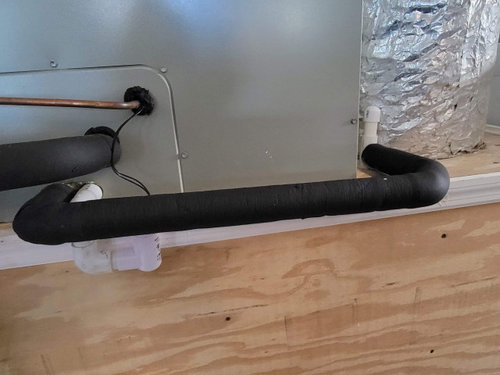
Hi! AC drain constantly gets blocked, but no blockage, is it incline?

You can see the black drain left to right with a slight incline.

The safety valve is below the drain line (white pipe, below and to the left in photo).

Power hose cleaning and manually pouring water, and no problems.

Leaving the AC running, and very quickly the emergency valve is filled with water and the system turns off, and can't be restarted until lines drained.


Any ideas?


Comments (23)

  • 3 years ago

    Make sure primary and secondary aren;t reversed. It's unusual not having 4" or more drop into a trap near outlet. I'd put a trap within 12" and run line beneath unit if possible.

    stigw0rt thanked klem1
  • 3 years ago

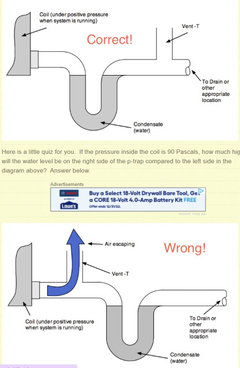
    Not all drain lines should have traps, or so I'm told. Apparently not ones from a coil under positive pressure.

    stigw0rt thanked Elmer J Fudd
  • PRO
    3 years ago
    last modified: 3 years ago

    Where do you live that you are running the AC right now?

    Your unit from the picture you posted looks like a AH that contains an Evap coil in the bottom of the unit (if it's an upflow) If it's a down flow with gas heat, that changes things. I say this because you left off alot of important information. Guessing and HVAC doesn't work out well & if I conversed with my favorite fortune teller he'd tell me that is 9/10's of the law.

    In an AH the coil is always opposite of the blower which is backwards in comparison to a system that has an e-coil and a gas furnace. This config issue mostly has to do with using an AH in combination with a heat pump that has back up heat kit installed. However this doesn't mean you have a heat pump. Knowing for sure again (psst - it's 9/10's of the law)

    Why is config important? suction from the blower. In some situations this suction will be enough to prevent condensate from draining properly. It could also be the primary and secondary are reversed as Klem suggested. Always check the dumb stuff first, especially if you or amateur hour installed this machine. (deal of the century is often what I am told, those deals rarely last long)

    I service the Katy, Texas area... again if you're running the AC right now even here next to the gates of hell --- isn't a good idea.

    stigw0rt thanked Austin Air Companie
  • 3 years ago
    last modified: 3 years ago

    Thanks for all the feedback, gentlemen. Apologies for the lack of details. It is a Trane TEM4A0C48S41SBA.

    Not crazy enough to be running AC right now 😂. But the trap/emergency valve was full of water from when the AC was running (Florida), and the unit wouldn't run/heat because of it.


  • 3 years ago

    So, from the photos you are saying that there is no condensate P-trap before the vent? E.g., like here: https://russellking.me/2012/09/22/no-its-not-a-pee-trap-so-please-dont/ 


  • 3 years ago
    last modified: 3 years ago

    Your coil is under negative pressure and there's no way i can tell if there is a trap after the vent but if there is a trap do away with it and configure as follows.

    Cut drain pipe 4" from first elbow,rotate pipe stub 1/4tr turn clockwise so it now points down,install trap,extend pipe to line up with existing vertical pipe with cap shown near return duct, 90% pipe into plenum and connect to vertical pipe.

  • PRO
    3 years ago

    The vertical pipe looks to me like a clean out with a cap, albeit one that's not located appropriately.

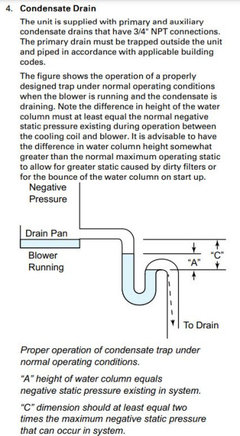
    The condensate trap needs to be designed for trapping a negative pressure system. You can find the dimensions for a p-trap for a negative pressure system at the following link: http://0323c7c.netsolhost.com/docs/Trane_-_Trapping_Design_Flaws%5B1%5D.pdf

  • PRO
    3 years ago

    Not crazy enough to be running AC right now 😂. But the trap/emergency valve was full of water from when the AC was running (Florida), and the unit wouldn't run/heat because of it.


    Ok that is good info to know. This unit was made in Feb 2022 so less than a year old, should still be under the traditional 1 year warranty. I suppose technically the installing contractor could call this maintenance problem and charge for it... but this sort of thing happens to Trane peeps all the time. (slap a trane whatever in and it will fix anything. I know this because I worked for a Trane dealer a long time ago when Trane was actually a decent brand. --- not that what you have here is a Trane problem --- this is just how the problems "start".)


    You paid for a product / didn't get what you paid for --- what is the installing contractor telling you? I can't believe you paid for this product so you could then go on the internet to discuss with strangers ways to fix it?


    If the unit was 10 years old? maybe. So there's more you're not telling us?


    I don't want people knowing my business... well that's kind of what happens when you discuss things on the internet.


    You need to call your installing contractor.


    If I had installed this machine I would test the primary drain line an easy test -- pour gallon of water down primary drain, if it drains the problem is with the installation. (The installation is what you paid for -- it should be free of defects for a period of 1 year is traditional warranty from nearly any HVAC company worth a grain of salt.)


    I service the Katy, Texas area.


    What in the tarnation? It's supposed to be 77F today here. Feels a little like the tropics. Santa parading around in flip flops and short-shorts. That is a sight to see let me tell ya. ha-ha.


  • PRO
    3 years ago

    "I suppose technically the installing contractor could call this maintenance problem and charge for it... but this sort of thing happens to Trane peeps all the time. "

    Nope. The improper installation isn't a function of the brand name on the equipment. The installer omitted an important installation detail--the need for which is clearly called out in the manufacturer's installation instructions. I suspect the installer did the work without a permit (my understanding is that Florida requires mechanical contractors to pull permits when replacing A/C systems) which allowed the work to be performed without the benefit of an inspection.

  • PRO
    3 years ago

    Charles there are often times traps that are out of sight. Putting double traps on a condensate line that is improperly vented can and will cause similar drainage problems.


    They paid for a new system, they need to call the contractor who installed this machine.


    As it were, builders in my area do this all the time. Put double traps on HVAC, it works for a few years because the drain lines are new... then trouble sets in. The builder is long gone by then... rinse and repeat for 29 years -- now you know my life story. Ha-ha.

  • PRO
    3 years ago

    "Charles there are often times traps that are out of sight." Based on the photo provided by the OP, that's not likely the case here, Ray. Even an air seal type condensate trap would cause a bulge or offset in the insulation. And any type of condensate trap should be readily accessible for service.

  • PRO
    3 years ago

    " ... we must be at the center of the universe because the water flow is defying the laws of physics!" Not to worry, Ray, the laws of physics still govern the operation of the OP's system. Condensate flow in the OP's system is driven by gravity, but the drain outlet is on the suction side of the blower. This requires that it be suitable for operating in a negative pressure environment. Without a trap, air can be pulled into the air handler through the drain line, impeding the flow of condensate. When the blower cycles off, condensate can drain normally. For long operating cycles (as would be the case in the OP's climate zone,) the lack of a trap risks overflow of the pan or shutdown of the system by the activation of the overflow sensor. The fix is to install a condensate trap. There are a variety of options available from simple p-traps to air seal traps to ejector-type traps. Take your pick.

  • PRO
    3 years ago
    last modified: 3 years ago

    Ray,

    The concrete floor isn't relevant to the OP's problem. Based on the photo and the OP's description of the problem, it doesn't take a rocket scientist to infer the omission of a condensate trap. Klem1 noted it in his first post on this thread. If you're advancing a "hidden" trap argument, it would need to be inside the plywood return plenum; that appears to be where the condensate line disappears en route to a drain. That would require the plenum to be disassembled for trap maintenance. That's not accessible for routine maintenance.

  • 3 years ago

    I found the installatin instructions for the TEM4A0C48S41SBA.

    Installation instrunctions for trap installation.

    Here is what is shown on page 6:


    It describes how a trap must be installed on the exterior of the unit. The minimum dimensions are shown. The instruction did not show which drain is the primary or secondary. The primary should below the level of the secondary.

    I recommend you install a clear EZ trap. You will be able to visually see if there is a clog and the plastic caps make it easy to clean. It comes with a clean out brush.

  • PRO
    3 years ago

    I don't see any deleted posts in this thread so the builder is having selective amnesia. When things don't go a builder's way they start making stuff up. It's nothing new or profound.


    An Air Handler or any evap coil will need a trap that is a given.


    BUT it does NOT say that it should have TWO traps.


    Double trapping will cause you trouble. Want trouble? go ahead I always love paying customers that don't listen to good sound advice.


    There is more to HVAC than it turns on and shuts off. We commenters here like to pretend that isn't the case.


    Professional is a widely tossed around word that means what exactly in a world of pretenders? Those that talk a good game, but show little to back up what they say.


    Remember the question I asked the builder? The plumbing stub for the AC condensate on a concrete slab --- where is the trap? (sometimes these are visible, many times in older homes they are not.)


    The builder only does new homes (well when he's not banging away on the keyboard chasing the low hanging fruit of a blue collar job he doesn't really do -- he hires out for HVAC contracting)


    He says so right here:

    click to enlarge


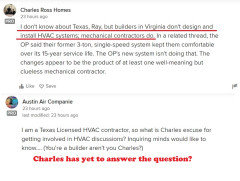
    This is you isn't it Charles? You're a builder aren't you Charles?


    (Mike Home is a home owner in New Jersey) --- why is this important in a fake world?


    You tell me... I'm just providing truthful info.


  • PRO
    3 years ago

    "I don't see any deleted posts in this thread..."

    Ray, I'd like to nominate you for a Yogi Berra award.

  • PRO
    3 years ago

    This post has also been posted in Plumbing discussions...


    New Improved Triple Jeopardy round: A shower that is installed on a concrete slab in residential construction the trap of that shower is located where?


    Note: contrary to popular myth, all drains in residential construction lead to the same place. This is primarily why it's often referred to as "The Poop Show". Get it wrong and you'll be smelling it *sewer gas.


    Cue the final jeopardy music.

  • PRO
    3 years ago
    last modified: 3 years ago

    Ray,

    I wanted to allow a reasonable separation in time between my nominating you for a Yoggi Berra award (yea, Ray, you're a winner!) and your comment about a condensate drain for an HVAC system operating under vacuum conditions. A p-trap for an HVAC system directly connected to a sanitary sewer connection likely violates code requirements in your home state of Texas, Ray. Frankly, it's a ridiculous suggestion that a p-trap for an HVAC system would be buried in a concrete slab. It should be piped such that it is is accessible for maintenance and has an atmospheric break. I believe that you've miss diagnosed the OP's issue, Ray, and your cover story and suggestion likely violates even your local code in Texas.

    Sometimes, it's better to listen than to speak, Ray. I don't think Houzz.com was intended as a continuing education forum for trade "professionals," but if the shoe fits.

  • PRO
    3 years ago

    "...if you need an AC guy you call a licensed HVAC contractor in your area. If you need a plumber you call a plumber." Installation of a HVAC condensate drain falls at the intersection of the two trades. Whichever trade is responsible for installing the drain should follow the local code requirements. A direct connection of a condensate drain to a sanitary sewer line would not be allowed in the municipalities we build in.

    There was a modification to the International Mechanical code in 2021 which clarifies acceptable practice for condensate drainage (2021 IMC 307.2.1.1) The only direct connections allowed are wye branch tail piece connections at a lavatory drain (ahead of the p-trap) and wye connections at a bathtub overflow. Codes may vary from one locality to another so this portion of the code may be revised, enhanced or omitted. Check with your local code official if you have questions.

  • 3 years ago
    last modified: 3 years ago

    " There was a modification to the International Mechanical code in 2021 which clarifies acceptable practice for condensate drainage (2021 IMC 307.2.1.1) The only direct connections allowed are wye branch tail piece connections at a lavatory drain (ahead of the p-trap) ... "

    I have one like this in my second home. It was built a bit over 20 years ago in a neighborhood development that had one builder. I presume it must have been allowed by code in my location at that time. It's kind of a neat and tidy way to handle AC condensate, no damp spots at the foundation edge. At this home, the HVAC equipment is in the attic and the bathroom vanity connection is upstairs, so it's a short and mostly vertical run.

  • PRO
    3 years ago

    @Elmer J Fudd,

    The International Residential Code (IRC) has been vague about the requirements for HVAC condensate drains for some time. The specific language in the 2018 IRC states:

    "Condensate from cooling coils and evaporators shall be conveyed from the drain pan outlet to an approved place of disposal...." 2018 IRC M1411.3 The determination of what is "approved" has been up to the local code official.

    The changes published as part of the 2021 International Mechanical Code provide very specific guidance on approved receptors for condensate including pictures of all code-approved alternatives. It's my opinion that the inclusion of pictures is especially helpful for HVAC technicians with poor reading comprehension, but ensuring that the work preformed complies with the code requires a permit to be pulled and the work inspected. Therein lies the problem for the vast majority of replacement work.

  • 3 years ago
    last modified: 3 years ago

    " ensuring that the work preformed complies with the code requires a permit to be pulled and the work inspected. Therein lies the problem for the vast majority of replacement work. "

    There are enough hacks in the HVAC business that compliance with codes and even best practices falls off when, as you say, compliance with even pulling permits falls off. In my experience, top trade contractors of all types are not inclined to do unpermitted work. Whether or not a contractor will do so can be a telltale of the type of operation the person runs.

    I may have mentioned before that in my state, the standard seller's disclosure form has a question about whether, to the best of the seller's knowledge, any work was done on the house of the type that required a building permit but for which no permit was obtained. Permit histories by property are available online in many counties. When the real estate market is hot, noncompliance can be something for which there's no traction to do something about. At other times, the lack of permit compliance can compromise selling values or cause the seller to be asked to do so on a delinquent basis if a buyer insists.