Software
Houzz Logo Print
webuser_27078013

Mykonos Quartzite Help for white stains

3 years ago

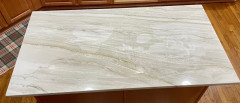
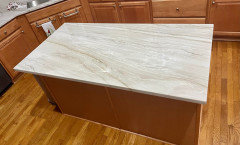
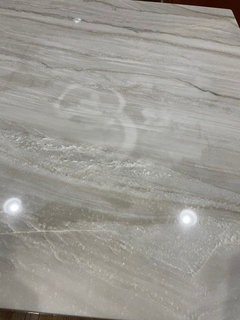
Hoping to get some kind help and support regarding my new Mykonos Quartzite counters. As background, I initially planned to purchase quartz for my kitchen, but was deterred by the stone shop as we did not want scorching or staining. I was guided to Mykonos as it had the veining we wanted, but was supposedly sturdier than the white quartzites. We were told that sealing would allow us to use the counters in a similar manner to Granite. I did months of research and after speaking to close to a dozen people from various stone stores and fabricators who I thought were experts, found stone slabs that we loved and had them installed a couple weeks ago. Fast forward to installation day and the island, which was our favorite piece, had what looked like bleach stains all over it. The fabricator said that it would dry out and many of the white areas have. That said, there are multiple spots where white circles have remained that are lighter than the rest of the counters. We are at a loss as I don’t know how much time we should give before we have the fabricator cut a new island. Outside of that, this was our favorite piece and the one that had the most beautiful veining in gold and gray. Has anyone had a similar situation with Mykonos? Did it ever resolve naturally? Any other updates on this type of quartzite or advice on things like preferred sealants and maintenance? I know there are horror stories and as much as I truly did research, it is not until now that I am finding out how temperamental this product is. I went on the advice of who I thought were experts, and am now very frustrated. We are in no position to replace these anytime soon, but we do not want them ruined either. Any suggestions for this specific stone would be greatly appreciated.

Comments (14)

  • 3 years ago

    Install Day

  • 3 years ago

    Week and a half later

  • 3 years ago

    Circular stains

  • PRO
    3 years ago

    Measure the diameter of the circles in the top, then measure the vacuum pods at the faricator's shop and on his CNC bed. Odds are they are identical.

  • 3 years ago

    vacuum pods ?

  • 3 years ago
    last modified: 3 years ago

    @unpostoalsole, stone fabricators use large "suction cups" with handles that they attach to cut slabs so they can move/manipulate them by hand. Sometimes they leave circular marks on some slabs.

  • 3 years ago

    bump...i was considering this stone and color


  • 3 years ago
    last modified: 3 years ago

    Based on my very limited experience, I would guess that the stone was still wet from water used during fabrication and that it was sealed before it had a chance to completely dry out. The darker parts are probably where more water was absorbed and the lighter parts are where less water was absorbed. We had a couple of light colored quartzite slabs that we did not realize the fabricator was storing outside. When it came time for fabrication to select what part of the stone to use, our stones were very splotchy -- it turned out it was because they were wet from the weeks of torrential rain -- the denser parts of the stone absorbed less water and looked very white in comparison to the less dense parts that had absorbed a lot of water. The stones were extremely splotchy looking. We had to wait a month for them to dry out -- the darker parts lightened up as the stone was drying out and the coloring became more uniform looking again. Once the stones are sealed, it becomes much harder for any water trapped inside to evaporate. BTW, I did an experiment with a small sample of our quartzite that our fabricator had chipped off for us a long time back to take around to do our tile and paint selections -- I put it in a cup that had a small amount of water at the bottom (most of the stone was above the water level)-- within just a few minutes, the water had wicked up into the stone way above the water level in the cup and the stone became much darker where the water got absorbed.

  • 3 years ago

    After waiting nearly 2 months, we had to have the entire island replaced as the damage did not change. I agree with all the comments that it was related to suction cups, but we still don’t truly know what the cause of it was. That said, this stone is incredibly porous, and requires a ton of sealing to be even usable. Although it is not ideal, we are very seriously considering Tuffskin as it’s not practical with our family to have a stone that is so porous. As a sidenote, as I am sure everyone will be commenting, I did test a slab of this before installation and did not have any of the issues we are seeing on our stone. The slab I tested was from the same lot. My understanding is there are variations even within the same lot that are more porous than others. Again, the stone itself is beautiful, and if you don’t use your kitchen very often, I would consider it. That said, I would never purchase quartzite again no matter what the vendors say. It’s a pretty big regret that is going to end up being extremely pricey for us regardless of what we do.

  • 3 years ago

    Sorry to hear that Jodie. Did you replace with the same type of Mykonos quartzite? When our White Santorini slabs were almost dry, our fabricator broke one of our slabs (blown over by a huge gust of wind apparently), so we needed to get new slabs. No one had White Santorini so after looking around for two weeks, we found Mykonos quartzite slabs this morning and decide to buy those. Keeping my fingers crossed that they work out for us. It's a gorgeous stone.

  • 3 years ago

    Long story short, we had enough remaining that we had planned to potentially use in a bathroom space. I’m not thrilled that we had to use that to fix the problem that the stone itself or fabricator made, but to be honest, given how porous the stone is, I don’t think we would have wanted to use it anyways. I am just happy that it is done as I spent close to six months finding and researching the stone and I am quite disappointed at how unsuitable it truly is for a kitchen. I will say that even though all of our stone is from the same lot, there are definitely pieces that almost don’t need sealer, and pieces that after close to six coats of sealer are still letting water in any liquid soak right in. Be sure to get a sample of your exact stone, and test it like crazy. ❤️

  • 3 years ago

    I was also told that I am the only one that had this issue with the lot that we purchased. Supposedly multiple other customers have our lot and did not have one single issue. I guess it’s possible we just got a couple bad slabs.

  • 3 years ago

    Mykonos! ugh! Out timelines and experiences are similar. I reserved 3 slabs of Mykonos in January which were installed on May 2. Since then it's been a horror story. Our fabricator told us the product would arrive sealed. It wasn't. Multiple coats of three different sealers and the counters still absorb liquid and stain. The 'stoneyard' is taking no responsiblity; the fabricator is trying to resolve it. My instinct and fear is that the Mykonos we purchased is actually marble. This is NOT the product for a working kitchen.

Sponsored
Hope Restoration & General Contracting
Average rating: 4.7 out of 5 stars35 Reviews
Columbus Design-Build, Kitchen & Bath Remodeling, Historic Renovations