Software
Houzz Logo Print
webuser_436275107

Help with temporary mud mitigation

3 years ago

Hi all. I need to re-plant a new lawn in a couple months after some construction essentially ruined the lawn that was there. Meantime I have an awful mud problem on about half of the space which just keeps getting worse as it never dries between rains. I was thinking I'd just top the muddy area with some sand until I reseed, just to cut down the sloppy mess at least a little.
Would sand be compatible with planting a new lawn in a couple months? Or something else that might help with the mud right now? Thanks.

Comments (18)

  • 3 years ago

    The first thing you need to do is figure out why the area stays wet. if necessary you may need to lay pipe or create swales to move the water away from the area. Since there is little grass, now is the time to fix the problem when the destruction is not a question.


    Once the area is dry consider planting grass.


    In some incidences sand could help with the drainage.

  • 3 years ago

    Yes, thanks, we did add drainage by trenching and diverting downspots and as noted I am planing on planting new grass in spring. My question is, as a temporary way to minimize the mud, would sand be compatible with new grass seed later on?

  • 3 years ago

    Personally I think sand would be a positive for your yard.


    Many years ago we put sod down in the construction area around our new patio. Appearance-wise it help, but not as much as the stepping stones. Long term the sodded area is no better than the rest of the seeded yard.

  • 3 years ago

    Need to know where you live and what kind of grass you intend to seed with?

    I would not use sand at this point, because sand is permanent and will change your drainage. If it changes it in the wrong direction you could end up with a flooded house or basement.

    To answer the direct question, I prefer sand to soil because it can be leveled very easily. Once the grass fills in, sand becomes a stable bed, but if the grass every dies away, the sand reverts to unstable at the surface.

    Spring is not the best time of year to seed a lawn for most of the country. That's why your location and grass preference is important. Spring is the best time of year for sprouting summer weed seeds like crabgrass, but if you have to, then you have to. Just don't expect a gorgeous lawn in July. The best time to repair a spring seeded lawn is right at the end of summer. Again, need to know where you live for better support.

  • 3 years ago

    Yup more context: I have a lawn service who I had asked but not heard back from. He now has responded saying a quality topsoil is better than sand at this point. I'm in Richmond VA and the seed will be fescue. Lawn guy is the one who proposed "deep aeration and re-seed around April, depending on weather." But I am exploring some sort of temp fix for now as the level of mud in one section (and on my dog's paws) is extreme. Thanks.

  • 3 years ago

    Thanks for the location.

    Your landscaper might prefer topsoil because it is more profitable. Just a consideration.

    If you have one location that is much worse, I would prefer to use mulch, instead of soil or sand, to tame the mud. Mulch will eventually disappear completely and not change your drainage. Sand and soil will always change the drainage.

    I wonder if a picture of the area might help us to understand what you're dealing with??

  • 3 years ago

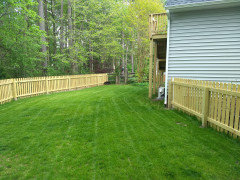
    Yes thanks I hadn't thought of mulch but I think it's the way to go. Here's my "before," this is spring 2020, exactly a year after the garage (right) was built.

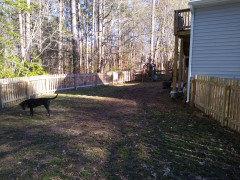
    And here's what I have today:

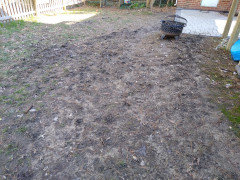
    A closer look:

    So could it be that the beautiful new lawn I had after construction was only "surface level," that is, needed a few more seasons to really dig in and get established? We have had above avg rainfall the last few years. Just seems to get worse every year.

  • 3 years ago

    Thanks for the pix. That helps. Is this area the north side of the building? If so then fescue is the only grass type that will work there. Fescue would need nearly continual reseeding/overseeding to keep up with the dogs, but then the winter comes and seed won't sprout, so. As long as you have dogs you might as well just mulch the area. You can get free mulch usually from people who do tree trimming with a chipper/shredder. It's a lot of wheelbarrows for 8 yards, but free is still good.

  • 3 years ago

    Yup, that's definitely north side. And fescue from what I've seen is all anyone has here in central Virginia. I came from SoCal and Arizona where it's all bermuda. I put down mulch on the bad area today, might do more. As for my photos I know one taken in May vs one in January is not apples to apples. But still, wouldn't that beautiful lawn I had in 2020 have become MORE established and healthy, rather than less, by now? Or maybe...TOO MUCH water?

  • 3 years ago

    What is your watering schedule during the growing season?


  • 3 years ago

    Aha, yes, well, admittedly INCONSISTENT. I'm probably a little complacent as relative to where I came from (CA/AZ) it rains ALL the time here. But in summer, we'll go a couple weeks without rain. I know I don't water enough, so maybe that is a factor. Conversely though, my front lawn, well established is doing fine, with my same inconsistent watering.

  • 3 years ago

    Before you do anything I think you need to figure out why your lawn went from picture #1 to picture #2. That really shouldn't happen. Something is going on.

  • 3 years ago

    Aha, YES, my thought exactly. Although as a non expert I can only guess. I'll press that issue with my lawn service. Thanks.

  • 3 years ago

    I thought you might be watering too frequently. It sounds like you're raining too frequently.

    Unless you have fescue, other normal turfgrass types will not do well in that much shade. Plus you have rain and dogs. Once fescue is uprooted, it does not reroot or spread to fill like Kentucky bluegrass would.

  • 3 years ago

    Ah that's good to know. If anything, I don't water enough in July/Aug. And I'll ask my lawn service if bluegrass may be an option in that yard. The beautiful lawn "before" photo was before tons of rain and before the Lab arrived. Makes sense if it does not re-root. I really appreciate the info.

  • 3 years ago

    Ditto what dchall said. Kentucky blue grass is not going to like shade. I think fescue is your best option. That and figuring out why it gets and stays wet back there. I have an irrigation system and I almost never irrigate the north side of my house. The shade back there keeps the soil moist without me having to water. I am in a different climate from you (Syracuse) but you're situation may be similar.


    Once the lawn back there is established I would not water it on a schedule. I would wait until it looks like it's thirsty (we can talk about that) and THEN water it. Excessive watering, especially in the fall may be part of your problem.


    I feel your pain on the muddy dog - I have one too. If addressing that problem is a priority, I agree that mulch is probably your best option. Put it down now and then do your best to shovel it up in the spring before putting down fescue. So long as your seed gets down to the soil, leftover mulch wont hurt it. Over time it will decompose. Though you may get a bunch of mushrooms for a few years.


    Good luck

  • 3 years ago

    schreibdave said, Once the lawn back there is established I would not water it on a schedule.

    In San Antonio I don't follow my own schedule, either. I water when it seems to need it. The watering plan I suggest is a starting point to emphasize that deep watering is important and the frequency should be stretched way out from what most people seem to gravitate to. San Antonio will be rationing water as we do every summer. So sometimes I would like to water every 10 days, but The Man says to water once a week. During those times the grass will suffer if it stays dry for 2 weeks. Deep watering is the real secret.