Software
Houzz Logo Print
hzdeleted_19697995

Drooping peace lily

3 years ago
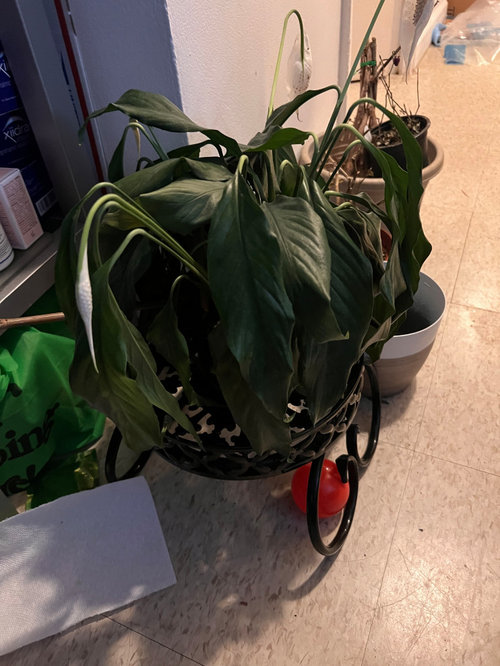
Hi there!


Need advice- I may have overwatered my peace lily and wanted to know if it can be revived?


Comments (7)

  • 3 years ago
    last modified: 3 years ago

    If the grow medium deep in the pot is nearly dry and the plant is wilting, it's almost certainly due to under-watering. If the plant wilts while you can still easily detect moisture in the grow medium, it's almost certainly due to over-watering.

    Wilting occurs when a plant's internal water pressure drops to a point low enough that the plant can no longer maintain turgidity (keep its cells full of water under pressure). Less experienced growers very commonly think reflexively that because a plant or planting wilted, it must follow that the grow medium is too dry and the plant needs watering. Clearly, if there is not enough water in the soil, logic would lead one to that conclusion.

    What might seem counter-intuitive is the fact that too much water in the grow medium also can, and does, cause wilting; this, because roots need an adequate supply of oxygen in order to function efficiently/normally. An excessive amount of water displaces air in the grow medium and a fraction of that air contains oxygen required by the roots.

    If a planting wilts, first check to see if the soil is dry. Using a wooden tell inserted into the soil all the way to the pot bottom is probably the most reliable way of checking for soil moisture and determining if it's time to water if the tell comes out dry or nearly dry, it's time to water. Ask if you're unfamiliar with using a 'tell' or want more info. If you determine the soil is dry, of course you should water unless there is reason not to. E.g., perhaps the plant needs or you want it to have a dry rest.

    If a planting wilts while you can still easily detect moisture in the medium, odds are very high that over-watering is the cause of the wilting for the reason already described above. Often, growers will report they've been watering, but the plant is still wilted, but it does perk up at night. This is because there are many small holes (stomata) on leaves through which gasses from inside the plant are exchanged with gasses from the air surrounding the plant, one of the gasses that moves out of the leaves is water vapor. In preparation for the respiration or dark cycle, special cells surrounding stomata (guard cells) close the openings through which water escapes. This helps the plant rebuild all or more often some of it's internal pressure, which often conspicuously even if not entirely reduces the degree of wilting. When you see this, you can be quite sure over-watering is in play.

    Al

  • 3 years ago

    Thank you, Tapla, for going to such great detail and educating me on peace lilies! i couldn’t have asked for anymore. it turned out that the soil was very dry, so i put it inder the tap and let it flow for approximately one minute, completely soaking it with no expectations whatsoever! After a few hoyrs, the leaves started rebounding. i was so pleased!


  • 3 years ago

    You're welcome. It would be good to remember that determining appropriate watering intervals is an important part of your care regimen; and, it will save you from some heartache or frustrations. The part about using a "tell" is important, so I'll post the short piece I wrote about that in its entirety. Are you ok insofar as having a good nutritional supplementation program (fertilizing) in place, or would you like recommendations?


    Al

  • 3 years ago

    I did not imagine the Peace Lily to be this tricky to manage since it’s considered a common houseplant, if I’m not wrong. But i’m also new to them and really didn’t expect such a sudden change like this to occur. I would definitely appreciate a fertilizer plan. I currently have Miracle gro indoor plant food liquid and spikes. not fancy at all!

  • 3 years ago

    I would also appreciate your piece on ”tell”! sounds very interesting.

  • 3 years ago

    It's really not tricky. Plants vary more in what they will tolerate than in what the want. If you set cacti and about 2/3 of the succulents aside from the group of plants we commonly grow as houseplants, they pretty much all want a medium that drains well and provides plenty of air porosity in the soil, even at container capacity (when the soil is holding as much water as it can hold). Many erroneously believe that because PLs are found naturally at water's edge that they want or need or can tolerate a saturated soil. They can't, because growing in a container is not like growing at waters edge because the root structure of plants with their feet in water is very different than roots of the same plant in a pot.


    So, when it comes to watering a PL, the objective is to use a grow medium you can keep moist enough w/o it holding so much water after a thorough watering that it affects root function or root health. A "tell" allows you to monitor moisture levels deep in the pot, where it counts. There is no need to be concerned that the top inch or two of the soil is dry, but there is concern if the soil becomes dry all the way to the bottom and causes the plant to wilt. I'll leave something at the end of the post about using a tell.


    If you water correctly, so you're wetting the entire soil column and at least 20% of the water applied exits the drain hole with no pathway by which the waste water can make its way back into the grow medium, and are getting the watering intervals right, fertilizing is extremely easy. It's when you are forced (by an excessively water-retentive medium) to water in sips to avoid watering, salts from fertilizer solutions and tapwater builds up in the soil, which limits water and nutrient uptake. Flushing the soil as you water prevents that, and after a few waterings resets the medium's fertility level to near zero. Not flushing regularly not only allows salts to build in the soil, it also allows nutrient ratios, each to the others, to become skewed. When this occurs, an excess of one nutrient can cause a deficiency of one or more other nutrients. Case in point: If someone is using a bloom booster (high in phosphorous) fertilizer for containerized plants, they are supplying more P than the plant can use. Excess P causes deficiencies of calcium, potassium, copper, zinc, and especially iron. Ideally, the fertilizer you use would provide nutrients at a ratio as close to the ratio at which nutrients are taken up. The RATIO that does this best and can be used for an extremely high % of plants (95%+) is 3:1:2. A fertilizer's RATIO is far more important than it's NPK %s, but hobby growers seldom pay much attention to it. Commonly used examples of 3:1:2 ratio fertilizers include 24-8-16, 12-4-8, and 9-3-6. I use Foliage-Pro 9-3-6 for nearly everything I grow in pots. It contains all nutrients essential to normal growth (few products can make that claim), in the ratio at which the average plant actually uses the nutrients, and it derives >2/3 of its nitrogen from nitrate sources .... a big plus for plants grown indoors because it helps to keep plants full and compact.


    It makes most sense to tie the frequency with which you fertilize to the number of times you water .... as long as you're watering correctly. In summer, you can fertilize about every 3rd-4th time you water, and in winter about every 4th-5th time. Keep track by dropping a marble, button, other object, in the pot when you water. If you're regimen has you watering every 4th watering, when you're about to drop in the 4th object, fertilize instead, retrieve the objects and start the cycle over.


    Using a 'tell'

    Over-watering saps vitality and is one of the most common plant assassins, so learning to avoid it is worth the small effort. Plants make and store their own energy source – photosynthate - (sugar/glucose). Functioning roots need energy to drive their metabolic processes, and in order to get it, they use oxygen to burn (oxidize) their food. From this, we can see that terrestrial plants need plenty of air (oxygen) in the soil to drive root function. Many off-the-shelf soils hold too much water and not enough air to support the kind of root health most growers would like to see; and, a healthy root system is a prerequisite to a healthy plant.

    Watering in small sips in order to avoid over-watering leads to a residual build-up of dissolved solids (salts) in the soil from tapwater and fertilizer solutions - which limits a plant's ability to absorb water – so watering in sips simply moves us to the other horn of a dilemma and creates another problem that requires resolution. Better, would be to simply adopt a soil that drains well enough to allow watering to beyond the saturation point, so we're flushing the soil of accumulating dissolved solids whenever we water; this, w/o the plant being forced to pay a tax in the form of reduced vitality, due to prolong periods of soil saturation. Sometimes, though, that's not a course we can immediately steer, which makes controlling how often we water a very important factor.

    In many cases, we can judge whether or not a planting needs watering by hefting the pot. This is especially true if the pot is made from light material, like plastic, but doesn't work (as) well when the pot is made from heavier material, like clay, or when the size/weight of the pot precludes grabbing it with one hand to judge its weight and gauge the need for water.

    Fingers stuck an inch or two into the soil work ok for shallow pots, but not for deep pots. Deep pots might have 3 or more inches of soil that feels totally dry, while the lower several inches of the soil is 100% saturated. Obviously, the lack of oxygen in the root zone situation can wreak havoc with root health and cause the loss of a very notable measure of your plant's potential. Inexpensive watering meters don't even measure moisture levels, they measure electrical conductivity. Clean the tip and insert it into a cup of distilled water and witness the fact it reads 'DRY'.

    One of the most reliable methods of checking a planting's need for water is using a 'tell' (more reliable than a 'moisture meter'. You can use a bamboo skewer in a pinch, but a wooden dowel rod of about 5/16” (75-85mm) works better. They usually come 48” (120cm) long and can usually be cut in half or in several pieces, depending on how deep your pots are. Sharpen both ends of each tell in a pencil sharpener and slightly blunt the tip so it's about the diameter of the head on a straight pin. Push the wooden tell deep into the soil. Don't worry, it won't harm the root system. If the plant is quite root-bound, you might need to try several places until you find one where you can push it all the way to the pot's bottom. Leave it a few seconds, then withdraw it and inspect the tip for moisture. For most plantings, withhold water until the tell's tip comes out nearly dry. If you see signs of wilting, adjust the interval between waterings so drought stress isn't a recurring issue.

    Al