Software
Houzz Logo Print
flannery2021

Need help with range hood vent routing!

3 years ago
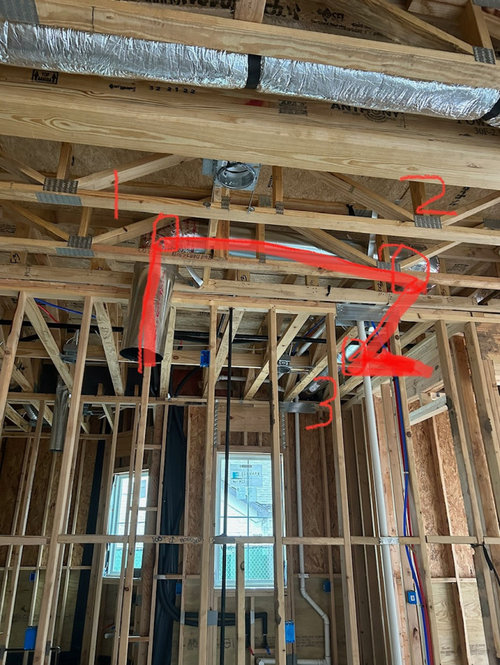
Need some advice on the range hood vent. I have attached a picutre showing the vent route has three 90-degree bents at location 1,2, and 3 then go out in horizontal direction. The builder said he tried to minimize the penetration on the roof. the duct size is 10 inches. Is three turns too much? Is it better to go vertical after point 3 than horizontal? Is roof penetration a concern? Is this a good routing? Hope to get some advice here. Thanks!


Comments (7)

  • 3 years ago
    last modified: 3 years ago

    Duct adequacy is dependent on diameter, turns, length, and air flow rate (CFM). What is your hood internal blower, or intended exterior blower, rated to provide (in free air)? One can, in principle with an exterior blower, achieve any flow rate desired against any reasonable pressure loss in the ducting, hood transitions, hood baffle filter (usually dominates), and imperfect make-up air (MUA) (goal is to not dominate).

  • 3 years ago
    last modified: 3 years ago

    Air flow noise is generally lower than blade tip noise. However, this thread hasn't gotten to topics such as using a silencer. Also, I don't know if the flow velocity is expected to be 2000 ft/min, or 500 ft/min, because there is no blower data yet revealed.

    The question was: Is three turns too much? Too much for noise, pressure loss, something else? Is avoiding a little more noise more important than avoiding a roof penetration?

    There are no free lunches here. If one goes up to the attic, there are still likely to be two lesser bends to aim at the most desirable spot, and a bend to align with the roof perpendicular. I don't (yet) know enough to support one over the other for the OP. My system goes from kitchen to attic, bends twice with ~ 60 degree bends, and then interfaces with the Wolf/Broan down-roof blower with a ~22-degree bend. The silencer is in the second section from the hood. Baffle hiss dominates. I haven't had an issue with roof penetrations.

    If a roof exhaust is chosen, one must have preplanned the MUA source location so that recycling of exhaust is avoided.

  • 3 years ago

    No air leaves the kitchen via the hood system that isn't replaced by some means. If the means is very restrictive, such as house leakage, the hood system may be "gagged," combustion appliances may be back-drafted, and moisture may be pulled into the walls while dust is pulled into the interior. Deliberate replacement of hood exhaust air is called make-up air (MUA), and is usually provided by an MUA system. The system may be just a duct, or duct, filter, and heater, or a more elaborate system with blower and control devices.

    A silencer is used in the hood system duct to reduce noise generated away from the hood and ducted back to the hood. This implies that a remote blower is used. Remote means in-line or external. The silencer attenuates blade tip turbulence noise, and duct turbulence noise generated in the blower side of the silencer. The silencer has no effect on turbulence noise generated on the hood side of the silence, and hence is not appropriate where the hood contains the blower. You can use a "down-roof" blower without it taking up attic space. Wolf, Broan, and Abbaka, among others, supply them. See http://www.abbaka.com/pdf/BrochureHyEx.pdf for an example, or the Wolf Design Guide.

    Please review several hood threads on this forum to gain insight into this topic. The first dozen or so pages of https://www.tagengineering.ca/wp-content/uploads/2015/02/KVSApplDesign_catalog.pdf will review the material from a commercial point of view (what residential ventilation is trying to approximate in less space), and a view toward air quality considerations in https://bamasotan.us/range-exhaust-hood-faq/.

    Without addressing the question of sizing flow rate vs hood in this message, in general hoods and remote blowers may be paired without regard to manufacturer, except ... , there is always the question of blower control type vs. what may be provided with the hood control panel. Some pairings will be compatible, and some not. I cannot answer your exact question. If you were an EE or E-Tech, you might be able to adapt a control to a particular motor, or replace a hood control with one that is compatible.

  • 3 years ago

    @kaseki thank you for your comprehensive explanation. I will talk to the builder about the MUA system; but I am afraid it's too late. I talked to him about external blower or inline blower, he can install, but the hood salesperson warned me there is no company will service an external blower on the roof or an inline blower in the attic. if that's the case, how do people fix the external blower on the roof in case something goes wrong?

  • 3 years ago

    @flannery2021 Do you not have codes for MUA where you live? By me any hood over 400cfm requires makeup air by code.

  • 3 years ago

    Failures of quality blowers are fairly rare. If you can't do anything yourself, then worst case you will need separate trades-persons to disconnect, remove, replace, reconnect. Small contractor organizations, even single-person, can do the job if qualified. How is replacement different in required skill levels than what your contractor is going to do for initial install?