Software
Houzz Logo Print
webuser_834679376

Practical tips for pruning ficus trees

3 years ago
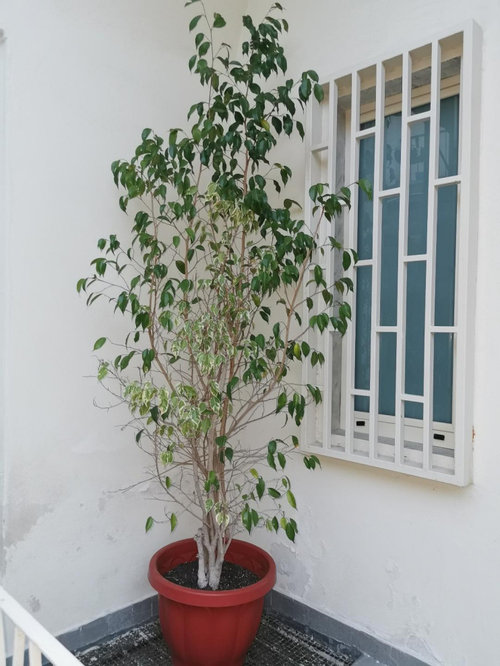
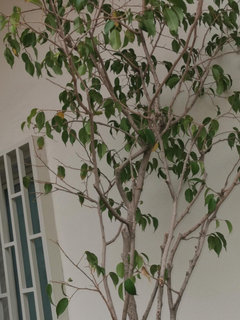
I'd like to start this discussion where @tapla (mid-Michigan, USDA z5b-6a)

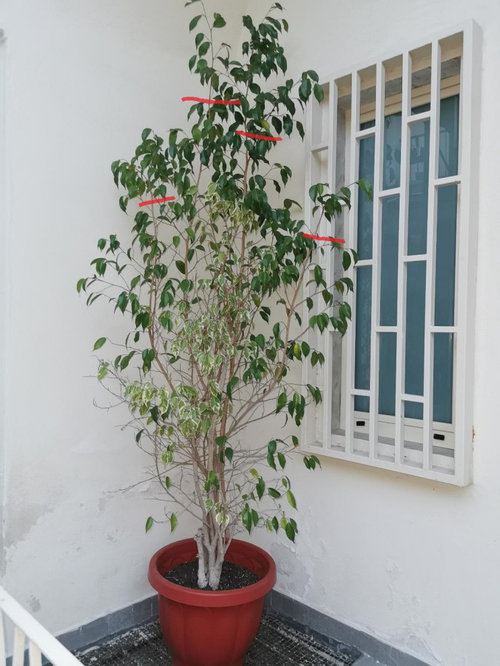
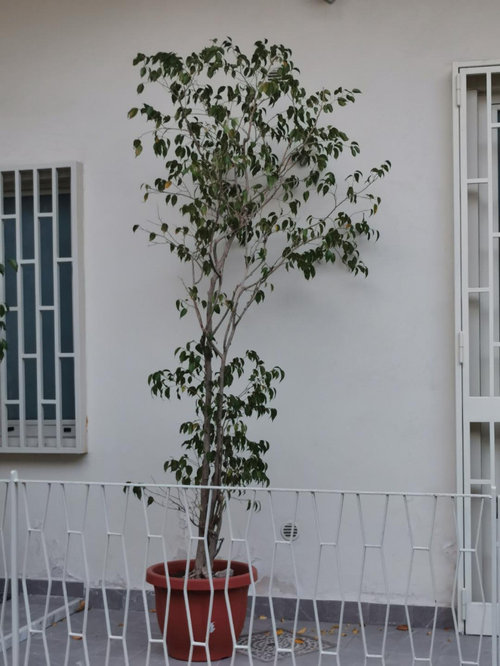
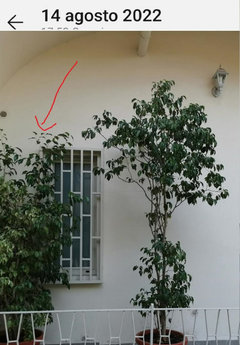
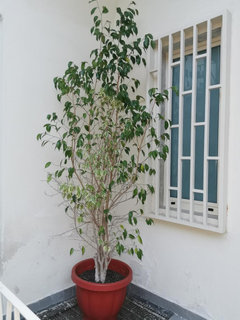
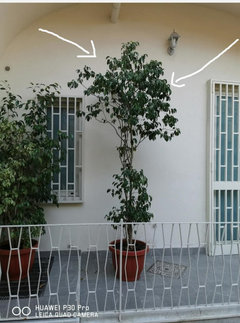
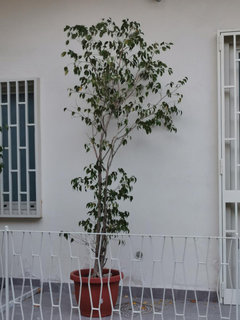
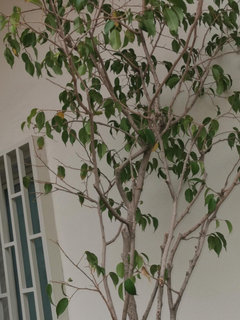
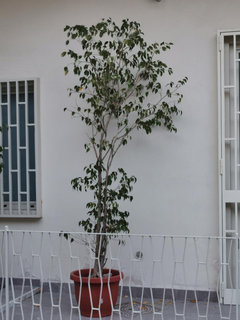
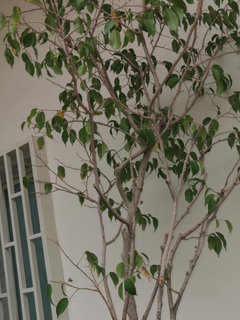
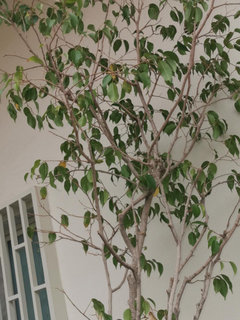
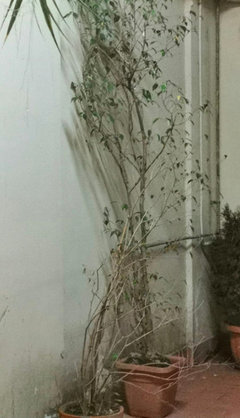
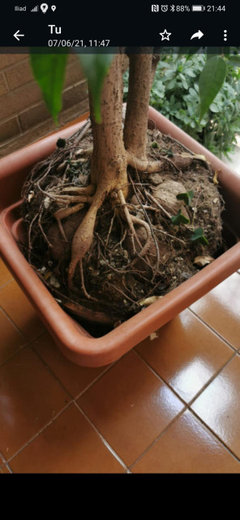
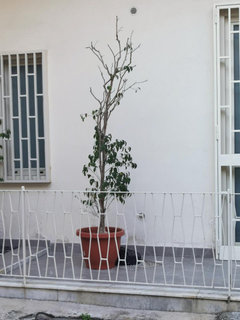
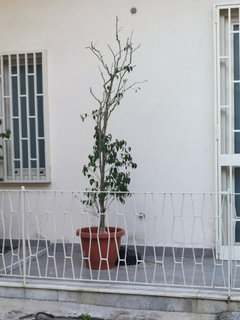
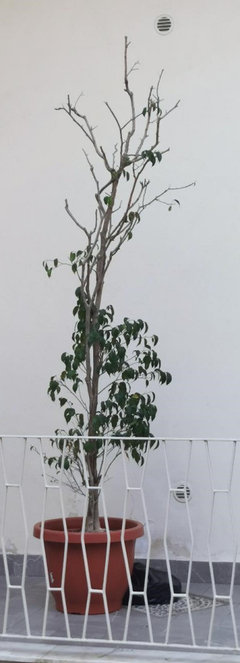
can give some practical pruning advice. Al, could you indicate with lines where you could like in this example?


Comments (17)

  • 3 years ago

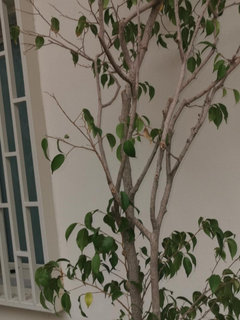
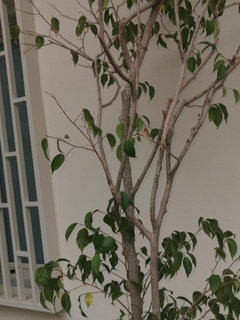
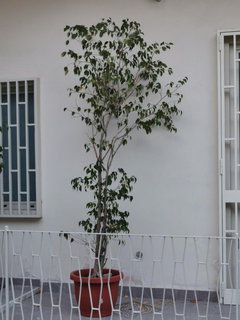
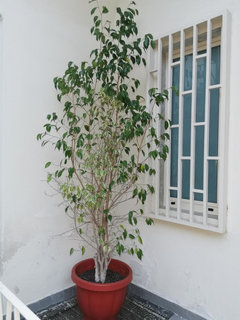
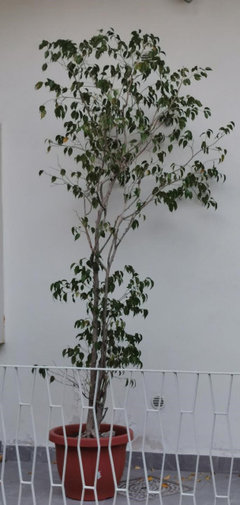
    Is the last image the oldest or most recent? I'm looking at the last image. Is that a F benjamina 'Variegata' reverting due to lack of light?


    Your long range pruning plan should be to keep the top restrained primarily by more aggressive pruning. Reason: your tree is very apical dominant, which makes it genetically obligated to spend about 2/3 of its energy in the top 1/3 of the tree. You can grow a top anytime, but you need to have a plan to ensure the lower branches are getting their share of the plants food/energy. In order to do that, you need to be in control, not the plant.


    For now the foliage low on the tree is strengthening and thickening the trunk, so I'd let it grow. Looking at the last image, I'm thinking that you're likely to end up with a tree where all the foliage is going to be located above where there's a bit of a bare spot about half way up the tree. Your other option would be to cut the top back hard, then keep it somewhat restrained as the lower branches catch up. Always remember getting the top right will be easy. Getting the lower half right/looking natural ..... not so much.


    Because I'm so familiar with how the tree will respond, it wouldn't bother me a bit to shorten the tree by half, so where the foliage stops about half way up the tree would be the new top, and you could build from there. All you'd need to do is follow the heavy stems down to where you can cut them back just above a branch growing in a favorable direction.


    Al


  • 3 years ago
    last modified: 3 years ago

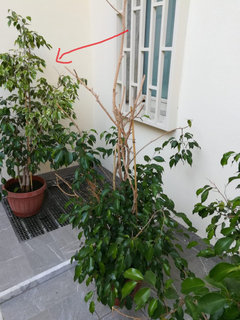
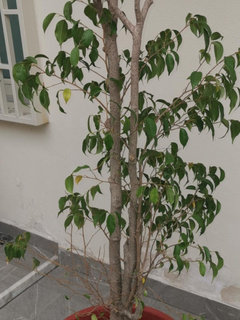
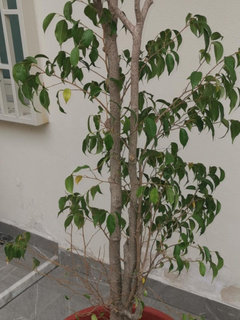
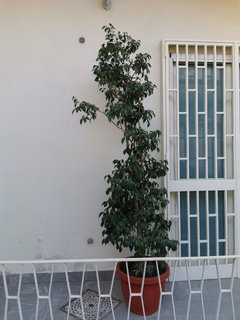
    Al, sorry, I wasn't clear. The first two photos portray the same plant at the same time: in the second photo I simply inserted red lines to ask you to do the same (but it may be complicated for you) to indicate where to prune. The third photo, on the other hand, portrays a second plant, placed one meter away from the first. Now I will try to tell you about these two plants. First of all I want to underline one thing: these two ficuses are located outside my doctor's office on the ground floor of a 19th century building. These two indoor plants suffer much more than the ones I have on the terrace of my house (a condominium): I don't know if this is due to the fact that the ones I have on the terrace of the house are more sheltered or the exposure.

    Meanwhile they talk about the first plant. It was a variegated ficus which then lost part of its variegation over 4 years ago I don't know why (plant in pain?). Anyway, for me it was better because I don't like variegated ficuses and indeed I would like it to lose the variegation altogether because now it is half variegated and half not. During the winter of 2018-2019 this plant deteriorated a lot, it was severely pruned in March and one of the main trunks died (as you can see in the photos I inserted in the first post). Below you can see the plant (the one with the red arrow) in the summer of 2019 when it was starting to make new leaves.


    As you can see in June 2021 the plant had recovered very well:


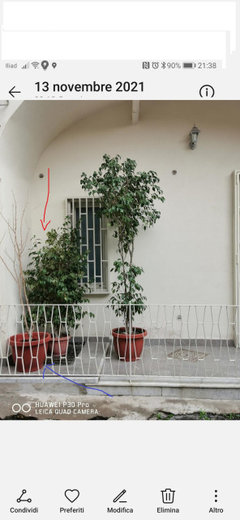
    In November 2021 I repotted the plant (red arrow) into a larger pot (blue arrow), but I didn't prune the roots at all and I think there was root congestion:


    In June 2022 the plant was still fine (you can see it in this photo), but then it deteriorated over the winter (in winter, as I told you, it always depersices a lot, and then fills up progressively over the course of the summer).


    May 2023:


  • 3 years ago
    last modified: 3 years ago

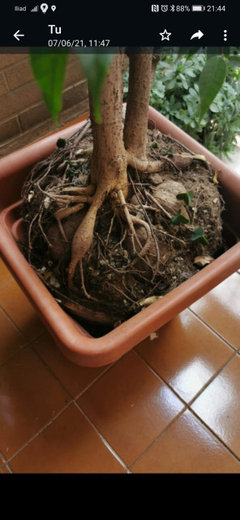
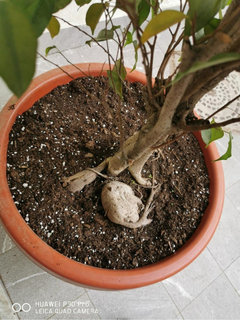
    Now I'll tell you about the second plant (third photo of the first post). This tree was donated to our condo by my mom in 2009 and has been treated very very poorly. In June 2021 I decided to take it back and try to recover it. This plant was in a pot of an earthenware pot which was in turn placed in a plastic pot.

    June 2021:


    Pensa che il vaso di terracotta era diventato un tutt'uno col terreno tanto che ho dovuto romperlo con un martello. Ho semplicemente messo l'albero in un vaso più grande (guarda le radici) e l'ho portato fuori il mio medical office.


    August 2022 (white arrows):


    May 2023 (after the winter):


  • 3 years ago

    Other photos of the second tree:


  • 3 years ago

    Mike - I know you worked hard on your posts, but I'm getting older and it's TMI all at once. Any chance you could break it down so the images and text are all in the same place. Ask as many questions as you like but maybe work on them 1 or 2 at a time and organize it so I can see the images you're referencing and the questions in the same pots.


    Al

  • 3 years ago

    I try again and try to make less confusion. Plant number 1. Advise me on how to prune it.


    Some details of the plant:


    A few notes on the history of this ficus:

    This tree was donated to our condo by my mom in 2009 and has been treated very very poorly. In June 2021 I decided to take it back and try to recover it. This plant was in a pot of an earthenware pot which was in turn placed in a plastic pot.


    June 2021:


    The clay pot had become one with the ground so much that I had to break it with a hammer. I simply put the tree in a bigger pot (without pruning the roots).

  • 3 years ago

    Three general questions not related to the pruning of plant number 1.


    1. Is it possible to prune in two different rounds, one a few days apart from the other? Or can this have negative consequences?


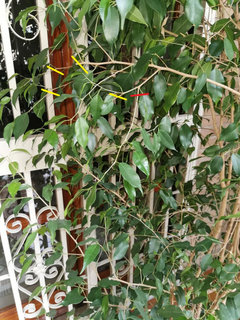
    2. Is it correct to cut immediately after a side branch that goes upwards (yellow lines in the last photo)?


    3. Is it correct to cut the lateral branches that go downwards (red line in the last photo)?


    Maybe I should prune my ficus without thinking too much: in an Italian forum the users told me that I can cut as I want as demonstrated by the hedges and the geometric figures obtained with weeping figs.

  • 3 years ago

    Plant 1. In the end I did a hard pruning (since this ficus had an unpleasant appearance I felt like risking it).


    Before pruning:


    After pruning:


    You would have shortened it further? Shall I try to loosen the roots in two weeks?

  • 3 years ago
    last modified: 3 years ago

    Yes, I'd have cut it back hard enough (about half as tall as it is now) that the low foliage mass would become the entire canopy, then begin pinching. Or at least I would move forward with that plan. I say that because you might want to temporarily use the trunk above the foliage mass that ends at mid-height as a stake to temporarily tie branches to, unless you feel that's too unsightly. It will take at least all summer for any branches you reposition to become fixed in place.

    Most growers approach growing such that maximizing growth is the ultimate achievement, but it makes much more sense to look at growth as the tool that keeps trees healthy while you prune them with the idea that an eye-appealing product is the end goal.

    Al

    Michele Rossi thanked tapla (mid-Michigan, USDA z5b-6a)
  • 3 years ago
    last modified: 3 years ago

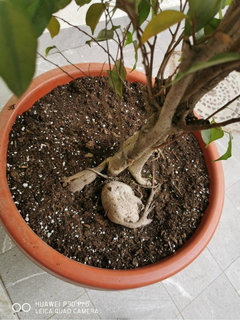
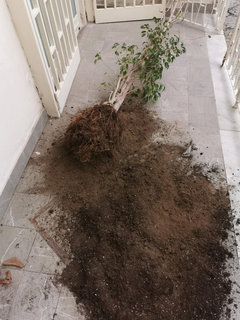
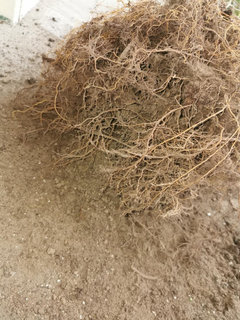
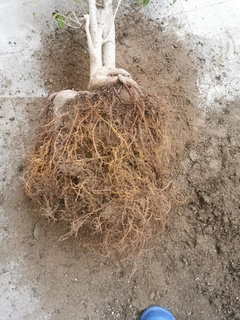
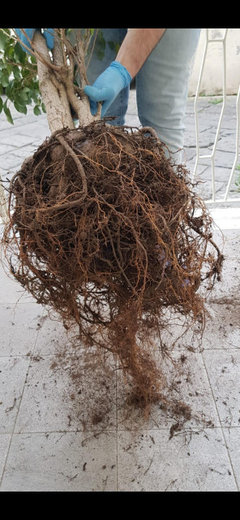
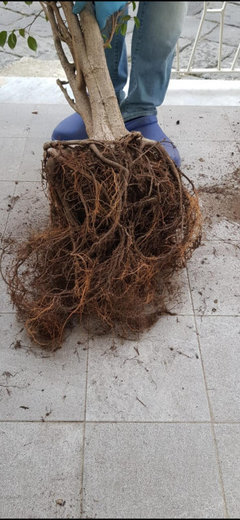
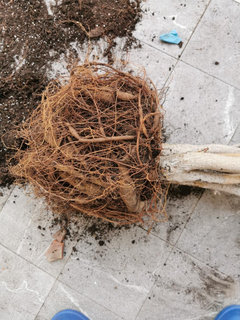
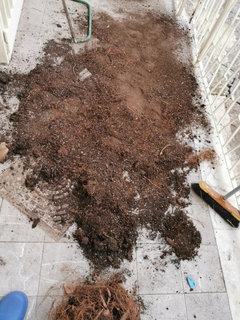
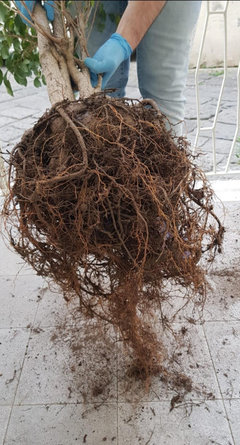
    Finally I took courage and put my hands - as you would say, dear @tapla (mid-Michigan, USDA z5b-6a) - into the ball of roots of this ficus:


    It's my first time and now I'm exhausted (I did everything with my bare hands and without tools).


    Final look:


    I didn't cut anything - I'm inexperienced and I was already very worried. I hope that having loosened the roots and removed a large part of the soil can already be considered a good job. I await you, master Al. PS: I noticed your kind tribute to Italy with the Ruffino box. ;)

  • 3 years ago

    Thanks for the kind words ..... and I wondered if you'd notice the Ruffino box. It was handy and I've taken many images of plants sitting on that box, if only because it usually rests on a cart in front of a folding table I use as the background when snapping pictures of plants.

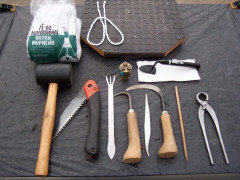
    I usually start a repot by sawing off the bottom 1/3-1/2 of the root mass, then bare root what's left before pruning out unnecessary heavy roots. I often prune back large roots as I'm bare-rooting because it speeds the process. I also use a number of hand tools I associate with repotting.

    What jumps out at me is, it appears the roots weren't kept constantly wet during the repotting process. If that is accurate, it's likely all fine (hair) roots will be lost and perhaps some as large as 3mm, depending on how long they were exposed w/o moisture.

    Did you cut back the top of the tree, too?

    If at first you think the results are simply negative, be patient. You might lose most of the leaves if indeed the repot was done w/o keeping the roots wet. Just be sure to avoid over-watering. In 2-3 weeks, your tree should be on the road to recovery, ..... sooner if the roots were kept wet.

    Al

    Michele Rossi thanked tapla (mid-Michigan, USDA z5b-6a)
  • 3 years ago

    No, I haven't cut the top off the tree yet: I have to find the courage to do it. From your words I understood that it is useless to keep the alberto so high if not to use it as a support. How many centimeters should I remove?


    You saw it right: I didn't keep the roots moist for two reasons. 1. At the beginning I forgot about this recommendation of yours (I was doing something completely new for me and I wasn't very lucid). 2. When I remembered this, I thought that if I started watering, all that soil would turn to mud (the soil placed in the center of the rootball was very fine).


    Two final considerations.


    The ball of roots in the center was mostly empty. I hope it hasn't been too empty in the middle and, if so, that's okay.


    As you teach, I did not put broken shards or expanded clay on the bottom of the vase. Before, when I watered, the water immediately came out of the holes in the bottom. Immediately after repotting, I put in the usual amount of water and no water came out. I don't think the holes could be plugged yet, right? Could it be that the new medium was dehydrated and that the root ball was previously running water sideways?

  • 3 years ago

    How many centimeters should I remove? Cut it back so there are at least 2 healthy branches (with green leaves) growing off the trunk or branch. Once your tree starts growing again, you can pinch all branches back to 2 healthy leaves to force the branches to back-bud.

    You keep pruning and pinching so you force the foliage to grow back closer to the trunk. You want to avoid a tree with long branches with foliage concentrated at branch tips; so, always be on the lookout for ways to shorten the branches - especially in the top 1/3 of the tree. THAT is where the plant will focus 2/3 of its energy.

    I thought that if I started watering, all that soil would turn to mud (the soil placed in the center of the rootball was very fine). Sometimes, water makes it more difficult to remove the soil, but usually it works to your advantage; however, when you consider how important water is to fine root viability, I'd consider it a must. I always work over a plastic tub of water and dunk the plant at least every minute. You might need a spritzer or mister of some type ..... like the one in the image of repotting tools up a few posts. It's the round brass tool.


    They come in various flow rates from 1L/minute - 8L/minute, and send out 3 jets of fine mist. https://www.amazon.com/Fogg-It-Nozzles-Superfine-Volume/dp/B000OWMWX2?th=1

    The ball of roots in the center was mostly empty. I hope it hasn't been too empty in the middle and, if so, that's okay. It's an indication the roots could only find ample air at the perimeter of the root/soil mass where the soil typically shrinks away from the rim of the pot. Fixing it would require upgrading your grow medium to something the plant finds more appealing. The same is true if water wasn't wetting the center of the root mass.

    Could it be that the new medium was dehydrated and that the root ball was previously running water sideways? Yes, both. It's very common for water to run across the top of media which have dried down to the point of becoming hydrophobic and down the crack between the pot sidewall and soil mass, then out the drain hole.

    Al

  • 3 years ago

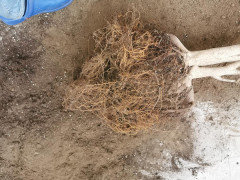
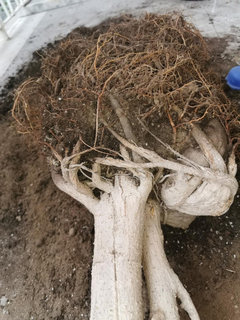
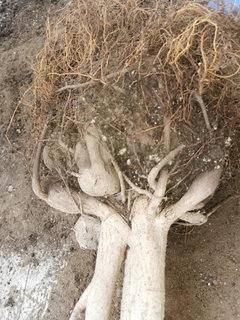
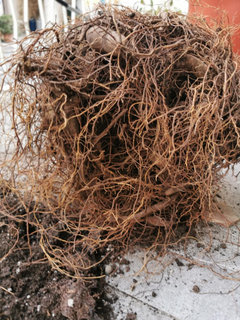
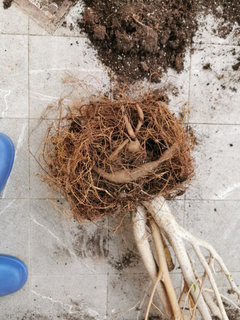
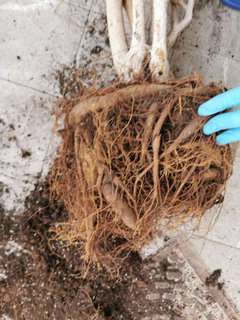
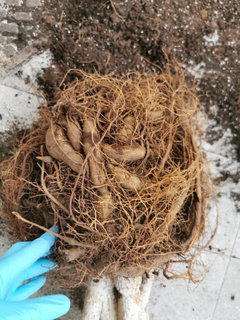
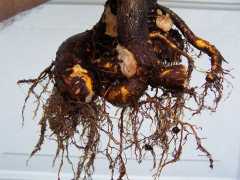
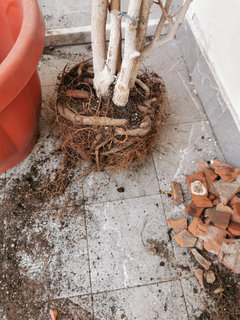
    Today I tried to work on the ball of roots of this other ficus.


    I found it even more difficult to untangle the roots of this ficus than the other. I had to use the saw you see in the last photo. I couldn't do better.

  • 3 years ago

    F benjamina after serious rootwork

    Don't be afraid of removing those heavy encircling roots, which is the ultimate goal - getting rid of the heavy roots not attached to the base of the trunk to make more room for the fine roots.

    Al

  • 2 years ago
    last modified: 2 years ago
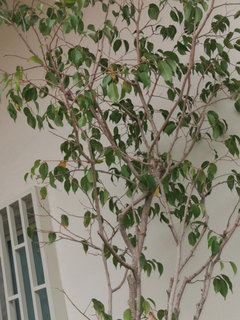
    I want to update you on one of the two ficus benjamin whose branches and roots I pruned in June 2023 (they were the first two plants whose roots I worked on and I limited myself to cutting the roots rather than cutting them). Below are three photos from last year.


    This is what the tree looks like today:


    As you can see, I didn't have the courage to shorten the tree (following your advice already required a great deal of courage :D): I thought that I can still shorten the tree in the future.

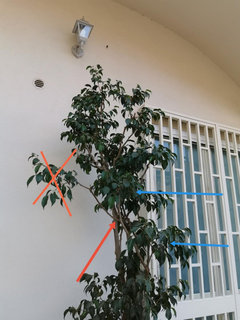
    I have some questions for you.

    1. This year I limited myself to eliminating 4-5 cm of soil from the base and sides of the root ball. I know this doesn't solve root congestion, but can it be useful as an intervention in the years when you don't get your hands in the root ball?

    2. If I pinch the branches of the upper third of the plant several times a month, do I push the growth of the branches of the lower two thirds of the plant?

    3. I would like to eliminate the group of leaves where I put the red X because it is unsightly. Do I cut where I put the red arrow in order to enhance the two groups of leaves indicated by the blue arrows? If instead of eliminating the group of leaves where I put the red X, I left 1-2 leaves, could I hope for leaves to appear along that long woody branch?