Software
Houzz Logo Print
richard_mcneil2

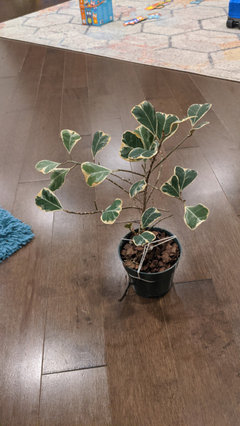
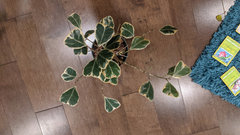
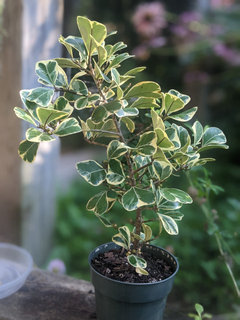
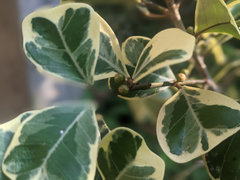
Thoughts on Ficus triangulata variegata

Was tempted to try this variegated specie of Ficus, as I like Ficus, but they seem to look spindly to me and decided to hold off. Anyone grow these? Curiously, it seems to be a South African native and most Ficus seem more diversified in tropical Asia.


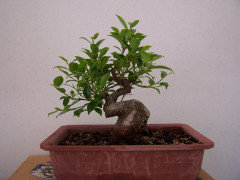
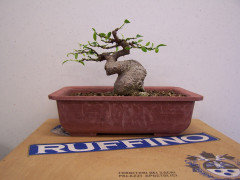
Ended up getting a Ficus microcarpa instead, love their trunks.

Comments (23)

  • 3 years ago

    Variegated plants lack the genetic vigor Mother Nature endowed the all green plants with; this, because the reduced level of the green pigment, chlorophyll, limits the leaves' ability to synthesize sugars and starch, the plant's true food. Ficus microcarpa is a much more vigorous plant than triangularis, and has naturally stronger stems. Most growers would be better off growing F microcarpa than F benjamina, too.

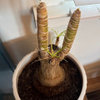
    Before:


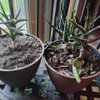
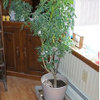
    After:

    Al

  • 3 years ago

    Yes, I know about the variegation issue related to a relative lack of vigor. I have F. benjamina, and know that micocarpa is much easier indoors, used to have one..., no comparison. Also grow elastica, lyrata and 'Audrey' (a banyan). Thanks, I will skip on the trigangularis.

  • 3 years ago

    Similar to F triangularis is F diversifolia, which also has triangular leaves but produces an impressive abundance of tiny figs all year 'round.


    Al

  • 3 years ago

    I find F. triangularis pretty darn fussy for a ficus, and the variegated form more so. IF one can get the plant through the first few years from rooting they do get a bit easier. I don’t find them worth the trouble, but YMMV.

  • 3 years ago

    The two things I've found that sets triangularis apart from other species of Ficus more commonly grown are the fact that secondary growth (thickening) is quite slow and the plant reacts much more negatively to wet feet than Ficus more commonly grown as houseplants.

    Al

  • 3 years ago

    Al, my variegated triangularis has been doing horribly but also has produced lots of tiny figs on occasion, usually when it seems most stressed/unhappy.  I wondered if that was a last-ditch attempt to save itself though seed propagation... 


    I've recently reported it and set it outside and am hoping to see some growth soon, after which I plan to prune it a bit.  You mentioned it doesn't thicken as readily as other ficuses, I've definitely noticed that, so would you recommend any different treatment as far as pruning this one?

  • 3 years ago

    Hey! Haven't talked to you in a while.


    "..... would you recommend any different treatment as far as pruning this one?" Not at this point. If the plant was badly rootbound, that's likely the reason for all growth being way out at the branch tips. After the plant rebounds (from the repot) and takes off, you can shorten all the branches to chase the foliage back closer to the trunk, making the plant look more compact.

    Triangularis and diversifolia like it drier than most other figs, and seem to be most unhappy when watering intervals are too close together. I'd had some with leaves that turned yellow and fell until I figured out I had to be more careful about wet feet with those than other ficus. Pumila is just the opposite - don't ever let one go completely dry because it will kill it.


    Have fun!


    Al

  • 3 years ago

    Yes, long time!!


    My triangularis suffered from root rot unfortunately... I had to remove many rotten roots.


    This one and my olive plant both seem to suffer terribly in the winter. It could just be inconsistent watering, but I have wondered if these two in particular need a dormancy period...

  • 3 years ago
    last modified: 3 years ago

    My triangularis suffered from root rot unfortunately... I had to remove many rotten roots. Yes, they let you know when their getting too much water. As I noted, they like it, a bit drier than the more commonly grown species like benjamina, elastica, lyrata, benghalensis, microcarpa.

    Al

  • 3 years ago

    Al, I've read that in nature, olives need 200 to 600 hrs chill hours between 2 deg C and 10 deg C, though I think that's related to flowering and fruiting.  


    I am surprised to see you mention 20 deg C as a threshold for chill hours, that's practically still room temperature!  


    How do you define dormancy?  I am so confused when I read something like "such and such houseplant is dormant in the winter months, so reduce watering".  In my mind, dormancy requires loss of foliage so that, accordingly, it's water needs are much diminished.  What is your take on this?


    And how do we relate this back to olive trees grown as houseplants? Should it get the same winter treatment as, say, fruiting figs, which lose all leaves and can be kept in the dark all winter?

  • 3 years ago

    I'm really sorry. I read a study and looked at a graph about the chilling requirements and misinterpreted it. The graph was related to bud/leaf differentiation and opening while the plant was ending it's ecodormancy, AFTER it had already experienced sufficient chilling to end dormancy.

    Good catch - and I apologize. This should be more useful.


    Al

  • 2 years ago

    Thought I would update on how my Ficus triangularis is doing. It got a ton of new growth but actually has recently lost many leaves. Still looks great but I worry about it. It's also decided too put out a ton of fruit.

  • 2 years ago

    F triangularis and F diversifolia are probably the 2 Ficus easiest to over-water. They just don't like wet feet at all. That might be behind the leaf loss unless you recently brought them indoors for the fall/ winter/ early spring months.


    Al

  • 2 years ago

    Thanks, Al. I wondered about the moisture of the soil, it's still outside but we have had so much rain... I do have a wick in the pot, been relying on that to prevent root rot, but maybe that is not sufficient...

  • 2 years ago
    last modified: 2 years ago

    Should have picked one up when I saw it to increase my Ficus hoard. Currently, am growing; F. elastica, lyrata, benjamina, microcarpa, benghalensis, Ficus maclellandii 'Alii' and F. carica (the hardy kind/outside). F. triangularis are not so readily available. Next time I see one, I will buy it. Yeah, they are S. African in origin so prefer a much drier soil condition, I am guessing (but may also be more tolerant of drier air.


    P.S., Just ordered a Ficus religiosa.

  • 2 years ago

    North, I hadn't seen these anywhere for a few years, but in the last few months they have popped up at 2 nurseries near me.

    Al, fertilization could well be an issue... with heavy rains, I definitely did not feed it as much as I would if it were indoors. I suppose the fruiting also needs lots of nutrients? More leaves lost today and I see the fruits have grown all fast!

  • 2 years ago

    Trees and herbaceous plants prioritize their parts, but perhaps it's better to say that the strength of energy sinks has a distinct order. Energy sinks are plant parts which require allocations of energy/ food, and the parts are not equal in how or when the plant responds. The strongest energy sink and first in the 'pecking order is respiratory function (i.e. to maintenance of living tissues), then to production of fine roots, followed by flower and seed/fruit production, then primary growth (extension of both roots and shoots), then secondary growth (thickening), and finally, the synthesis of defensive chemicals. That the plant's reproductive parts are a higher priority than multiplicative/ primary growth, means that removing the fruits would free up energy/ food to support more leaves and branches.


    Those fruits are called synconia collectively and synconium individually, and are made up of thousands of tiny flowers within the synconium.


    Al

  • 2 years ago
    last modified: 2 years ago

    Have you been good about fertilizing regularly? Low fertility with regard to one or more of nitrogen, phosphorous, potassium, or magnesium can cause loss of older foliage as the plant robs those nutrients from older leaves (to provide the building blocks for new growth) before they're shed.

    Hi Al! As you know (you pointed this out to me a few months ago), I use a magnesium-free fertilizer for my ficus benjamina. I use this fertilizer because here in Italy it is the one that comes closest to the 3:1:2 ratio. After nitrogen, phosphorus and potassium, is magnesium the most important microelement? Could I remedy this by buying a product that contains calcium and magnesium? In this case, I wouldn't know how often to use the product.

  • 2 years ago

    Magnesium (Mg) is one of the 3 secondary macro nutrients, and compared to the 6 primary and secondary macro-nutrients, Mg is used in the smallest amounts.


    Here, I have given Nitrogen (N) the value of 100 because it is the nutrient component most used by most plants. Other nutrients are listed as a weight percentage and parts per 100 parts of N. To read the chart: Phosphorous - plants use 13-19 parts of P or an average of about 16 parts for every 100 parts of N, or 6 times more N than P. Plants use about 45-80 parts of Potassium or an average of about 62 parts for every 100 parts of N, or about 3/5 as much K as N, and so on.

    N 100

    P 13-19 (16) 1/6

    K 45-80 (62) 3/5

    S 6-9 (8) 1/12

    Mg 5-15 (10) 1/10

    Ca 5-15 (10) 1/10

    Fe 0.7

    Mn 0.4

    B(oron) 0.2

    Zn 0.06

    Cu 0.03

    Cl 0.03

    M(olybden) 0.003


    If your fertilizer contains calcium, you can use Epsom salts (MgSO4) as a source of magnesium. If you are fertilizing at production rates, use/add .625ml/l each time you fertilize.


    Al


  • 2 years ago
    last modified: 2 years ago

    @tapla (mid-Michigan, USDA z5b-6a), thank you very much for your quick response.


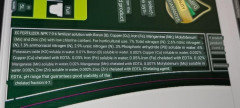
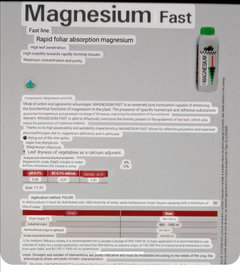
    Above is the composition of my fertilizer (I translated it into English for you). As you can see, both magnesium and calcium are missing. So I guess I should also provide calcium?

    ******

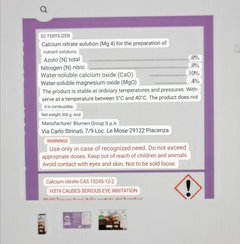
    The product below also contains nitrogen as well as calcium and magnesium. It might be fine as an addition to my fertilizer since my fertilizer does not contain NKP in the 3:1:2 ratio. However, by doing so I would go from 7:3:6 to 15:3:6 and go from providing too little to too much nitrogen, am I right? Probably this is not correct, since 15 ml of my fertilizer but only 2 ml of this product should be added to 2 liters of water.


    ******

    There is also this product that contains only calcium and magnesium:


    ******

    PS1: You recommend adding .625ml/l of Epsom salts (MgSO4). Ml? Maybe mg? They are salts in solid form, not a liquid.


    PS2: I also read a lot of useful information in this old discussion: https://www.houzz.com/discussions/1499314/quick-ficus-question

  • 2 years ago

    @tapla (mid-Michigan, USDA z5b-6a), when you have time, would you be so kind as to reply to my latest post?

  • 2 years ago
    last modified: 2 years ago

    You can use products with other than 3:1:2 ratios. The reason it is recommended is because it provides nutrients in the ratio at which the average plant actually uses the nutrients. This reduces waste, but more importantly (for the plant) it helps to avoid skewed nutrient ratios from build-up whenever the soil is not being adequately flushed, and it allows the grower to fertilize at the lowest rate (concentration) possible and still not have deficiencies and toxicities (too little or too much) of nutrients. Example: It is impossible to provide adequate N use a high P(hosphorous) fertilizer (bloom booster) in containers w/o providing toxic levels of phosphorous. To be clear, when it comes to fertilizing, anything in the soil solution that limits uptake of other nutrients is a toxicity, even if the symptoms are not conspicuous.

    I think your best course would be to look for a fertilizer in a 3:1:2 ratio (like 24-8-16, 12-4-8, 9-3-6), even if it doesn't contain Ca(lcium) or Mg (magnesium). You can then supplement the Ca/Mg with another product like Cal-Mag. You can make your own 380 ppm Cal-Mag supplement (260ppm Ca/ 120ppm Mg) in a 2:1 ratio respectively, by combining 6g of calcium nitrate and 4.5g Epsom salts per gallon of distilled, R/O, or otherwise deionized water (rain, snow melt, or condensate from air conditioners or dehumidifiers).


    Al

Sponsored
Mary Shipley Interiors
Average rating: 4.8 out of 5 stars34 Reviews
Columbus OH Premier Interior Designer 10x Best of Houzz