Software
Houzz Logo Print
webuser_374210182

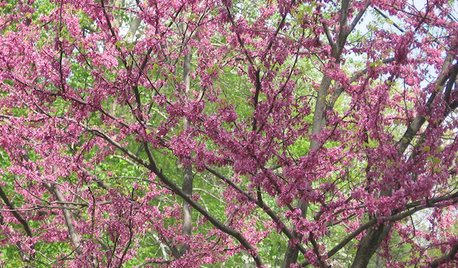
Eastern redbud very slow to leaf-out

3 years ago
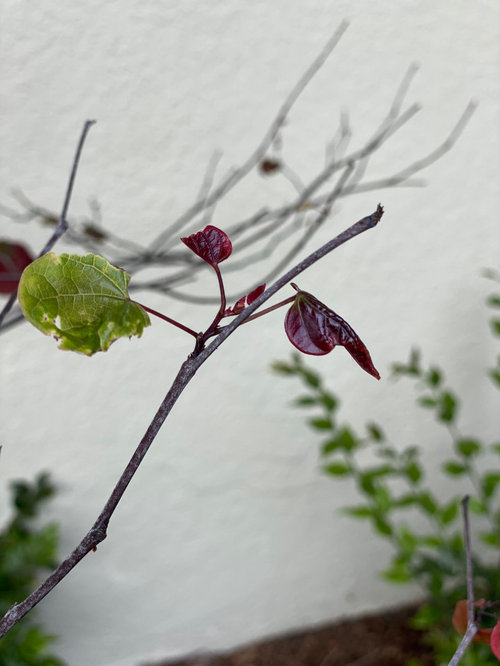
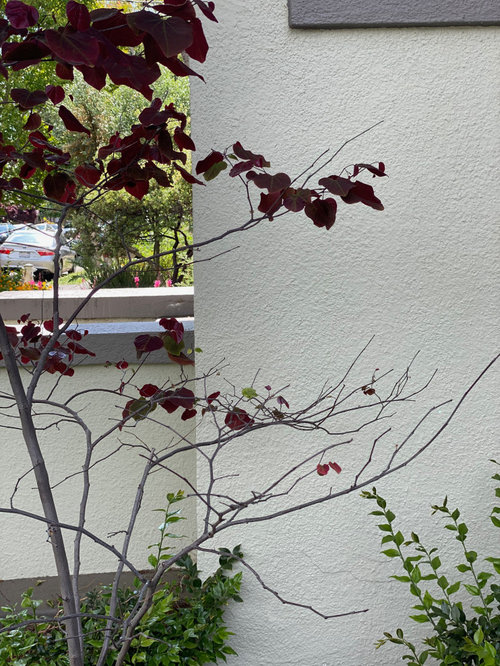
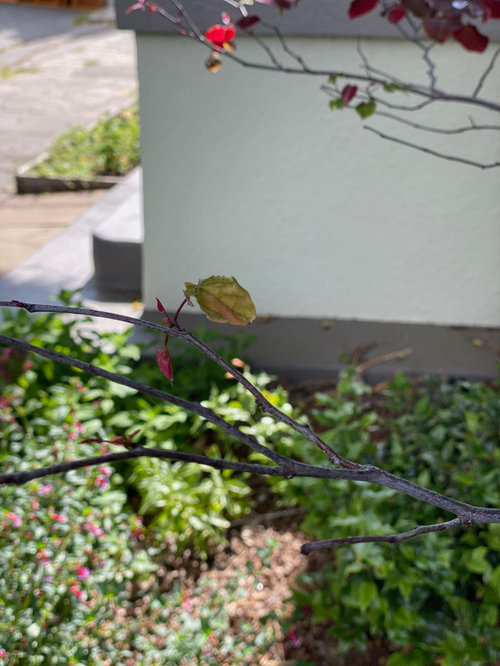
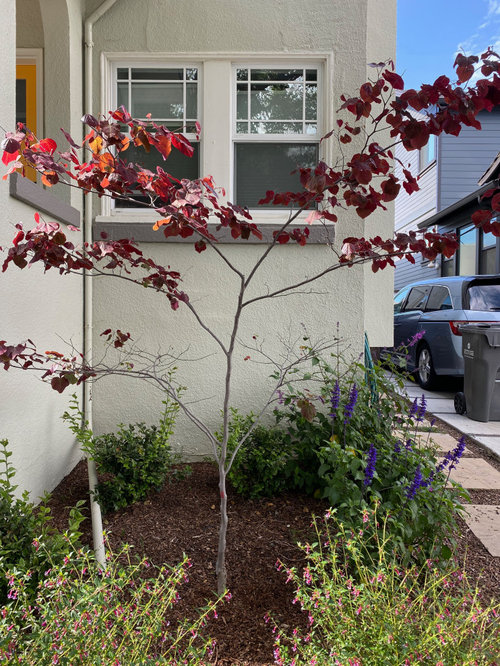
I planted an eastern redbud (Cercis canadensis) 3 years ago in the spring, and it doesn't seem to be doing well - it barely bloomed and it's lower branches have few to no leaves.


- it's on the south facing side of the building, but under the canopy of a large tree, so it's fairly shady.

- it was pretty dry it's first two years, so perhaps didn't get enough water, but it rained a ton this year, and I recently increased the irrigation on it to 4+ gal every 10 days. (I redid the drip line so more was upslope)

- I've did compost dressing in Feb, some slow release fertilizer a bit later, and some seaweed fertlizer every month since then.


I'm in Oakland, CA (zone 9b)


Comments (24)

  • 3 years ago

    We have not had significant rain for months; how much have you been watering? Have you fed it?

  • 3 years ago

    Hi,

    As I said above, I recently increased the irrigation on it to 4+ gal every 10 days and redid the drip line so more was upslope. I dressed with compost in Feb, some slow release fertilizer a bit later, and some seaweed fertlizer every month since then.


    Prior to increasing the irrigation 3-4 weeks ago, it was maybe at 3gal, but I think too much was downslope since it was in a small dripline in a circle around it. Definitely willing to believe it wasn't getting enough water, which is why I increased it. But it barely bloomed in April and there was a lot of rain until early May here. Was wondering if it was too shaded?

  • 3 years ago

    How many hours a day of direct sun does it get?

  • 3 years ago

    I honestly don’t know how to answer that. It may get some morning sun (on its east side, obvi) and some late afternoon on its west side - but as I said it’s under the canopy of a large street tree. It’s mostly filtered sun.

  • 3 years ago

    pull back the soil at the trunk soil interface..and find out how deep the root flare is..snap pix.. show us...


    https://duckduckgo.com/?t=ffab&q=tree+root+flare&iax=images&ia=images


    .. trees need moisture at root depth.. and then near drying before the next deep watering.. dripping the top few inches is rarely good enough for a tree ...


    you are responsible for water the year of transplant.... the second year in drought or the hot season.. and it should be free range by the 3rd year...


    a well established tree should never need fert .. but a little of this or that shouldnt hurt ...


    lets see those pix..


    ken

    Stephanie thanked ken_adrian Adrian MI cold Z5
  • 3 years ago

    Stephanie,

    6-8 hours of direct, unfiltered sun each day is considered 'Full Sun' so if anything, yours is most likely on the low side of getting enough sun to flourish to it's full potential.

    There may be other issues as ken mentioned.

  • 3 years ago

    I wouldn't worry about the sun exposure, Redbuds are quite tolerant to partial shade, especially in a high summer heat area as is California. And while the tree is not thriving, the siting looks very tight for a tree that wants to be 20 feet by 20 feet or more.

    Is there a reason you did not select one of the CA native redbuds, Cercis occidentalis? A smaller tree overall and far better adapted to your location.

  • 3 years ago

    Gardengal48 - I didn’t pick or plant the tree, a landscape designer did. 😞 though these are not uncommon in my area to be used in front planting beds similar to how I have it.

    Ken - I’ll try for a pic. The irrigation runs for an hour with the goal of it getting deep vs the top few inches.

  • 3 years ago

    Gardengal: the California redbud does not have a nice red leaved form like ’Forest Pansy’, and the Eastern sp. does just fine here in the Bay Area.

    It does however require a lot more water that the native, so I’m not surprised it isn’t thriving. I would increase the frequency of waterings and see if that doesn’t result in better growth.

  • 3 years ago

    " Gardengal: the California redbud does not have a nice red leaved form like ’Forest Pansy’, and the Eastern sp. does just fine here in the Bay Area. "

    Not sure how valid this comment is. Eastern redbuds are notorious for their difficulty in establishing outside of their native range and are far more susceptible to drought than the CA native species, and that can lead to issues like verticillium wilt (to which they are highly prone). They also tend to be very short lived, with Forest Pansy typically leading the pack.

    Red leaves can be achieved by a lot of other, far more suitable plantings if that's the desire.

  • 3 years ago

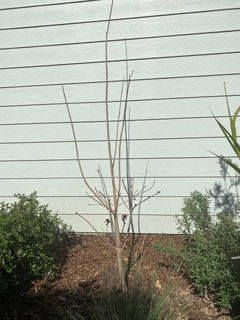
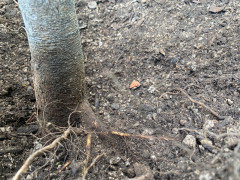
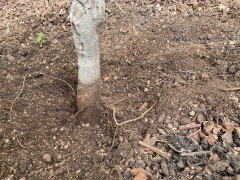
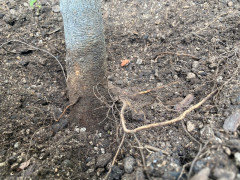
    Ken - I dug down about 6-8 inches and while the trunk got wider there weren’t a lot of woody roots except towards the upslope. I’ve tried to include pics, but not sure how much you can see.

    What does this tell you?

  • 3 years ago

    (Never mind the first pic. The app doesn’t seem to work well from my phone to pick images)

  • 3 years ago

    Oh wow! Thank you so much. That’s disappointing that a professional made such a mistake when it was planted. Hopefully I can fix it, but if it’s been 3 years is it too late?

    Thank you Bill and Ken.

  • 3 years ago

    ken got it right.


    no, It's not too late. I raised a spruce tree that was planted too deep for about 3 years. It took a year to recover but is doing great now.


    Your biggest decision will be whether you can just remove dirt and level it off, like in the video, or if you have to physically raise the tree, which will be more work. But either way, it needs to be done.


    Any of those smaller, adventitious roots coming out of the trunk, above the root flare, or growing upward, out of the main roots, can be snipped off.

    Stephanie thanked BillMN-z4a
  • 3 years ago
    last modified: 3 years ago

    Oh, and if you have to raise the tree, it will probably look like the one in this video, ater being dug. But don't leave it out in the sun too long and let the roots dry. Just dig it up and put more dirt in the hole, pack it down fairly tight to prevent settling and replant the tree. You might have to stake it for a while until the roots regrow and get strong.

    https://www.youtube.com/watch?v=F9h40MQLtpQ

    Stephanie thanked BillMN-z4a
  • 3 years ago

    Thank you! Given I dug down almost 8 inches and just got to some of the flare, I’m guessing I’ll need to raise it. 😞 but at least I now know what’s wrong.

    Appreciate the help!

  • 3 years ago

    Oh, if you have to dig it out completely, that is best done when the tree is dormant. Either early spring or Fall. Someone correct me if I'm wrong about that.

  • 3 years ago

    Okay, another question if I do choose to raise it – the branches are almost horizontal from the trunk and are quite long, so the drip line is huge. does that mean i'd have to dig out that far? If so, that's basically impossible given it's placement in the garden bed. if not, how big should I assume the root ball would be?

  • 3 years ago

    That is why it is best to wait until the tree is in dormancy, as any transplant after 3 years is going to involve root disturbance. It's inevitable. But during dormancy, the roots have time to regenerate without having to support any active topgrowth so the impact is substantially reduced.

    I would not be encouraged about the tree's chances for survival if you attempted to do this now. And frankly I wonder about the long term viability anyway of a tree that has spent 3 years being planted far too deep and is already in a highly weakened state. It's a risk.

  • 3 years ago

    no, the drip line means nothing where transplanting is concerned.


    There are standards with root ball size per inch of trunk diameter.

    If your tree is 2" diameter at 6" off the ground, you would dig at least 12" from the trunk, ending up with a root ball of 24" diameter.

    A one-inch trunk = 16" dia. root ball and 3" a total of 32" dia.


    There are as many methods as there are gardeners. One way, is to dig a root ball, and raise it in place, using the leverage of shovels or pitch forks (and some help from one or two hefty friends), you can tamp additional soil underneath the original root ball, without lifting all that weight completely out of the hole.


  • 3 years ago
    last modified: 3 years ago

    Gardengal has a good point.

    Eastern red bud trees are known to be hard to transplant, once the roots are well established. They can even die from transplant shock.

    It's up to you but if you want a sure bet, replace the tree with a new, smaller one from the nursery. You could try the raising and by next year, you'll know if it works or not and then replace it. The choice is yours.

    bill

  • 3 years ago
    last modified: 3 years ago

    Yeah, I was assuming I’d dig it up and either transplant or replace it in the fall. Either way, I’ve got to wait a few months and dig it up!

    Thanks all!

  • 3 years ago

    In future, when you buy a small tree, it would be cheaper to just plant it yourself. (Assuming there is no physical reason why you can't.) Planting a tree is easy and you could do it in half an hour at no cost. Once you've done a bit of research you'll be a lot better at doing it than the 'professional' who did this.