Software
Houzz Logo Print
taher_zad

Compost bin help

3 years ago

I'm looking to start a compost bin. After doing much reading online, I've decided there is too much information online. So I'd like peoples actual experience, please. Will any type of bin work? I don't really have room for a big open compost bin but I do have room for a small plastic one or two, like the one shown here.

https://foresttofood.com/2023/07/08/composting-and-organic-gardening-unleashed-exploring-top-products-for-your-journey/

Are the small plastic ones ok? Some I've looked at had bases, I thought they had to touch the ground to work.

Any advice or recommendations greatly appreciated!

Comments (7)

  • 3 years ago

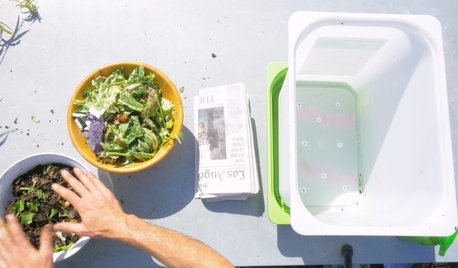
    The first few are worm composters........a completely different approach to composting than a standard "compost bin". The last one - the kitchen composter - is a bit of a joke. It is far too small to be very effective and there is NO way it can produce a usable compost product in only 5 hours!!

    Ideally, an effective compost bin is one that is not enclosed in plastic, is outdoors and in contact with the ground and is approximately 3 feet wide and deep and 3 feet tall. Those dimensions seem to maximize the decomposition activity by being able to generate enough heat to minimize the need to "work" or turn the pile yet still produce decent results. You can build one easily using something like old shipping pallets or even chicken wire.

    In a pinch, you can use an old plastic garbage can but make sure you heavily perforate the bottom and sides to allow for drainage of any liquids and so that air can reach the materials inside. Oxygen is critical for the composting process, which is why plastic bins are not favored by active composters.

  • 3 years ago

    Do you have a piece of ground three feet x three? If so you have space for a proper bin. About 30 years ago I was given one a bit like this https://www.thompson-morgan.com/p/modular-wooden-compost-bin/wkc1601TM . It is still going strong. I have others on my allotment, but this is my most compact and fits into my pocket sized garden.

  • 3 years ago

    If you mow your lawn and bag the clippings the small containers will fill on the first mowing. Assume you fill the bagger on every mowing then ignore the small containers. From my experience you don't need any kind of material around a compost bin. They just pull the eye to the gaudy color or the trashy look. The compost alone doesn't attract the eye.

  • PRO
    3 years ago

    A bit before the bin... what are you composting? Just some kitchen scrap/household paper, balcony gardening, bigger yard or garden? I ask because you show worm bins, which are run mostly on kitchen scrap and household paper, sometimes some fallen leaves or grass clippings. But not for composting something like your old tomato plants or trimmings off your bushes sort of stuff. Worm composting bins often don't touch the ground, and they don't have to- the bottoms are sealed. That helps keep your worms in the bin instead of potentally running away out the bottom of the system. Some of them have the spigots on the bottom to drain off excess liquid that can happen with worm composting. You can make your own DIY worm composting bin setup rather than buy one if you like.

    If you are looking to compost yard scrap as well as the household stuff, you are better off using more traditional composting bins. They aren't meant for using worms to do the composting, though sometimes worms will show up in bins. They don't have to touch the ground, some folks like having tumbling composters. But many bins do touch the ground since it's handy to just have them on the ground instead of elevated. Some folks like to leave their bins or piles cold, but if you don't have a lot of space you will likely want to do hot composting since it turns faster and can take up less room over time.

    The small household auto-composters that have come onto the market recently are interesting. To my understanding they can work. But only if you are a low scrap producing house and/or you keep up hard on the running it to turn out the composting as much as you are making scrap. I haven't tried one myself, so can't vouch for how good or not they are.

  • 3 years ago

    I think it depends on what you are composting, and what your local wildlife.

    Here, I don’t put kitchen waste in an open bin because it will attract various varmints including possibly rats.

    So, I use a large plastic trash can —maybe 33 gal? with locking lid. Drilled holes up & down sides and in bottom. ( have 2 of these).

    In those I compost all my kitchen veggie scraps, paper towels, small cardboard, parchment paper, shredded paper. I’ll sprinkle in a few leaves here and there if I think it needs more “ browns”. It runs just a little more wet/ green than is ideal but not bad. Stuff keeps breaking down so I can keep adding, especially in summer— I use a compost stirrer thingy but it doesn’t get really turned lots, as it’s to heavy. Eventually stopp adding to one & let it mature, while starting back in the empty one. Makes not a lot, but a compost “muffin “ to tump out & use. The benefit is we never add veggies or fruits etc to kitchen trash, so only take it out weekly. Plus, for me it’s the best way to compost a fair amount of paper stuffs, which are gobbled up by the veggie waste , which needs something like that for balance, & breaks down.

    Because of the holes it gets some air, communicates somewhat with the dining which it’s setting, will get worms after is broken down & not hot, gets soldier flies when larger chunky fruit waste is there.

    Then I use open square bins for leaves & yard greens , spent flowers & veggie plants that are not of general interest to marauders. These are pretty slow, close to cold- composting, as have tons of leaves relative to green waste. But it all turns into compost eventually!


  • 3 years ago
    last modified: 3 years ago

    There are two types of composters---people who want to make compost to enrich their gardens and people for whom composting is a lifestyle.

    For instance, I don't know what I'd do with my banana peels, watermelon rinds, stuff with my social security number on it, onion tops, leaves, dead plants, eggshells, my orange rinds, pineapple tops, the pumpkins after Halloween, ends from the lettuce, old cotton socks, shrimp shells, avocado and peach pits, all the coffee grounds, the occasional teabag leftover from a guest's visit, lobster shells from summer gatherings, carrot tops, peanut shells, corn husks... Well, you get the drift. What would I do with all that refuse? Send it to the landfill with my stale bread?!!

    A dedicated composter needs a 3' x 3' bin at the very least, which can easily be made from hardware cloth or pallets. Or maybe even a large tumbler in the yard. Of course, a large tumbler takes up as much room as a bin.

    If you're composting to get some soil amendments once in a while, have you considered a worm bin? They work well and are a lot of fun. They don't do well in the sun, though, and are generally an indoor thing. Most other small setups are very inefficient and can make the process disappointing.

    Decide what you are---a man or a mouse, no, no, no, just kidding, I mean are you a small batch composter or someone who likes to manage their household and yard trash in a sustainable way? We can discuss particulars after we attempt to convert you to a larger bin.Humbly yours,


  • 3 years ago
    last modified: 3 years ago

    My city gives away free compost bins that are rodent-proof, which my old wire bins were not - rats made a nest in the nice warm pile ☹️

    They look like this:


    I really like mine. I have it on a concrete slab so roots don't get in.

    I think other cities do this, you might want to check with yours - and/or your county extension agency. Ours offers workshops and bins as well.