Software
Houzz Logo Print
maackia

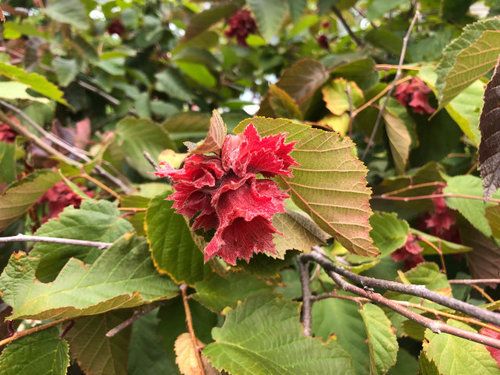
Corylus, but which one?

3 years ago
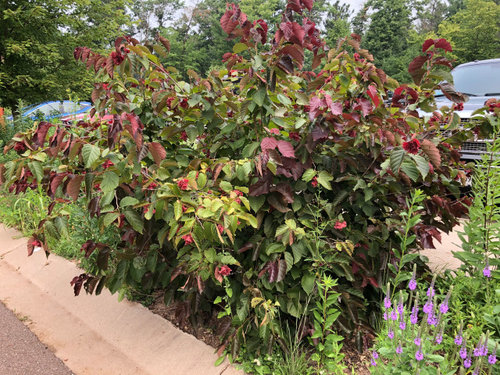
We’ve got C. americana growing wild, but this looks to be something else. It’s a parking lot planting, so most likely a cultivar of some sort. Full sun conditions. Any ideas?


Comments (20)

  • 3 years ago

    Possibly C. avellana 'Rote Zellernoot', or sometimes seen incorrectly as 'Rode Zellernoot'

  • 3 years ago

    Is ’Rote Zellernoot’ commonly available in the U.S.? This is a nature center (Beaver Creek Reserve), but I was surprised to see Corylus in this location. The two-tone foliage makes it look like there are two different plants.

  • 3 years ago

    Possibly. Although the taxonomy is so confused you may need to look for it under a multiple of names:

    Synonyms / alternative names
    Corylus avellana 'Purple Avalon'
    Corylus avellana 'Purpurea'
    Corylus avellana 'Red Zellernut'
    Corylus avellana 'Rode Zellernoot'
    Corylus avellana 'Rote Zeller'
    Corylus avellana 'Rotter Zellernuss'
    Corylus avellana 'Red Zellernut'
    Corylus avellana 'Rote Zellernuss'
    Corylus avellana 'Rouge de Zeller'
    Corylus avellana 'Red Zellernuss'
    Corylus avellana 'Rotter Zellernuss'


    However, the same article also goes on to state: "With their vulnerability to Eastern Filbert Blight, the group has probably never been grown much in North America; in North American Landscape Trees, Arthur Lee Jacobson states that a weak-growing plant of this sort was known as ‘Purple Avalon’ around 1974 (while wrongly placing ‘Rote Zeller’ as a clone of Corylus maxima; another sale-name in America was ‘Red Fortin’, used for a short-husked hazel with red leaves fading to bronzy-green which was found in the abandoned orchard of a French immigrant, Mr Fortin, in Washington State. Another clone found in the same orchard, ‘Fortin’, had longer husks and probably represented C. maxima ‘Frühe van Frauendorf’ (q.v.; Jacobson 1996).

  • 3 years ago

    Wow, bright red nut husks.

  • 3 years ago

    This place is close to where I live so I can reach out to their staff for a possible ID.

    Beng, the husks are what caught my attention. I could see working this one somewhere into the garden.

  • 3 years ago

    There is a newish hybrid called 'Red Dragon' which is EFB resistant. I have never seen it, only read the name in lists of cultivars. But it must look like this, right?


  • 3 years ago

    " But it must look like this, right? "

    Not really :-) It is just a red leaved form of contorted filbert or Harry Lauder's walking stick, virtually identical to 'Red Majestic'. IME, it remans a solid burgundy-purple all season, no greening no red husks. And is very unlikely to produce fruits, even with cross pollination.

  • 3 years ago
    last modified: 3 years ago

    Haha, ok. Well I'm glad I didn't make a definite statement. Point is, a Eastern Filbert Blight resistant hazelnut with red foliage has been created...this must be another one, it would seem? Because the upper Midwest would be an area of high endemism of that disease, given that, as Maackia points out, there are plenty of C. americana around.

    maackia thanked UpperBayGardener (zone 7)
  • 3 years ago

    Might be 'Purpleleaf Bailey Select'

    maackia thanked arbordave (SE MI)
  • 3 years ago

    My corylus maxima red filbert has very bright husks (and is currently the same greeny bronze shade). Only has a small crop unlike the vigorous Cosford (I sadly chopped down) cos the only nuts I saw were the thousands buried by squirrels)

  • 3 years ago

    The foliage pics of ’Purpleleaf Bailey Select’ look right, but nothing about the carmine husks. That seems odd, or did I miss something?

    Rosaprimula, can you share some pics of your C. maxima?

  • 3 years ago

    ooof, will need the help of offspring but will try to do my best. The catkins are pretty lurid too. Nothing like the usual pale yellow avellana ones. I think it was probably marketed more as an ornamental than a cropper, although I don't recall any sort of cultivar name apart from 'red filbert'.


    For a few years, I enjoyed bumper harvests...until the squirrels discovered them. Same with the cherries but once they are in the little pests mental map, they never forget.

    maackia thanked rosaprimula UK (Cambridge) Z8/9
  • 3 years ago

    Given the location of where it's growing, I'd second Purple Leaf Bailey Select, a Bailey Nurseries introduction.

    maackia thanked pennlake
  • 3 years ago

    If it is Purpleleaf Bailey Select, I think they’re missing an opportunity by not including the colorful husks in the plant description. I wonder if one of the largest U.S.-based nursery wholesalers will take my advice? ;)

  • 3 years ago

    I'm sold but it looks like a lot of other people were, too. Sold out everywhere!


  • 3 years ago

    I can’t find it either, but I did reach out out to a few staff members. One of them noticed this shrub and was gushing about the “involucres.“ That was encouraging.

    Any chance this shrub would come true from seed?

  • 3 years ago

    It is worh collecting some seed and try. If it is the Bailey selecrion i beleive it actually was a seed strain where the green plants were discarded in seedling stage (Corylus can be hard to propagate from cuttings) However they likely maintained a seedling block of all purple plants to generate the seed.

  • 3 years ago

    ’Purpleleaf Bailey Select’ look right, but nothing about the carmine husks.


    ===>>


    boy i havent heard a reference to carmine.. since dad and i worked on our stamp collection 50 odd years ago...


    ken

    maackia thanked ken_adrian Adrian MI cold Z5
  • 3 years ago
    last modified: 3 years ago

    Ken, that alone makes me happy I used the word. Enjoy the trip down memory lane. Do you still have the stamp collection?

    Pennlake, that is interesting, but now look what you've started. I'm not much of a propagator, but I can plunk seeds in the ground. The article says to harvest seeds when they are mature, meaning when the seeds turn in the husks. Does this mean they shouldn't be harvested until the seed is actually loose in the husk?