Software
Houzz Logo Print
catherine_cook45

Help figuring out if my door is original

3 years ago
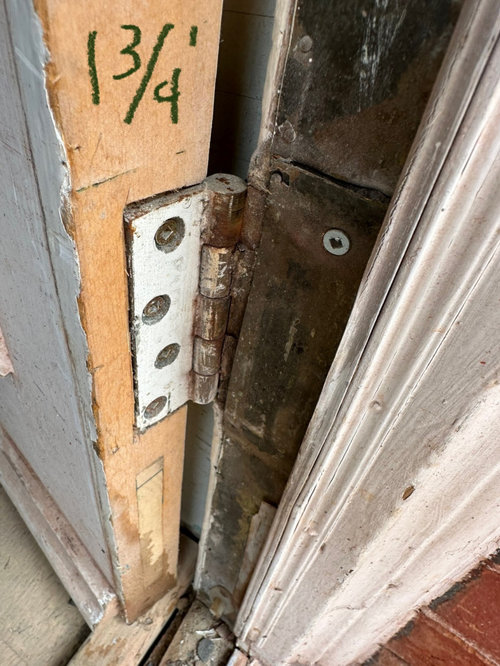
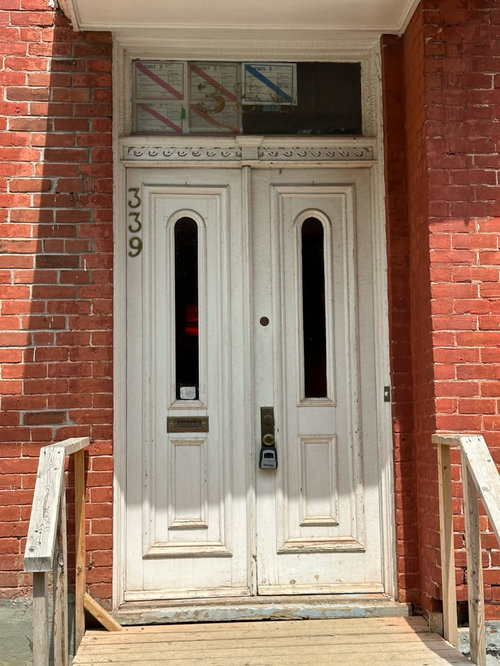
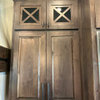
Any one know how to find out if a door is original or if it was added after. I am renovating a Dutch colonial house which was built in 1873. But the door looks really out of place. The panels look like they were added and are not part of the structure. They are really very busy. And the narrow double doors do not look like something. You would find on a farm! Help!!!

I know it was once a dairy farm. I am trying to restore the door properly.

Comments (23)

  • PRO
    3 years ago

    It doesn't look out of place to me. I'm betting original.

  • 3 years ago

    Well I am not sure it would have only had 2 coats of paint. The thickness is only 1 and 3/4 thick which is quite thin. My current house was built in 1900 and it is 3 inches thick. . The paneling is glued on rather than actually carved in. And the ornate detail seem odd for a modest farm house. Also the double doors are narrow and don’t seem functional for a farm house. I also have not seen any house built in 1873 were a farm house and had double doors like this. The doors look out of place. They may be old, but I am not thinking they are original. I am wondering if there is anyone out there who has clues to look for to figure this out.

  • 3 years ago
    last modified: 3 years ago

    The style is of the period. I lived on a block with houses built between 1830 and the 1880s and many of them had very narrow double front doors although usually thicker. The elaborateness of the door would depend upon the wealth of the builder and sometimes elaborate details or houses ended up in modest environments. Where I grew up there was big Victorian planted in the middle of a bunch of small shabby workers houses because the factory owner lived right across from his factory and workers so he could keep everything under surveillance. There wasn't the modern idea especially in rural areas where rich people and fancy houses were all together in a community isolated from everyone else.

    All that said it's possible that your current old door was put on your old house at some later time.

  • 3 years ago

    This is an old very modest Dutch colonial - it was not a wealthy farm. I have not seen any Dutch colonial farm houses that had double doors. I I do not think this was the land owners house - actually I know it was not. The land was owned by the church but they did not tend or live on the land. The land was rented out to farmers. I don’t think they would have spent the money on such an ornate door. Also it was an old dairy farm, I am even wondering if it was originally a barn that was converted later.

  • 3 years ago

    Also the paneling that is stuck on (possibly nailed to the door) rather then carved into the door is also very odd. And the the thickness and only two coats of paint also do not make sense.

  • 3 years ago

    Also Anyone know when copper weather strips came into play?

  • 3 years ago

    My current door from the 1900 does not have this - the door is wood on wood. It is not efficient but it is pretty.

  • 3 years ago

    Oh and this is not a Victorian home it is a Dutch Colonial Farm House.

  • 3 years ago
    last modified: 3 years ago

    Without seeing the rest the facade it's hard to say. People fiddling with and changing their houses and putting on inappropriate details is nothing new.

    I would not assume that just because the church owned it that it would be modest. The buildings built and owned by the church in the town I grew up in were a very close second in quality and grandeur to those of the few wealthy people in town. Well built and well maintained because back when it was a church going community, people would do all sorts of special favors for the church.

    I am not sure what conclusions I would make about layers of paint. There were surfaces in my 1840 house that had one or two layers of paint, some baseboards had about eight. Or your door could have been salvaged and stripped of old paint.

    Also doors of this era were not carved. The houses I lived in from 1838 and 1840, one of which had a major addition in the late 1890s all had doors that had some applied moldings on them, especially in the fancier parts of the houses. Copper weather stripping isn't a particular tell. It's been around a long time and you can still get it.

    I don't know, you seem to want this door to Not be original to the house for some reason...maybe it's not. But it's an old door anyway, it wasn't made in 1980. If you don't like it or think it's appropriate just change it, then.

  • PRO
    3 years ago

    You can tell from the trim that it was always a double door- see that little block under the transom in the center? Also lots of plain houses had fancy doors- by this time period doors and other architectural details were made in factories so even modest houses could have a fancy front door and front parlor. The style of the door is appropriate for the era as well including the pronounced bolection moulding. All that said I don’t think they were born on your house- the 1 3/4” written on the side screams Architectural salvage store. Regarding thickness, the thickness looks right for the jamb but you can measure that. All in all as part of a big renovation I would leave them, they are as good a guess as anything else to what might have been there.

  • 3 years ago
    last modified: 3 years ago

    The pressure treated wood stoop on this house, to me ups the ante that the door is old salvage.

    Maybe the original entry area was remuddled at some point and someone started putting it back together with older architectural elements again.

    There is an 1820s house nearby that was lived in for decades as a stabilized ruin and it's now being restored and there has been a lot comment about the beautiful original 1820s door in it's beautifully decayed state.

    It's a beautiful 1820s door and it's beautiful 1820s house. But I happen to know the door is not original to that house. When I first saw house when I was in college, it had a newer front door. Newer but still 19th century. The correct door for the house was put back on later. ( It may have been in the basement I don't know).

    The current owners are keeping the much later bay storefront window added to the house in the Civil War era it looks like, rather than going back completely to the Federal period.

    Since the door is probably a fairly recent addition...when were Sharpee pens invented? ...you could re-restore to a Dutch style door.

  • 3 years ago

    It just does not fit with a Dutch colonial home. I have yet to see one built in the 1800’s that has this type of door. It’s a small house.

  • 3 years ago

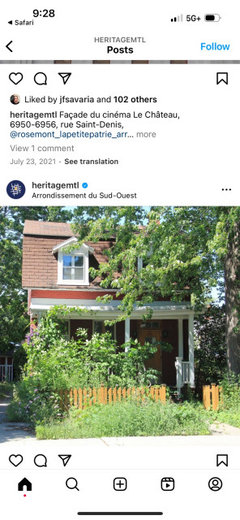
    That looks like the above

  • 3 years ago

    Sounds like, regardless of whether it is original, you don’t like the door. Why don’t you change it? Does your municipality have rules around changing original elements and that is why you are trying to figure out whether the door is original?

  • 3 years ago

    yes, it does not seem like it ever fit the house. I do have to get a permit and prove that was not original if I want to change it. Either way it has to be replace, and if I am going to spend the money on a proper custom wood door want it replaced with something thit is correct not something that was added by mistake years ago. The door is rotted, and negelected for a long time. The two 23" doors are impractical, and not functional for my needs. I need at least a standard 36" door. The house was completly restored and I am looking to make sure the door looks good and is functinal

  • PRO
    3 years ago

    If the opening is 48” wide it always had double doors. Most houses weren’t (and aren’t) architect designed so often combine different styles, especially so during the Victorian era. In my town the historic preservation commission would insist that stay a double door…

  • 3 years ago

    Even if built in a rural area which was just farm land. It was not built in an urban setting.

  • 3 years ago

    I am pretty sure it was once a barn

  • 3 years ago

    You don’t like the door . You are convinced it’s not original. You should find a local person to verify it’s not original so you can get a permit to change it . No one here can help you obtain the proof you need .

  • 3 years ago

    I would show them the 1-3/4" written on the edge with a Sharpee as part of the proof. That wasn't written 1900. Sharpees were invented in 1964. I don't think anyanybody would have a reason to write the thickness on a door that's never been off the house.

    My house did have Roman numerals and other marks on them chiseled on the edge of the sashes to indicate which opening they went into since each opening was slightly different.

  • 3 years ago

    Thanks everyone - I was not asking for someone to prove one way or another just wondering if their were things to look for.

  • 3 years ago

    If it was original, it might have been rehung or otherwise fixed in the sharpie era. I'd look around at other houses of the same era in your area. I'd tend to vote original.

Sponsored
Mary Shipley Interiors
Average rating: 4.8 out of 5 stars34 Reviews
Columbus OH Premier Interior Designer 10x Best of Houzz