Software
Houzz Logo Print
ocean547

Bertazzoni Induction and condensation

3 years ago
last modified: 3 years ago
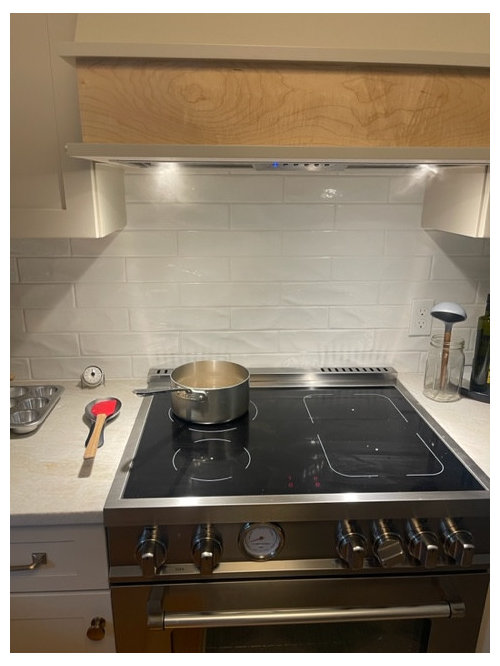
Hello! We just replaced our gas range with a Bertazzoni induction range, which is generally great. I am having an issue with condensation dripping from the range hood whenever I boil water (or anything). It's very annoying and did not happen with the gas range. Anyone else have this issue? Our range hood is a little low, but since it never happened with the gas range, I don't know why it's happening. I have tried boiling more gradually than the rapid setting and it still happens. I have tried runing the range hood on high, (its a newer XO Appliance one that works very well). No luck.

I don't imagine that our hood being a few inches higher would make any difference. Would love to hear if anyone is having this issue and a possible solution! We just renovated our kitchen so everything is new.


Comments (10)

  • PRO
    3 years ago

    I think I need to know exactly what was changed when you renovated . Is this a new hood ? How high is it from the bottom of the hood to the range top? Are you sure the hood was installed with the proper venting for the hood size? How many CFM is the hood?

  • 3 years ago

    Is your range hood vented outside or is it recirculating? I have a Miele induction range and a range hood that vents outside and we do not have this issue.

  • PRO
    3 years ago

    What is the CFM of the fan? The pipe to the exterior size? When was the last time you cleaned it?

  • 3 years ago

    You say everything is new ... but then you say it didn't happen with your gas range?

    Did you still have your gas range installed with the new hood?


    I have a 36" Wolf Induction range with a 42" Vent-a-hood and have no condensation dripping issues. I regularly make large batches of oatmeal that are simmered for 20 minutes, so there is constant steam and I run the fan on low.

  • 3 years ago
    last modified: 3 years ago

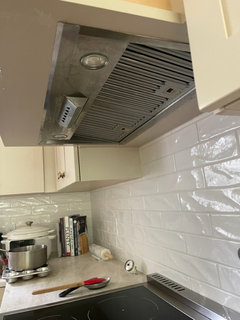
    So much information omitted by @ocean547! First, is the hood exhausted to the outside, or is it a recirculating hood? Second, when you say the condensation is dripping from the range hood, I can't make out from the photo where it is dripping from - tell us, the front edge, the center bottom, the back wall, where? Third, it looks like you have an insert - can you show a photo of the insert from underneath? I am trying to see the coverage it provides.

    Here are possible reasons you are experiencing condensation; it could be any of these or a combination:

    - it is summer, and if your indoor air is moisture-packed, the boiling water cannot evaporate. That is physics. Your A/C should be on, or your thermostat should be set at a lower temp;

    - if the hood insert does not have mesh or baffle coverage all the way side to side and/or from front to back, the boiling water droplets will have a surface on which to collect rather than escape through the hood duct;

    - if the insert needs to be cleaned, then it is clogged and is not allowing the steam to escape;

    - if you are boiling water on the front burners, but your hood is not deep enough to cover the front burners, then the steam will collect on any nearby surface;

    - if your hood exhausts to the outside, but there is either a blockage in the duct, or the damper flap of your hood is closed, then it is not allowing steam to escape.

  • PRO
    3 years ago

    There is also if the duct is not insulated or air sealed properly, you can have the cool air of the home inside the duct creating a cold glass effect with the hot moist attic air condensing against it, and dripping down the outside of the duct, into the hood from above. Ducts should always be insulated. Penetrations from conditioned to unconditioned space should always be insulated and air sealed properly.

  • 3 years ago
    last modified: 3 years ago

    "it never happened with the gas range"

    Sure. The flame from the gas burner heated the surface of the hood causing the water to evaporate, just like your car's defroster warms the windshield to clear condensation.


    @M Miller: "- it is summer, and if your indoor air is moisture-packed, the boiling water cannot evaporate. That is physics. Your A/C should be on, or your thermostat should be set at a lower temp;"

    No, cooler air holds less moisture. If she reduced the room temperature thereby reducing the temperature of the hood surface, more water would condense when it reached the hood, resulting in more dripping.

  • 3 years ago
    last modified: 3 years ago

    We had a kitchen renovation that was completed in January '23 and the gas range was installed. We decided induction was a better choice for our health and family, so we sold that one, and switched it out with induction that we've had for a month. We used the gas one for 6 months without any condensation issues. The hood (insert) vents to the exterior. Here's a photo - we usually cook on the back burners because we have a toddler - but it condensates on the front also when I do use those.

    The curious part for me is why did it not happen with gas - it must have something to do with the flame and moisture. We definately had hot weather when the gas stove was in and hood was running.

    The cabinet company that designed our hood never mentioned the height, and I didn't know to ask. We haven't had any issues until we switched out the range to induction. It is clearly something related to the range, or combination of this range with that hood insert. I just don't know why, what, or how to remedy. Putting gas back in is not an option.

    We have central AC in the house, so it's usually around 72 degrees. This is the hood model I believe, there is 24 inches between stove top and hood insert: https://www.appliancesconnection.com/xo-xoi3015sc.html?ref=GoogleShoppingPhysicalStock&gclid=CjwKCAjwq4imBhBQEiwA9Nx1Bi8VQFZMOnv0m2S2-LIoazg_aX5PbITgnjhG_bBrAgYn9g0aodGE7xoC0ugQAvD_BwE


  • 3 years ago

    The moisture seems to collect on the exterior surface, and just inside the grates. A quick google search revealed this from a range hood manufacturer. Whelp! Looks like I'm stuck with it...

    "Induction cooking does not directly heat the air around the vessel and is therefore an energy efficient method of cooking.

    However, as the surrounding air is not warmed, the risk of condensation forming on cold surfaces such as the splashback and the rangehood is increased."