

Do Low-e windows protect white quartz from yellowing?
I have hurricane low-e windows, and a southern exposure over one wall, with a pretty bright (in summer) western sunset on another wall in kitchen that directly shines inside for about 3 hours day. I'm looking at various white quartz options. Yes, I've read the many threads about quartz and direct sun, but I cannot find anything about whether Low-E helps. Thank-you.
Comments (16)
 2 years ago
I was skeptical UV light sources would yellow Quartz and found this from a prior post.
what this guy said makes perfect sense and you can see the original post and the pictures in the by clicking on this link to the original thread.
Quartz - Stone Care, Cleaning & Repair Experts
3 years agolast modified: 3 years ago
We hear everyday from people claiming to UV Damage to their quart countertop including brands like Caesarstone, LG, Cambria, Silestone, Quantum quartz etc.
The facts are the UV or a spectrum of UV light that is omitted from various light sources including sunlight accelerates the reaction of soaps, salt and surfactant contained in 99% of all multi surface cleaners. Also if you live within 5 miles of a salt water body of water. E.G ocean, tidal creek or river. This will also cause the yellow stain, yellowing of quartz in the lighter colours.
Why does yellow stains occur on Quartz?
Yellow staining of any lighter coloured quartz occurs from when any high pH cleaners are used frequently e.g. 99% of off the shelf cleaner are a pH of more than 10. Which is the same pH or corrosiveness as drain cleaner.
Windex has a pH over 12 which is more corrosive and contains more corrosive salts than oven cleaner. All will eventually dull and damage any stone. But will damage quartz countertops more and in less time.
Why? Quartz is not from a volcano basically. It is not as dense as granite, not formed at temperatures more than 1000 degrees C. It is not natural and is subject to various additives, ingredients that make quartz for the use of countertops or work surfaces.
What is a Quartz Countertops yellow stain?
Stains on Quartz of lighter colours, polished, marble look, matte, suede, rugged or any other finish are all effected.
Over time (usually 4-6 years of use, though seen within 18 months on new marble look quartz) the stone/quartz has a reaction with salts, soap and surfactants contained in 99% of all multi surface cleaners. Turning any lighter coloured quartz yellow over time.
You can easily tell how yellow your quartz countertop has become. By getting a new sample of your brand of quartz and comparing it to your quartz countertop. To see how much yellowing has occurred. You will be surprised who much colour difference there is.
The most common yellow stains on any quartz brand countertop are the following;
1) General yellowing to the entire quartz surface due to build up of salts & surfactants
2) Around under mounted sinks - due to salts & surfactants in dish soaps. High pH
3) high use & cleaned area.
4) Under coffee machines
5) under pot plants on the quartz countertop
6) under dish mats or drying mats near the sink
7) under fish tanks.
All of the above allow the salts & surfactants to form and generate the quartz countertops causing the yellow or light brown staining. As you will notice that UV light does not generate dish mats, under fish tanks and also pot plants. Whilst UV light can accelerate the yellow staining to white quartz countertops. IT IS NOT THE CAUSE!
Of special note:
Any region between the tropic of Capricorn and the tropic of cancer where high humidity is present or you are within 5-7 miles of a salt water body, or are using treated or untreated artisan water. This will also accelerate the yellow staining to white or light coloured quartz countertops. No matter the brand or finish. All brands are affected including the popular brands such as MSI, QStone, Stone Ambassador, Caesarstone, Silestone, LG Viatera etc. Hence the TDS (total devolved salts) in the air are the issue.
Where does yellow stains occur on Quartz countertop?
The most common yellow stains on any quartz brand countertop are the following;
1) General yellowing to the entire quartz surface due to build up of salts & surfactants
2) Around under mounted sinks - due to salts & surfactants in dish soaps. High pH
3) high use & cleaned area.
4) Under coffee machines
5) under pot plants on the quartz countertop
6) under dish mats or drying mats near the sink
7) under fish tanks.
All of the above allow the salts & surfactants to form and generate the quartz countertops causing the yellow or light brown staining. As you will notice that UV light does not generate dish mats, under fish tanks and also pot plants. Whilst UV light can accelerate the yellow staining to white quartz countertops. IT IS NOT THE CAUSE!
When does yellow staining on Quartz occur?
Usually yellow staining to white quartz countertops or any lighter colour quartz if not cleaned correctly and all the surfaces at least once per week. White or light colour Quartz stone countertops WILL YELLOW STAIN over time.
Generally the older colours or standard colours like Caesarstone White Shimmer, Ice Snow etc it is between 4 - 6 years. At this time the difference is quite dramatic, as this is why most people realise the issue.
On the newer marble look ranges, we see PATCHING of yellow or brownish stains to quartz stone countertops including all the major brands. Yellow stains will look like the stone has gone patchy. We also note that Caesarstone are aware of the issue with the marble look ranges. Caesarstone have changed their general information to reflect this by the term “PATINA”. Which is something applied to metal not stone. It is metal ageing and oxidising. Stone does not and will never oxide.
It is obvious that the term “PATINA” now applied to quartz stone surfaces produced by Caesarstone is to combat the YELLOW STAINS occurring on Caesarstone and any other quartz stone surface. Also everything that Caesarstone is recommending to clean their stone surfaces is high in pH full of salts and surfactants. Caesarstone and all other quartz manufactures are aware of the issues of yellow stains to quartz countertops and the cause.
To stop the yellow staining, you must
1) Clean with a neutral cleaner made for stone
2) Use a cleaner that has no soap, surfactants or salts in it.
3) Use a nano or microfibre cloth.
The only known cleaners that clean, kill germs are the following
1) Stone Power Cleaner
2) a solution of methylated Spirits & Water at a ratio of 50/50.
Note: that we recommend you use a high quality microfibre that is 380gsm and knitted. Yes all microfibres are not equal. Our Nano Cleaning cloth or something like the mothers mcirofibre cloths are of this quality.
How do you clean yellow stains from Quartz, Caesarstone, Silestone etc?
We must say we have seen it all, and heard it all!
The facts are that a yellow stain on a Quartz stone countertop that is listed above is NOT A STAIN! - it is DAMAGE to the quartz caused by corrosive chemicals that are salts & surfactants. Simple answer is be careful what you use or what advise you get.
Yellow staining to white or lighter colour quartz countertops can be fully removed, without damage to any quartz brand of finish.
Quartz Refresh is the only product on the market that works, fully restores the stone back to the original colour and finish.
So to clean the yellow or brownish stain to white quartz countertops is not easy as it is damage. Bar Keepers Friend, VIM, Gumption, Ajax powder cleaner, magic erasers, bleach or any other home brew, forum recommendation WILL NOT WORK!.
Sometimes you can be lucky that the damage (yellow stain in white quartz) is not that deep. Yes it can be removed by some or all of the above cleaning products.
Though they work by sanding the surface, they will sand away the yellow stain or damage. But it will also change the surface finish, meaning that the polish is now sanded.
It would be like sanding away a mark on the paint of your car. Yes it will remove it, but it will also make it dull, not polished etc.
Why the other way of fully removing the yellow staining to white quartz countertops other than using Quartz Refresh is to “GRIND” the surface down past the damage.
Whilst this is effective, it is a messy, requires a lot of time and money to have done.
But the most critical issue is that the factory finish can not be restored fully.
On stone and especially quartz to get back the factory polish on the stone is EXTREMELY difficult, but can be done by a select few.
How to avoid yellow stains on quartz countertops, caesarstone or any brand?
To stop the yellow staining, you must
1) Clean with a neutral cleaner made for stone
2) Use a cleaner that has no soap, surfactants or salts in it.
3) Use a nano or microfibre cloth.
The only known cleaners that clean, kill germs are the following
1) Stone Power Cleaner
2) a solution of methylated Spirits & Water at a ratio of 50/50.
Note: that we recommend you use a high quality microfibre that is 380gsm and knitted. Yes all microfibres are not equal. Our Nano Cleaning cloth or something like the mothers mcirofibre cloths are of this quality.
How to remove yellow stains on white quartz countertops
We must say we have seen it all, and heard it all!
The facts are that a yellow stain on a Quartz stone countertop that is listed above is NOT A STAIN! - it is DAMAGE to the quartz caused by corrosive chemicals that are salts & surfactants. Simple answer is be careful what you use or what advise you get.
Yellow staining to white or lighter colour quartz countertops can be fully removed, without damage to any quartz brand of finish.
Quartz Refresh is the only product on the market that works, fully restores the stone back to the original colour and finish.
So to clean the yellow or brownish stain to white quartz countertops is not easy as it is damage. Bar Keepers Friend, VIM, Gumption, Ajax powder cleaner, magic erasers, bleach or any other home brew, forum recommendation WILL NOT WORK!.
Sometimes you can be lucky that the damage (yellow stain in white quartz) is not that deep. Yes it can be removed by some or all of the above cleaning products.
Though they work by sanding the surface, they will sand away the yellow stain or damage. But it will also change the surface finish, meaning that the polish is now sanded.
It would be like sanding away a mark on the paint of your car. Yes it will remove it, but it will also make it dull, not polished etc.
Why the other way of fully removing the yellow staining to white quartz countertops other than using Quartz Refresh is to “GRIND” the surface down past the damage.
Whilst this is effective, it is a messy, requires a lot of time and money to have done.
But the most critical issue is that the factory finish can not be restored fully.
On stone and especially quartz to get back the factory polish on the stone is EXTREMELY difficult, but can be done by a select few.
Yellow staining from salts & surfacts

If you check around the yellowing is a common issue with the use of the incorrect advise and cleaning solutions. This is what causes the yellow stains to any quartz countertop.
https://www.productreview.com.au/listings/caesarstone

Related Professionals
Dothan Architects & Building Designers · Chambersburg Design-Build Firms · Spring Design-Build Firms · Rolla Home Builders · Elko Home Builders · Hopkinsville General Contractors · Newark General Contractors · Torrington Interior Designers & Decorators · Winona Interior Designers & Decorators · Monroe Interior Designers & Decorators · Oxnard Interior Designers & Decorators · Terre Haute Kitchen Remodelers · Portsmouth Kitchen Remodelers · Florence Custom Countertops · Marinette Custom Countertops PRO2 years ago
That dude is a delusional serial spammer. Many things can damage quartz enough to yellow it. Including heat behind a range, the wrong chemicals for cleaning, and UV exposure. Once the polymer chains are broken in a resin, the only thing that "restores" it is abrasion of the damaged surface to expose new undamaged surface. That's not going to come out of a bottle. That comes with diamond polishing pads, and a huge amount of skill to make it look even and not completely swirly and effed up. Quartz is way more difficult to polish than natural stone.
Keen B thanked DeWayneKeen B
Original Author2 years ago@dewayne and @millworkman I hear you, thank you. Can either of you weigh in on the low-e window protection?
- 2 years ago
Have you thought about using shades on those windows?
My past experience is with wood floors, furniture, wool rugs and fabric ... all of which will show fading when exposed to direct sunlight and to a lesser level with indirect light. I use opaque cellular blinds to block the sunlight during the stronger times of day.
This is the reason I powered and automated all my blinds in the new build! For example, my dining room has 3 large West facing windows. The shades open at 7 am and then close at 3 pm as the direct sunlight starts to reach inside the room. The light still filters through the shade, so it isn't dark in the space. In my East facing bedroom, the blinds stay down until 12 pm, stay open for rest of the day and then close at 8 pm (or when the sun sets).
I also have hurricane/impact windows, but definitely not relying on that alone to protect my floors, furniture, rugs, etc. The blinds also cut the heat gain into the room, which is important in FL.
Keen B thanked chispa  Keen B thanked millworkman
 PRO2 years ago
Engineered stone manufacturers prohibit slab storage in direct sunlight. That should tell you all you need to know, despite the soap salesman's claims.
Get a good window treatment or switch to Corian.Keen B thanked Joseph Corlett, LLC- 2 years ago
Low-e windows have been around for a long time. I think it is pretty clear from the science that they should help - any anecdotal reports to the contrary are just anecdotes.
But they don't make it go away. I have certainly had wood fade with low-e windows.
Now - I would also not lump all windows that are low-e in the same category.
Anecdote here - my impact glass windows have relatively poor SHGC characteristics. They are 12 years old and I don't have the exact specs. I don't pretend to know what mix of light is particularly harmful to quartz and heat is not a perfect proxy for all wavelengths of light. But my low-e windows inland (ie non-impact) have much better SHGC properties and I suspect block more of the waves that would yellow quartz.
I wonder if impact glass doesn't block UV as well. Or I just got cheap windows. They certainly were built for the SE coast - I think the glass was PPG. Apparently there are 4 US glass companies with Cardinal being the biggest and PPG being second. To really get into the numbers, find out which yours is. What I remember is that specs were kind of hard to come by for impact windows.
Keen B thanked David Cary - 2 years agolast modified: 2 years ago
While I also can't speak to quartz fading, I can comment on glass and coatings.
There are three primary glass manufacturers that supply the residential window market in North America: Cardinal, Guardian, and Vitro. There used to be a fourth, AFG, but Cardinal acquired most of their North American assets a few years ago, while Vitro acquired PPG glass assets some years before that.
Cardinal, based in Minneapolis, is by far the largest supplier to the residential window market in North America even though Guardian is a larger company overall. But while a US based company, most of Guardian's assets are overseas while all of Cardinal's assets are in the US. Vitro is based out of Mexico and would be the third largest glass supplier.
Laminated glass is used for impact windows. Depending on the interlayer (plastic between two glass panes) used for manufacturing the laminated glass it will block from about 97% to about 100% of UV light through the window. However, as much as UV is the primary contributor to fading, visible light also plays a significant part as well.
I suspect that most people are at least passingly familiar with UVA and UVB. UVA is approximately 315-380nm while UVB is roughly 280-315nm, while visible light is from 380-780nm. From our perspective, UVA is the primary contributor to getting a tan (and skin cancer) while UVB is the primary contributor to getting burned. (If anyone is curious, germicidal is UVC at about 100-280nm, but sun-related UVC is blocked by the atmosphere, and that's a VERY good thing...healthy ozone layer matters).
Ordinary window glass will block UVB and a little bit of UVA. Adding the interlayer in impact glass blocks most of the rest, but does virtually nothing for blocking visible light, whereas LowE coatings will block some UV but also some of visible light as well in the wavelengths that tend to contribute the most to fading thus being the most effective choice for limiting fading short of boarding-up your windows.
There are a couple of different scales used to define the effectiveness of materials at slowing fading based on UV and visible light combination. I stole this small chart from the Cardinal website because it explains the various options for limiting fading potential much better than I can....
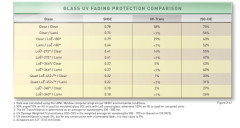
The last two numbers in the Cardinal LoE name is the percentage amount of visible light passed by the coating. Note that the darker the coating, the more effective at limiting fading potential.Keen B thanked oberon476  PRO2 years ago
Impact glass typically has laminated glass as part of the formulation so that would block nearly ALL of the UV spectrum.
What is not being discussed is whether or not the visible spectrum creates any of this yellowing effect.
Just as has been noted before, blocking 100% of the UVA/UVB rays will not keep wood floors from fading to some measure. The VISIBLE spectrum has a definitive contingent of fading potential built into it.Keen B thanked Windows on Washington Ltd- 2 years ago
I had white quartz counter tops with low E windows - essentially floor to ceiling glass along one side of the house, including kitchen. My walnut cabinets faded badly but I never noticed my white quartz yellow in the 10+ years I had the counters. I replaced the quartz recently with white matte porcelain to match the rest of the house.
Keen B thanked rockybird  PRO2 years ago
The sun is a beast.
Everything including paint starts fading day 1 but you may not notice.
Low E helps slow it down.
One more item to list on my "engineered quartz" page
Keen B thanked Jeffrey R. Grenz, General Contractor- PRO2 years ago
The UV is the main culprit in resin degradation, not the visible light spectrum. If you have large windows that are safety glass, you will likely be fine for 50+ years for your name quartz not yellowing. The other aspect to this though, is the quality of the resin. That's just one reason to source your quartz from a reputable name brand manufacturer. The lower quality materials sourced from Vietnam, China, or India, do not have the same type of quality control that does a company who has made it for 30 years will have. The quality of the raw materials matters to the end result, and the end wear and durability.
Keen B thanked DeWayne Keen B
Original Author2 years agolast modified: 2 years ago@Jeffrey R Grenz and @rockybird and @dewayne Oddly, one of the major slab yards/fabricators in the area where I'm building (They have sites throughout the Southeast) actually store much of their white quartz out in the stone yard with the hot FLA sun beating down. I can literally see what you are saying, and I don't notice yellowing. Still, the ones I see out there are patterned, not pure white.
@rockybird I considered the porcelain, too, since it has a reputation for its heat and scratch proofing, but in my build area where you cannot get a slab without a fabricator pricing it, the fabricators are overly wary of it and keep turning me down, or pricing it much higher than anything else. One place wanted me to sign a waiver in case it broke on their timeclock (before it was installed.) And the local big box store that carries Cosentino's product hides the samples. The salespersons were reluctant to even let me look at them and said all their fabricators refuse to work with it. It put me off, Are you pleased with yours? What product?
- 2 years ago
Sorry! I missed your comment. I'm not sure which porcelain counters I have. I think they are the more common brand. I know they are expensive! I'm sorry you have trouble finding sales people to endorse them. I absolutely love them. I love the matte white finish. The store I bought them from sells to very high end clients and they told me porcelain is what everyone is using now in those homes.




millworkman