Software
Houzz Logo Print
rewindtech

Any zone 6 Crape Myrtles?

I went to the outer banks this summer and was amazed by the beautiful crape Myrtle’s that were there. I was wondering if there was a crape Myrtle variety that can survive in zone 6 if planted in the right place? It rarely gets to -10F here.

Comments (17)

  • 3 years ago

    In the right location there are some that will survive and even bloom well. But they will never grow into a tree-like form nor even be very shrubby, acting instead as dieback perennials. If you can live with that.

  • 3 years ago

    I might try dynamite as a tree form one, last year it got to -7 but that was only because it was a bad winter storm. Besides that it really only gets to like -2 at most

  • 3 years ago

    Certain varieties may well be root hardy in zone 6 but they will experience top growth dieback. There is a big difference. They will not be "trees" :-)


  • 3 years ago

    I will try to have them as a tree, I’ve seen other people in my state say that they have had them as trees for years and they’ve never died back

  • 3 years ago

    I have four which are perennials including a dynamite that goes back to at least Obama's first term.


    Initially I had it planted down low in the yard. One year I decided to move it up by the house. I should have bought a new one it was soo much work even involving my neighbor's truck. The thing survived though and I saved $20 on a new one

  • 3 years ago
    last modified: 3 years ago

    Not sure where 6a/MW is located. The numerous hybrid Crepes are probably safer in a marginal climate than a pure "indica', which I do believe Dynamite is. Simple rule of thumb is those that are named after a native American group, are hybrids, and better for the colder areas (Zuni, Hopi, Catalba, etc.). Under Zone 6b I would say, Crepes have more issues, and Zone 7 and above are zones were may varieties WILL WANT to become TREES!


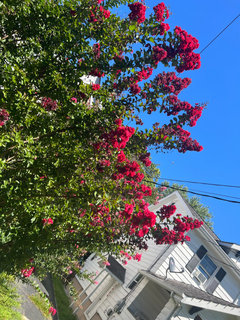
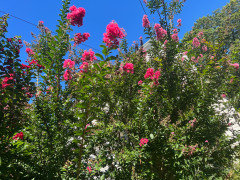
    Dynamite Reds are in the front and Hopi in the back. Last several years, my Crepes have been more affected by HIGH summer humidity than winter cold, and I do believe the hybrids are more resistant to incessantly high humidity. More pure indica Dynamites, much as I LOVE them, always suffer more from the summer humidity (with white powdery mildews) compared to any of the hybrids.

  • 3 years ago

    NE Ohio

  • 3 years ago
    last modified: 3 years ago

    They all need HIGH HEAT and FULL SUN, air circulation helps big time with the humidity issues. I LOVE them, mine will be blooming through October near the house. Of the hybrids, I particularly love HOPI, for the medium pink blossoms. In colder zones, they will just die back more, in milder zones, they will only get bigger and more treelike and not be the shrub you envisioned. For me, it's always a challenge to keep them in check..., many wanna be trees. They are pretty hard to get rid of actually. Years ago, I had a Hopi that developed a frost crack on the south side of a weirdly WARM February, that alternated with frost. It died back to the ground, now is a small TREE again. Around me, NJ/Zone 7, they are mostly available in nurseries from May into July. Give them a try.

  • 3 years ago

    I just want it to get at least 6 feet tall and be a tree

  • 3 years ago
    last modified: 3 years ago

    Here in middle z6 out in the sticks, my CMs usually die mostly or entirely to the ground -- Natchez seems the hardiest. Strangely, nearby, higher up on a hill, there are CMs much larger. Go figure. Bigger ones in a nearby city, too (urban heat island). It's at a point that I may remove them for poor performance -- the flowers hardly attract any insects except Japanese beetles.

  • 3 years ago

    We are supposed to be in 6a but it is usually much more mild

  • 3 years ago
    last modified: 3 years ago

    Given any of the more cold-resistant varieties and good siting, it's certainly possible to have large woody shrubs and crepe myrtle trees in zone 6.

    In my zone 6b neighborhood alone there's a 30-foot white-flowered crepe myrtle tree (Acoma?) that's obviously survived at least one winter low down near -20F. In Lexington KY (about 20 miles to the northwest) there are many long-term survivors that have achieved impressive size.

    I have 20+ crepe myrtles, all recently planted. Several proved wood-hardy through last winter's plunge to -9F and should be even more cold-tolerant in the future. Since crepes bloom on new growth, even plants that experience winter die-back put on a fine show the following summer.

    Not all zone 6 climates are alike of course - ample summer heat tends to allow for buildup of nutrient reserves which may increase winter hardiness.

  • 3 years ago

    Part of the problem on my lot is that quite a few branches come thru the winter, and buds break out, then a hard freeze happens and not only the new greenery dies, but most of or the entire living branch dies too.

  • 3 years ago

    Beng, living near a coast has its advantages, my Spring warmth is delayed by the cold ocean, so March can mild but usually the warmth does not start until April or May and by then, deadly frosts become more uncommon. Yeah, alternating COLD and warm is not helpful, in the Spring it causes the kind of damage you observe, in the winter, it leads to sunscald and frost cracks on trees, especially those south-facing. My Crepes have gotten too big, and I have not pruned them back the last year and now they wanna be trees. I do love them, but they need space for people who thought they were planting bushes and not trees. Incredibly resilient, one of mine recuperated fully from total top dead due to a frost crack. Plus, mine are now self-propagating from seed. The bigger problem seems to be getting rid of them!

  • 3 years ago
    last modified: 3 years ago


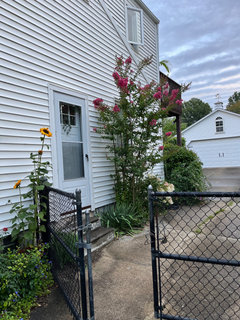
    I live in NE Ohio and my crepe myrtle survived that below zero weather last Christmas! It is planted close to the house, facing south. it is very tall for Ohio!

  • 3 years ago

    Henry, don't let the doubters try to convince you of the lack of hardy crape myrtle cultivars. A number of cultivars (as some of the posts above indicate) should do fine in your location. I've seen multiple different ones come through exceptionally cold winters for my area with no or minimal damage. If you do some Google searching, you'll find many cultivars listed as hardy (without dieback) for zone 6.