Software
Houzz Logo Print
jason_carlton26

Gifted two orchids, now what?

I was gifted two orchids yesterday, and now I don't know what to do with them! LOL


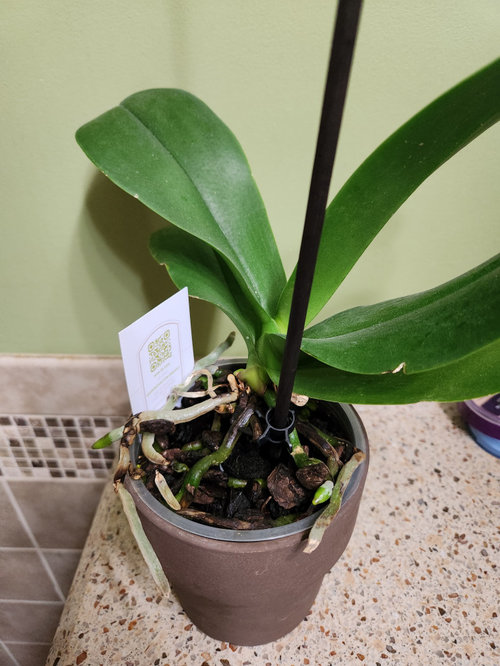
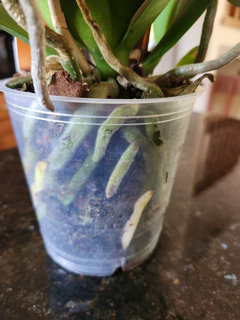
This is a pic of one, but they both look about the same:


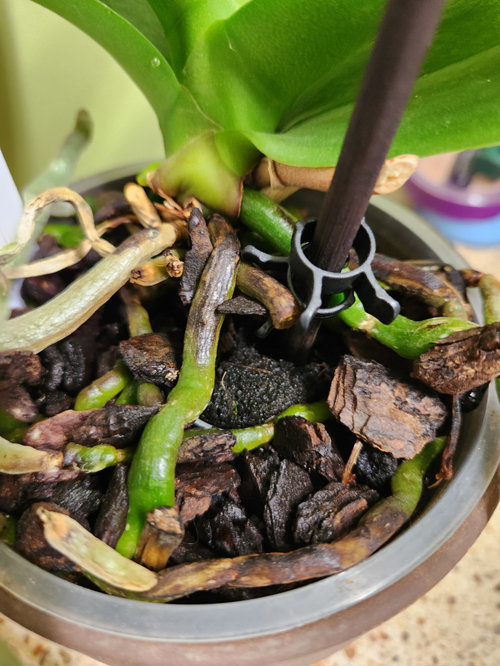
You can see that the roots are way out of the pot:


Should I repot them, or do they prefer being rootbound?


If I need to repot them, can you recommend a pot size and anything regarding the potting soil?

Comments (10)

  • 2 years ago

    Jason, First things first, It sounds and looks like you have been gifted with two nice healthy Phalaenopsis orchid plants. It appears from your photos that the plants are planted in a slotted clear plastic liner, which has been placed inside a hard plastic or perhaps ceramic outer "liner" pot. The outer pot is placed there for several reasons, one is to protect the plant's roots in shipment, and the second is (and I'm being a bit facetious here) to generate more orchid plant sales. Most of these outer sleeves have no drainage holes in them, and more often than not, you will find them on the store shelves about half full of water. When the roots of an orchid plant sit in water for an extended period of time (say a week or so) you most often have a dead plant on your hands. It will probably take a few weeks for it to "tell" you its in trouble, and it will first exhibit signs of lack of water, because its roots have rotted away and it no longer has a way to transport water into the plant. When most new orchid growers loose a plant, it seems to trigger something inside them that says "I can do this", so they go out and purchase another plant and try again. So, if that outer liner does not have a drainage hole in it, get the plant out of it and closely examine the plant's roots for signs of root rot. Black mushy rotted roots is what you do not want to find inside that inner clear pot.

    If you find turgid, healthy roots in the pot you are in good shape, and there is no hurry to proceed further. If you do find root rot in the pot, un-pot the plant, and with a clean sterile blade, cut away all the rotted roots back to living tissue and set the plant out so it can dry off.

    Either way, take photos of both plants, and post them here so we can see what is going on, and I'm sure that me or someone (probably a number of 'someones') will jump in here with suggestions and help for you.

    Good luck Billsc

  • 2 years ago

    It appears from your photos that the plants are planted in a slotted clear plastic liner, which has been placed inside a hard plastic or perhaps ceramic outer "liner" pot.


    @Billsc, you're exactly right on that! The plastic liner had legs, though, so while there was water in the bottom of the clay-ish pot, the roots weren't sitting in it.


    Either way, take photos of both plants, and post them here so we can see what is going on, and I'm sure that me or someone (probably a number of 'someones') will jump in here with suggestions and help for you.


    You were right, too, that the outer pots had no drainage holes. But I don't see any obvious root rot, so I think I'm good on that point.


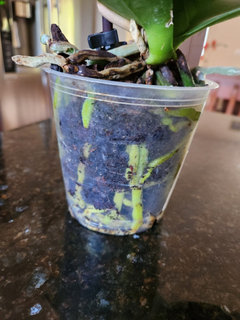
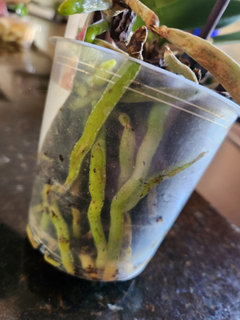
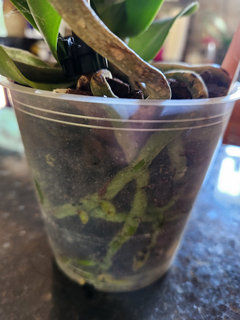
    Here are pics of one, from opposite sides of the clear liner:


    And here's the other one:


    You can see that the roots have far outgrown the pot! If I should repot them, can you recommend a pot size? And is there a special type of orchid soil I should buy?

  • 2 years ago

    I wouldn't say the roots have far outgrown the pots, but it is time to think about repotting. Now, this may be a bit difficult. I suggest you repot the plants in a fir bark orchid mix, but finding the correct mix has become more difficult lately. First off, you need Fir bark, not a pine bark mix. It seems that a lot of the companies that are putting out orchid bark mixes today are using composted pine bark because it is much cheaper, and easier to get. On the packages they just call it orchid mix, or maybe "orchid bark mix". The packages are usually not transparent, so you can't see whats inside, and most of the places selling it don't know either. If you can find a nursery (as opposed to a big box retailer) that is selling orchids and orchid bark mix, they may be able to tell you what their mix is made of, or allow you to peek inside one of their packages. Fir bark comes in light brown "nuggets", not dark dark brown flakes. Orchid bark mix is sold dry, and the pine bark mixes are usually very damp to down right wet. In addition to the fir bark, the mix should contain a bit of peat moss clumps, charcoal pieces and course perlite, and be dry in the container.

    I would suggest a clay orchid pot. That is a pot with a drain hole in the bottom, and three or four slits in the side. Probably about a 6 inch size. size is gong to be an eyeball guess, and if you get one a bit too large, it won't be bad. Just try not go get a pot that is too small to comfortably hold those roots after they are fluffed up. If you can't find an orchid pot with the slits in the side, an azalea pot will work. The azalea pot is one that is larger in diameter than it is tall..the squatty pots. When you get all this assembled, post again. In the meantime, water your plants when they get dry, and watering means soaking them. Let them drip dry and put them back in their liners if you want to, and don't water again until they are dry again. Make sure none of the roots are ever sitting in water. No direct hot sunlight, but reasonably bright light.

    Jason, zone 7A, near Greensboro NC thanked Billsc
  • 2 years ago

    It is normal for roots to grow outside the pot. It is time to think about repotting, but I would not recommend clay because it dries out too quickly. If you use it, soak your pot in water overnight first. You can use sphagnum moss or a bark mix for your medium. i would not recommend an azaelea pot for a Phalaenopsis. It will be top heavy and tip over when the flower spikes form. It is recommended going up one size when repotting. That plant is currently in a 2 inch pot, so 4 inches maximum or the roots will rot.

  • 2 years ago

    Those are the types of pots I use too but I don’t have decorative pots. My care routine is almost identical to yours. i have north and south windows but it’s too hot and bright on the south side so I’m experimenting with the north side and added a grow light to supplement the natural light. If north windows work for you, hopefully it will work for me as well. I’ve been doing this for a few years and have about a dozen plants, most of them are in flower or bud at the current time.

  • 2 years ago
    last modified: 2 years ago

    I agree with Jean about the aerial roots. In nature, Phals grow on trees with the roots clinging to the bark, and others reaching out for air and moisture. The roots growing out of the OP's pot does not mean the orchid has outgrown the pot, and shouldn't be buried in the medium when repotting. I water my orchids when the roots look white and the plant feels very light, using distilled water or rainwater with a small amount of orchid food added. Now, it seems using tap water is okay, but I still hesitate to use it.

  • 2 years ago

    Jason, I've read all these posts, and I see nothing from anyone that I would call inaccurate or false information. every person posting here is an orchid grower, and appears to be doing a very good job with their plants. They are all giving you good information, so I would give you one word of caution. Good information is great, it's the way you interpret and use that information that will get you in trouble, if you don't apply it with a goodly dose of common sense. I suggest, at this point in your orchid growing experience you might want to get a book or two on basic orchid culture - especially Phalaenopsis orchid culture - and do some studying. I suggest the American Orchid Society as a starting point.

    Phalaenopsis (and many other) orchids are epiphytes. That means they attach themselves to objects like tree limbs and trunks, and rocks. They do this for support, and as a mechanism to obtain food and water. Epiphytic orchids have roots, aerial roots, and That's it. That's how they attach themselves to things, and transport food and water into the main part of the plant. When aerial roots are growing among the damp lichens and mosses on their hosts, they are a bright green. When aerial roots happen to grow off of a limb, or rock, and hang down in the air, dry air and/or sunlight will burn the outer covering of the roots and they will turn gray, brown, or even black. When these dark roots get rained on, they too will turn a rusty gray green color while they are wet.

    Be careful trying to automatically pot your plants up one pot size. Let's assume you have a Phal that is in bloom, and badly needs to be repotted. If you wait until after it is finished blooming, you may find it is simply impossible to get it into a pot one size larger. I have a Phal that stayed in bloom for more than 2 years, and when I finally bit the bullet, cut all the bloom spikes off it, and repotted it, it came out of a six inch pot, and the only way I could get it into an eight inch pot was to bury half the roots in the bark mix, and let the remaining roots just sit on top of the pot. Today, some of those roots are growing almost straight up into the air. I preach common sense a lot when it comes to growing plants. In nature there are few hard rules. You find plants violating their basic "culture rules" frequently. And as for those little people who run around in the jungles putting three ice cubes in the orchid pots every week..... The premise is good, (don't over water your orchids), but I wonder where they keep all the ice makers? ;-) keep up the good work. Bill

  • 2 years ago

    I suppose that going up more than one size might depond on the potting medium, how of you repot, and whether or not you have a heavy hand with the watering can. If it’s moss and you overwater, you are probably going to have problems with root rot. Conventional wisdom says to only increase one pot size, two at the most because they enjoy tight spaces. You are right about being careful about how you interpret information, and there is also a lot of trial and error involved. I enjoyed your ice cube comment. There is actually a community that advocates soaking the roots in hydrogen peroxide when repotting, then people come back a couple of days later wondering why their orchid died.

  • 2 years ago

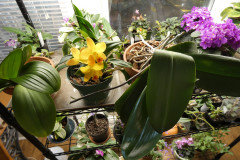
    Colleen, Sounds like we think alike. I wonder who has the hydrogen peroxide concession in the South American Jungles? I'm going to point this post back at Jason, because its a continuation of my last post. I got called to lunch, and forgot the last part of my post....I'm attaching a photo of part of my light stand with three of my orchids. The orchid on the right is the one I can't keep from blooming. You see the last bloom spike at the lower left of the yellow Cattleya. It is already throwing a branch getting ready to start blooming again. I buried half the root ball, but had to leave the top of it exposed, and the roots are just going crazy looking for something to attach to. The yellow Cattleya has a story also. I retired from USN and came here to take a job with a local large orchid nursery. Our breeder had purchased a block of this cross with hopes he could use one of the plants in a breeding project he was working on. This little guy bloomed, and the blooms did not meet the breeder's criteria, and it got pushed under the bench somehow. It was literally on its last leg when it was discovered and brought up to the main office to be thrown out in the trash. It was in pitiful shape, but I asked for it and took it home. It just dropped two blooms, now has three more, and there are two more new pseudobulbs getting ready to bloom. I love the little yellow blooms with their red lips. Bill


Sponsored
Kuhns Contracting, Inc.
Average rating: 5 out of 5 stars26 Reviews
Central Ohio's Trusted Home Remodeler Specializing in Kitchens & Baths