Software
Houzz Logo Print
ontario_canada5a_usda4b

Staking Rule of Thumb

2 years ago
last modified: 2 years ago

A generally accepted rule of thumb for staking a newly planted, young tree appears to be tying it loosely to a stake for a year (assuming normal upright growth habit, not talking about snake like growth habits and the like)

Anyone wants to elaborate on the rule of thumb?

What tests do you do to keep it on the stake for longer than a year?

What tests do you do before untying it from the stake?

Comments (12)

  • 2 years ago

    trees are meant to blow in the wind.. theres a song about it.. lol .. oh wait.. thats the answer blowing in the wind ...


    trees ROOTs are not supposed to move in the ground due to said wind ..


    so the goal is to stabilize the root mass long enough so the transplant can grow some roots.. to hold the tree above ..


    if you start small.. it shouldnt and wont be much of an issue... the problems are greater when the tree is e.g. 6 foot tall and you have a 18 inch to 2 foot ball and burlap... frankly.. you are relying on prayer at that point.. so you have to stake it up ..


    stakes need to remain as long as you think it will take to grow the roots its needs.. again.. a smaller tree should be set after one year.. the huge one.. who knows...


    it is also highly dependent on the soil type.. in my sand.. i barely needed stakes.. but again.. i bought cheap and small.. so i could buy more ... and as always.. clay is its own nightmare... but you should not amend the planting cauldron.. but that is a different show....


    ken

  • 2 years ago
    last modified: 2 years ago

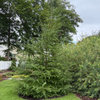
    Here's a picture of a 7' sugar maple I planted in late summer of 2017.

    In the beginning of June 2018, a gusty thunderstorm wind tipped it in the ground, snapping a couple of the slender new roots.

    By no means is this tied lightly. There is quite a bit of tension of the nylon ties. But the nylon is stretchable, so it gives (a couple/few inches) when the wind is blowing but will only give so far.


    The top of the tree never did do any flopping, so the intention for this staking was to keep the root ball from moving/tipping under high winds until more rooting developed.

    The staking is fairly low on the trunk so the top could bend and sway at will.

    iirc: I left this on the trunk only for the one season and removed it once the leaves fell (possibly the next spring). The root ball was clay soil placed in a silty sandy loam soil, so it didn't take long for the tree to root solid.

    eta: The material in nylon stockings will not cut into the trunk so is good for this application.

    Beware of using wire, hard plastic or other material that may cut into the bark over the season and into the next.

  • 2 years ago

    Bill, your posting makes me wonder what grows their roots faster, conifers or deciduous trees.

  • 2 years ago

    Which ones are you comparing? e.g., Sequoia gigantea with Acer spicatum? ;-)

  • 2 years ago
    last modified: 2 years ago

    LOL, comparing trees of the same size of course, your deciduous tree recovered so fast.

  • 2 years ago

    ' your deciduous tree recovered so fast. '


    Not really. It was planted summer of '17 so it had a few months to elongate roots the rest of the season. Then in the spring of '18, new roots began and grew some until the wind tipped the tree just a bit.


    I don't think it was ever completely dislodged from the ground and only the one side that was lifted had any root damage and if so, not all that much.

    I just pressed the lifted side down an inch or two just using my weight, then staked it.


    In my soft, porous soil, the major mass of the root system was disturbed very little and continued growing on for the rest of the season.


    I just checked my old pictures and don't see the stakes on the tree past 8-21-18.

    But we don't get strong storms all that much and I may have put stakes back on if a storm was forecast.


    Staking methods will involve whether it's bare root, potted, b&b and as ken alluded to size of the tree, soil type, etc. etc.


    As far as how fast roots grow, it's probably associated with how fast of a growing tree it is in the first place. :-)


  • 2 years ago

    I've rarely had to stake trees. The two I did were an overly tall 10 gallon Firefall maple and some quaking aspens.

  • 2 years ago

    I've never staked a tree in my life. But I have done a lot of unstaking :-)

    I believe it is done far too often, frequently when unnecessary, and done incorrectly and left in place too long.

  • 2 years ago

    This is a comprehensive guide to staking trees from the RHS: https://www.rhs.org.uk/plants/types/trees/how-to-stake-a-tree


    Note that the recommendations are for very short stakes designed to stop the roots moving, not the trunk, mostly to be used in windy situations and not intended to be permanent.

  • 2 years ago
    last modified: 2 years ago

    I'll have to admit. I've only done staking when necessary and only for as long as it was needed.

  • 2 years ago
    last modified: 2 years ago

    I don't stake my young trees from wind. I make a wrap with garden stakes and saran wrap. lol It's cheap and extremely effective. I do this for the first 5yrs after planting, then i remove it. This way my trees still get wind and they still move around, but they won't be molded into a bent tree, or worse, decapitated, which ive had happen. Ive had comments from people walking by my house saying they love this idea. I think it looks adorable. :)


  • 2 years ago

    Location can determine whether of not you want to stake.

    In the eastern half of the US, where severe thunderstorms occur, not only are there high winds, but there are also strong gusty winds that will switch directions suddenly. Such winds many times hit in smaller areas but will do extreme damage on a small scale.

    I think that's the kind of wind that hit my sugar maple.

    70 mph hitting the tree from the south and in a nano second, 70 mph hitting the same tree from the northwest. These types of wind can do more damage than straight line winds often equaling tornadic activity.

    https://www.weather.gov/Thunderstorm_Winds_Explained.pdf