Software
Houzz Logo Print
westes

Ideal Soil Mix for Italian Cypress?

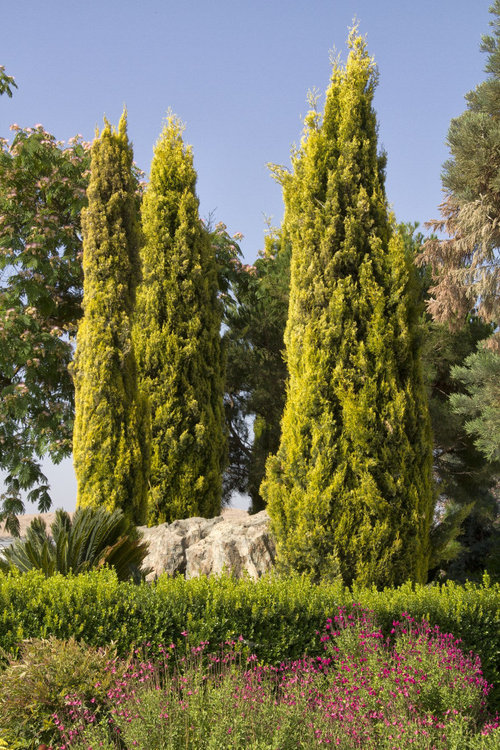
I have some Swane's Golden Italian Cypress, which is a yellowish variety of the standard Cupressus sempervirens. These will start off in a raised bed so I can create an ideal soil mix. The raised bed is on top of a clay loam soil (San Francisco Bay Area zone 9b). Would a bark-based soil mix work well?

I buy a mix from Ciardella's Garden Supply in Palo Alto named Ciardella's Mix. It's somewhat comparable to the 5-1-1 mix by @tapla (mid-Michigan, USDA z5b-6a). This is a very well-drained soil, highly organic, and has good structure. I have found most container plants thrive in it, and I have a few raised beds with this as the soil layer over clay loam, and the plants in those beds have thrived. I realize that some do not like to create layers of soil and prefer to just use the normal clay loam as the raised bed soil. The mix I am using is not expensive by the cubic yard and money should not be a reason to reject it. Is there any reason to reject using this as a raised bed soil mix for Italian Cypress?


Comments (13)

  • 2 years ago

    These will start off in a raised bed


    ==>> sorry if i missed it.. but where will they finish?

    westes Zone 9b California SF Bay thanked ken_adrian Adrian MI cold Z5
  • 2 years ago

    @tapla (mid-Michigan, USDA z5b-6a) I find that a good wood bark mulch on top of raised bed soil very dramatically improves water retention even in the summer sun. The mulch buffers the summer heat and the top of my soil layer under the mulch stays nice and moist with minimal regular water.

  • 2 years ago

    @ken_adrian Adrian MI cold Z5 What I meant is that the roots will start out life in an oxygen rich well-draining bark soil, and as they mature the roots will sink down into clay loam under the raised bed.

  • 2 years ago

    "I find that a good wood bark mulch on top of raised bed soil very dramatically improves water retention even in the summer sun." Apples/oranges. Using mulch shades the native mineral soil, keeps the top few inches of the soil cooler, and slows air movement across the top of the soil which reduces evaporation. That's one of the primary purposes of mulch; however, you'll find water retention to be exceedingly poor in the mulch layer. In the same vein, using the 5:1:1 mix e.g., as the actual substrate forces you to depend on it for water retention, which will be very poor in a RB.


    You've often read complaints that the 5:1:1 mix "doesn't hold enough water, Typically that's because the bark used was too large or the grower was comparing it to other media they were accustomed to, and which provided watering intervals (in containers) measured in weeks as opposed to 2 or 3 days. Keep in mind that something like the 5:1:1 mix used as a the actual substrate will hold absolutely no perched water and will dry VERY quickly due to it's high air porosity.


    If you are only going to use the substrate you use to give the trees a healthy start. It might make more sense to cleanly cut the bottom out of a nursery can, fill it with regular potting soil + some Turface fines such that your trees root flare is above existing grade and call it good. in the spring following ('25), when the trees start pushing, simply remove the pot and leave the tree to its own devices. No RB necessary and no outlay for the grow medium.


    The medium you see in my hand (image up-thread) would be far more water-retentive in a pot than the 5:1;1 mix, yet as I mentioned, I wouldn't do it again if I had a do over because it requires such frequent watering - everyday it doesn't rain from mid-Jun through mid-Sep. Best luck.


    Al

    westes Zone 9b California SF Bay thanked tapla (mid-Michigan, USDA z5b-6a)
  • 2 years ago

    @tapla (mid-Michigan, USDA z5b-6a) What kind of soil do you have there locally? Here we have clay loam, and one point I would make is that if I made my raised bed have 80% clay loam, it would compact as hard as rock. Part of the reason I like raised beds is that it gives me a chance to build a structured soil that is highly friable to the touch and easily passes oxygen to the growing roots. Once the roots establish lower then can grab nutrition from the clay while still benefiting from the higher oxygen levels in the raised bed soil. I don't know if trees will respond positively to that, but certainly my climbing vines like Clematis love to establish that way.

  • 2 years ago

    Are you sure the plants are actually rooting into the soil? In a similar situation here, I've found that plant roots hit the interface and stop cold. So with a tall plant, I'd be concerned that it is likely to windthrow due to inadequate anchoring.

    westes Zone 9b California SF Bay thanked mad_gallica (z5 Eastern NY)
  • 2 years ago

    Typically, I suggest mixes like the gritty and 5:1:1 mixes because they work so well for conventional container culture, though you do need to water a highly aerated, fast-draining medium more often than most packaged media based on all or as very large fraction of fine ingredients. But neither is appropriate in raised beds unless you might be growing plants that tolerate extremely dry soil or you are committed to keeping the top layer of soil moist no matter what it takes.


    What will occur with the rapid drying down of a soil like the 5:1:1 mix as the top strata of your soil column: The highly organic mix in the beds will dry down VERY quickly. This exposure to dry conditions will kill off the fine roots growing in the organic layer - just like low oxygen levels in saturated soils kill fine roots. The plant will then be forced to grow new (fine) roots when the top layer of your soil column is watered, only to die as well. You're familiar with the toll the cyclic death/regeneration of fine roots takes. Soon, when roots start growing into the lower clay portion of the soil column, roots within the top strata will lignify and serve only as plumbing and anchorage. This essentially turns the top layer of organic material into mulch.


    Example:

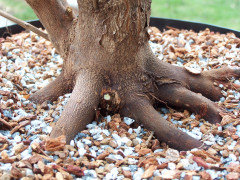
    This plant was potted the day it was lifted from the RBs I use to grow on potential bonsai material. It was grown in the soil you see in my hand upthread. The roots you see were buried, and though I was VERY careful about not allowing the soil to dry down too much, note how lignified they are. There were very few fine roots attached to the heavy roots growing in the organic medium at the top of the soil column.


    I know this to be true because I've lifted more than 100 trees from these raised beds to train as bonsai. I've also grown tomatoes, peppers, bush cukes, several herbs, and sundry other plants in these beds.


    Clematis, as you know, like their roots in the shade and their foliage in the sun, so any form of organic mulch covering their roots is going to be a plus on several fronts - shade/cooler soil, better water retention due to reduced evaporation, and the plant benefits from the breakdown of the organic materials at the interface between the mineral soil below and the organic layer above.


    You're call. I know you know enough to be able to adjust to whatever occurs. I'm just trying to save you a bit of frustration.


    Al

    westes Zone 9b California SF Bay thanked tapla (mid-Michigan, USDA z5b-6a)
  • 2 years ago

    @mad_gallica (z5 Eastern NY) What species of trees did you plant in a raised bed that refused to root into the soil under the bed? I guess this will be genera/species specific and I don't have a vast experience to know which plants are reluctant to root deeply. That said, conifers start out life in an organic layer on the forest floor, and they root down into sandy loam below that layer. So you would hope that this division of plants has the genes to understand that they need to seek out real soil down deeper.

  • 2 years ago

    @tapla (mid-Michigan, USDA z5b-6a) I have confidence that I can keep the raised bed soil moist, especially if I have a thick mulch layer on top of it, but I still take your point on drying seriously. Interestingly, I have this raised bed setup working amazingly well with Clematis that get partial sun during the day but not nearly as well in exposures that get full sun.

    If you wanted to try to remediate such a planting that had - for example - 5:1:1 mix in the raised bed, would you just mix smaller particles into the mix, maybe sand? And if that did not keep the raised bed mix sufficiently hydrated, then maybe mix in some clay loam?

  • 2 years ago

    Conifers spread their roots on the surface vs having a tap root.

    westes Zone 9b California SF Bay thanked A Mat
  • 2 years ago

    @A Mat Italian Cypress do have a small taproot, going down about three feet. But that might make an argument that I should not make the raised bed go too high.

  • 2 years ago
    last modified: 2 years ago

    @A Mat Plants aren't genetically obligated to produce roots in any given strata of soil. As long as there is an appropriate volume of air, water, and nutrients in the soil, roots will grow regardless of the depth of the soil column. Growers should also understand that roots do not go 'searching for resources. When conditions are favorable where roots are currently growing, they will continue to grow there. If conditions are not favorable, they stop growing where resources are unfavorably scarce and change directions following favorable conditions. They will not grow through an unfavorable area of the soil column to reach a more favorable area.

    To amend a RB medium with an overly high % of OM, I'd probably use a combination of one of the Turface products finer than MVP/Allsport, and a few bags of reed/sedge peat, which has quite a bit of silt in it. Fine play sand would work too, but wouldn't hold as much water as the Turface.

    Al

    westes Zone 9b California SF Bay thanked tapla (mid-Michigan, USDA z5b-6a)