Software
Houzz Logo Print
rewindtech

Has anyone had experience with cold hardy palms in zone 6?

I have been looking at Sabal Minor “mccurtain” and rhapidophyllum hystrix, has anyone had experience with these suffering below -5?

Comments (12)

  • 2 years ago

    I live about 2 hours from Pittsburgh, not a giant difference except winters are slightly warmer from Lake Erie

  • 2 years ago
    last modified: 2 years ago

    They will 'suffer' at temps below zero, but unless it's a very prolonged cold spell, the plants should still be able to survive. Of course, low temperature is only one factor in damage or survival of palms. Duration of the cold spell, number of daytime highs below freezing, depth of soil frost, exposure to desiccating winds, etc. all play a role. They may defoliate or have bad cosmetic damage, but if the ground does not stay frozen for a long time, the underground meristem should remain alive and the plant should survive.

  • 2 years ago

    You're looking at temperature but have you also considered soil type?

  • 2 years ago

    We have clay soil or rocky soil that can range from dry to wet

  • 2 years ago

    We had 2 cold spells at night last year that went below zero on December 23rd and 24th

  • 2 years ago

    I have a few Mccurtain seedlings which did well enough their first year, but I lost a few the second even having them in a coldframe both winters. We usually drop to or just below zero, but for the last two years it hasn't been for anything close to an extended time.

    Last winter we had a brutal drop from near 50F to -2F and I think this might have been too much for a few of the seedlings (even in the coldframe) but I like to tell myself that only the most hardy survived and now I'm better off?

    I worry about planting them out. Hopefully a bigger plant will have more of a chance, so maybe in another year Ill try? But right now I have my doubts.

    A mouse trap is set for tonight. My germinating needle palm seeds in the garage were eaten last week and someone has to pay. Obviously there wont be a hardiness report on them anytime soon but I suspect they won't have a problem in this zone.

  • 2 years ago

    the palm in the pix above.. is in a very tight micro climate due to the conifer hedges ... one might suspect there is little winter winds to desiccate the foliage ... and that is the keys to leaf damage ...


    what is the ridiculous 15 foot tenting in the last pic.. lol... looks like something i would have tried back it he day.. lol ... i would worry about heat accumulation on sunny winter days... is that the palm??? if so... then they are/were concerned with winter winds...


    ken

  • 2 years ago
    last modified: 2 years ago

    Generally, palms are not sustainable below a zone 7a/b climate (at a minimum). Sabals are probably the best to experiement with, but you need a LONG, subtropical summer for these (growing season of 200 days or longer). I personally do not like needle palms at all, I hate the needles, and they are slow to establish. My favorites are Japanese fans (Trachycarpus), but these can have issues with winter cold and wet, so best to protect the palms from snow and rain. I am in zone 7a/b NJ and am a palm enthusiast big time. And even though my yard is filled with subtropical evergreen magnolias (M. grandiflora) that have begun to self sow, I have yet to keep a palm alive in the ground for repeated winters (without covering and lights). Climate is definitely warming, so maybe eventually.

  • 2 years ago

    Agree with 41 North. Sorry, but I think Needle palms are a very acquired taste. They just aren't very attractive in my opinion. But they are the hardiest, and don't require quite as long a growing season as Sabal. That's why they show up in places like coastal MA.


  • 2 years ago

    I have a three-year-old Sabal "Louisiana" grown from seed which survived last December's blast down to -9F with no damage, protected only by straw mulch and a large pot covering it. I planted two more seedling-grown plants this past spring.


    There's plenty of discussion on growing and protecting palms and palmettos in zone 6 (and in even colder zones) in this Facebook group:


    https://www.facebook.com/groups/zonepushers


    The group features gardeners who construct frames and tents with supplemental heating sources for their hardy palms. It includes a gardener in N.Y.'s Hudson Valley and the Pittsburgh grower whose garden is shown in the above photos. He'd probably be amused to hear his structure termed "ridiculous".


    I'm not about to go to those lengths to grow hardy palms (including getting up on a tall ladder every spring and late fall) and they're not necessary in all circumstances. But I salute those willing to make the effort,


  • 2 years ago
    last modified: 2 years ago

    I've had Sabal minor (Mccurtain and simply an Arkansas selection) at my (zone 6b/7a) houses for 23 years now. I've had defoliation a few times when the wind dried them out after ground froze (would recommend somewhere protected from prevailing winds), but in both houses (Oklahoma and now Arkansas), they have experienced up to -27F (polar vortex event) and passed through the other side. In both houses, maturity (ie berries) were produced.

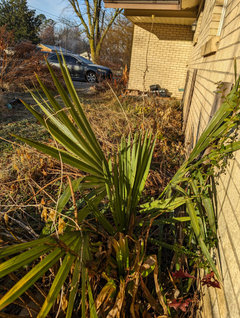
    I have a mature Arkansas one now and a small McCurtain seedling (4 years or so now). It should produce a mature leaf (upright and divided) this year. I would say that to reach the flowering stage took about six years (though I don't remember if that included a setback winter) in both places. We had a -17 last year, but it didn't really hurt it, but a year before that we had drying winds with frozen conditions...not that cold but blistering, killing essentially all the foliage. I took this photo two days ago. I provide no protection at all other than initial siting of the plant.


    I think they should be more used in landscapes. We have few evergreens native to my state at least.

    Oh, and I had a needle palm in Oklahoma and while I've been considering it, I am not currently growing one, and probably won't. It grew slower (took 4 years to really begin growing) and was initially more sensitive to winter damage, though more resistant when it got older. And yes, the spines were treacherous and seemed to be mostly invisible till impaled.

Sponsored
Haus Studio
Average rating: 4.8 out of 5 stars28 Reviews
Franklin County's Preferred Custom Cabinetry & Design Studio