Software
Houzz Logo Print
david_way80

Hood Depth Question

2 years ago

I have a 48” Wolf range and am doing a custom hood with a Wolf insert (PL521912). We are struggling a bit in determining hood depth and are hoping Kas can assist. We are planning to do a stainless frame around the insert so we can make the hood any dimension we want. We are going with a 58.5” width.

The range is 27” deep and the burners are 24” deep. I heard most hoods are 22-23” to avoid head banging, but I am concerned this will not provide proper ventelation coverage. I also heard the hood should completely cover the burners at a minimum. What do you recommend for a hood depth?

Thank you

Comments (10)

  • 2 years ago

    " First IMO no one needs a48" range "


    If they want a 48" range who are you to chastise them for it? I have seen you do this too many times between this and quartz tops.

  • 2 years ago

    Eh? KAS exclaims as he wipes hibernation residue from his eyes.

    Here are what I believe are the basics of capture. Assume that every point on a pan base (and some of the side area in the case of a wok) is an emitter of plume effluent. Effluent here being mainly grease, oil, and/or water. In the case of gas cooking, combustion products are also rising with the cooking plume, adding to the plume flow and somewhat to upward velocity.

    The effluent from this elemental emission point rises and diverges into a conical shape. Think ice cream cone with ice cream filling. The convolution of all these elemental cones yields a cone truncated at the pan base and extending to the hood. The velocity of the effluent "rays' composing the overall plume will be highest at the center dropping off with angle.

    The actual cone in free air will cover more angular space than the hood would cover, but the more extreme rays will be low velocity and easily entrained into the overall flow of air to the hood, assuming that the overall flow is sufficient for containment, not covered in this message.

    The hood has to directly capture the stronger part of the cone, and the relevant cone angle w.r.t. the vertical can be the better part of 10 degrees.* And this has to be performed for every likely pot or pan to be used on every burner.

    So, at a minimum, for a wall hood the hood capture boundary on three sides has to extend past the likely pan edges. With enough flow we can treat light bars and thick side edges as part of the capture area so long as they are outside the plume-divergence-angle-from-vertical boundary of the potential pan array. For a wall hood, the vertical wall surface acts acts as a reflector to the plume rays.

    So what does this mean, practically. Assume that the particular range-top has a pan outline of 48 inches by 24 inches (relative to the wall). If the hood capture plane at the base is at 36 inches above the pan bases, then the 6.5-degree angle (see footnote) implies 4.1 inches of plume growth on the three sides. This would require a hood entry area of 56 inches wide by 28 inches front-to-back -- slightly less at 30 inches high.

    What saves us from having to go that deep, particularly with side skirts, curtains, or even cabinets, is that with a wall the hood intake air velocity profile is tilted toward the cook, and this makes it possible to entrain some of the plume rays that would escape over the cook's head into the hood flow.

    I don't think any of us can do computational fluid dynamics (CFD) ex mente, so we have to go from experience. And that tells us that 24 inches front to back is likely to be sufficient, particularly if the most greasy odorous cooking is done on rear burners.

    Now for the bad news. This monologue was directed at conventional hoods with reasonably defined capture boundaries at the base. What happens with an insert, more or less flush with a flat surface as Wolf directs? Well, all rays that diverge away from vertical toward the cook that hit the flat surface will in principle reflect outward due to momentum conservation. The weaker ones will be dragged inward by the air flow, but note that at a boundary, the drop in air velocity tangential to the intake face falls rapidly, within mere inches.

    Wolf's deepest wall hood liner is 22-5/8 deep. If you want more plume overlap on the cook's side then the assembly may need to be spaced out from the wall. Flat plate at the back between liner and wall could reflect impinging plume rays downward where they would be entrained by the main flow.

    Choosing a higher actual air flow into the insert than my recommended 90 ft/min will help a bit in extending the effective capture area. If this velocity is met a few inches below the entire flat hood "base" then some front-to-back extension will have been achieved.

    My hope is that with perspective taken from this message, and in the context of your cooking style, you can weigh the possible construction options such that you feel you have done your best in making the insert work for you. As you can probably sense at this point, there is a performance trade-off with an insert over a standard canopy hood (typically available in larger sizes) unless you have a custom insert fabricated.

    Don't forget: Any type of hood that is combustible has to be protected on the side facing the flame.

    ZZZZZ

    _______

    *Thermal plumes of kitchen appliances: part 2 Cooking mode, Risto Kosonen, Hannu Koskela, Pekka Saarinen, Energy and Buildings, 2006, Issue 10.

    For gas cooking, the plume angle at 0.8m was found to be 7.8 degrees. This is the 1/e velocity value using a Gaussian approximation for the plume velocity shape. If containment flow at the capture area base is based on a 50% of peak plume velocity, then we need to correct the angle to be that at 50% of peak plume velocity. For a Gaussian distribution, that factor is 84% yielding about 6.5 degrees.

    The actual phenomena that occur may be envisioned by imagining that over the cooktop there is a gradually widening and slowing plume shape interacting with an inversely oriented hood intake velocity shape where successful capture interaction is defined as diverting plume ray momenta such that their vectors end up directed into the hood capture area. Further, the temperature of the plume rays is being affected by the cooler air pulled from the room (hopefully via MUA). Only CFD analysis can deal with this complex interaction. Arm waving around the details limits us to qualitative advice on hood requirements.

  • 2 years ago

    ”So????”

    Interesting a PRO would even have to ask.

  • PRO
    2 years ago
    last modified: 2 years ago

    God knows here, and everywhere else, I'm not one for mincing words or opinion.

    Regulars on this site know that truth, but they ALSO know I strongly believe as most of us do:.......

    Ninety nine percent of design is opinion, best use of a space, it is wishes, dreams, it is personal, and it is tailored to a client. We may have opinion of our own - our jobs are to enhance/embrace,and bring the best result to the likes and preferences of another.

    So? The relentless and dictatorial bash of quartz, of large pro ranges, of anything traditional or warm to include all lighting beyond 4000k. The loathing of plantation shutters, the favoring of solar screen shades whether appropriate to decor or not?

    I think we're begging here as to the "So???"

    What if we all entered your personal space, said..."Not loving this, this, this..."

  • 2 years ago

    Let me take a moment to take a stab at "why 'quartz.'"

    Once upon a time DuPont developed Corian. Corian is a plexiglass type resin loaded with aluminum oxide (sapphire) and some coloring. It is durable, cleanable to sterile level, easily worked. Careful application of heat can allow some permanent bending. It can also develop burn marks. Amateurs with carbide tools can work it like hardwood.* I finished my 2.5 baths with Corian, and the Manchester, NH airport lobby was built with seemingly acres of Corian.

    Corian is, however, somewhat plain, and far from the look that can be achieved by polished granites quarried from various places around the world. So in an attempt to fill the 'gap' between Corian and granite, 'quartz' was developed, using resin and larger stones. One can argue it provides some advantages of both Corian and granite, and also argue that it provides some disadvantages.

    As a kitchen counter, granite is far more heat resistant than 'quartz,' but in some cases susceptible to staining if porosity is not fully blocked and is also susceptible to chipping. Very hot pans can cause internal moisture to spall stone, so there is that slight risk. Fabrication is a job for pros.

    Soapstone is inherently safe against heat, but softer and thus more susceptible to scratching and chipping. Dark is the usual color, but inclusions can make it attractive. DIY fabrication or modification is possible, but probably not generally desirable.

    So while 'quartz' can bring the granite look into a kitchen, there is a heat damage risk. In my view, 'quartz' should not be used as a countertop anywhere an accidental or uninformed placement of a hot pan can occur, or on walls behind ranges or gas cooktops in island trim.

    ______________

    *At some point after ca. 1990 DuPont went out of their way to block amateur acquisition of Corian sheet and bonding cements and adhesives. I don't know its present availability status.

  • 2 years ago

    Thank you for taking the time to provide such a detailed answer to my question Kas. It is much appreciated an I have a better understanding of how to proceed with the custom hood now.
    Cheers.

  • 2 years ago
    last modified: 2 years ago

    @Patricia Colwell: I'll bypass your notion that " no one needs a48" range." But..."Why not just get a good stainless hood from Vent-a-hood?" You really don't see why many want something more?

    Well...

    • Ventilation performance: it's clear that the centrifugal Magic Lung "squirrel cage" blowers do not have the purported 50% greater output than rated cfm. A custom hood liner with an inline blower installed remotely, like a Fantech FKD10XL, will blow a Ventahood into the weeds.
    • Noise: Ventahoods are incredibly loud. I knew that because we had one. But years ago, I decided to do a more detailed analysis, and in this link: Vent hoods and noise: the real scoop on VAH I showed that VAH hoods ran at 67 db versus 60 db from a hood with remote blower and silencer. For reference, 60 db is the sound level of normal conversation. 67 db is level of noise that Caltrans feels justifies construction of a soundwall by an existing freeway.
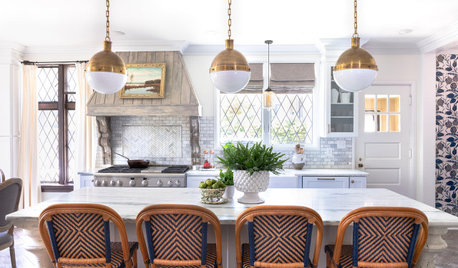
    • Design: a hood liner with custom surround gives you infinite choices, versus yet another nondescript stainless hood. Here's our inspiration photo for the hood surround we are having built (for a much smaller Cluny Lacanche)


    You can't get that look with a VAH.

    • Cost: given the underperformance, a VAH often can cost as much as a hood surround/liner/blower combo.
    • Ease of maintenance. Washing the squirrel cage blowers is a huge pain. My ModernAire baffles go into the dishwasher and right back up. Night and day.
    • Flexibility: a custom hood liner and surround can be exactly the size you want--for example, for our range which is an oddball 55" wide. VAH comes only in 6" increments.

    I could go on. But the notion that kitchen ventilation is as simple as "get a Ventahood" seems awfully misguided.

  • 2 years ago
    last modified: 2 years ago

    Looking at the picture you posted, that hood system is installed much too high to be effective -- unless it has a super strong suction that would likely also extinguish a gas flame.

    As Kaseki mentioned, FOGSS (Fumes, Odors, Grease, Smoke, Steam) spread as they rise and the farther (higher) the exhaust fan is from the cooking surface, the greater the spread. In your example, It would need to be quite a bit wider than the cooking surface to be effective, yet it appears, at best, to be the no wider than 6" wider than the cooking surface -- which is too narrow for this particular setup. If it was installed at what is probably the recommendation of no more than 30" or 36" above the cooking surface, it might work...except there is no "cup" to capture the FOGSS for exhausting.

    (The hood actually appears narrower -- look at the right side & where it ends. It might be light reflection, though, that makes it look narrower.)


    I will say that I have a VAH (from 2008) and it's the most effective hood I've ever had. On low or medium, I can easily carry on a conversation with others (on high, it's a bit more difficult). As to cleaning, it's not that difficult -- remove two screws put it in the DW, put it back in, and you're done.


    I understand that not everyone likes VAH, but there are others out there as well that many like. I don't remember if anyone has commented on Wolf.

  • 2 years ago
    last modified: 2 years ago

    Oh, and we have a 42"W x 24"D hood installed over a 36" cooktop. It's installed per the spec - 30" above the cooking surface.

    We don't hit our heads on it and we're a tall family -- ranging in height from 5'10" (me) to my son at 6'7". From my experience, you "sense" it and don't hit your head. The only time I remember my husband hitting his head is when he stuck his head inside the hood to look at it and hit the back of his head when he was backing out of the hood! It also does not "block" our view of the food on the cooktop.

    I got the one with the "emerald lip", though, just in case. I didn't know at the time whether hitting our heads was going to be an issue.

    In your case, I recommend the hood be 6" wider and, if available, 27" deep. If not available, then 24"D. If you mount it higher than recommended, then increase the width accordingly. E.g., if you mount it higher, consider getting a hood 12" wider.

  • 2 years ago

    Assuming @Buehl is referring to @clinresga's comment, please note that the image is described as an inspiration photo. @clinresga has been here for a long time and has likely endured many repetitions of my commentary w.r.t. overlap.

    If the hood base is at 7 ft from the floor (typical commercial placement and what the inspiration image suggests), then indeed the overlaps should be more than 3 or so inches, not only because the placement is further up the expanding plume cone, but because drafts from HVAC and/or turbulence from movement of persons near the hood will cause more plume disturbance and potentially missed capture of some plume portions. I'd consider 6-inches on each of the three sides to be effective. Higher flow rate will slightly improve capture (commercial hoods depend mainly on hood overlap); flame disturbance 4 ft below will be slight due to the rapid drop in air velocity that far from the hood aperture.

    Due to the huge reservoir volume below the baffles typical of commercial hoods, they can operate with lower specific flow velocities at the capture boundary. See Fig 4 from the Greenheck Guide below. For residential style hoods and cooking I recommend 90 ft/min due to the lack of volume to spread and slow the plume rays before reaching the baffles.


    If this were my cooking nook, I would make it deeper front-to-back, put the insert higher, and trap all the the rising plume into a large inverted pan that feeds the insert. Due to momentum reflections, the insert still has to cover most of the overlap area. (As a guideline, a ray hitting just outside the baffles that reflects down and out should hit a side surface that drives the ray back into the main flow. So this is a geometry problem.)

    Note also that we don't know from the inspiration photo whether the wall at the back is properly constructed to be non-combustible. With an island trim gas cooktop it needs to be even if the facing/backsplash is stone. (Judging from the island in the photo, the backspash may be 'quartz' and not non-combustible.)