Software
Houzz Logo Print
helpmehelpthishouse

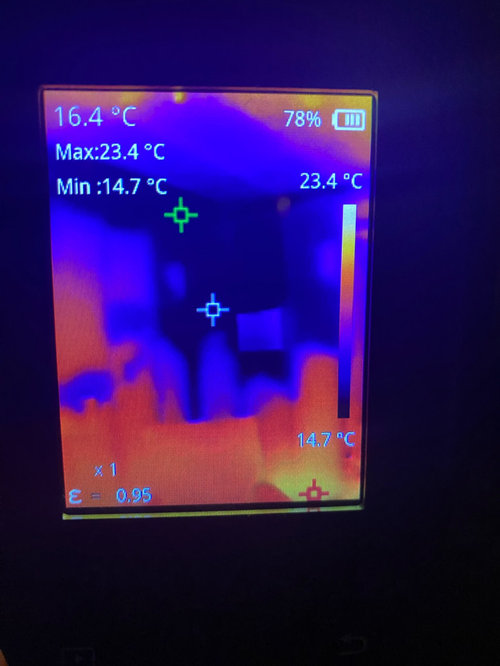
infrared camera - what happened here…

Hi all! We live in a 1929 Colonial with mostly plaster walls. From what we can tell and see behind outlets, cellulose insulation had been blown into the walls at some point in time. No idea when. We’ve been here 5 years. Previous owners were here for 30+.

There are some rooms that get way colder than others and I recently purchased an infrared camera to see what’s going on behind the walls. This is an image from a 2nd floor bedroom. Above this bedroom is a mostly finished attic space. The section right above this dark area is behind a kneewall so I can’t really see what’s going on (though I put a boroscope in that space to investigate and didn’t see much.)

Anyways…does this look like maybe the cellulose insulation just settled towards the bottom? I always track moisture levels in our house (I’m paranoid about mold) and I have a moisture meter which reads normal across this area so I don’t think there’s an active leak…though maybe something happened in the past but we do not know.

Clearly a huge gap here. I wonder if maybe they didn’t insulate this area at all?

Not an easy thing to open up a plaster wall so just seeing if anyone has thoughts on this…should we try to do more blown insulation in that area? Or do more investigating?

Thanks!

Comments (8)

  • 2 years ago

    Where do you live? What's the outdoor moisture? In Maine, this time of year, the air is super dry, because colder air holds less moisture, which means when that air is inside and heated, it is very dry.


    What does the space look like from the inside and the outside?


    I have a space in my 100yo Queen Anne that is odd, cramped, and inadequately insulated. Odd and cramped explains why it is hard to insulate, which is why it wasn't adequately insulated.

  • 2 years ago

    It does look like an abscence of insulation in your dark blue areas. You mention a kneewall above this area, could this wall also be a kneewall? If it is open behind the studs it would take a lot of blow to fill the whole cavity. There are devices that can be used in small drilled holes to see whats going on in your walls without making a big hole. Good luck!

  • 2 years ago

    Sorry I should’ve included a normal pic of the space for reference. The view here is a bedroom and the darker section is the top half of two walls. I had to take a pic of the image from my phone bc I’m still figuring out the device! So it would be a normal wall cavity space (behind plaster + lathe) to fill. I’m just wondering if that much settling is normal (it looks to have fallen to the bottom 3 feet of the wall (if it did settle/fall there). I wonder if that’s normal if it was blown in decades ago. There are patchy areas on the other parts of the exterior walls, but this is the biggest most blatant gap in insulation, and also the coldest room! Makes sense I guess.

  • 2 years ago

    That would not be a normal amount of settling even after years, should be inches not feet.

  • 2 years ago

    Right. It seems like that would be extreme. I wonder if maybe they didn’t even insulate that space to begin with then. Ugh. There’s no easy way to figure this out!

  • 2 years ago

    After going into attics and tearing into walls of homes with cellulose I can attest it settles A BUNCH not to mention deterioration. In a few decades remaining cellulose can look like an exceptionally dirty attic. It would be interesting to see what an energy auditor would conclude from your findings.

  • 2 years ago
    last modified: 2 years ago

    I had a four square house from the 1930,s where something similar happened.

    The poor farmers that built it had no money and decided to keep out the cold by stapling potato seed bags inside the stud cavities. As you can imagine it did not help much. For years a 1100 sq ft house took 500 gallons of oil and 5 full cords of firewood to heat it per winter.

    In the 1980,s the owners put cellulose into the walls by drilling holes from the outside. The way that works is, when the pressure built in the pumping system, it indicated the cavity was full.

    Except it was not. in 2017 i tore into the walls to put in new wiring. what happened was, the insulation built behind the bags stapled inside and fluffed out, but that was it. 90% of the wall cavity had no insulation. I am betting an obstruction of some sort also happened to you and why you have the void.

    Just for everyone’s information, in the end I reinsulated the house for $570, R 19 fiberglass with a foot in the ceiling at R 38. I also put in 75 outlets while i was there.

    I could heat that 1100 sq ft house on a bag of wood pellets a day here in Maine. (This morning it was 4 degrees f without windchill) A half a years worth of oil and firewood would have paid for insulation. What a colossal waste of wood and oil all those years.

  • 2 years ago

    Wow! I assume you also had plaster walls then…how did you go about reinsulating? Did you rip out the wall, or just patches? This is where I’m stuck. I’m having a contractor come to offer his input. Months ago I had an insulation company come, and they suggested adding more loose cellulose to the walls, but he simply did a visual inspection without any kind of infrared camera and I was turned off by that. The fact that I could get an infrared camera like this simply as a homeowner and he didn’t use one (or any other instrument) to assess, and that’s his sole business, was weird. So I sort of don’t trust insulation companies right now…