Software
Houzz Logo Print
txguy

BlueStar RNB vs Gaggenau Vario

2 years ago

I'm looking at 2 pretty different options for my new build, and was hoping for some advice/comments/suggestions from the helpful folks here.


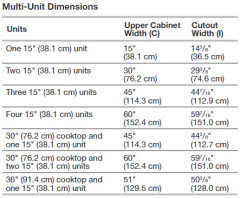
In short, I am deciding between a 48" or 60" BlueStar RNB rangetop with griddle and either 6 or 8 burners, or 4 of the Gaggenau Vario modules, likely 2x dual gas burner, 1x wok gas burner, and 1x dual induction. The Gaggenau modules are 15" each, so that would end up being a 60" setup.


There is obviously a big difference in aesthetics between the 2 options, and although the Gaggenau would fit better with my minimalist, contemporary design style, my designer is confident we can make either work.


The Gaggenau provides a mix of gas and induction (which I have never used, but am interested in) but would lack the built-in griddle. But beyond that, I'm unsure how the cooking performance of the 2 will compare. The BS has higher output, but the Gaggenau wok burner is rated at 18.8K BTU, which seems like it should be adequate (and is more than I have available right now). The Gaggenau would offer some smaller burners which seem useful for a lot of everyday tasks, but sadly they'd both be at the rear of the unit (the 5 burner 36" Vario unit has one in front and one in the back, and I prefer this setup). I still have concerns about the low-output/simmer performance on the BS, but I am also unsure how I feel about the Gaggenau achieving its lowest setting by cycling on and off. The Gaggenau would be more spacious, with 15" allocated to each burner vs 12" for the BS (this is the advantage of using 3 separate Gaggenau gas modules vs the single 36" gas module). And of course there is the open vs closed burner issue, from both a performance and cleaning perspective. The BS is dead simple with little to go wrong and easy repairs, whereas the Gaggenau uses electronics even to regulate the gas (the knobs connect to the valve with a wiring harness) so there are many more failure points (although the units being independent should mean the likelihood of a total failure is very low).


These are just some of my thoughts regarding the 2 -- and that completely ignores the aesthetic differences. I'd very much appreciate any opinions, thoughts, advice, or discussion.

Comments (9)

  • 2 years ago

    Anyone have thoughts?

  • 2 years ago

    Hello TX Guy. Each of these two brands have good reputations, and, in many ways, you have shared with us a balance of the pros and cons of each that you have seen thus far. It’s important to note here that both brands are considered “niche brands“ as compared to mass market, less expensive options. But I do think your instinct for the advantages of the Bluestar’s simplicity, are particularly poignant here. With either of these two options you are looking at, as they age, both of them will, at some point, need at least some level of repair. This is where access to people who can service your appliance matters. The induction portion of the Gagennau has some really wonderful uses, but along with it comes a much higher level of complexity that, not only requires very highly knowledgable technicians to repair, but also a supply of digital parts that are likely proprietary to the brand. Sometimes, repairs for induction can be so exorbitant, that many owners simply put them out at the curb and they go into the landfill or to the e-waste recycling bin. And the option of repairing induction is only when assuming that the parts are available, which no consumer should ever assume in this day and time. Short-lived appliances, don’t hurt so much when you’re working with a $1500 induction cooktop, but when you are fortunate enough to be in Gagenau/Bluestar territory, that would really hurt my feelings to watch good money, tossed into the waist bin, especially knowing that the manufacturer made them this way intentionally. I believe that for anyone who is able to budget for it, the more you spend, the more you should expect, and I’m not just talking about features. Even lower price appliances can offer a bewildering or ray of features, but, for my part, the more I spend, the longer Service life I expect out of something I purchase. Others may differ and not care because they want the features they want, and longevity be damned, but that is really not very sustainable for either one’s budget or the environment.

    If you go with the Bluestar, you will have all of its advantages, and you may be able to mitigate some of the cons that you mentioned. For example, you can purchase simmer plates to help reduce the heat levels of the Bluestar’s smallest burner, which will give you the better simmer that you are looking for. Bluestar’s open burner design allows you to drop a Wok right into the burner without any special Wok rings or accessories. And due to the Bluestar’s, inherently simple, but robust construction, any repairs, as you have noted, should be relatively simple, and if maintained regularly, you really should never have to buy another gas cooking, appliance again, unless you move, or renovate for some other future reason.

    As for induction, some of the folks on the forum, here have purchased individual, countertop induction hobs, which can be very useful when you are preparing delicate sauces, or wanting to melt butter slowly, for example. I myself treat induction the way I treat microwave ovens. None of them are viewed as decades, long lasting appliances and are treated as more like disposables. I know that sounds odd when you are considering induction appliances which can be luxury in price, but are relatively short in service time compared to something like a basic gas appliance.

    In reference to cooking, you don’t want to “guesstimate” whether the extra BTUs will be helpful to you because anyone who enjoys Wok cooking on a regular basis will tell you that ‘less is not more.’ And so, if use of a Wok was not a part of your cooking style, then you could likely simply go all induction and take a chance on how many years you get out of the appliance. (when they are working well, they are truly awesome, but then, so are the open burner versions of a Bluestar ). But with how you describe cooking in your own home, I think the Bluestar would serve you well for basically as long as you need it, and you still have the option of getting some small individual induction for those times when induction would be really helpful. Some folks might suggest that just going with induction means you would not need all that much make up air, but that won’t really be helpful given the considerable effluent with smoke and grease that is going to be admitted when a Wok is used. Also, I “think” that it was Patricia here in the forum, who may also use this sort of a hybrid approach to having a gas appliance as the main heavy hitter in the kitchen, but with some portable induction hobbs as a nice accessory when needed. You might check with her to see what her experience has been like, having gone this route. FYI, there are consumer grade, portable induction units, but there are also commercial grade portables that have higher power levels, should you need them.

    TXGuy thanked HU-16168550092
  • 2 years ago

    @ HU-16168550092 Thank you so much for your detailed reply. It is certainly disheartening to think that a Vario induction hob might one day need to be "disposed of", especially since it would need to be replaced with another Vario product that matches the remaining units. I'm going to see if I can visit a Gaggenau showroom and maybe that will make my decision easier.

  • 2 years ago

    @ HU-16168550092 I've seen the BS in person and have been able to turn on the burners, but not actually cook on it. Unfortunately, the Gaggenau showroom won't be local to me, so they won't know about service in my area, but I will check with the local resellers to get a list of servicers. Your comments about sevice are good advice for anyone purchasing an appliance of any cost, IMHO.

  • 2 years ago

    Another possibility is Jenn-Air appliances:


    TXGuy thanked wdccruise
  • 2 years ago

    @wdccruise Thanks for the suggestion...the Jenn Air gas module is nice because is offers 20K BTU. However, I prefer the knob placement flexibility of the Gaggenau...although I prefer the price of the Jenn Air :) Miele and Wolf also offer modules with knobs placed like the Jenn Air.

  • 2 years ago

    "However, I prefer the knob placement flexibility of the Gaggenau..."

    I assume you have quite a bit of $$$ as not only are these products expensive but installation is more difficult as you cannot just drop the cooktops into a countertop cutout.

  • 2 years ago

    @wdccruise Well, it's all relative, but the Gaggenau products do fit into my overall budget, at least based on the information I have right now. If other portions of the project end up being more than I thought, that could change.