Software
Houzz Logo Print
jacqueline9ca

OT - update from rainy California...

2 years ago

Well, another rain storm came in during the night - we actually got a 3 day break from the rain this week - lovely sunny days. I went on several bike rides and walks. Also spread more plant food on the roses - I am getting lazy about the 1-2 rainstorms we get each week now, and don't "water it in", as Mother Nature is doing that. This storm was predicted, and is supposed to last for at least 2, and maybe 3 days without stopping, and they said it will drop at least 10 feet of snow in the nearby Sierra Nevada mountains.


Of course, everyone around here who skis (not me) is going up to the mountains (about 3-5 hours driving from here, depending on where you live/are headed for) every weekend. The weatherman said on TV last evening "if you have not left for the mountains yet, DO NOT GO" - he thought the two main highways to go up there from here may be closed by this storm. We are staying home and cosy.


The garden is getting ready to explode - every day when I walked around, more and different things were starting to bloom. So exciting. Sometimes good old Mother Nature makes lovely groupings of blooms which I had nothing to do with - yesterday one area had added a large amount of light blue forget-me-nots to its already luscious bloom of yellow oxalis. Stunning. They both just show up in the Spring - as does light and dark pink (and if I am lucky, white) Valerian (Jupiters beard). I call them wild flowers, although I think the Valerian is a really naturalized import from the Mediterranean area.


Of course, our long, warm/hot and totally dry summer is coming, but at least this winter the large trees and bushes are getting a good amount of water to sustain them. I am enjoying all of this rain while I can.


Jackie

Comments (11)

  • 2 years ago

    You go it, gal...and your garden. It sounds lovely.

  • 2 years ago

    Well, Jackie, if that "yellow oxalis" is Oxalis pes-carpae, which is in bloom all over the SF Bay Area right now, it's not native either (nor is forget-me-nots...). From a plant ecology perspective, that oxalis has the dubious renown of being one of THE most successful invasive plants EVER. Though originally from South Africa, one widely-used common name is "Bermuda buttercup", probably showing how, because of its humungous success at installing itself in suitable climates worldwide and becoming massively ubiquitous wherever it goes, nobody even remembers where it really came from any more :-). So successful in spreading itself, in fact, that it no longer bothers with sexual reproduction/seed -- has lost that ability and spreads exclusively via zillions of practically microscopic bulblets. But, they do make a nice show and some great color combos (blue! orange! purple!) with them can be done. Told daughter, given the population of it in the garden of her house in Kensington, she should make lemonade with those "lemons" in her plantings as there is no getting rid of it. And, it does completely disappear by summer, at least.


    The rain is making fertilizing and pulling weeds a bit less work than it might be. And, yes indeed, it is looking like spring -- roses are leafing out and starting to bud up. The droughts of the recent past make these years of decent rain (so far!) even more enjoyable.

  • 2 years ago

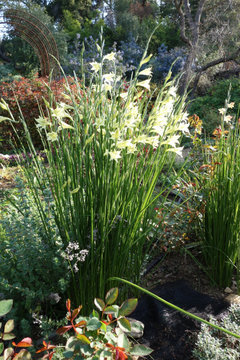
    I think you may have dodged a bullet there by not having success with O. pes-carpae, Melissa. I, a bit unfortunately, did not with another South African bulb, Gladiolus tristis, which showed up as a little, anonymous hitchhiker in a pot of something else I bought from the UC Berkeley Botanical Garden's plant sale. That single plant has now become hundreds or thousands in the bed it landed in and there is no getting rid of it. Like O. pes-carpae, it spreads via tiny bulblets which get left behind even if you pull the larger plant out, but also by seed (masses of seed in every pod!). [Relevant to this, I once heard second-hand of discussions among scientists at the Botanical Garden at a meeting about invasive plants in California, where one determination was that a major source of invasive species in Berkeley's Strawberry Canyon and beyond is the Botanical Garden itself -- yet another case of, "We have met the enemy and he is us."]


    I say "a bit unfortunately" because it is a lovely flower with a glorious, almost-intoxicating night scent, even as it is annoying in how quickly it proliferates and makes that part of the spring garden messier than I would like. It is a great, long-lasting cut flower.


    This was 10 years ago, when there were still discreet clumps:

    I am so glad to hear of the substantial amount of rainfall you are getting! The duration of temporary ponds needed to support frog and toad reproduction varies according to the species and climate. Along the California coast, a pond that lasts at least through June or July can support California Red-legged frog (CRLF) reproduction, for example. Conservation biologists take advantage of this fact for one strategy to get rid of invasive bullfrogs that can negatively impact CRLF populations: because of cold summer temperatures along our coast, non-native bullfrogs require two years to metamorphose from being a tadpole versus the shorter period required by the CRLF, so draining the pond after the CRLF frogs have left it destroys the bullfrog tadpoles. A little research into the length of time spent as tadpoles for your local frog and toad species, as well as other preferred pond conditions, would let you know how long the ponds need to persist. For example, CRLF prefer that there be some sort of spiky aquatic vegetation on which to attach their egg masses, such as Eleocharis or Schoenoplectus, whereas I've seen Pacific Chorous frogs (aka tree frogs) successfully produce young in plain water that was retained in some deep ruts left by Army tanks doing winter practice manuevers in clay soil, with no vegetation at all.

  • 2 years ago

    Of course the oxalis I mentioned is O. pes-caprae.! I grew up here, and when I was a child we liked to chew the stems - we called it "sour grass". I like the way it turns our entire neighborhood yellow in the Spring, and then dies down to nothing in a couple of months. The foliage is very easy to pull up if it is interfering with another plant, although I agree that it is almost impossible to get rid of those tiny bulblets, which are 10-20 inches under the soil (I had a gardener who tried to do that in one bed once, and all he accomplished was digging up every other plant in the bed to get at the bulblets. Within 2 seasons, they were all back. ) So, I decided to enjoy the Spring bloom, and not worry about them. Helps that I grew up with them, and have happy memories of that.


    Jackie

  • 2 years ago

    Catspa, I do love reading what you have to say. Probably you're right about the oxalis. The gladiolus is very pretty, but I believe you when you say it's too invasive to be desirable.

    Jackie, sounds like you're having a great spring, and likely to keep on going with all that water.

    It's continuing to rain here....still welcome. Very cheering, when usually gray weather just makes me want to sleep.

  • 2 years ago

    Catspa, that gladiolus tristis is remarkably lovely and your description of the scent and its performance as a cut flower make me want to try it! I wonder if it would be invasive in my region of Arizona… hmmm. Very little becomes invasive here beyond mesquite and Bermuda grass.

  • 2 years ago

    @judijunebugarizonazn8, I think Gladiolus tristis would be invasive in any summer-irrigated situation. It is native to South Africa's marshlands and, notably, only thrives and spreads in the irrigated parts of my garden where the roses grow; it hasn't moved into the native or unirrigated parts (so far!). However, it does very well in pots and is easily grown that way, which is what I did for several years before, unfortunately, putting it into the ground. So, one way to enjoy it without it becoming annoying might be to grow it in pots and be sure to deadhead it before the seeds are ripe.


    Similar, but even more lovely and way more interesting and wonderful, I think, is Gladiolus liliaceus, which I also got from the UC Berkeley Botanical Garden (knowingly purchased, though!). It has an even stronger night scent of cloves and, even more astonishing, the flower is purple in color from dusk to dawn, but changes to reddish brown in daylight, becoming purple again when daylight fades. After the G. tristis fiasco, I have only grown it in pots. It is easily propagated from seed in those pots, which I have successfully done over the years, and I have not found it invading the garden. However, it does come from an area of South Africa where rainfall amounts and patterns sound similar to what we have here, so I'm a bit leery about it possibly being more widely invasive, even though its native area in South Africa, the "renosterveld", is characterized also by fertile soils, which we don't have here (it does do best with if its pots are kept well-fertilized). Here's a discussion about it from the Pacific Bulb Society (for some reason, I have no photos of mine, though I've grown them for years!): Gladiolus liliaceus.

  • 2 years ago

    Down in our part of the SF Bay we are also getting a very nice rainfall this season. I had so hoped for back-to-back years of good rain since I had planted my back garden in natives (still roses in the front and along the fence). Two years of good rainfall back-to-back is the best start they can get. For a while this fall it looked like another drought year, but the weather smiled on us after all, and we got what I had hoped we would get.

  • 2 years ago

    4 days from my first post above, I guess I should have said "snowy California". We have gotten about 1 1/2 inches of rain here out of this cold storm in the past 3 days, but the mountains have gotten 10-12 FEET of snow, and counting. Both Interstate Hwy 80 (4 to 8 lanes wide, depending) and State Hwy 50, which are the only ways to get to the mountains from the SF Bay Area are closed. Hwy 80 is closed for 100 miles, to the Nevada state line. The CA Highway Patrol had to rescue 100s of people off of the closed portion, because it was closed abruptly because of white out conditions, and they were trapped. (This was despite warnings for days that NO ONE should try to drive up there.). The got all of the people out, but many many cars and large semi trucks had to be abandoned on the hwy. Now if it ever stops snowing up there, they have to be removed. The CHP announced this morning that Hwy 80 is closed "indefinitely". It was a real blizzard, burying not only the hwys but also whole towns. The good news is that the "snow pack", which provides much of Californias' water supply during our totally dry summers, is getting larger by the moment.


    Jackie

  • 2 years ago

    Thank you, catspa, for your explanation. Both varieties of gladiolus sound intriguing to me, but the tristis looks more demure and graceful somehow. However, with that kind of thuggish reputation, I’ll enjoy it on picture only. That scent will just have to be a pleasure I deny myself of! :)

    Jackie, you really did get snow in the mountains this time, didn’t you! I remember another year some time back when we had a year like that in California. Driving between those walls of snow after the roads were all clear was quite an experience. Two of my daughters and a cousin have reservations to hike the John Muir Trail this summer and they are feeling a bit apprehensive about all this snowpack even if it is a good thing for the water table.