Software
Houzz Logo Print
webuser_875978293

Help with modifying sink cabinet.

2 years ago
last modified: 2 years ago
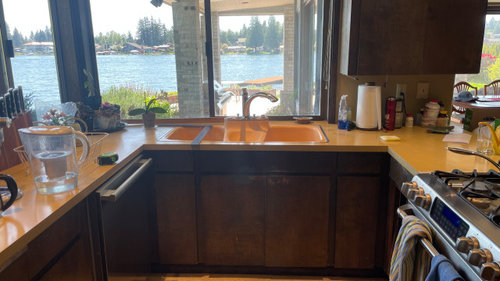
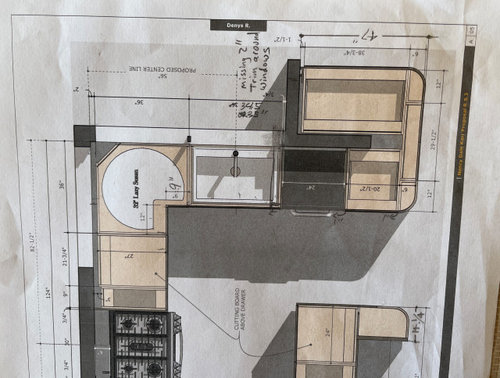
I just found a glitch in the sink placement when mocking up our kitchen remodel plans. The sink will either not be centered on the right half of our window, or will not be centered in the cabinet. We are doing custom faceless cabinets, so can easily go with a slightly smaller cabinet, but wanted to get some info based on my chosen sink (topZero 32 inch 16 gauge) . Countertops will be either Quartzite or Quartz. I haven’t yet approached our team with this idea, so want to get as much info as possible before I present this option to both our cabinet designer and slab salesperson next week.

I figured out that the maximum size sink cabinet for centering, is 34.5 inches, and if the cabinet was slightly smaller, I could increase the width for the corner lazy susan cabinet and our silverware drawer. I did see several places in discussions about being able to put a 32 inch sink into a 32 inch cabinet. I have done some research on the internet and in Houzz, but still have questions.

My questions for the Houzz brain storming team:

What is the optimum smallest cabinet width for a 32 inch wide sink? (Inside diameter is 30" by 17" with a 1" flange all around the perimeter.)

Are we losing support strength if we make the cabinet smaller?

If the flange width is larger than the inside of the cabinet, does the flange sit on top edge of the cabinet, and is the top edge slightly trimmed so the top of the flange is flush and level with the cabinet tops?

Is it much more difficult to remove a sink if it fails, as the top is above the wood cabinet box edge?

Is there an increased chance for water to get into the wood framework?

I have also seen slings promoted for holding the sinks in place. I have some questions on the slings for holding in the sinks so I can talk with the sink/countertop installation team.

Are the slings stainless or a material that won’t rust or rot?

Will the slings need inspections and how often?

Are some slings much better than others?

Have you had slings fail?

How easy are they to replace if failing or failed?

Why don’t you just put in a couple of stainless crossbars under the sink flange that would cross the width of the cabinet?

Do you also do the usual sink support with clips and screws for a double/redundant support mechanism?

Thank you,

someone who waited 20 years to get her kitchen remodel.


Comments (6)

  • PRO
    2 years ago

    "What is the optimum smallest cabinet width for a 32 inch wide sink? (Inside diameter is 30" by 17" with a 1" flange all around the perimeter.)"


    32".


    "Are we losing support strength if we make the cabinet smaller?"


    No.


    "If the flange width is larger than the inside of the cabinet, does the flange sit on top edge of the cabinet, and is the top edge slightly trimmed so the top of the flange is flush and level with the cabinet tops?"


    Yes and yes, but with a strap system, you want the top of the cabinets relieved an inch or so. This allows the sink to be low enough to be caulked and strapped in place. The sink and straps now do the structural work the compromised side of the cabinet was doing holding up the top.


    "Is it much more difficult to remove a sink if it fails, as the top is above the wood cabinet box edge?"


    No. The cabinet front is tapped off to gain access to the sink. The top is not removed.


    "Is there an increased chance for water to get into the wood framework?"


    Yes, if you use the crap sink clips provided by the sink manufacturer or the fabricator. Strap your sink in place for waterproofing please.


    "I have also seen slings promoted for holding the sinks in place. I have some questions on the slings for holding in the sinks so I can talk with the sink/countertop installation team.

    Are the slings stainless or a material that won’t rust or rot?"


    Yes, but that's irrelevant because a strapped sink doesn't leak. Ever.


    "Will the slings need inspections and how often?"


    No.


    "Are some slings much better than others?"


    No, but which strap system you or your fabricator choose may depend upon your drain placement.

    "Have you had slings fail?"


    Yes, but rarely. Installer error every time. (Embarrassed face here.)


    "How easy are they to replace if failing or failed?"


    Very easy, believe me.


    "Why don’t you just put in a couple of stainless crossbars under the sink flange that would cross the width of the cabinet?"


    Stainless crossbars cannot push sinks up to the bottom of the stone as straps do, 24/7, 365. The crossbars, like clips and blocking, leak.

    "Do you also do the usual sink support with clips and screws for a double/redundant support mechanism?"


    You could, but you're wasting time and money.

  • 2 years ago

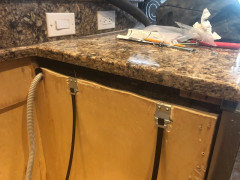
    Thank you for the picture @Joseph Corlett, LLC. So was that was a straight crossbar and too flexible, so sagged in the middle? Does a sling change the direction of pressure upward depending on which area might have more sag, to hold things more evenly? If a sling stretches, the sink would drop more evenly. I do know you are a proponent of slings, and someone did post a picture of a sling that did fail after a few years. I believe it was a HUSH sling. I would really appreciate hearing more about the slings, how they hold the sink better than clip, show to check for failure, when to replace, and whether you use it alone or along with the clips.

  • PRO
    2 years ago
    last modified: 2 years ago
    Get a 33" 1/4-3/4 offset bowl and be done with the math figuring. Deliberately offsetting the main bowl will work visually and physically.

    Nancy Karr thanked Minardi
  • 2 years ago

    I just put a sink flange on top of my frameless cabinets. It maximized the size sink I could put in the cabinet.


    I don't expect my sink to fail. I have a 27 year old Kohler sink undermounted to granite that still looks and acts new. If the new sink fails, I might have to cut it out. I feel like if a sink fails, it's a pretty major issue that will require something drastic.


    I also don't expect any water to get between the granite and the sink and wick into the tops of the sides. There as been zero leakage from my current sink in this area (or any other area, for that matter) I looked into a sling, but effectively putting the sink flange on the sides of the cabinets seems like the sink is just one big sling.


    I also feel like sink changes usually coincide with counter changes (or overall kitchen remodels, etc) so you'd get to the sink to change it out that way - not that a sink failed.


    If I was really concerned about additional support, I would probably get this thing:

    https://sinkmount.com/product/petes-sink-mount/


    Nancy Karr thanked just_janni
  • PRO
    2 years ago

    "So was that was a straight crossbar and too flexible, so sagged in the middle?"


    No, it was a divided sink with steel on the flat and the crossbars were on each end, not the front and rear, of the sink. A divided sink cannot be held in place on the ends only because the flat steel flexes and leaks.


    "Does a sling change the direction of pressure upward depending on which area might have more sag, to hold things more evenly?"


    When a divided sink is strapped, it cannot budge without violating the laws of physics. The sink flange is pressured evenly.


    "If a sling stretches, the sink would drop more evenly."


    Steel straps do not stretch.