Software
Houzz Logo Print
em_eff79

dwarf Alberta spruce - what is happening here?

2 years ago
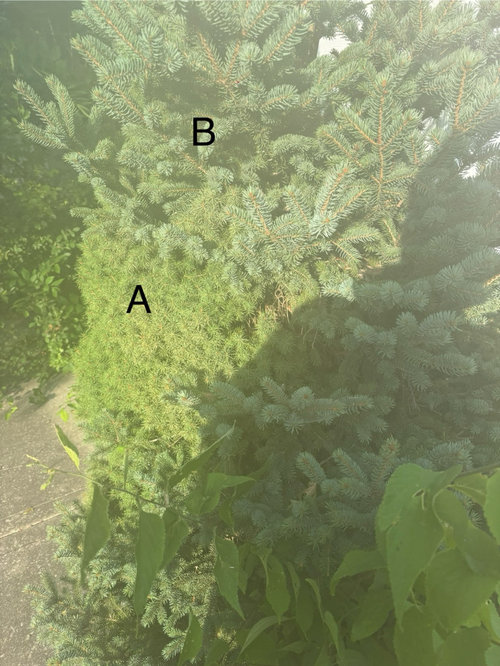
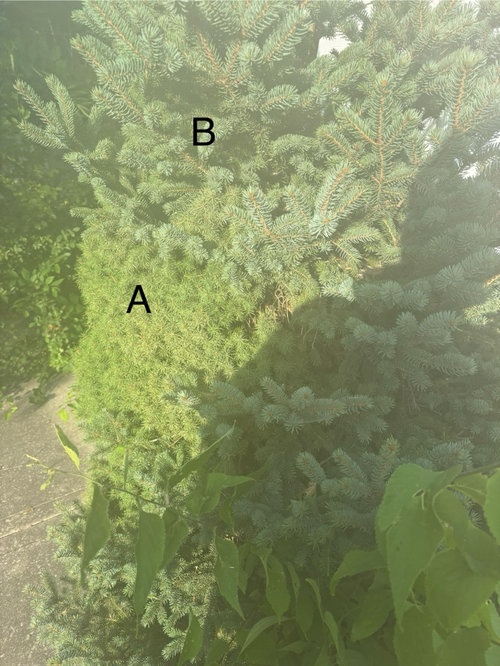
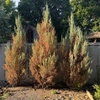
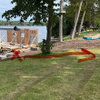
I am dealing with some very overgrown landscaping and would welcome advice. This DAS is 25 years old and I’m not even sure which part of it is what it is supposed to be! The tree is about half one way and half the other. I have labeled one pic with “A” and “B” in case someone could clarify what needs to go. Also, it may be a moot point as I’m guessing this tree just needs to be removed.

Comments (8)

  • 2 years ago

    The simple answer is that it is a reversion. If I remember correctly, the Dwarf Alberta spruce is a mutation of the White Spruce. Since it is a mutation, sometimes the genes can go revert back into the original species, causing it to sprout normal foliage. The tree doesn't necessarily have to be removed; you can cut the reverted part off. It might have a gap, but in my experience it will eventually fill in.

  • 2 years ago
    last modified: 2 years ago

    What you are seeing is called reversion.

    It's when a naturally, genetically altered tree like a DAS decides to send out regular branches that are the same as a normal white spruce.

    This is not unusual.

    Generally, if you keep an eye on your tree, and see this happening, you can 'nip it in the bud' and remove it before it takes over and becomes a major part of the tree.

    In your case, I believe, if you remove all the reversion, there may not be much left, or the original DAS will be so deformed it will never be a nice-looking tree.

    You could try it to see what it will look like but I'd save time by just replacing the tree.


    Or just leave it and have an unusual looking tree.

  • 2 years ago

    Thank you all for taking the time to explain and advise. I do appreciate it. Am I correct that the part I have labeled “B” in the photo is the reversion?

  • 2 years ago

    Yes, the portion labeled "b" is the reversion

  • 2 years ago

    Thank you

  • 2 years ago

    This from James Wick ; Alberta Spruce (Picea x albertiana) is a naturally occurring hybrid between Picea glauca and Picea englemanii, formerly it was classified as a subordinate taxa to Picea glauca var albertiana.Dwarf Alberta Spruce (Picea x albertiana ‘Conica’) is a dwarf cultivar there of. Generally in nursery trade still sold under its former classification of Picea glauca var alberiana ‘Conica’ or abbreviated Picea glauca ‘Conica’ because nurserymen in the US are slow to adapt new taxonomyBut wait, don’t get settled in quite yet. New molecular research shows many of the plants originally described as Picea glauca var albertiana and later into Picea x albertiana are actually Picea glauca x mariana nand not Picea glauca x Picea Englemanii. The current proposal of taxonomists is to conserve Picea x albertiana for Picea glauca x englemanii and move the Picea glauca x mariana into a new hybrid group Picea x Darwiniana which willl transfer many cultivars currently under Picea x albertiana into Picea darwiniana and based on area where ‘Conica’ was discovered Dwarf Alberta Spruce likely will be one that proves to be a x darwiniana so expect some taxonomic muddy waters to come.Now back to Dwarf Alberta Spruce: Picea x albertiana ‘Conica’ (or if simpler old taxonomy Picea glauca ‘Conica’) this dwarf cultivar was discovered as a wild growing seedling on the banks of Lake Hogan, Alberta Canada. Contrary to much of the information on the internet it did not originate from a witches broom. The origins were well documented at time of discovery now it is unknown if it could have been a seedling from a witches broom or if it was some other form of chance seedlingNow for the growth commonly referred to as “reversion” in vernacular, These growths occur on nearly all specimens of Dwarf Alberta Spruce and the majority occur at the same age or growth stage of the Dwarf Alberta Spruce. Also interestingly one step upwards growths occur on the miniature cultivars derived from Dwarf Alberta Spruce such as ‘Jeans Dilly’ at about the same frequency and also about the same age. This is important information as it implies likelyhood of it being hormone related and not genetic mutation. Couple this info with some research conducted in the 1980s showing some dwarf conifer “reversions” are the result of switching on or off of a gene receptor and not a change in genetics. (I do not know if Dwarf Alberta was one of the conifers in these studies). Now we have a known possible mechanism that might be causing these growths AND an age correlation of parent plant and these growths.Now let’s look at some research I performed in the late 1990s and early 2000s in seedlings grown from these growths on ‘Conica’. Seedlings from these “reversions” have slower growth, shorter needles, and shorter internodes compared to typical species Picea glauca var glauca, Picea glauca var densata, and Picea x albertiana. This shows the dwarfing gene of Dwarf Alberta Spruce remains in the “reversion” further showing these growths are not genetic mutations towards typical species.Now let’s look at the features of these growths. This large growing growth on Dwarf Alberta Spruce has shorter needles compared to typical species Alberta Spruce, a much more open growth habit, and extremely heavy cone set. These aspects of morphology and habit are pretty uniform across all occurrences and this makes these growths notably distinctive compared against typical species Alberta Spruce. So much so that a cultivar group recognition exists for clones of these “reversions” when cloned these growths fall under the trinomial nomenclature of Picea x albertiana ‘Intermedia’ (previously Picea glauca ‘Intermedia’).From a compilation of studies and the background of the cultivar itself best hypothesis would be that these growths are merely the adult form of the cultivar, it’s reproductive stage in the same way Thuja occidentalis ‘Rheingold’ or Sherwood Moss’ have a juvinile form and develop adult characteristics or how English Ivy has a juvenile form and adult form. Plant matures to a certain age or height then a hormone change triggers reproductive growths… dwarf Alberta spruce hitting pube

    Intresting ,Ron


  • 2 years ago

    Wow, that is very interesting! So while I’ve been (horribly) ignoring my little tree, it was actually going through puberty. I feel even more neglectful somehow. 😁 so this is just one of those cases where a very attractive child becomes a rather strange looking adult?
    Back to my dilemma, I will probably try just cutting it into a cone shape while completely ignoring the two different growths. I did it a few years back when the weird growth was just starting and it looked okay.

Sponsored
River Mill Construction
Average rating: 5 out of 5 stars2 Reviews
Delaware County's Customer Focused General Contractor