Software
Houzz Logo Print
elena_nuta

Ficus branching

2 years ago
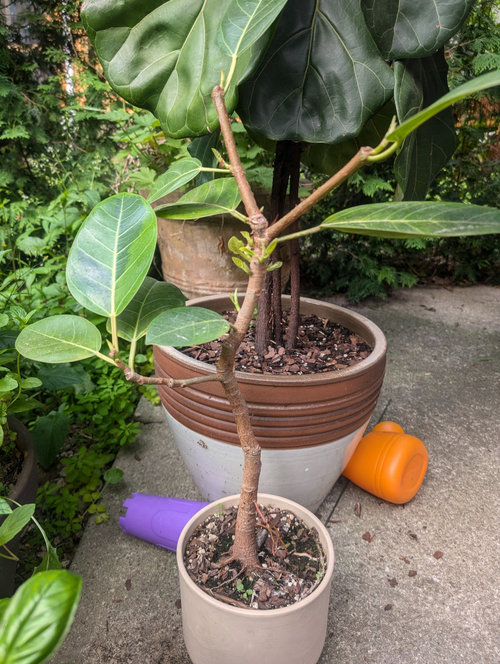
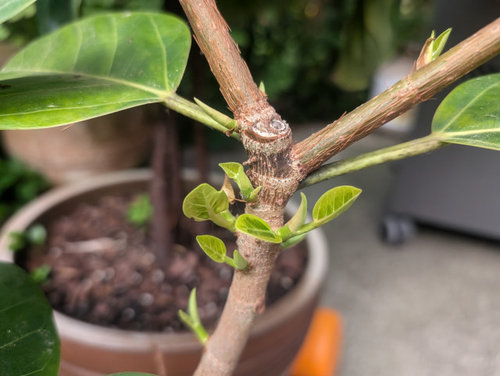
Since pruning several weeks ago, my ficus altissima has sprouted many branches very close together. I can't tell if this is a good thing or if it'll look odd as the plant matures. Should I remove a few branches now?
Thanks for any advice!

Comments (5)

  • 2 years ago

    You should try to avoid allowing your tree to produce clumps of branches concentrated in a short area. All buds near the bottom of the 'V' formed by the top branches, including the 2 axillary buds immediately distal to the pruning cut should be rubbed off with your thumb or pruned off. Wash your hands (afterward) if you use your thumb You might want to make an exception re the lowest bud on the main trunk. It might be sufficiently low enough on the tree to provide a well-positioned branch. If you keep it, let it grow unpinched/pruned until it is thicker than the branches that form the 'V'. Leaving more leaves on it will speed it's thickening. Thin branches located below thicker branches jar the eye whether consciously or unconsciously. In the case of 'unconsciously' your mind will be telling you something isn't right, but you don't know what. That's because you've seen a million trees in nature where the lower branches are always thickest. If your vision for the tree includes only branch growth originating above the bottom of the 'V'. you can allow both branches below the bottom of the 'V' to grow for a time as sacrifice branches to help thicken/strengthen the trunk. Time to remove them when they are about 1/2-2/3 the thickness of the trunk.

    You can remove the 4 mature leaves - the 2 attached to the bottom of the 'V' and those at the distal ends of both sides of the 'V'. This does reduce the food supply, but it is a VERY helpful tool that helps keep your plant fuller and more compact through its reducing effect on internode length.

    As each new branch grows, pinch the branch back to 2 leaves as the 3rd leaf on each branch is starting to form. You'll get a new branch from the axil of each leaf. Pinching early is the key to not wasting the plants energy because you need to prune hard, removing growth already paid for in terms of energy outlay.

    Al

  • 2 years ago

    Thanks, Al, i thought I remembered reading in some of your old posts that clumps of branches are not desirable.


    I've been wondering... once I remove a branch, can a new branch ever sprout at that same spot?

  • 2 years ago

    I've been wondering... once I remove a branch, can a new branch ever sprout at that same spot?

    In this image ^^^ (Ficus microcarpa), notice the short stub the pencil points toward. It is a remnant of the leaf stem (petiole) I cut through to remove the leaf. The near vertical branch immediately distal to the stub originated as one of a number of latent/ dormant axillary buds in the axil of the leaf that was removed. A row of several dormant buds still remain in that location, suppressed by the flow of auxin through the branch. Removing the branch nearly eliminates the flow of auxin suppressing the buds, so they activate. If the branch is removed such that the existing buds are not destroyed (usually by cutting to close to the point of attachment) a new branch will grow there.

    Sometimes, several buds can be activated on some tree species when a branch is removed, and some trees (Ulmus [elm] family comes to mind) will form adventitious buds anywhere on the tree, but particularly around the entire branch collar, recognized by the swelling (older trees) where branches attach.

    Another Ficus retusa showing 2 branches in the axils of the 2 largest leaves. In the lower node, the leaf was removed prior to starting the cutting, so there are 2 axillary branches. The other node shows 2 axillary branches with the leaf still attached.

    Technically, plants are generating organisms where animals, including humans, are regenerating organisms, the difference being animals can regenerate new tissue in the same spatial position as damaged or dead tissue, where plants cannot. This concept is more important when we discuss plant "healing", which involves the generation of callus tissue in response to wounding, callus tissue that occupies a different spatial position.

    Given what you asked about branches occurring in the same place, and even though there are more than 1 axillary branch at 2 nodes in the image above, the branches technically originate from different positions due to where the axillary buds are located.

    Al

  • 2 years ago

    I would let them all grow for now and then edit them in the future when you can clearly see which are in a good position.

    This Ficus is very amenable to pruning. Don’t worry too much.


  • 2 years ago

    Where there is a bud, there will be a branch, and determining which branches have potential to improve the composition and which will never be a part of the composition is something that should happen asap. The only reason to retain superfluous branches would be to utilize them as sacrifice branches which will help thicken and/or increase trunk taper - usually not a major consideration for trees grown as houseplants, though understanding how to use sacrifice branches can add considerably to the plant's eye appeal. Even the position of sacrifice branches should be carefully considered so they don't create the reverse taper/bulge, and sacrifice branches shouldn't shade other branches that are or will become a part of the composition.

    Too, when one allows a large number of branches to grow in close proximity along the trunk or a lower order branch, it invites serious thickening in that area. This creates an unsightly bulge that jars the eye. If Elena were to allow all the new branches in the immediate vicinity of the bifurcation to grow, within a year there would be a bulge so conspicuous the only way to fix it would be by pruning below the bulge, which would be a severe blow, to the tree's development.

    Illustrated:

    Notice the unsightly swelling and reverse taper in several places that accompanies the practice of allowing multiple branches to grow in close proximity. Removing the branches will make things worse because of the callus tissue that will form to cover the wounds left by branch removal. This isn't my tree, but I can see the practitioner plans to chop this tree just above the low branch moving right and forward. (S)he doesn't care about the swelling because the plan is to use only the trunk below the swelling.

    Ideally, branches low on the trunk would have more vertical space between the branches, with the space between branches decreasing toward the top of the tree. It allows space for birds to fly through the tree. The last was a bit tongue-in-cheek, but the principle of negative space (some openness) is something to plan for if one is trying to mimic nature.

    Al

Sponsored
Wannemacher Interiors
Average rating: 5 out of 5 stars26 Reviews
Customized Award-Winning Interior Design Solutions in Franklin Cnty OH