

Helping crispy fried roses recover?
Hi all, I would love to hear from those who have been in this situation before and for you to share your strategies for dealing with the following situation..
A combination of high temperatures (topping out around 105) and - the real killer - a vicious hot wind blowing up from Africa has blow-torched some of my roses. For example, Marie Pavie, which was directly in the path of the wind, has gone from this:
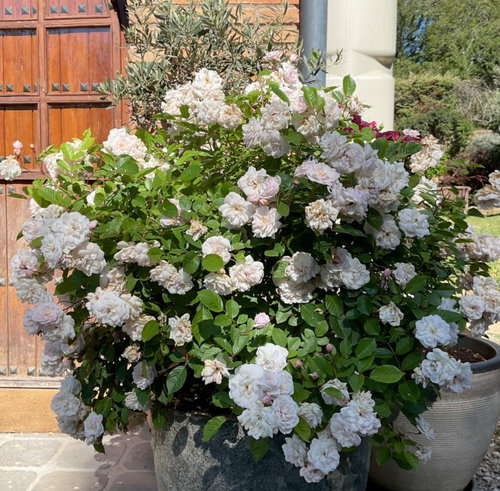
to this:
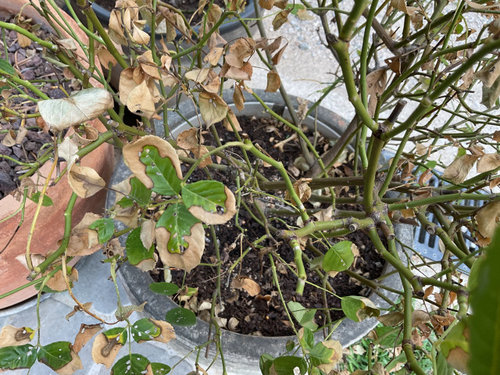
After the hot wind finally ceased, it took a week of constant watering - no feeding - just to rehydrate the potting mix. Now what to do? I have had a few fried leaves before but nothing so bad as this.
My plan was to just keep giving the fried roses lots of water until the weather cools off. Then to feed, prune and pick off the dead leaves. My thinking being even the dead leaves are providing some protection and it would be a bad idea to encourage tender new growth in the current heat.
Is this a good plan and if so should I stick with it? I am really tempted to intervene now because they look so dreadful!
Your collective guidance would be much appreciated!
Comments (47)
 2 years ago
Does removing dead leaves encourage new growth?
Do dead leaves, remaining on the rose, suppress new growth?
Related Professionals
Odessa Landscape Architects & Landscape Designers · Lafayette Landscape Contractors · Pueblo Landscape Contractors · Nashville Home Builders · Escanaba Home Builders · Fairbanks Home Builders · Portsmouth Landscape Architects & Landscape Designers · Lake City Landscape Contractors · Elkton Landscape Contractors · Fergus Falls Landscape Contractors · Greenville Home Builders · Bloomington Home Builders · Fergus Falls Home Builders · Oneonta Home Builders · Vancouver Home Builders- 2 years ago
I'm no expert in this kind of situation, but your plan sounds reasonable. Your 'Marie Pavié' certainly was beautiful before the bad weather got it.
About the timing, roses need a lead period of, I'm guessing, about six weeks between when they start to make new growth and when they flower. I'd start fertilizing about that long before when you think conditions will be suitable for them to bloom. (This is something I've had occasion to notice because, since I don't water, I depend on some rain toward the end of summer in order for the roses to flower. If they get a good rain around mid-August to early September, they bloom wonderfully in late-September to mid-October. Fertilizer's not a problem since they grow in the ground. But if it doesn't rain earlier, there's not much of a fall flowering. When you want to start watering and fertilizing depends on when your roses generally bloom in fall.)
Of course the seasons have been so weird lately it can be hard to predict the weather. We all just have to give it our best shot.
 2 years ago
I hate this has happened, but I've seen the same in my garden, although not quite to that extreme. You have my sympathies.
Just water normally, checking to make sure the soil is never waterlogged. Even with the heat and winds, the plant itself will be taking up water at a lesser rate, because of the loss of leaf area. It's going to entail watching more closely than you might otherwise. Don't remove the leaves, unless it just bothers you. The plant will drop them when it needs to, either prior to, or when new leaves begin to grow. If the heat and winds continue, it won't hurt to actually mist the plant several times a day, especially if new growth starts during the heat wave. Don't worry about disease. You have to save the plant by slowing down water loss. Blackspot, for instance, is not a problem at temps above 90F, so wet 'em down. DO NOT fertilize until new growth begins. If you have been regularly fertilizing, there are still unused nutrients in the soil, and additional fertilizer may burn the roots. Patience is a virtue. Roses are tougher than we give them credit for, though that's hard to remember when it's YOUR roses, lol.
Hopefully, you'll soon experience cooler Fall weather. The roses will love it as much as you do, and will probably put on new leaves rapidly once it does cool down.
NollieSpainZ9
Original Author2 years agoThank you Melissa and Sheila, I really needed someone to tell me to lay off ‘doing something’ just for the sake of aesthetics, so I shall keep my itchy fingers at bay! It’s so hard to predict the weather here even without climate weirdness, some years we have cool, rainy autumns, other times it stays pretty hot well into November. So it’s a waiting game, but that’s good advice about the lead period, Melissa.
Rifis, well anytime I have picked off leaves attacked by black spot or shredded by sawflies has encouraged new leaves to form in their place, but whether picking off fried leaves does the same I don’t really know. The phrase ‘growth follows the knife‘ I have found to be largely true, so one could perhaps substitute fingers for knife?? 2 years ago
I have similar temps here and today it will be 100F. The key for me, and my roses are just fine, is lots of water everyday and plant your roses in the ground. Every rose plant of mine, except a new Angel Face, is in the ground. Angel Face has been growing on our patio in its 5 gallon nursery pot. It gets a lot of water daily and is in the shade on the patio, starting in the afternoon. I'll plant her in the ground by the end of August. last year, I kept Rouge Royale in its pot until September. But these are only temporary. In the ground for roses in dry, stinking hot gardens. And grow lots of hot peppers in pots. Diane
Grow these guys in pots.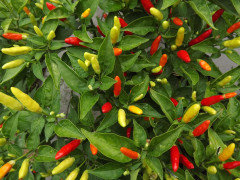
Temporary pot dweller Angel Face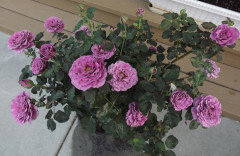
 2 years ago
I learned from my mother when a potted plant needs emergency revival, to place the pot in a bucket of water so it can hydrate it's roots from the bottom. Just give it time, preferably in a shaded spot but you can hydrate in place too. I do this for all my potted plants not only roses, when I feel the planting medium is dried out. It works better than just continual water from the top plus it uses less water. You can tell when to remove the pot when the surface looks dark & moist again. But sometimes I just let it soak overnight & never had a problem. I have old umbrellas that I've poked into big pots for sun protection too. But thank goodness we haven't had any heat waves around here this year--yet, knock on wood.
NollieSpainZ9
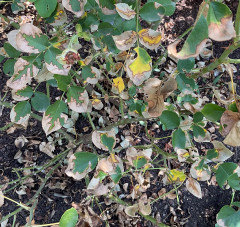
Original Author2 years agoDiane, I totally agree water is key to surviving sun and hot temperatures, but plenty of roses in the ground that are well watered are similarly affected. Unfortunately, no amount of water can prevent leaves burning in scorchingly hot saharan wind! This in-ground rose is in rich, moist soil, for example:
Your mother is spot on Soozie Q, that is an excellent strategy! I have done that in the past with lightweight pots but those particular ones are really heavy and I didn’t think my back could take lifting them. The best I managed was continually filling the drip trays underneath as well as watering from the top, letting it soak in then repeat endlessly. I got there in the end! Its a great way of loosening up the roots of pot bound nursery plants too.- 2 years ago
I think you are doing right to keep moist and leave damaged leaves on. This time of year all my roses look like that from the regular temps in the teens and the strong summer sun.
Three strategies that help here is mulch (soil stays moist for 2 days instead of 1), pulling potted roses under porch eaves so they receive a shorter amount of morning only sun, and where possible using a pot within a pot planting method. The roses still look bad but they are less likely to completely give up. NollieSpainZ9
Original Author2 years agoThanks Mojavemaria, it’s so encouraging to know I’m on the right track. I’m guessing by your name you are near the desert? Do you get killer hot winds too? We used to get them maybe one or two days a year, but they seem to be increasing in frequency and severity.
In theory I do everything right - pots in no more than four hours of morning sun under the eaves or sheltered from the worst of the southern and afternoon sun by hedges etc., double-pot, water a lot and mulch. I think the only thing I could have done to protect them further was to drag them into the cool house, but I don’t think my wife would’ve been too happy about that. Wouldn’t have helped the roses in the ground either!
One exception to the pot positioning rule is Munstead Wood, which is on a stone table fully exposed to wind and all-day sun, but it simply shrugged it off the Saharan wind. It’s blooms are paler and a little frazzled, but what a trooper to be blooming at all!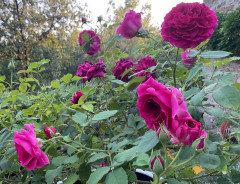
An earlier photo showing it’s death-defying position: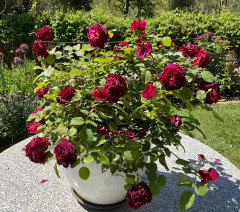
- 2 years ago
Italian summers, alas, now are more "African" in nature than what used to be called "Mediterranean" and I can only confirm the fact that sun of this intensity is a real killer. I can truly sympathize with the feeling of theoretically doing everything right, and still experiencing distressing results. In the past I could plant roses out, water them once a week during summer (by hand)for their first season, and they grew. Now it's become a terrible challenge to get roses started out there. True, watering once a week will be considered by many to be too little,but since my garden is far from home, without running water, I literally can do no better. Part of the problem is also that many of these are potted plants,which seem to be very difficult to establish. Even with shade cloth, some seem to be failing, though I'll only be able to count the bodies after this wretched, seemingly endless summer is finally over.
The potted ones here at the house seem fine,but they get afternoon shade,and get water every other day more or less.
- 2 years ago
Wow that Munstead Wood is impressive! We have lived in Las Vegas for almost 35 years so a lot of heat and dry air although wind is more a fall/spring problem. I used to have more luck with roses but climate change has not been helpful here.
Some people have success with creating moister microclimates (lawns) around their roses but the whole Southwest US is being encouraged to conserve water and I try to do my part so most of our landscape is low water use and in the summer our roses look quite awful.
I’m sure your roses will recover but if you notice some doing better than others it sounds like a good opportunity to get rid of the duds and try new ones! NollieSpainZ9
Original Author2 years agoMaria and Bart, I think we are all experiencing the unwelcome effects of climate change to some degree. Both of your climates sound tough environments for growing roses and mine seems to be rapidly changing too.
My little corner of Northeast Spain is traditionally classed as ’sub tropical humid’ because of the Pyrenean mountains to the north, which can generate summer storms that chuck a huge amount of rain on the area, plus the contributory factors of the surrounding high forests and river valleys. Not that it feels at all like that at present, with parched ground and hot, dry air.
It is interesting to see how different roses react, the most heat resistant generally have dark green leathery leaves and blooms with good petal substance. Those with pale, delicate leaves and thin petals are usually the worst. But some just defy such generalities so I never know until I try a particular rose. I treat my garden a test bed, which of course requires regularly winnowing out the wimps and the purchase of new trial roses 😆NollieSpainZ9
Original Author2 years ago@fig_insanity Z7b E TN my apologies, I missed your reply earlier but thank you so much for your input.
Typically for this mountainous area, the weather has suddenly and dramatically changed. Yesterday, the temperature dropped from the high 90’s to below 70 in an hour because we had a massive thunderstorm with monsoon-like rain. The cooler weather looks set to continue for the rest of the week.. The few roses blooming were battered but the garden is breathing a huge sigh of relief!
Fig, your point about misting is a good one. I don’t usually mist because our well water is so hard and calciferous it leaves white deposits on the leaves, but my rainwater barrels are now full again so I can use that if it suddenly heats up, which doubtless it will. Several fried roses are beginning to show signs of new growth already, hopefully the hot winds are done for the year and recovery is around the corner. Finger’s crossed!- 2 years ago
O, Nollie, you lucky ducks! The weather here has been so awful and hot for about 2months by now, ; it's gotten steadily worse. How I long for rain!!!
NollieSpainZ9
Original Author2 years agoIt was such a huge relief Bart, the rain continued all last night too! Back to sunny 29c today and if it stays under 30 for the rest of the week I’ll be a very happy duckie indeed! I was getting so depressed about the heat and fried garden situation. I really don’t know how you manage with a remote garden and no water in a hot climate.
- 2 years ago
Bart, we got brief but decisive rain both yesterday and today (also DD and I went up into the local mountains for Ferragosto--Feriae Augusti--and it was gray! and it rained! and it was cool! we loved it!), and the forecast is for rain on Sunday, so perhaps your conditions will improve a bit as well. At least it looks as though temperatures won't be quite as high as recently, thank goodness. I hope you get rain soon. And we, too, as the recent taste of it was nice, but we need something more drastic.
Nollie, congratulations! That sounds wonderful!
- 2 years ago
O you luckies! It's grey here, too, Melissa, but totally dry. I sure hope things will get better for me.Nollie, I'm struggling SO hard against depression and extreme fatigue. I worry a LOT about the future, believe me.
NollieSpainZ9
Original Author2 years agoThanks Melissa, I never thought I would be so happy to see black, rain-laden clouds. We are theoretically due another big storm over the weekend so I hope it comes. I also hope relief soon comes for you too Bart.
- 2 years ago
Just a note: I was down in the bottom of the big garden yesterday, in the area where we have some fruit trees planted, to pick plums and look around. Half the plums, what we call Italian plums in the U.S., turned out to be wormy, though the other half were good, but what prompts me to write here was that little 'Marie Pavié' was showing off quite a respectable bloom. Not bad for a rose that gets no care to speak of, not to mention that it's shaded by the quince in front of it.
In general that area looks more fertile than when we first started messing with it over two decades ago, no surprise there, I suppose--though heavy clay needs an awful lot of work--and this year's good rainfall certainly produced notable growth. The figs are loaded; now to see whether they can ripen their fruit, an issue with our plants this year. And 'Cl. Mme. Caroline Testout' is showing once again what an amazingly tough and willing rose she is: lots of new growth and, who knows? she may well produce a good fall bloom. I highly recommend this rose for those who garden in heavy soils, and, really, everyone else as well. (I don't know about acid soils or sand.) The lady is on her own roots, and was planted about fourteen years ago in ground poor even by our standards.
I had to come in after a few hours when I began to feel I was on the edge of heat exhaustion, a repeat of the day before when I had the nerve to go on a walk. This has been a problem in recent weeks, even though it's not even that hot; perhaps a result of high humidity and a universally warm environment. Today the forecast is for rain, though, and the sky this morning is promisingly gray. I don't dare check the forecast, for fear it may have changed.
 2 years ago
Wow...that's awful. To see a rose go from such exuberance to that pitiful state is terrible. I wish you all the best...some rain and cooler weather.
- 2 years ago
We got a sprinkling of rain here,and it's a bit cooler.
Melissa, please be careful.I don't know what it is exactly, but I think that these prolonged weeks of extreme heat almost have some kind of cumulative effect.DH and I are both pretty much cronically tired. Bored, too, but too burnt-out and devoid of energy to find a remedy. I have trouble even getting up to face another day,battling depression.I only go into the actual garden once a week to water, and it's very depressing. Up through July, plants seemed to be managing, but when I went to water on August 2nd, I saw many of the juveniles suffering from "sudden die-back" By this I mean that canes which looked fine the previous week had turned yellow and were dying or were already dead.Then last Friday, the 16th, I saw even more die-back on other juveniles.All of these roses are shaded and have been recieving water once a week-I can physically do no better than this, I'm literally at my limit. Even a well-established rose, Perfume Flower Circus, was showing signs of real stress; I shaded it but plan move it in fall and will replace it with a plant that will shade that area (Blue Moon wisteria would shade the path, too). Note the fact that this rose has been in this spot for years, but apparently the heat has been getting steadily worse and the plant just can't take it any more. My point is that heat and drought kill slowly. Cold-hardiness is much discussed on rose sites; apparently cold can kill a plant off in one season. Heat and drought work differently; they wear things down. Like throwing a lobster in a pot and gradually bringing the water to boil. I think heat can do this kind of stuff to humans, in a different way, but it's the same principle. Back when I first came to Italy, I think 30-33 degrees Celsius was about the maximum temperatures of summer, and was considered as being very hot. The temperatures would reach these levels only for about a month or so-say from July to mid-August,and there would be no rain. After that, it would begin to rain more and more often, and the temperatures tended to go down considerably. Now, alas, we have begun to consider 30-33 degrees C as "not that hot",because we've been close to 40° C for such a prolonged time. So be very careful, dearie. I know it's so, so boring, but you just can't expose yourself to the outdoors for any length of time in this sort of climate. Note that I myself, though forced to go out to my land to bring water, just do the drive, park the car in the shade, fasten the hose to the water-transport tank in the car,and transfer the water into the garden tanks. I do almost no physical activity and stay out of the sun,but even so, 3 trips like this in one day leave me totally exhausted.
I also suspect that women our age might be more sensitive to heat than are men; we might well be much stronger than our bros in other ways, but not this one. That's just what I've been thinking, of course...
NollieSpainZ9
Original Author2 years agoSuch is life these days, rosecanadian, but roses always surprise me with how remarkably resilient they are.
Both humidity and hot winds do add to the high heat enervation Melissa, during those times my outdoor existence is limited to a few hours post dawn and pre twilight, with most of the ‘working day‘ spent flaked out indoors.
Well our storm arrived early and it rained continuously yesterday evening and through the night so the recovery continues apace. After only a few days of cooler, rainier weather, here is the indomitable Marie Pavie, putting out new growth and even buds already: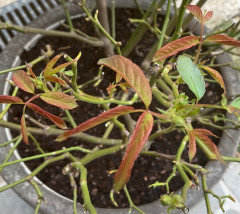
 2 years ago
Ingrid so movingly reported on her difficulties with climate change. Her garden got hotter and dryer and continuing her previous garden became unsustainable.
I do think we all need to be mindful in hot zones.
- 2 years ago
Bart, I appreciate your concern. We got a couple of days of gray, cooler weather, not much rain, but temperatures haven't ramped up yet again, and I have been out some, puttering around in the currently less threatening conditions. The heat won't last forever! Actually, my own body is sending me signals of change: after weeks of mainly eating salads of various kinds, today I was informed that roasted vegetables sounded like a good idea, and celery could find a place again in my diet, too.
Like you, I wonder about the effects of this weather on my aging, chronic-fatigue-afflicted body. Particularly as the high temperatures of this month didn't seem all that high; certainly nothing compared to what we lived through back in 2017, and yet repeatedly I felt on the brink of heat exhaustion. I have no answers, but it certainly does encourage me to keep on planting in an attempt to cool my local environment.
Speaking of planting, I'm going to risk being obnoxious be repeating my warnings about bay laurel. It's a weed. I was out doing cleanup a little distance from our big (30'x30') plant, and I was pulling up laurel seedlings all over the area where I was working. UNDER the multi-trunked tree itself, every time I'm in the area I pull dozens--hundreds--of seedlings; not once a year, but over and over again.
I've been pondering your hedge problem. A possibility that recently occurred to me is large-leafed privet, a common plant here, I don't know about where you are. This gets to be a large shrub, is evergreen, grows easily, seems to have a natural habit of somewhat higher than wide, and is pretty good looking. Like all privets of my acquaintance it needs to be hacked back every few years to keep it green and lush, though at least then you get the organic matter. I'm talking about the green-leaved, non-variegated kind.
And I will once more put in a word for photinia. I know you don't like the red new growth. But photinia is well behaved and tough. It seems to get along quite well for years without pruning, has (like the privet), a natural habit taller than wide, never looks terrible. Mature plants in favorable situations can get the size of a small tree, but not bigger than that (that I've seen). I've never known it to seed, though it flowers if not pruned at the right (wrong) moment. I don't know whether you've seen free-growing plants of it: to me they're more attractive than the slaughtered buzz-cut hedges covered with fresh red growth, which manage to be both boring and loud.
The problem as I understand it, is that you want good tall hedges that won't take over the garden, and plants for these are few and far between. Most tall hedges need pruning, and I know all about the pains and problems of that, from my struggles with yew and bay laurel. The two plants I mentioned earlier might get up to a useful size for you, without overgrowing it, and wouldn't need frequent pruning to keep them in bounds. There's also Portuguese laurel (related to English laurel, not bay laurel--two different botanical families). This can probably handle your conditions, but in my experience it grows slowly, and gets taller than wide, so I can't recommend it, not for hedging. Or Phillyrea latifolia, a fine evergreen, but very slow growing, at least in my garden. Then there are deciduous hedges, but that's a topic for another day.
I could think about this better if I actually knew what your garden looked like. This may all be quite off base.
NollieSpainZ9
Original Authorlast yearUpdate 2:
Well, I am humbled and gratified how a rose shrub can be completely torched, endure being totally defoliated and pruned back, all in the full 100+ heat of August, then bounce back to full, lush growth and bloom in less than a month..
This is Marie Pavie now: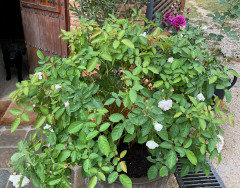
Rose de Rescht was also directly in the path of the hot wind and had all it’s foliage scorched. Unlike MP, it lacked any sign of new growth, so I pruned it back hard to bare sticks and crossed my fingers. From bare sticks to this in only three weeks: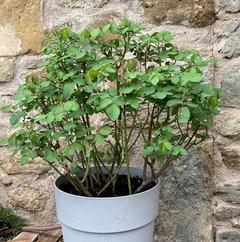
Thanks to all for your advice and support. I know roses are resilient, but nevertheless, I find their rapid rate of recovery quite astonishing!- last yearlast modified: last year
Glad to also see that you are growing the heavy petaled version of Marie Pavie, Nollie. Were did you get it? Stateside there are at least three Marie Pavies in commerce. Is yours grafted or own root, and if grafted, on what rootstock?
What a summer you've had! You know, even though my garden is zone 6 (I categorize it zone 5 simply because if I grow anything zone 6, rose or whatnot, it survives winter poorly.), my special microclimate is a miserable inferno because of the radiated heat generated by all the cement, asphalt, and brick in my city enclave. Just walking through my garden during the heat of the day is overwhelming. I water like crazy, and I didn't, defoliation would take over. As it is, the roses that have thinner foliage get fried considerably. They do bound back around now every year, but this year has been extra torturous, with daily highs in the 90°s, day after day. This means that with the heat index due to the high humidity, that it feels like 105-110°F when it's in the 90°s. Glad it is currently moderating.
Moses
NollieSpainZ9
Original Authorlast yearYour’e welcome Sheila, it’s always good to share a happy ending!
Moses, it was from Tuincentrum Lottum, a very economical Dutch nursery, grafted on Laxa, as practically all roses over here are. I assume it’s the ‘correct‘ one but wouldn’t really know, but it does seem to be the same rose sold throughout Europe.
Your inferno microclimate does sound thoroughly miserable. At least at my altitude, surrounded by evergreen oak forest and high river valleys, the nights do cool down somewhat. There are usually only a few hellish weeks in July and August when it doesn’t. Marie seems one of the few exceptions to the rule, but usually shiny, leathery foliage and blooms with good petal substance survive the heat and summer downpours here better than most. My little corner is classed as subtropical humid, although I have lost a few roses to late winter freezes and can get frosts that can kill off early growth as late as mid April - altitude again. Still, our love of roses keeps us going despite the climate increasingly conspiring against us!- last year
What a remarkable recovery!! I'm amazed!! And I'm proud of our rose community that they could help you so well. :) :)
- last year
My 'Marie Pavié' has done tolerably well on its own roots (clay soil, neutral to alkaline, on a slope).
 last year
That's wonderful to hear! More evidence that roses can be survivors and not the wimpy divas that some people consider them to be. Thanks for letting us know the progress.
Cynthia
 last year
Roses are such amazingly resilient plants! Thanks for sharing this with us, Nollie!
NollieSpainZ9
Original Authorlast yearGlad you all appreciate the feedback, it’s only polite to give it in my book, given you all took the time to offer your advice. If it helps others along the way, all the better. It is indeed a great community!
 last year
Nollie -- thanks for the update. We just had our own 106 degree days followed by "Sundowner" winds (the temp drops just as sun sets to about 80, and then the winds come down over the passes and we literally heat up 20 degrees in 20 minutes. Several of my plants are toasty right now. I knew it was coming, and I deep watered, but even so, some of the leaves are just burnt to a crisp. Thankfully, our heat wave ends tonight! Might even get mist in a few days!
NollieSpainZ9
Original Authorlast yearFinger’s crossed it does cool down for you DDinSB. Ugh, sundowner winds sound horrible - just as you and your plants are looking forward to it cooling off in the evening it does the opposite! Our hot African wind is called a Calima, which makes me think calamity, which they are!
- last yearlast modified: last year
Just got an email from Otto & Sons, a nursery about an hour and 15 minutes from me, in a hotter and dryer area, with even worse winds. Here are their tips on helping roses recover (all of which I think you already named...but sometimes it's nice to have the experts reassure us!):
Greetings!
I hope you managed to stay cool during last week's extreme heat. With temperatures soaring into the triple digits for five consecutive days, your roses may have experienced some stress and damage.
Now that the intense heat has subsided, there are several key steps you can take to help your roses recover and thrive.
Begin with a light pruning of your roses. Remove any damaged or dead branches and foliage to allow the plant to direct its energy towards producing fresh, healthy growth. This light trim will also stimulate a new flush of blooms that will last well into the fall.
The extreme temperatures stress plants, and a boost of nutrients will help them recover and encourage new growth and flowering. Be sure to use a balanced fertilizer or one specifically formulated for roses, and follow the instructions on the bag to ensure effective use of the fertilizer.
By taking these steps, you’ll help your roses ensure a stunning display of blooms as the weather cools down. I
- last year
Deborah, our summer included plenty of 100s with temps up to 107F. My roses look great, a verification that lots of water is the key to roses coming through heat waves just fine. My roses haven't had fertilizer since March. Water is the best fertilizer. Diane
- last yearlast modified: last year
I'm sure you're right, Diane. But last year I overwatered a couple of roses (I don't see how I did, but I did), and nearly lost them. Someone on the forum suggested my soil doesn't drain well, but I have to dig pretty deep to get a 5-gallon gopher wire cage in properly, and I've been amending most of my garden for 20 years now, so I don't think that's true. So I wonder if it's not the heat that bothers my roses just in terms of the temps, but the hot, dessicating winds that burn them, and so maybe I did overwater during a heatwave, but underwatered just before the winds. Hopefully I didn't overwater this year.
NollieSpainZ9
Original Authorlast yearDD, good to know Ottos agrees with the experts on here!
Diane I agree with you that water (and afternoon shade) are key to helping roses through intense heat, but there really is a big difference between heat and a scorchingly hot wind that literally burns your roses to a crisp. No amount of water can prevent that, unfortuntely, but I'm cheered immensely by their power of recovery afterwards.- last yearlast modified: last year
That's something that I'd never heard of before...it's almost like an invisible flame torch.
- last year
Exactly! Last year wind burned a couple of shrubs(not roses) so badly they didn’t recover.
NollieSpainZ9
Original Authorlast yearlast modified: last yearGot it in one Carol!
Although the rest have recovered, I think one of my standard tree roses might be toast. It has one green cane hanging in there on the north side but the rest are burnt leafless twigs. Oh but we’ve just had a bizarre arctic blast of icy cold air that plunged overnight temperatures by 30, yes THIRTY degrees, so that remaining cane will probably now die of shock or something!
- last year
We dropped 25F from mid nineties to high of 68F. Tuesday to Wednesday. Diane
- last year
Nollie...that must be incredibly hard on your roses. My goodness!!
Diane - that's quite the drop!
- last year
Just got back from a week's trip to the beach,and haven't yet gone out to my land. The weather changed drastically here, too-from 40 degrees Celsius every day to chilly and-thank Heaven-RAINY. I wonder how my already hideously stressed-out new implants will have fared; a few were near dead when I was last out there...
- last year
Barb bart - I'm glad you got some relief from the heat and that you got some rain. :)










Sheila z8a Rogue Valley OR