Software
Houzz Logo Print
roxanna_gw

taking cuttings of annuals

last year
last modified: last year

This year I bought some new-to-me annuals that have done superbly and I would love to take cuttings to grow on for next year as I may not find them for sale again. I have an excellent system indoors with shelving + plant lights.

Question = what are the chances for survival throughout the long winter months here in Massachusetts? Nothing ventured, nothing gained, I suppose! They will root easily -- one has already created roots along the upper stems without any encouragement on my part. These are coleus plants.

Is it worth a try?

Comments (14)

  • PRO
    last year

    Coleus is a perennial. It's just a tropical one, so it's usually used as an annual in places where the temps dip below 60. I've overwintered them indoors in the past, but haven't for a while.

    roxanna thanked beesneeds
  • last year

    Hurrah! Thank you both - I'll give it a try.


  • last year

    I don't know about coleus, but what I do is take cuttings in autumn (usually September) to grow on as "mother plants", from which I take cuttings in the late winter for a supply of annuals to plant-out during the season. I grow the mother plants in a sunny windowsill; if they get leggy or overgrown, I just trim them back. Works well for heliotrope and salvia.


    I do this because bringing plants inside can introduce bugs inside the house -- bring in teh plant, bring in the bugs if they're hitching a ride. Then it's a constant battle, depending on the particular pest. Taking cuttings, I just rinse them off well before sticking into the potting medium, and if by small chance there are some tiny eggs or something left on them, the pests will hatch inside the plastic bag or humidity dome I use when I root cuttings, they're trapped in there and I can easily off them. It's never happened yet, though...yet...


    The exception is geranium (pelargonium). Bugs leave them alone IME -- probably the scent of the foliage. So I trim back, rinse off the plant, rinse off all dirt from the roots, and pot up in fresh growing medium to grow on the windowsill over the winter. I do dig and over-winter my geraniums dormant (brown paper bag method), but that one mother plant is my insurance policy against losses. Which actually happened this year -- lost every.single.one of my dormant over-wintered geraniums and was able to grow cuttings and put the mother back outside this summer. No big deal for white ones, but there is a specific color within a series that I can't find anymore -- and you never met a color fuss-budget like me :0p.

    roxanna thanked porkchop_z5b_MI
  • last year
    last modified: last year

    Coleous grow fine indoors over winter — mother plants or cuttings. My grandfather (z5 NY) had a wicker plant stand, always with coleous in it, and he brought it inside to grow near his kitchen window every winter. Cuttings root very quickly in water, so I’ve seen many grown in a glass on a windowsill over winter.


    eta: I overwinter my pots of EE, several pelargoniums, and lantana. It gives me color in our dark winters! :)


    roxanna thanked party_music50
  • last year

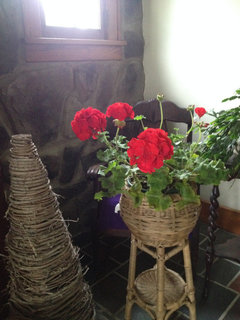
    ^^ That red geranium is stunning against the stone wall!

    roxanna thanked porkchop_z5b_MI
  • last year

    I've had good luck taking cuttings of a different Plectranthus. They get leggy over the winter (they don't get adequate light), but then I can either make new cuttings in the spring or trim them back when the light is better. I got it from a botanical garden, which takes cuttings each year for a mother plant that they use to take cuttings in the spring.


    I would take some cuttings, but be ready for the fact that they aren't going to look great in the spring. But you should have a plant that can generate some nice looking plants to plant outside when the weather is nice.

    roxanna thanked Sigrid
  • last year

    Excellent advice from mxk3, with no need for me to add anything from me. What annuals were you thinking of taking? I have never taken cuttings of true annuals...just tender perennials which are treated as annuals because of climate restrictions. I am not even sure that true annuals can be held in a vegetative state for indefinite lengths of time...it would be an interesting experiment if you have the specific lighting requirements (18hours, mostly blue spectrum). While I have taken cuttings from annuals (both soft tips and semi-ripe), I have never attempted to keep them in a vegetative state for any length of time (such as a winter)...because the plant genetics are demanding seed production (then death). No fat roots to sustain a plant over a winter because the main (only) purpose of annuals is to pass on the DNA through copious seed production.

    I do grow one 'annual' using lights and, like mixxy, I keep a 'mother plant. However, I have never really allowed my cuttings to grow away indefinitely (because space) but would be really interested to see how long you can keep it in a healthy vegetative state. I only grow my cuttings for around 2 months, then change the timing over into flowering mode (12 hours of continuous darkness). Mine will reach flowering maturity between 7-11 weeks (depending on variety). Seed production has been suppressed (feminisation)...so if I wanted to keep this particular strain of plant, I would possibly take a series of cuttings (cuttings from cuttings)...in this way, I have kept a desirable mother plant alive for years.

    I am really curious to hear how you get on, Roxanna.

    roxanna thanked HU-618169007
  • last year

    I want to try this with Zinnias. Are they true annuals? Do they have built-in senescence of some sort? Can you make several generations of cuttings to keep what you want living? I'm hoping it's possible. I think the biggest obstacle will be avoiding leaf problems like mildew or other fungal diseases when growing in less than optimal conditions (aka indoors under lights).

    roxanna thanked meconella
  • last year
    last modified: last year

    Hi meconella,

    "I want to try this with Zinnias. Are they true annuals? Do they have built-in senescence of some sort?"

    I believe Zinnias are true annuals. As far as I know, they do not have any built-in senescence. In past years, I have grown as many as three generations of zinnias from cuttings and developed a small garden full of zinnias with a common ancestor.

    ZM

    roxanna thanked zen_man
  • last year
    last modified: last year

    Hi Zen_man, we've 'talked' before a few years ago. I learned a lot from some of your information. :)

    In late February I planted some seed from Floret's Golden Hour. I planned to save seed from them (they are expensive). A bit later I made some new plants from cuttings, and later another small round of cuttings. (seedling --> cutting --> cutting) These latest ones, small plants, are now in the ground in the garden and growing well. When they get large enough, I'll do another round of cuttings. I've also been taking cuttings from particular plants of a Benary's Giant mix. I don't breed Zinnias, but I am practicing selection.

    I know Zinnias are considered annuals, and for most locations, that is, practically speaking, true. But in my warmer, frost-free climate (coastal Mediterranean) I'm finding some 'annual' plants can live much longer. If there is no built-in senescence, what would kill them if the plants are given enough warmth and light indoors in winter? I dunno. I'll give it a try.

    It's also so easy to grow them from seed, and there are good varieties available, most folks would not bother with cuttings. ....Unless it's something you love doing, and it's for more of a particular plant, or you just want larger plant starts much faster.

    roxanna thanked meconella
  • last year
    last modified: last year

    Hi meconella,

    "If there is no built-in senescence, what would kill them if the plants are given enough warmth and light indoors in winter? I dunno. I'll give it a try."

    Let us know your findings. Here in Kansas, we have a killing freeze by at least late October or early November, which keeps annuals "honest."

    Some people (not me) can grow zinnias using Tissue Culture as an ultimate extension of growing from cuttings. Tissue Culture is sort of like growing from cuttings, but the "cuttings" can be very small. I may try it someday, but not today. TC requires some special materials and equipment.

    This was one of my unique home-hybridized zinnias. You can click on the photos to open a larger version, and you can close the larger version by clicking on the "X" in the upper right-hand corner of the photo.

    ZM

    roxanna thanked zen_man
  • last year

    That is a very pretty Zinnia flower, Zman. I like the soft color. It's reminiscent of a Zinderella type.

    As for growing zinnias here over winter, that will have to be done inside. We don't get freezes, but it's still too cold for them to do well outside. Though about 3 years ago when I got some Floret seeds, after starting the seed inside, I transplanted them in containers outside (it was either late January /Feb/Mar?), raised 3 feet off the ground, against a S-facing window, and in sun from dawn to dusk. They grew and did bloom. Maybe I can nurse some indoor started cuttings in that same location. I'm most interested in doing this.

    Come next year, my plan is to sow seeds of various types, plant in the garden, and use cuttings to propagate only the individual plants I love. They root and grow so fast. Most root in about 10 days. Even this late summer I've filled 4 beds from cuttings and misc started seeds (packets and home-saved seeds).

  • last year
    last modified: last year

    Hi meconella,

    "As for growing zinnias here over winter, that will have to be done inside."

    I plan to grow a few zinnias indoors in our apartment this Winter. Not a lot, because of space limitations, but I can try some of my home hybridized hybrids of hybrids.

    ZM

    roxanna thanked zen_man
Sponsored