Software
Houzz Logo Print
bigislandbagels

Integrated / Built-in Dehumidifier

We just purchased a house in Hawaii and are just beginning to plan / coordinate an extensive whole-house remodel, inc becoming off-the-grid.
For the past 18 years we've been living in Colorado where our concerns have been adding moisture, and now we need to learn a whole new language. Not sure I even understand this new alphabet ....
While we're not sure we'll want a whole-house dehumidifier we already know we'll definitely need them in our closets + walk-in pantry, and for those areas they'll need to be integrated / tied-in, not portable units or ones where we'll have to empty tanks. We will have splits in the bedrooms and living area but aren't planning on using them much as we a) get tradewinds, b) will have ceiling fans, c) know we'll acclimate.
But not our food and textiles (clothing, linens).
I would so appreciate any guidance / links to figure out what to get for our walk-in pantry, clothing closets, linen closet.
Thank you for any guidance -- really appreciate it.

Comments (11)

  • PRO
    last year

    Adding a dehumidifier into your HVAC system design is smart, not only for comfort, but also for the longevity of the materials in your home. It's not that expensive. The units are maybe $1200-$1,500 plus any additional cost of connecting it to the mechanical. Having a separate dehumidifier connected to the system allows you to run the dehumidifier without having to run the AC, and it uses much less energy. I would do as much research on HVAC system design as possible before you start having HVAC contractors out to give you estimates. It will greatly depend on your budget, but a properly designed HVAC system will greatly improve the quality of your life.


    Top choice: get a HVAC design company (e.g., Positive Energy) first design your system before you bring in any contractors. They will talk to you about ERV and HRV systems like Zehnder, get you a Manual J analysis (and Manual S and Manual D) of the home so your system is not oversized (like almost all HVAC contractors do), and will help you design something that's ideal for your home. The issue here is that this will cost money and they'll design a great system that will likely cost more more to install.


    Second choice: do a bunch of research so you know what to require when hiring an HVAC contractor. In my experience, it requires you sticking to your guns and not getting talked out of things.

  • last year

    Getting the trade winds is what complicates humidity control.

  • PRO
    last year

    Hi, horseenabler,

    I think you've got three principal design objectives: 1.) to select construction materials, fixtures, finishes, and furnishings which are long-term sustainable in the local climate; 2.) to control indoor conditions for occupant comfort, and 3.) to control indoor conditions for occupant health, e.g., to prevent mold and mildew growth. Your ventilation strategy will be key to achieving no. 3. You have the benefit of your Hawaiian neighbors' years of experience. Ask around about what works and what doesn't.

  • last year

    Agree with posters about tradewinds etc.

    I wonder if it is even possible to control humidity well in closets and pantries. They would need to be pretty well sealed and doors would have to be kept closed. Then you would need supplies and returns in each of these small spaces. Perhaps you could just do a primary closet and a pantry. The duct work and install would be a lot of money for humidity control alone. Like $10k kind of number.

    Seems like small units that you plumb to a drain would be more reasonable. I have one I would just give you. All you would need to do is install a drain in the closet and pantry. It comes with a plastic hose.

    You would still want to have the doors relatively tight. Humidity travels easily through air infiltration. Better than temperature does.

  • PRO
    last year

    "Then you would need supplies and returns in each of these small spaces." If you install returns, the system will be in violation of mechanical code requirements which prohibit installation of returns in closets, and a number of other spaces. 2018 IRC, section M1602.2 (4)

  • PRO
    last year
    last modified: last year

    Climate controlling, or humidity controlling, just a part of a home runs into vapor sealing issues, and condensation issues. When old fashioned louvered doors and windows allow natural air ventilation for everything, you just need air movement from a fan to avoid too many issues. Thus, ceiling fans.

    When you have an internal dryzone, or cold zone, water vapor is going to want to equalize and penetrate it, so it gets a LOT more complicated with management. That's the paradox of climate control in moderate climates.

    Also, the desire to be off grid says zero home HVAC. That requires a substantial amount of electricity. If you want to be off grid, the house needs to be built like it was before electricity, with no insulation or vapor sealing in the wall cavity, the post and beams being built from rot resistant wood, and add just enough modern wiring for lights and maybe some sort of cooking device. You are going back to 1900 build standards.

  • last year
    last modified: last year

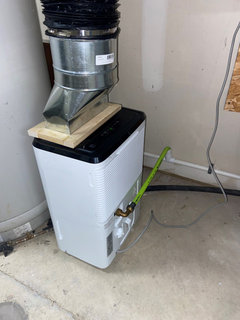
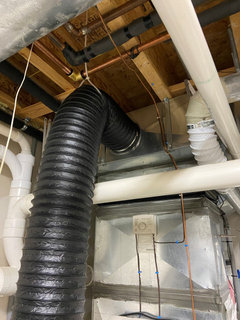
    I wouldn't fork out the $$$ for an integrated HVAC dehumidifier, and besides, I DID NOT want to call an inexperienced/expensive HVAC tech if there were problems, so I did something different with a free standing humidifier; I located the unit next to my HVAC system and plumbed the dehumidifier air outlet back into my furnace air return (where I set the ECM blower to run all the time - at least on the lowest speed) and plumbed the dehumidifier drain into the nearby A/C condensate drain line. So I get whole-house dehumidification without the issue of daily monitoring, all for under $375 (mostly) from Az, including a 4 year protection (replacement) plan. We're 3 years into this setup with no issues. The wooden/duct adapter I made sits on top of the unit and locates into the unit outlet with 1/4" wooden pegs epoxied in the duct fitting corners. The 8" duct is an Az item and connects to an 8" takeoff mounted in the HVAC return air duct.


  • last year
    last modified: last year

    Looking at it from the other end, you could go for a vacuum sealer to bag your perishables not stored in a freezer or frig. Zero humidity problems. You can get very close with a freezer ziplock and a straw. A lot of clothing could be stored the same way. Roll things up to limit wrinkles. Now you can open to the trades all you want.

  • last year
    last modified: last year

    See Building Science Corp. for information on whole house dehumidification.

    FWIW, in our Cold Climate Zone (that hits 100ºF.+ at times in the summer) we are using two stand-alone dehumidifiers with direct drains in the basement only to control summer humidity. Been using that setup for four decades on many homes. Seems to work.

  • PRO
    last year

    Basements are problematic with respect to dehumidification since they typically have no cooling load and thus, no potential for dehumidification via air conditioning. That's where a stand-alone dehumidifier works well. I have an integrated dehumidifier on each of the two levels of my home to provide dehumidification in shoulder seaons when neither heating nor cooling is required.