Software
Houzz Logo Print
alexander_bridges

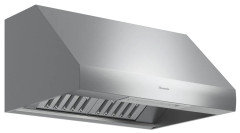
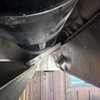
Vent hood with steep baffle angle

Hi everyone - we're remodeling our kitchen to improve ventilation. I'm stronly considering a commercial hood from HoodMart to achieve excellent capture area and containment volume, large ducts with silencer, powerful remote blower, and active make up air. I've read the FAQs and guides on this site.


BUT, does anyone know of a "residential" range hood model that actually has decent containment volume? All the hoods I see have flat or low-angle baffles rather than the >= 45 deg seen in commercial models. I assume this is for two reasons:


1. Commercial kitchens must drain grease from baffles

2. "Residential" hoods are designed to accommodate internal blowers, even if the user chooses a remote blower option


Anyone know of a non-commercial hood model that is designed specifically with remote blowers in mind, with baffles angled up?


Comments (14)

  • last year
    last modified: last year

    The Thermador PH 36GWS has angled baffles and a grease tray. And it can accomodate integral, inline, and remote blowers.


  • last year

    Thanks for your replies.


    John - Could you provide a picture of your setup? I'd like a commercial setup and in fact have a quote from HoodMart, but our kitchen is small, and family is concerned about an overwhelming structure. I've seen the photos around opaone's Accurex hood that features here on the forums frequently. Would be helpful to see another commercial hood in a residential setup.


    Eam44 - thanks for the link. Wifi in a hood seems... interesting, but it certainly addresses my question about angled baffles. Much appreciated.

  • last year

    On the plus side, if it had speakers it could provide the bass for all those raves you’ll be throwing in your kitchen. WiFi vent hoods 😏

  • last year
    last modified: last year

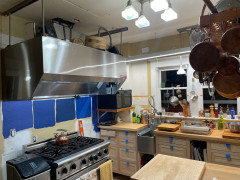
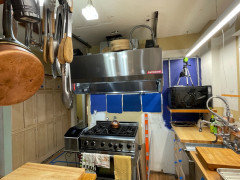
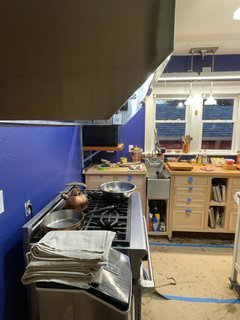
    Sorry, kitchen is a work-in-progress and a mess. Among the to-do’s is a surround to cover the above-hood void in my particular installation. After I put bigger speakers and a subwoofer up there . . . with a WiFi receiver.


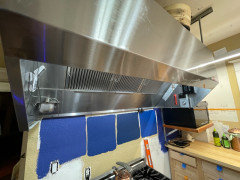
    I think you have to accept or embrace the commercial look of the thing, as well as its size. It just is not “pretty” and can’t be. Maybe a good cabinet maker could disguise it, I don’t know.


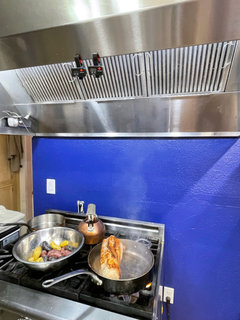
    Cooking with the hood is great. Nothing but nothing escapes the hood at full CFM. I’ve done silly and slightly dangerous things like pouring water into pans of hot oil to see if I could create a cloud that the hood won’t capture, and so far haven’t been successful. I’ve also ignited three foot high flares when wok cooking, and the hood doesn’t care. There are side panels too, but mine got in the way.


    You actually stand under the hood, so it feels and is spacious with no hood leading edge in your face. With this size hood and so much capture volume, the standard residential kitchen rules about maximum height from burner to hood don’t apply.


  • last year

    I just noticed CaptiveAire have the “WRH” line, for “residential appliance used in a commercial setting“, whatever that means. They have the fan built into the hood, and mount to the wall instead of hanging from the ceiling. Max CFM is 800 but with that much capture volume, that might be plenty. My fan/duct combination only pulls 1000 CFM (calculated by CaptiveAire) as I got the small 120v fan, not the bigger 220v fans. It is ample.

  • last year

    John - This is extremely helpful, thank you. I appreciate seeing it from different angles. I've reached out to HoodMart regarding a 30" deep option. Will see what the family will embrace. Cheers.

  • last year

    New maxim: The better the hood the harder it is to actually embrace.

  • last year

    If your capacity for embracing goes only so far, the Thermador that eam linked to looks pretty great for a residential hood. It isn’t very deep (27”) though.


    On noise, I have a view that probably differs from most. I think that if the hood capture is very effective, so that you can usually run it at low rpm, then I don’t care too much if it is loud at high rpm, because you’ll seldom run high rpm and then only briefly.


    In that case I’d personally prioritize ease of installation, repair, etc over being quieter at high rpm.


  • last year

    I would say that if the hood capture volume (reservoir) is large enough to allow plume averaging where the plumes reach the baffle area, then you may be able to run the hood at low rpm (low CFM), assuming also that the nature of the reservoir shape minimizes reflection and escape. The requirement, then, is that the blower CFM actually achieved given pressure losses in the loop from cooktop to outside to cooktop must equal or exceed the CFM of the plume or plumes being captured.

    Plume CFM is plume area (pi times plume radius squared, in sq. ft.) times plume velocity (potentially up to 240 ft/min). Usually, one is not searing on all burners, so plume averaging allows modest CFM to be successful with large reservoir commercial configurations.

    Without such baffle averaging in typical residential hood low-tilt baffle designs near the hood base, the plume CFM has to be met or exceeded by the sub-area of the baffle space impinged upon and hence the overall CFM has to be higher by a factor of the reciprocal of the fraction of baffle space that is effective.


  • last year

    So one burner with a 12” diameter pan cranking out plume might need 200 CFM? 3.14 * ( 0.5 ^ 2 ) * 240 = 188. Typical heavy range use for me might be two burners simmering, two sauteeing or searing or stirfrying, maybe one with a sauce holding or something. Not like a commercial kitchen where the saute station is firing all six burners all the time.


    My main regret is that I didn’t mount the hood higher. It would have been difficult but I think possible. I’ve always wanted a salamander but there’s no room with the hood that low.

  • last year
    last modified: last year

    Yes, but it isn't clear to me that your hood is tall enough for full mixing. In any case, keep Figure 4 of the "Greenheck Guide" in mind.

    https://www.tagengineering.ca/wp-content/uploads/2015/02/KVSApplDesign_catalog.pdf

    Edit: For some reason, over the past 10 hours I haven't been able to add the actual figure, either as .png or .jpg.

  • last year
    last modified: last year

    The interior upper surface in the hood is about 7’ 3”. The lip at front is a bit over 6’; I wanted to be able to stand and move under the hood without ducking. The hood extends several inches past the range burners; I hung it with about 1“ clearance to the wall (on top of the built-in 3” standoff). Eventually I’ll push the range all the way back to the wall and increase that distance a bit.


    Seared a pork loin today, plume of smoking oil no issue at all.


  • last year

    The proof is in the pudding. If you do your worst (plume-wise) and the hood fully captures and contains the plume(s), then speculation based on mental attempts at CFD is no longer useful.