Software
Houzz Logo Print
lhatthesea

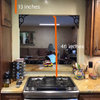
range in half wall - hood and venting reccommendations

11 months ago

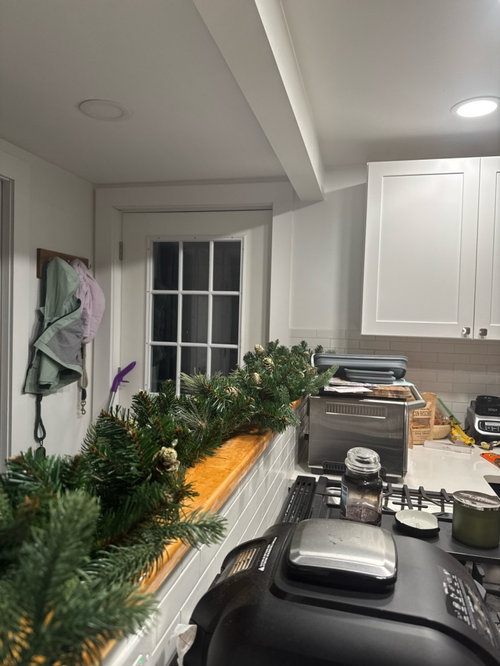
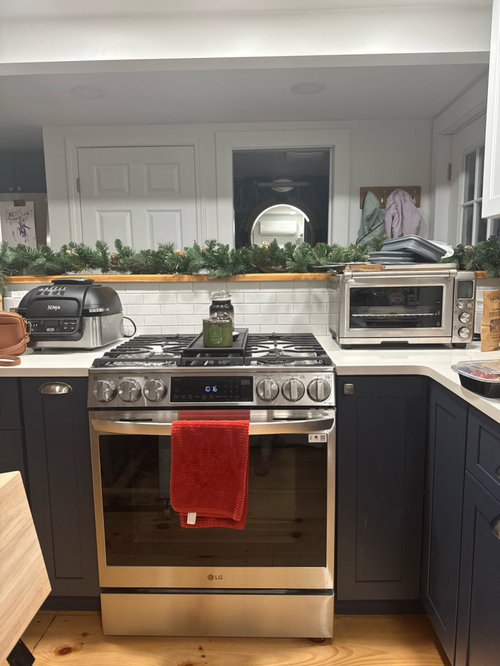
I'm looking for advice on choosing a range hood that I can install over a range situated on half wall and best way to vent to the outside. We are not looking to change the half wall as it opens up the kitchen. We're also hoping for something subtle, on the smaller side, that ideally will not hang too low. It is not going to be possible to vent this up so I was hoping to run the ductwork along the beam to the outside and perhaps build a soffit around it.

This is an 1800's colonial duplex that we remodeled. The kitchen has wide pine floors and 'weathered' brick wall so an ultra modern style would not be ideal. Behind the half wall is the back door, 1/4 bath, laundry closet, fridge and pantry.

I appreciate your recommendations.

Comments (8)

  • 11 months ago

    First, please remove the flammable decor from the range and Breville area. You are giving me a heart attack!


    on the smaller side, that ideally will not hang too low


    Yikes, I want to talk to the person who designed your kitchen and ask what they were thinking by not putting your range on an exterior wall and floating it in the middle of the kitchen.


    There are standard calculations for the size hood and how low to hang it that are determined by your BTUs and size range. (Others here know more than I.) I believe 24-36" above the range is the height recommendation, which is very low, and is really going to obstruct the look of your kitchen even with a small hood. But the purpose of it is to capture grease, odor, fumes. If you are not going to install it in such a way as to be maximally effective, you might want to reconsider if it is worth it to have one at all.


  • 11 months ago

    The wood shelf running behind the range is also flammable. Look at your specs, but I’d be surprised if that’s not a hazard.

  • PRO
    11 months ago

    WOW the venting is the least of the issues . First that wood has to go who ever designed this should be shot sorry. Worst place for a range and a gas one needs venting and proper venting. You need to show us the whole space and honestly be preapred for some pretty harsh comments . Waht you have would never meet code and IMO you willneed to rethink this layout. for sure

  • PRO
    11 months ago

    Any good island hood of at least 600-900 CFM , plus a 90 in the duct, to run it outside will work. Ventahood, Broan, Faber,,etc. You will need at least 36" wide by 27" deep, and an 8" duct. It needs to hang 30"-36" above the range, and obviously be non combustible.

  • 11 months ago

    McDonald Enterprises above covers the gist of it. Typically, island hoods do not vent sideways, but you will need (if that is an 8-foot ceiling) a duct cover (chimney) to hang the island hood from, so the duct transition to horizontal can potentially be performed in the chimney zone.

    Note that the higher you have the entry aperture of the hood, the less room you have for the 90-degree bend, and the larger the hood entry aperture should be to capture rising and expanding plumes. You don't have that much scenery behind, so I wouldn't worry about a 36-inch (or less) hood base height.

    In the attached image, I use a Wolf Pro Island hood. It ducts up but given some fabrication from a sheet metal shop could potentially duct sideways. Ignore the greater width than you need, I have an induction wok positioned next to my cooktop.

    There are certainly other island hoods than Wolf, so you will have to troll through the hoard of possibilities. Perhaps starting with the many multi-manufacturer on-line stores (e.g., AJ Madison) will allow comparison of features and sizes such that the hood and chimney section can be compatible with your beam. Note that the center of the hood intake aperture should ideally be aligned with the center of your burner array, front-to-back-wise. The chimney section and horizontal path the the wall could be painted white.

    An inlet piece of soapstone could deal with the wood surface behind the range. Since grease splatters there, soapstone might be easier to clean than granite, which can be porous. Otherwise, a white granite might work.

    Last, there are requirements for distance from combustibles that apply to ranges, and these may be found in the installation requirements. Combustibles include those in the half-wall behind the range. My thinking is that your hot rear oven vent is probably far enough from whatever wood is behind the tile, but that needs to be checked.


    (You can find this hood shape in Wolf's Design Guide. What this image reveals above the hood base is mostly the chimney section that the pyramidal hood attaches to. This hood is mounted to an 8-ft ceiling and has a 10-inch duct into an attic.)

  • 11 months ago

    Thank you all for your replies. The placement of appliances was quite a challenge as 1) the kitchen area is very small, 2) there is only one exterior wall and because it's a duplex, we were very limited on what we could do (i.e. couldn't move windows). The 'before' also had the stove on a half wall (no venting). Not that I’m saying it’s OK, but I now understand the previous owners must’ve run into the same situation.

    While our preference was for a smaller hood (some of them are MASSIVE), we will install whatever is necessary for maximum efficiency using the space we have. I'll definitely check out what is available and efficient at 36" above the range.

    The greenery is now gone. Also, I really like the idea of soapstone to replace the wood, so thank you for that suggestion. I'll also check out the various sources that were recommended.

  • 11 months ago

    You may also consider swapping the gas range for induction. Google gas ranges and the importance of venting. Sure, grease and cooking smells require a good hood to be managed well, but if you stick with gas you can’t get away with subpar venting and not have negative health effects. Staying with gas means you need no less than what McDonald says for safety, not efficiency.

  • 11 months ago

    Yep, have dealt with the small duplex factor before too. But if you are venting with a 90-degree turn, why could you not have put the range on the shared wall and also had a 90-degree turn that then exists the same wall you are exiting now? Water under the bridge I suspect!

Sponsored
SK Interiors
Average rating: 5 out of 5 stars55 Reviews
Loudoun County's Top Kitchen & Bath Designer I Best of Houzz 2014-2025