Software
Houzz Logo Print
jdpyn2

Hearth for wood stove

10 months ago
last modified: 10 months ago

I'm in the middle of building a hearth for a wood stove.

The home is pier and beam and I am comfortable with the floor support. There are three beams supporting the floor that are under the footprint of the hearth. During the remodel, I added a layer of 3/4" T&G OSB on top of the existing floor for a total of about 2 1/2" of decking.

Yesterday I cut some dura-rock tile backer and set it into a bed of large-format tile mastic (EDIT: thin set, not mastic) on the plywood decking to provide a good even base for the hearth. The backer also helps with my flooring concept...as a spacer. Next, I plan to apply another layer of mastic (Edit: thin set, not mastic) to the top surface of the tile backer and set the hearth stones. I'm using three 2'X4'X2 1/4" limestone slabs for the base of the hearth for a completed 4'X6'X2 1/4" footprint. The three slab ends will butt against the wall behind the stove (centered along a wall) so I don't have easy access to stand at the wall end of the blocks while setting them into the mastic. Therein lies the problem I'm hoping for someone to help me solve. It's going to be difficult to set the limestone blocks into the mastic without mashing the mastic out wherever the limestone block comes down first. The blocks are about 170 lbs each so it will be a two-person job lowering the slabs into the mastic. I want the three slabs to be very even and very well supported since I will be building up from the base with more limestone slabs tuned on their sides to form a wood-box under the stove. The stove itself weighs 400 lbs.

Are there any tricks to help me lower the slabs into the thin set evenly? I have done quite a bit of tile work and have learned it's a lot easier to lay a tile into the mastic level and even, in the first place, rather than putting one side of the tile down and then lowering the other and trying to re-distribute the thin set so the tile is both level and has an even layer of thin set under it for support.

Comments (10)

  • 10 months ago
    last modified: 10 months ago

    Ok, I came up with a solution

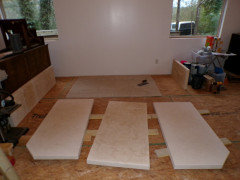
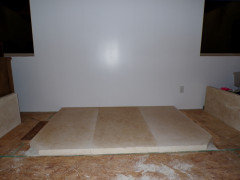
    Here is a general photo showing the location and the limestone slabs. The Dura-rock (Hardi-backer) is already set in thin set along the wall in the background.


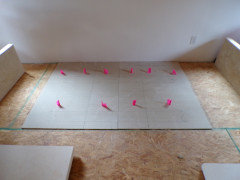
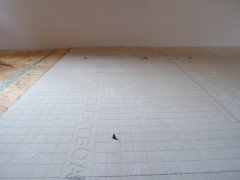
    I drilled pilot holes through the dura-rock and through the decking and dropped flagging wires into the holes so I could find them from underneath the house.


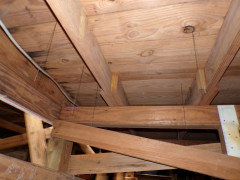
    Here are the flagging wires showing the locations of the pilot holes under the house


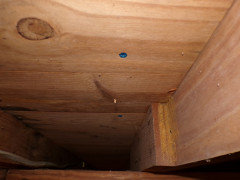
    Next I removed the flagging wires and ran a long screw up through the floor from under the house.


    The screws extend about 1/2-inch above the surface of the dura-rock. I ground the tips down a bit.


    Next I spread the thin set and carefully set the slabs down so they were supported just above the thin set, repositioned the slabs as necessary so they were in the right place. Then I went under the house and backed the screws out, lowering the slabs onto the mastic. It only took a little work then with a straight piece of lumber to settle the slabs into the thin set.


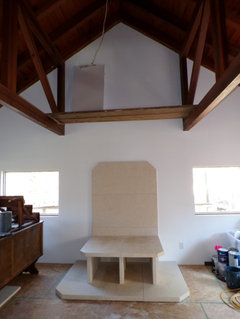
    I'll let this set overnight before beginning the slabs I'll set against the wall. Those slabs are thinner and won't be as difficult to handle. Once the backer is on the wall, I have some slabs cut (just visible in the photo above at far right and left) that will stand at right, left, and middle to support the surface slabs. The final project will be a hearth that will elevate the stove about 16" and will have space underneath to store firewood.

  • 10 months ago

    jrb451, yes, in this case it was just a brainstorm, realizing I had access to underneath the floor. I was stuck in a box of thinking I had to do all the work on top.

    Delta Systems. Thanks for the pointers but I used mastic (possibly not the term on the bag) that is designed for large format tile....floor tile included...so I'm quite sure it will set....that reminds me, "thinset" is probably the correct term for the material, not mastic. Your deflection ratings sound good but I'm turning the joints so the stone will move along the joints if the floor moves significantly, which I think is unlikely. If I were applying weight perpendicular to the long axis of the slabs, then you would be more likely to have made an accurate prediction regarding breakage.

  • 10 months ago
    last modified: 10 months ago

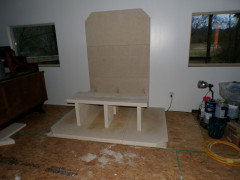
    I'll try to show the final look as I have time but here is an intermediate stage that may give some folks ideas for brainstorming similar projects. The floor slabs are installed and the wall pieces are also installed (with large-format tile thin set). The three rows of upright pieces are not permanently installed yet. I have two slabs (2' X 3') that will lay on top for the stove to sit on. They will run perpendicular with the wall (seam along the middle support) so the top slabs shouldn't be prone to cracking if my floor moves. I plan to use an adhesive designed for stone, probably in concert with a few thin metal plates (Simpson ties) attached underneath the top slabs to keep them from moving apart along the middle seam. I think the metal plates are critical since I doubt any adhesive will adhere well to limestone.

    The floor slabs are a foot wider on each side than the backer slabs on the wall. I plan to do something like stacked stone veneer on either side of the wall slabs to make up the difference. I also have some black granite tile that would look good with the black stove, or some wood that will match the widow sills (yet to be installed) as an alternative.


  • 10 months ago
    last modified: 10 months ago

    Deleting the Simpson ties concept. I tested a Gorilla caulk (think a Gorilla version of silicone) which bonds very well....couldn't break apart some test pieces I bonded and I think will have a little more microscopic flex than thin set. I am using the Gorilla silicone to bond all of the seams other than the slabs flat on the floor and flat against the wall.

  • 10 months ago
    last modified: 10 months ago

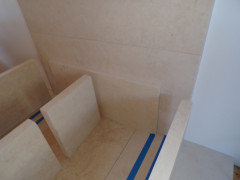
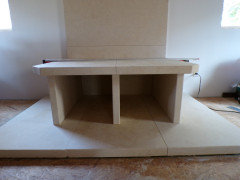
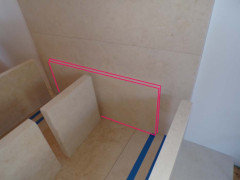
    To keep the support slabs from tipping sideways should the adhesive ever fail, I cut a slab to fit between the outer "legs" and under the surface slab. I adhered this piece to the back wall.


    Next I glued down the support legs and then set the surface slabs. I used a saw cut guide to help clamp the two slabs together, spreading the adhesive joining the two common edges between them.


    And here is the bigger picture showing more of the room.

    Next step is to install the chimney pipe. I'm doing a 30-degree wall penetration so I'll be cutting an oval hole in the sheetrock and another oval hole in the exterior siding (1/2" plywood sheathing and Hardi-siding).


  • 9 months ago

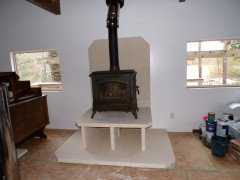
    Photo update on the hearth showing the stove and chimney. I did a 30-degree exit through the wall rather than making an exit through the cathedral ceiling.


  • 9 months ago

    Interesting look. Different than what I’d first envisioned from your original post. I hope that, over time, the heat from your stove doesn’t weaken the bond used on the support slabs and base.


    You’re going to put a ceiling fan in that cathedral ceiling, right?

    John 9a thanked jrb451
  • 9 months ago
    last modified: 9 months ago

    Yes, I actually have two ceiling fans but neither is at the highest part of the cathedral ceiling. I have two vents high on the wall opposite the stove. Those vents should allow warm air to be drawn off the ceiling area and into two upstairs rooms. I also have a location upstairs for my HVAC unit and should be able to circulate the warm air throughout the 1,300 sq ft home just by running the HVAC fan. I got the last two chimney pipe parts in today and hope to finish the outdoor part of the chimney tomorrow. My supplier had several parts on back order or I would have been able to finish work sooner and use the heater during this cold snap.

    The jury will be out on the adhesive for many years I guess but I think it will hold for a very long time. The limestone shouldn't get too hot since the stove has heat shields on the back and underneath. It's a silicone-based adhesive and I think that stuff is pretty heat resistant, although it's not the high-temp stuff. That being said, I think that unit would be fairly stable with zero adhesive....but certainly wouldn't feel comfortable without it! I posted this photo above but the stabilizing piece that gives me some confidence doesn't show up well. I highlighted it here. That piece is trapped between the right and left support blocks and it's partly supporting the platform the stove sits on so it gives the back of the platform a lot of stability. The adhesive mainly ensures the front of the platform doesn't shift if someone really plows into the stove some day.


    I think this is a fairly unique build so hopefully it will help others brainstorm ideas for their own projects. FYI, the limestone slabs were sourced from a local landscaping business. They were $60 each.

  • 2 months ago

    Would love to see a photo of completion! Looks like it will be lovely!