Software
Houzz Logo Print
central_valley

Salt-curing olives, a question

As an experiment, I'm salt-curing some olives for the first time. I've read that the olives should be kept completely submerged, or they'll turn brown. That's a problem, since most of them float.


I looked for a container with a floating cover to hold the olives down, but I couldn't find anything like that.


As a substitute, I put the olives in a two-liter canning jar, filled it with salt water up to the brim, and put a lid on it. Is that likely to be good enough? If not, can someone suggest a better way?


If this year's experiment is successful I want to cure a lot more olives next year, so the canning jar technique isn't going to work unless I fill the kitchen counter with canning jars!

Comments (19)

  • last year

    If you can purge all of the air from the jar you could then turn it upside down. The olives would then float up to the bottom of the jar and not be exposed to air as long as all air bubbles were purged.

  • last year
    last modified: last year

    @floral_uk: That's the kind of solution I had in mind. I didn't think of a plate because I can't imagine where I'd find a plate that's small enough to fit into the mouth of a two-liter canning jar.

    Maybe I should be looking for a straight-sided glass or ceramic vessel that is large enough to hold a plate.

    @vgkg_z-7_Va: That doesn't really make sense to me. If I could purge all of the air from the jar, I wouldn't have to turn it upside down.

    I tried to get all the air out before I sealed the jar. I just turned it upside down to see, and there's a little air in it... I'd guess about 30 ml. Maybe I succeeded in excluding all of the air, and what I see is gas emitted by the olives after I put the top on. I can try again when I change the water in a few days and see whether I'm starting without "air."

  • last year
    last modified: last year

    I don't know the diameter of your 2 litre jar. Perhaps you could use a plastic bag filled with water instead of the plate. Or a scale weight wrapped in plastic. Or a can of tomatoes. Or a tumbler.


    central_valley thanked floral_uk z.8/9 SW UK
  • last year

    The jar is square with rounded corners, about 10 cm on a side, but the mouth is about 7.5 cm.


    The bag filled with water is an interesting idea, and I'll try it when I next change the water. The can wouldn't work because it would prevent me from putting a cover on the jar. It is supposed to be covered to prevent contamination by whatever is floating in the air.

  • PRO
    last year
    last modified: last year

    Get a small plastic flexible cutting board. Cut it to fit the inside of your container, leaving a little bit of a gap of the edges. You flex it a little to get it in the mouth of the jar. Use a utensil when you pick it out of the brine again. You don't want to contaminate a batch at the end by sticking your fingers in there.

    You have options for weights. You can use ziplock bag filled with little glass decor pebbles as your weight. Filling a bag with brine water works too. If you can find pickle weights, great. They are just solid glass weights. Or look around the thrift shops for a solid glass paperweight of the right size. If your jar has a standard canning jar kind of screw, there are spring lids to keep stuff submerged.

    Also, instead of a solid lid, you can use a coffee filter as your cover if your weight is sticking out a bit. Use a rubber band to keep it on.

    If in the future you find you want to do bigger batches. You can look for fermenting crocks or barrels. They are expensive, but are made for this. But you can also use food safe buckets.

  • last year

    Thank you --- pickling weights are exactly what I want. I reinvented them in my head, but I had no idea what they were called, so I couldn't look for them.


    All the ones I've seen so far are solid glass, though, so if the jar isn't full of solid matter up to the neck, they'll sink into the jar rather than sit on top. I hope I can find one that floats, so I don't have to fill the jar almost all the way to make it work.

  • PRO
    last year

    They are pickle weights, not pickle floats. If a pickle weight sinks into the jar- you did not pack your jar right. Even if you only have a jar a quarter full of solids, a pickle weight still works fine if you packed the jar right. My pickling weights are glass, but all my fermenting weights are ceramic and came with their fermenters.

    Keep it simple with fermenting. As clean as possible. Pack your jar evenly and firmly. Make sure you note down your brine ratio and keep it with your fermenter just in case you need to do a top off.


    central_valley thanked beesneeds
  • last year
    last modified: last year

    "Even if you only have a jar a quarter full of solids, a pickle weight still works fine if you packed the jar right."

    I don't understand how that can be so.

    I see how it could be made to work if your pickles (or my olives) were almost as long asthe jar is high. You could stand them on end and let the weight rest on the upper ends. But pickles are not shaped that way, and olives even less so.

    I guess you could fill the jar part-way with inert objects like glass marbles. I think someone mentioned such an item earlier in the thread. But it seems like a very hard way to do something that could be simple.

    My thought is that a float will sink some distance into the brining solution and push any floating olives down out of contact with air. The only conditions are that the float be light enough not to sink and wide enough to leave no room for olives to float to the surface beside it.

    Another thought: if you glue something like a paint stirring stick across the top of a weight, it will fill the mouth of the jar but won't sink in.

  • PRO
    last year

    You pack your jar. Make sure it's even and firmly packed. Put your weight on top. Pour in your brine. Cover your container. People have been doing it this way for centuries. I've been doing it this way successfully for decades.

    I was the one that mentioned glass marbles. No, do not put them in to part fill the jar. You can use them inside a plastic bag to use as a weight on top of your olives.

  • last year

    Sorry, the bag of marbles sounds unreliable to me. Marbles are a lot heavier than water, so what's to prevent the marbles from shifting so that the bag's vertical dimension increases and its horizontal dimensions decrease, and the whole bag sinks into the brine while the floating olives pop up to the surface around it? This is a tipping-point problem: you can probably make the bag stay when you put it in, but if it gets too far out of balance, for any reason at any time during the curing process, it could sink.


    As for packing the jar, sorry, as you've described it, it can't work. If you put a heavy object in the jar it's going to sink until it rests on something solid, and if the contents don't fill enough of the space in the jar, it will sink below the mouth and leave the mouth open. If people have been "doing it for centuries," they've been doing something more than you've described, and what they've been doing isn't obvious.


    I changed the water last night and tried to exclude all of the air by putting a heap on it. I still got air in the jar, but very little; I estimated 2 to 3 ml. I think that when the jar is upright, this amount of water will remain in the raised rim of the lid (a canning lid), out of contact with the olives.


    When I emptied the jar I could smell the olives, and they smelled like cured black olives. After only two changes of water (three weeks), I consider that pretty encouraging.)

  • last year
    last modified: last year

    Can you post a picture of your arrangement? I'm having trouble understanding what the problem is. Maybe I'm misunderstanding your set up.


    Marbles or brine in a plastic bag would spread out horizontally. They can't defy gravity and rise vertically. The bag will also act as a lid so it doesn't matter if it doesn't reach the rim if the jar. Although you have made it harder for yourself by using a rectangular jar.

  • PRO
    last year

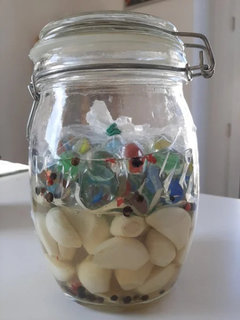
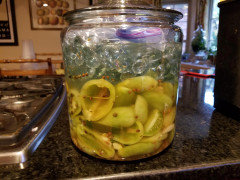
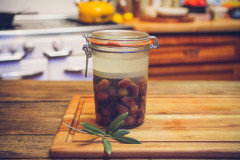
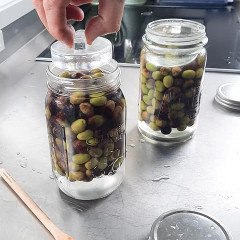
    Here of some images of ferments, as I have described it. The weights are being correctly used on top of what is being fermented.

    This is a partially filled jar of garlic, with a bag of glass as it's weight:


    This is a jar of tomatoes with a bag of glass as it's weight:


    This is a jar of olives, with a ceramic pickle weight:


    These are jars of olives, with glass pickle weights:


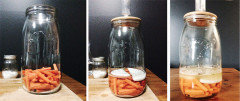
    And this is a Kilner fermenting jar- one of the kind I like to use most. It shows how you can do a partially filled jar, use the weights, and carrots as they ferment:


  • last year

    Exactly as I was imagining, beesneeds. I don't think it's as complicated as OP fears.

  • PRO
    last year

    Yes floral, not complicated. It's part of why fermenting like this has been done for centuries. It is fast and easy to set up. Just patience after that. I'm not sure what the OP is thinking of, so I figured some pics would help.

  • last year

    OK, I see what you're doing now. You use a big bag of marbles that doesn't just push the floating olives down into the brine, it sinks all the way to the bottom and spreads out so that all of the olives are trapped underneath. Yes, that would work.


    I wouldn't want to put a plastic bag in my brine, though for the same reason that I wouldn't want to use a plastic container: microparticles shed by the plastic into the solution. Is there a cleaner alternativ? Somehow I suspect that whatever great-grandma used before there were plastic bags was worse.

  • last year

    You could use a fabric or mesh bag. The pickling brine would soak into it and the marbles would still hold the pickles down.

  • PRO
    last year

    Great grandma used weights made of glass, ceramic, stone, brick, wood, and sometimes oak or grape leaves for the tannins. Using a bag of glass is a really recent thing. How ggma fermented and stored was a bit differen too. Back then they tended to ferment at lower temps like a cellar and then it kept stable there without refrigeration to stop the ferment. More modern, we tend to ferment faster at warmer house temps and then stop the process with refrigeration.

    Don't use fabric in your ferment. Natural fibers can help promote molds and other nasties in your ferment. Lacto ferments behave a bit differently than ethanol ferments- both need the same kind of clean and patience. But you can't treat them the same. Lacto is bacteria driven, ethanol is fungi driven.

    Also, more direct to olives. Wood ash (lye) was often used as part of a salt cure to help take the bitter out of fresh olives. It's still pretty commonly used, commercially and for home use. Often olives are cured before they are brined instead of fermenting them. Some folks also like to dry their fresh olives in a low and slow oven- the chemical that causes bitterness starts to become destroyed at 140F- a common drying and dehydrating temp.

  • last year
    last modified: last year

    I stand corrected on the fabric bag. I assumed it would be ok if sterilized before use, as one does with a jelly bag.

Sponsored
Daniel Home
Average rating: 4.8 out of 5 stars20 Reviews
Premier Interior Design Team Transforming Spaces in Franklin Co, Ohio