Software
Houzz Logo Print
raymondz7a

Cornus kousa 'Summer Gold' possibly diseased

last year
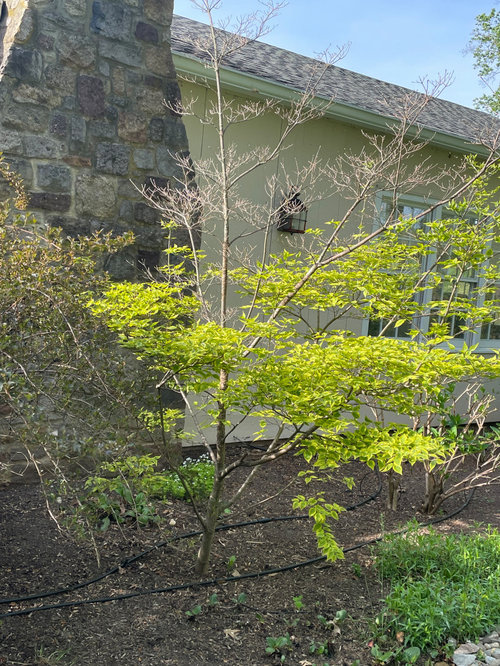


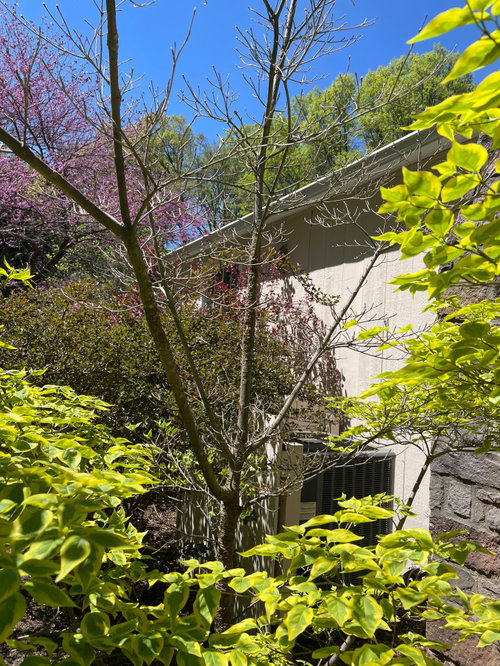
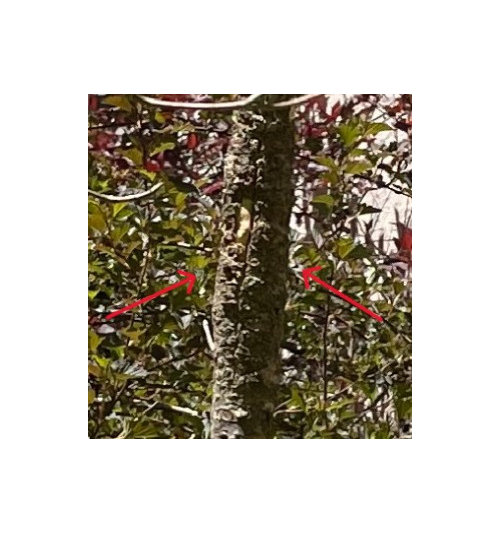
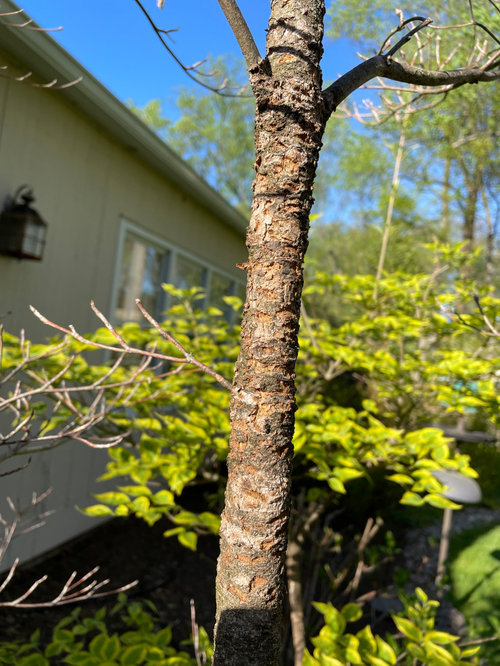
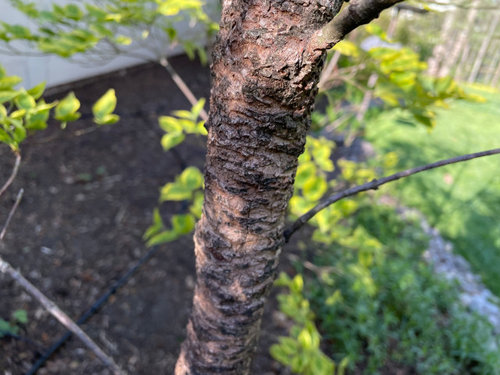
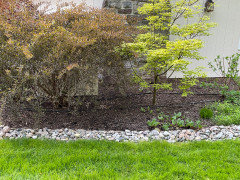
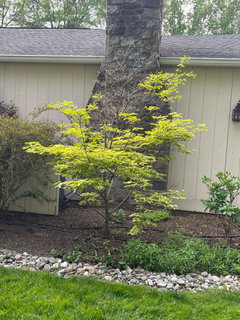
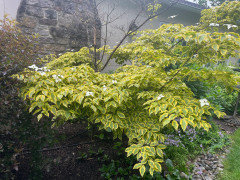
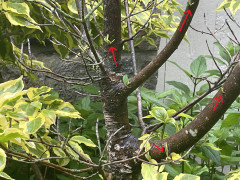
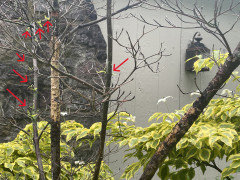
Good morning - this is my first post on Houzz. I would appreciate your thoughts and opinions on the possibility of disease affecting a tree. The tree is a Cornus kousa 'Summer Gold' and it has been in the ground about 10 years. I recently noticed that the upper parts of the tree have buds but is not leafing out. I have included some pictures of the tree and of the trunk - the bark looks odd, but this is a dogwood. Also, I noticed that there appears to be a vertical fissure on the upper trunk. I believe the upper branches are alive – I scraped the bark and saw green. I'm located in SE PA Z7a and precipitation conditions have been 'moderate drought' since 2024 and currently 'abnormally dry'. Yesterday, I was able to connect an outdoor water source and irrigate the tree - about 90 minutes slow drip. I am monitoring the tree to see if the upper branches are leafing out and as of this post they are not. Thanks for any help.

Comments (25)

  • last year
    last modified: last year

    Did this huge amount of bark injury and dieback happen just this FY? (i.e., in last 12 months) I'm at a loss, they are generally healthy trees, and not especially prone to any diseases. Is it possible: it got dry last summer, so tree started to look stressed, then you decided at some point to irrigate it towards the end of summer...maybe even fertilize it...that put it into a big flush of growth in the fall, which didn't harder off in time and was damaged by cold? Or maybe you even overwatered and it got some root rot.

    Curious to see what insights other people have on this. It's generally not a HD/Lowes plant (though I suppose it could be) and you're in SE PA which implies you might take horticulture a little more seriously than a random cross section of Americans...? Your post seems to suggest it has been smooth sailing until now. I would be interested to know if you remember where you got it.

    BTW and FWIW, I have relatives in Bucks County; now, your part of Philly suburbs could be different, but I go up there at least once a month and nothing I saw in terms of drought for the past year would have been bad enough to warrant watering of 10 years in the ground anything, except maybe the worst possible scenarios (hostas in a hell strip...'hardy big leaf' rhododendron planted on a south slope or whatnot...etc. etc.) Especially not a C kousa which is a tough resilient plant, or should be after 10 years.

    raymondz7a thanked UpperBayGardener (zone 7)
  • last year

    I see nothing that would indicate a disease is present. Some dieback, yes, but that is more likely due to cultural issues. Kousa dogwoods are not very drought tolerant and can react to drought stress by experiencing dieback. A period of dry weather last season in which the tree did not receive adequate soil moisture could produce this result.

    FWIW, green showing under the bark is not always a reliable indicator of tree vitality. It takes time for the tissue to lose internal moisture although it may well be dead already.

    Keep the root zone well hydrated as necessary and wait to see what, if anything, happens. Dead wood can always be removed at a later date.

    raymondz7a thanked gardengal48 (PNW Z8/9)
  • last year
    last modified: last year

    I looked at some old drought monitor maps just to remind myself - for a time last year the drought was actually worse up there, but of course certain areas like my brother's house might have faired better. I think he has a kousa or two so I'll check on them next time I'm at his house. I could be wrong about my overall assessment. At any rate agree w/GG, it's definitely something cultural.

    For perspective it was the worst drought I've gardened through in almost 40 years here in NE Maryland, and my kousa, in the ground for maybe 6 years, didn't need watering, but I have very deep loamy soil and a somewhat high water table. YMMV.

    raymondz7a thanked UpperBayGardener (zone 7)
  • last year

    Thank you David and GG – as you are my first responders I want to extend a special thanks. David, I also reside in Bucks and the tree was purchased at a wonderful wonderful local nursery - Paxson Hill Farm - which unfortunately closed last year. I don’t remember any signs of stress on the tree last year – I only looked at the bark seriously when I noticed the upper branches not leafing out. The winter was relatively mild. I run drip and I never fertilized this tree.

    GG – Sep and Oct 2024 were extremely dry here – I think combined about 7” under average rainfall. That’s a lot to makeup with drip - I am absentminded, getting older, and have a lot of material to water – but I can’t complain. I like wait and see.

    I don’t have a 2024 picture but some May 2023 attached.


  • last year

    Different location, different climate, different responses :) Even well established dogwood trees grown in full sun in my area will look droopy and limp in our habitually dry summers without some supplemental watering.

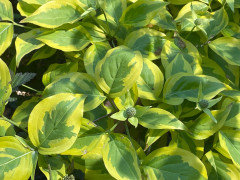
    It is also worth remembering that variegated plants tend to be less robust and less adaptable to cultural vagaries than their non-variegated cousins.

    raymondz7a thanked gardengal48 (PNW Z8/9)
  • last year

    I’m also in SE PA (Chester county). As mentioned, winter was mild but lots of rollercoaster temps (50-60 followed by 20’s) and little to no snow cover. On top of two months at the height of summer with virtually no rain and a fall that was on the dry side. I have a 13 year old variegated dogwood which is showing severe dieback. Two spindly branches at the bottom leafed out. No trunk or bark damage. And a 20 year old moosewood which appears completely dead, bark is split and peeling off and not leafing out. In each case, they didn’t show any real signs of stress during the summer.

    raymondz7a thanked Sandy Anderson
  • last year

    Thanks Sandy – I took a follow-up photo this morning – still not leafing out on the upper branches but the bottom looks lovely. I’m upset because I don’t know what will happen if the top doesn’t leaf out. The good news is we are expecting rain over the next 3-4 days.


  • last year

    Might be able to train a new leader and keep it going. It may not be as long lived if there are bark/trunk issues.

    raymondz7a thanked Sandy Anderson
  • last year

    I think it would be more prudent to start over with a more drought/hot exposure/poor soil tolerant species.


    FWIW, although there are large, old Kousas at places like Longwood, and certainly in some gardens...where they *really* become ubiquitous as stunning and (apparently) carefree, huge landscape specimens is further north along the coast of New England.


    raymondz7a thanked UpperBayGardener (zone 7)
  • last year

    Thanks again Sandy and David,


    I was recently reading another comment in a discussion in the Trees Forum (“Would you agree my redbud is actually a deadbud?”) posted by (porkchop_mxk3 z5b_MI)

    The poster (katob Z6ish, NE Pa) wrote something that got my attention:

    If it's a named variety I would be more inclined to wait for that hail Mary but for the straight species maybe not as much, although it does look like you planted a nice specimen.

    If it does leaf out here and there then you have that even bigger decision of how long to wait until it looks decent again.


    That’s kind of where I’m at on my kousa – as of today the upper portion has not shot out any new growth but the lower portion is, and it looks like it will flower.


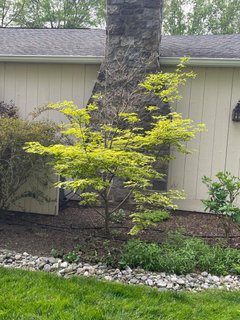
    I’ve included photos and I think if I lost the upper part then it wouldn’t look too bad (maybe just to me).


    The tree also serves as a landing spot for birds waiting on the feeder although they are adaptable.


    My other kousas look ok – older specimens that were in the ground when we bought the house (2011) – they were completely covered by vines and brush until we found and uncovered them. I think at least 2 are Rutgers hybrids – maybe Constellation.


    I’m inclined to wait until next spring to make a decision. Can you tell I don’t want to lose this tree.

  • last year
    last modified: last year

    Ok well, my real concern is yes, with pruning and whatnot, maybe you can get it back to a good tree form...but if it had a scrape with death after 10 years this is a sign the site is somehow unsuitable for it.

    'Constellation' is a florida x kousa hybrid so could well have hybrid vigor and better adaptability, in addition to being in a better spot.

    raymondz7a thanked UpperBayGardener (zone 7)
  • last year

    I wouldn't give up on it yet. If the "dead" part doesn't revive in a month or so, cut it off and in a couple yrs of recovery branch growth you may not notice it much.

    raymondz7a thanked bengz6westmd
  • last year

    I don’t want to take up anyone’s valuable gardening time so if anybody is interested the following is a response from the PennStateExtension (PlantClinic@psu.edu) regarding my tree. They accept digital sample submissions:


    To make things easier for clients, the Plant Disease Clinic is currently accepting digital sample submissions via email. You can take pictures of the diseased and healthy plants and send them to the clinic via the following email: PlantClinic@psu.edu. If you plan to send a sample or an image to the Plant Disease Clinic, make sure you fill out and send the Specimen Submission Form along with the samples. Check the Plant Disease Clinic website for detailed instructions on packing the samples and current drop-off recommendations.


    Response:

    Hi Ray,

    The dogwood in your photos shows symptoms of winter injury and possibly a fungal canker pathogen. Bark splitting is a common winter injury symptom and since the upper portion of the tree has not leafed out, the branches may have been damaged over the winter. Drought stress makes plants more susceptible to winter injury so the drought last summer and fall likely contributed to the problem. This stress can also make trees more susceptible to fungal canker pathogens. The unusual bark symptom is an indication of a possible fungal canker pathogen.

    We would need a sample of the affected branches or sections of trunk the area to test for these pathogens. The main management for fungal canker diseases is to prune and remove dead branches and provide good cultural care for the tree including watering during extended dry periods. Fungicides are not effective for managing fungal canker diseases. Since the tree is still green under the bark, I would recommend waiting to see if the leaves grow out more and if it recovers.

    Sara

    --

    Sara R. May, Ph.D.

    Head Diagnostician and Manager

    Plant Disease Clinic

    The Pennsylvania State University

    361 Science Drive

    Room 220

    University Park, PA 16802

    http://plantpath.psu.edu/facilities/plant-disease-clinic

    Phone: 814-865-2204

  • last year

    That's actually a really good response. Excellent even.

    My caveat about winter injury abetted by drought though, is that I still l suspect something caused the plant to push a flush of growth in the fall and not harden off...but, either way, net result was the same.

    raymondz7a thanked UpperBayGardener (zone 7)
  • last year
    last modified: last year

    I'm not sure I'd consider the response necessarily 'excellent' as it is generally recognized that kousa dogwoods are highly disease resistant compared to other flowering dogwoods. While they can contract dogwood anthracnose, the disease is typically little more than cosmetic in nature, resulting in just leaf spotting but highly unlikely to cause any dieback. Other fungal concerns tend to be rather inconsequential as well.

    I still believe the dieback - or delayed leaf-out - is due to drought stress from the previous season. But I have no PhD in plant pathology so go with her advice :-))

    raymondz7a thanked gardengal48 (PNW Z8/9)
  • last year
    last modified: last year

    Maybe I was just amazed a civil servent gave such a detailed response. I've gotten shorter ones in the couple cases I made such an inquiry.

    FWIW reports like this, and seeing them in New England, make me rethink recommending kousa this far south. (Which I have done, it was the #1 tree I recommended decades ago when my brother wanted a flowering tree for his PA house) You just don't see nearly as many huge, healthy ones as you do up there. Although we think 'hey, East Asian climate, must be similar to ours' here on the east coast...there are subtle differences. Japan and eastern China generally don't have the inconsistency of summer rainfall that we do.

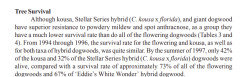
    Here's an interesting excerpt from this research article about these plants in Alabama

    https://aurora.auburn.edu/bitstream/handle/11200/4085/BULL0642.pdf


    Of course there could be more to the story and a lot of unexamined (by the article) subtleties, like what they were grafted* to, but it makes you wonder about the simple conclusion that kousa or its hybrids are always safer to plant. (Also, the way the timeframe is stated is a little weird, a range of years is compared to a year.) I still see plain old C. florida do well from NC to PA, as long as they are in an open site...full sun is OK up here at least.

    * word graft doesn't occur in that PDF. Ideally, I think eastern dogwoods would be grafted to florida, or maybe florida X kousa. Kousa seems ok too, I have an 'Eddie's White Wonder' on kousa and it's growing fine. C. nuttallii understock will not survive in my area.

    raymondz7a thanked UpperBayGardener (zone 7)
  • last year
    last modified: last year

    David, it is my understanding that dogwood trees tend not usually to be grafted........except for pink flowering versions of C. florida, as they will not come true from seed. But I can't swear to it. Are you sure your Eddies White Wonder is grafted? And on kousa rootstock? That seems very odd to me as kousa is not part of its hybrid mix.....why would they graft to a distinctly different rootstock? btw, straight C. nuttallii does not fair well here in cultivated gardens either. It is one of those PNW natives (like madrone) that is best to view au naturel as it rarely tolerates the conditions present in a cultivated garden. Nurseries here don't sell them, except for a few native plant nurseries. But EWW is very popular and does well.

    Interesting article. But I take exception to the caveat of C. kousa "adapted as far south as USDA Zone 8" as if the zonal designations were somehow aligned with the compass. Obviously they are not, as I am farther north than just about anywhere in the contiguous 48 states!!

  • last year
    last modified: last year

    Great question. I tried EWW, once, possibly twice way back in the 1990s. It died in the manner of other PNW things I was experimenting w/like Monkey Puzzle - after it got hot and humid for a while. Gave up on it. Assumed it was ungrowable on the east coast.

    Then read somewhere about it being sold by a wholesaler in Tennessee once upon a time! (Source was possibly Jacobson's excellent NALT, which remains the definitive volume on the topic. So shocking it was never republished. What the heck!?) By this point was starting to have an inkling of the effect of grafting on adaptability - first saw grafted firs for sale at Porterhowse Nursery in the late 2000s. Realized that was likely a factor. If it was cutting grown by Forestfarm, it was 50% nutallii trying to grow on the east coast, if grafted by them, there's a good chance that, nuttallii (or nuttallii hybrid) seeds being free and abundant, they just grafted onto that. (other place I could have mail order purchased it was Greers, where the same could apply obviously) Put it in the back of my mind. When I found out about Whitman Farms nursery, I asked her what she grafted them onto. (Lucille is great, glad I at least 'met' her on the phone a few times) She knew the issues nuttallii would pose for the east coast (and possibly, as you suggest, the west!) , and assured me she grafted onto kousa seedlings.

    That was maybe 5 years ago. It was a really small plant though, a first year graft, so it hasn't bloomed yet. I am especially cautious about fertilizing recently grafted things when they are young because I worry about it causing the rootstock to go crazy and send out a lot of suckers. It was also too shaded early on. I expect it to bloom next year...can't wait! But it grows like any other east-coast adopted dogwood would grow. OT but speaking of grafting, my 'Yellow Petticoats' rhodie, grafted by the late great Kathy Van Veen, is finally blooming! (would have been some of the last grafts she performed. So sad) I'm sure you're familiar with it...it's very yellow. It was grafted onto 'Charles Loomis', a super root rot resistant hybrid.


  • last year

    FWIW it's actually other cultivars of straight up nuttallii that NALT mentions being grown by a Tennessee wholesaler. They had to be grafted onto something else.


  • last year

    Good morning – it’s about 5 weeks or so since I first posted about the possibility of disease on my Cornus kousa ‘Summer Gold’.

    Well, ‘Summer Gold’ has flowered – albeit not profusely. What is more interesting is that some of the side branches that were not producing leaves at all, are now showing signs of life – I even think growth is appearing at the base of the leader. Above, bengz6westmd said:

    wouldn't give up on it yet. If the "dead" part doesn't revive in a month or so, cut it off and in a couple yrs of recovery branch growth you may not notice it much.

    Thanks again beng - I am hopeful.


  • last year

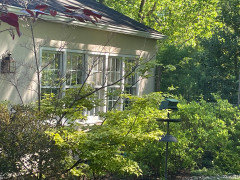
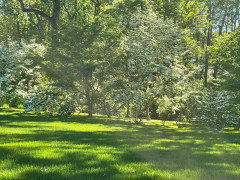
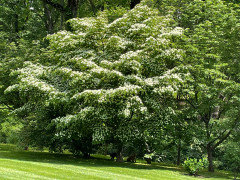
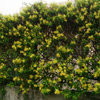
    Thanks David - I really hope the tree makes it - pulls the room together. You are right - there are a lot of biggish kousas in this area of PA. The kousa in the attached photo was covered in vines and whatnot in 2010 when we moved in - it took a while to clean it up. I have no idea what variety it is - but the dogs love to be under it.


  • 3 months ago

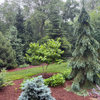
    Thank you to everyone who commented on my Cornus kousa 'Summer Gold' post from last year. Here’s where things stand today. I monitored to see if the upper portion was budding out in early spring. It was not - so I followed @bengz6westmd advice If the "dead" part doesn't revive in a month or so, cut it off and in a couple yrs of recovery branch growth you may not notice it much.


    This was the tree last year:

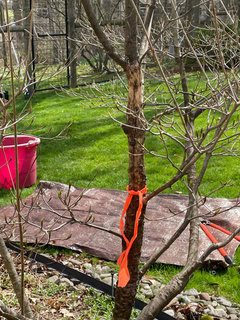
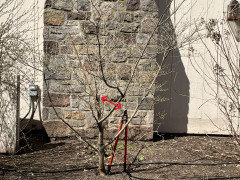
    This spring – I cut the tree right at the orange flag in the next photo.

    4/1/2026


    This photo taken after the cut – FYI @UpperBayGardener (zone 7) – the wood was pretty dense.

    4/1/2026


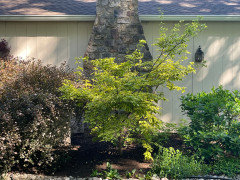
    This is how it looks today – not too bad - hard to tell the difference but it looks out of balance.

    5/16/2026


  • 3 months ago

    Good luck with it. At some point early on in participating, I lost the plot that this was a VARIEGATED cultivar. Those are almost always weaker growing. IMHO it could have contributed to some of the difficulties you've experienced with it.


    raymondz7a thanked UpperBayGardener (zone 7)
  • 3 months ago

    It looks good. One wonders what the problem was -- was it disease or some mechanical injury? Doesn't matter at this point. Remember that because it's variegated, it has less chlorophyll and so grows slower.

    raymondz7a thanked bengz6westmd