Software
Houzz Logo Print
westes

How to (NOT) Drain a Patio Using Decomposed Granite

last year
last modified: last year

I have an interesting drainage problem on a patio surface made of decomposed granite. I am looking for proposed solutions, but first, let me describe the problem. Someone who follows @tapla (mid-Michigan, USDA z5b-6a) 's work on perched water tables will see here that this science applies to domains other than container gardening.

https://www.houzz.com/discussions/6167237/container-soils-water-movement-and-retention-8-26-21

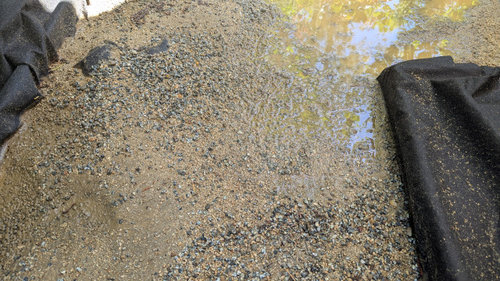
Someone helping me to design the area around a water fountain insisted I use decomposed granite. I don't like the material because normally in the rain, it develops puddles of water on top, and they can be very slow to drain and dry. So I took on the challenge of how to make a decomposed granite patio drain as well as it can drain, and unfortunately, I only solved half of the problem.

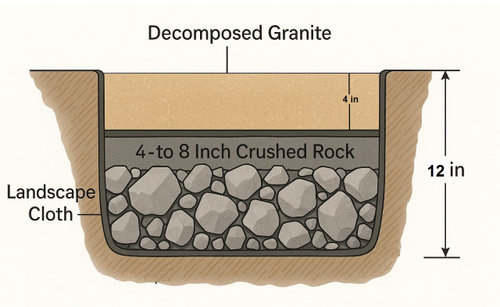
I dug a deep ditch about 12 inches deep where the patio is and lined it with landscape cloth, filled up to 8 inches of that with 4 to 8 inch rock, and then I covered it with another landscape cloth. The point of that was to create a drainage basin under the patio, which is in a part of the yard that has a flooding issue in the rain. That drainage ditch works fantastically well. and it removes all issues with water saturating the subsoil under the patio. If I had put crushed rock on top of this, I would have had a very nice patio that is incredibly well-drained.

Unfortunately, I put decomposed granite 4 inches deep on top of the landscape cloth. The problem is that the decomposed granite sitting on top of the landscape cloth is very similar to a container, rather than a raised bed. That container is forming a perched water table! After I saw what was happening, I researched, and in horror, I discovered that decomposed granite in a container will have a 6-inch perched water table. And the entire depth of my decomposed granite is only 4 inches.

That causes water to flood the patio and stay there for a long time, not draining through the landscape cloth. As in a container soil scenario, the very small dust-like particles of the decomposed granite have huge surface area, and this is causing both adhesion of water to those particles and cohesion of water to itself. This forms a stable perched water table, and the decomposed granite is simply not deep enough to overcome this perched water table.

What are some solutions? I want the patio to drain rapidly.

I tried adding 20% 1/4 inch and 3/8 inch crushed rock into the decomposed granite, but this did not overcome the issue. Decomposed granite is too much like clay, and even a small amount in a container creates substantial perched water.

I could redo this and make the depth of the decomposed granite around 10 inches, which gives 4 inches above the top of the 6-inch perched water table. I'm testing around this idea now in a large nursery container.

Tapla uses wicks to help reduce a perched water table in a container. I guess I could use a garden pot wick every two feet throughout the small patio area to help with the drainage. But I am skeptical that a wick will sufficiently drain the area, and I probably need to combine wicks together with a thicker layer of decomposed granite.

In truth, I probably just need to take out the decomposed granite and go back to the idea of crushed rock.

If anyone sees another solution, please share.


Comments (12)

  • last year

    Perhaps the fix is a combination of replacing the decomposed granite with rock and adding a drainage pipe underneath the fountain surround?

    I have an area around my pool that doesn‘t drain well because underlying it is granite ledge. A perforated pipe was added before the small rock was added on top. The pipe helps drain excess water away from the area.

    westes Zone 9b California SF Bay thanked Design Fan (NE z7a)
  • PRO
    last year

    I would go with Design Fan on this. You created a not very permeable container out of landscape cloth, and filled it with gravel. A fix would be replacing it with a more correct form of drain.

    westes Zone 9b California SF Bay thanked beesneeds
  • last year
    last modified: last year

    @Design Fan (NE z7a) and @beesneeds As Tapla has documented elsewhere, particles > 0.1 inch / 2.5 mm do not support perched water tables. I could simply place any decent crushed rock above the landscape cloth, and the patio would hold ZERO perched water.

    The landscape cloth I use drains RAPIDLY. I have multiple small patios built with gravel bases and secured on the edges with concrete, and those drain INSTANTLY and will last 50+ years.

    The yard is on a slope to the street so water in the subsoil already naturally travels away, but in any case the drainage basin I created is a buffer to migration of water into the subsoil. My problem is the design above the landscape cloth, and there was an expensive lesson here to think of such situations as being just a giant container, with perched water table rules all being applicable.

    The stubborn part of me still wants to find a way to make decomposed granite work as well as it can.

  • PRO
    last year

    Ah shoot, sorry about that. I forgot that Tapla is one of the only people the OP considers intelligent enough for advise around here. My bad for not paying enough attention to the topic poster, please disregard my previous post.

    Tapla is pretty awesome, so I can understand.

    westes Zone 9b California SF Bay thanked beesneeds
  • last year
    last modified: last year

    @tapla (mid-Michigan, USDA z5b-6a) The decomposed granite is the walking surface. I added a simple schematic to the original post, and I am copying that here as well.

    The total area is small, let's call it about 100 square feet.

    It would be difficult to grade the surface underneath the decomposed granite. I'm not sure that would be less work than other solutions, and my guess is that it won't fix the issue well because the small particle sizes in the DG create a strong capillary action/adhesion/cohesion. In other words, grading the subsoil/surface under the DG helps but does not really "fix" the problem.

    As I see it I have a few ways to go on this:

    1) I can replace the DG with crushed rock that has particle sizes > 0.1 inch / 2.5 mm, and the problem instantly disappears as there will be no perched water. The person who wanted DG will throw a fit, but that's my problem.

    2) I can amend the DG with some other crushed rock, trying to greatly reduce the perched water in the mix. For example, I have a beautiful gold 3/4" crushed rock, and I could try to densely pack that and let the DG fills spaces between those rocks. There would still be a lot of DG. Getting specific, tightly packed 3/4" crushed rock has about 30% to 40% void space between the rock. That's all space that the DG is going to fill. Having my mix be 30% as decomposed granite is probably not going to avoid perched water?

    ChatGPT suggested this mix:

    55-60% primary 3/4" crushed rock as the base.

    25-30% intermediate filler like 3/8" crushed rock (#8).

    10-15% fine sand or 1/8" screenings for further void filling.

    Less than 5% DG to act as a binder but not create perched water.

    How would you change that?

    3) I can add wicks throughout the patio, but I think this, at best, speeds up the drainage of the perched water, but doesn't really avoid the fact that the patio will be a muddy mess for many hours.

    4) I can add wicks and also increase the depth of the decomposed granite to 10+ inches, to put the perched water far below the surface of the patio. That's a lot of work.


  • last year
    last modified: last year

    @beesneeds No, I don't think Tapla is the only one who can answer this question. I was simply pointing out that I don't have a drainage problem underneath the landscape cloth that holds the decomposed granite. All of my problems live above that landscape cloth, in a perched water table created by lots of really small particles in the decomposed granite.

  • last year

    My drainage set up has been successful for years so I know my suggestion works. Good luck.

    westes Zone 9b California SF Bay thanked Design Fan (NE z7a)
  • last year

    @Design Fan (NE z7a) Drainage Pipes / French Drains are great. I use them in other places. I could add one here too. But the problem I am describing in this post is not about carrying water away from the patio area to another place. The problem I am describing is that water is binding into the decomposed granite and creating a waterlogged layer that cannot be removed by a simple drainage pipe.

    You are right that I could replace the decomposed granite with rock. That was one of the possible solutions I am looking at.

  • last year

    The landscape cloth I use drains RAPIDLY. I have multiple small patios built with gravel bases and secured on the edges with concrete, and those drain INSTANTLY and will last 50+ years.


    Looks like you found your solution!

    westes Zone 9b California SF Bay thanked w0lley32
  • last year

    @w0lley32 Sure, I have the option to use rock for the patio surface instead of decomposed granite. That's one possible solution.

    My question was trying to find a way to get a patio made with a decomposed granite surface to drain better, and to minimize perched water, without abandoning decomposed granite.

  • last year

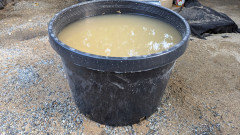
    Just for kicks, I put 10 inches of decomposed granite into a container and filled it. The water is draining about 1/2 inch per hour. After three hours, it's still a lake!