Software
Houzz Logo Print
webuser_102208142

Black Insulation Above Evap Coil?

5 months ago

Hello all, I had two questions regarding insulation in my HVAC system:

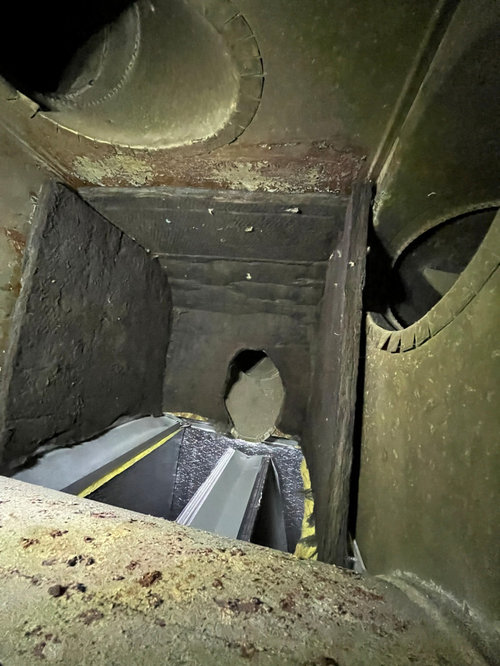
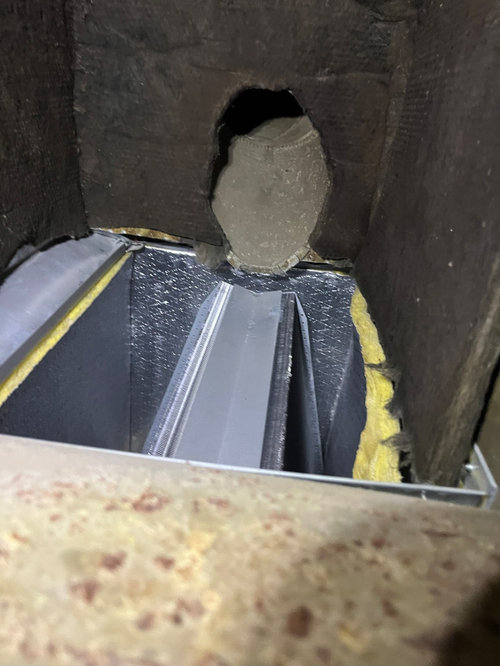
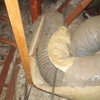
1) Inside the large elbow that sits on top of my evap coil and connects to the trunk line, there is this black, foam looking insulation. Is this serving any purpose or can I remove it? Its kind of nasty and dirty so if it can be removed I'd like to do it. Or at the very least, what product is it so I can swap it out with fresh stuff?

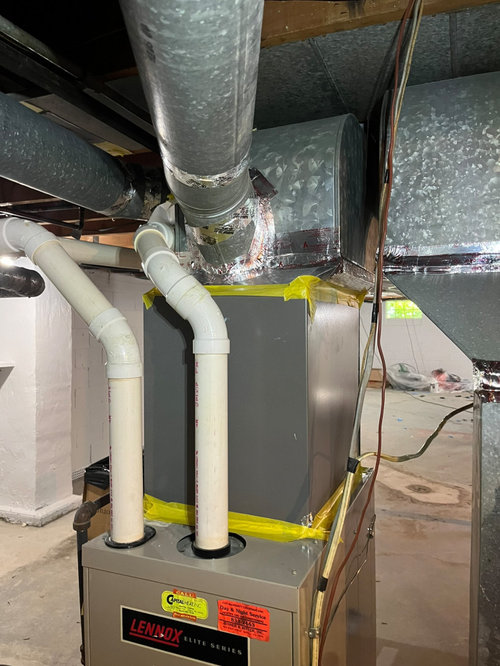
2) There is silver lined, yellow fiberglass insulation lining my evap coil box. I'm assuming this is OK but what purpose does it serve? There is some warning sticker on the outside of the evap coil box (Lennox) about how it contains fiberglass and the link between fiberglass and cancer.

Thanks!


Comments (24)

  • 5 months ago

    The gooy black stuff is presstite that can be bought at supply house, it prevents condensation drips from cold pipe. If I told you why air handler and ductwork are insulated you would know as much as I do and that isn't allowed.

  • PRO
    5 months ago

    I dont think its presstite, it looks more like duct liner to me....

  • PRO
    5 months ago

    Looks like the house was built before Air Conditioning entered the fray. (insulation ends after the plenum, not to mention no insulation on exterior of the duct work)


    Duct work and AC really needs to be insulated or the duct work often times sweats.


    This sweating of the duct work may provide an opportunity for mold to grow.

  • PRO
    5 months ago

    @Austin Air Companie so what would you recommend i do? remove the black stuff?

  • PRO
    5 months ago

    Given it's proximity to the AC coil it's more likely to sweat there first.


    The proper way would be to insulate all the duct work. Given the difficulty of such it might be easier to do this on the exterior of the duct work.


    Not sure why you want to remove it... it's there to prevent the duct work from sweating.

  • PRO
    5 months ago

    @Austin Air Companie The duct liner is actually in not great shape after I took another look at it. If I want to remove and replace with fresh stuff, how would you recommend I remove? It looks like it stuck down with some type of adhesive in spots.....

  • PRO
    5 months ago

    Yeah they glue it to hold it in place.


    Remove all the duct work and replace it with duct work that is insulated in advance OR wrap the existing duct work on the exterior of the duct work. (The wrap method is more common in your area as it looks like the system is in a basement. However there's just as many pros and cons to this method as any other.) -- there are no basements where I live.


    The unorthodox way would be to take it all apart and re-insulate it with fresh stuff inside the duct. Because labor is more, no one would do it that way. Then if you didn't glue it well, take a brief second to wonder what happens to your poor HVAC system.


    I've been to jobs where the insulation has come undone. gimmicks fill your err my conscious: like "hey it's hard to stop a trane" or "atta boy dave lennox" or "turn to the experts"

  • 5 months ago

    "wrap the existing duct work on the exterior of the duct work"

    Do this.

  • PRO
    4 months ago

    @Austin Air Companie @sktn77a


    Sorry to resurrect an old post but any chance this stuff contains asbestos. House was built 1952 in Buffalo, NY so have no idea how old this material is. Not sure if old duct liner might've contained asbestos instead of fiberglass. Could sample it but then I'd have to disconnect a bunch of things to access the plenum again which I'd rather not have to do.

  • PRO
    4 months ago

    @Austin Air Companie


    I did wind up taking a sample and will send out just for peace of mind. Any idea what is typically used to adhere these to the inside of plenums? The duct liner is adhered to the sheet metal in spots with some type of glue/adhesive but not sure what exactly was used......

  • PRO
    4 months ago

    Omniseq,


    There's a number of adhesives on the market for this. I personally haven't used them as when I buy a sheet metal plenum, they are already insulated. I just put them together on the job site. the insulation is preattached, 1 less thing for me to do when I have a big job come along.


    Your situation is completely different. 99% in my market is flex duct. (Quiet Flex) shhh! Probably 90% run and hung in an attic. (no basements) -- Flex duct is pre-insulated as well, no spray adhesive on those. Maybe 2% older builds have duct board which is nothing more than a board type insulation that comes in various thickness parameters. Problem with duct board is that it's easily crushed, not to mention comes apart easily too. I use it on occasion, but usually for special use circumstance as putting it together takes time to do it right so it doesn't blow itself apart. (trade secret, shh!) LOL. Is there anything such as a trade secret any more? We may never know..... just telling you how is probably not going to help you much in DIY land. Much of what I know is 30 years of experience... not talking about it, but actually doing it. Probably in the realm of 100,000 or more service calls, seeing mistakes of others, my own mistakes etc. So 20 years ago there may have been 20,000 guinea pigs who tasted my limited expertise?


    There are older builds here with hard metal pipe / insulated wrapped exterior. But I don't know of any one here who would do hard metal pipe duct work install for residential. Typically I chop this out and reattach with flex duct if a job like this comes along.


    I had a job like this a year ago when I installed my first R32 A2L refrigerant system. Although it's quite rare for me to see much hard pipe (duct work) anymore. (older section of town)


    Google search for specific use, if you don't use the right kind for this specific use there may be off gassing and smells to contend with. Inside your duct work and it's spread thru your house everytime the HVAC system is used. If it's on exterior of ductwork, the smell transfer is probably still there to some extent, but not likely as significant as interior of the duct work.

  • PRO
    3 months ago

    @Austin Air Companie @sktn77a


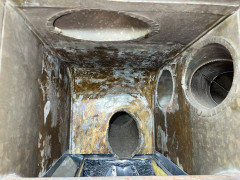
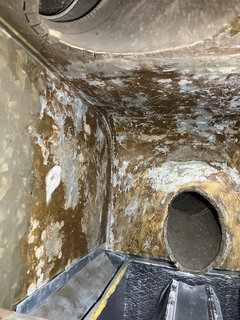
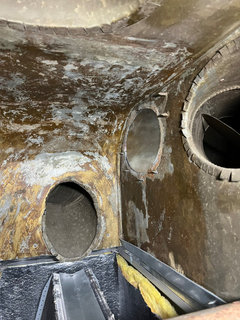
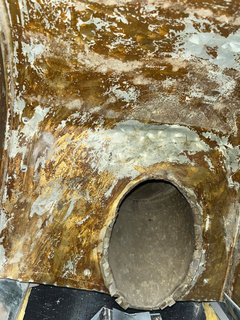
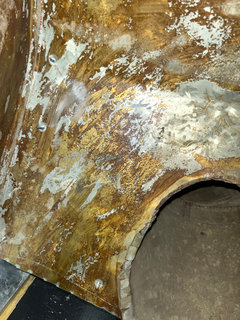
    The black duct liner was removed. This is what it looks like now. Any idea why its all gold/brown underneath? There is a distinct line inside the plenum where you can see where the duct liner used to be (goes from the normal silver colored metal to gold/brown). There's some texture to it in spots as well.


  • 3 months ago

    Probably adhesive or vapors from the adhesive that were trapped by the insulation and adhered to the box surface.

  • PRO
    3 months ago

    @sktn77a Is it fine to just leave as is? Just want to make sure its not hazardous since this is on the supply side. I guess I could try to remove it by scraping but that would just make a giant mess and I dont really feel safe using mineral spirits inside my ductwork lol.

  • 3 months ago

    Is the plan to leave the inside bare ?

  • PRO
    3 months ago

    @sktn77a


    Yes. No need to replace with new duct liner since that old duct liner was there for sound insulation for an old lennox furnace. I have a new furnace now, so no need for liner.

  • 3 months ago

    You can leave it as-is or, if your still concerned about possible asbestos residue, spray it with a sealer.

  • PRO
    3 months ago

    The duct liner came back negative so I'm not really worried about asbestos anymore. Doubt the adhesive would have asbestos either.

  • PRO
    3 months ago

    The black duct liner was removed. This is what it looks like now. Any idea why its all gold/brown underneath?


    Probably, maybe? something was used to get the insulation to stick to the sheet metal, other than that I have no idea. Some areas of the country probably used different things, typically the glue I've seen a handful of times like if the insulation comes undone is blue in color.


    Different areas probably use different materials or something may have been used to rough up the surface of the sheet metal to get the glue to stick better. Some use these little rivet like things in addition to glue to hold the insulation in place. So maybe just a different way to fasten it?


  • PRO
    3 months ago

    @Austin Air Companie Is it fine to just leave as is? Just want to make sure its not hazardous since this is on the supply side. I guess I could try to remove it by scraping but that would just make a giant mess and I dont really feel safe using mineral spirits inside my ductwork lol.

  • PRO
    3 months ago

    From this position I can't say it's not hazardous with 100% certainty.


    Again, without testing you're guessing.


    I'm not one to look at a picture and take a guess, I'm more in line with in person considerations which are devoid of DIY dealings.


    If I told you a guess, I'd be expected to keep doing that. That is a conflict of interest, and not to mention pays poorly. (I don't run this HVAC job as a side hustle, it is my primary form of income... not the only one, but primary.)


    Manufacturer's do not pay anything if unit is under warranty, they merely provide a part. 3rd party extended labor contracts don't pay as well as you think and there's more limitations, exclusions as to what they actually cover not to mention the contract typically locks out other contractors which may limit your choices. (There's more costs to shake a stick at, you pay those costs in one way or another. You learn this the easy way by paying someone else to do it OR the hard way thinking you can avoid those costs and attempt to DIY it. (There's a moral to this story if you think about it long enough.)


    I know you don't live anywhere near me, but this doesn't change my perspective.


    There's a lot of click bait DIY'ers that like to suggest they will save you money doing things yourself. The problem with that? -- You're knee deep in it. -- Those DIY'ers make their money via clicks and promotional things they sell, affiliated links etc. They're not there to help you beyond "Hey, subscribe and watch another video".


    (The other side of why I got involved in this thread / mmm maybe partly -- or just killing time in the morning while I drink my morning coffee.)


    I service the Katy, Texas area. (I'm not a DIY'er -- I am an actual Texas Licensed HVAC contractor. TACLB28416E)

  • 3 months ago

    Aaaahh how I miss days of yore when nothing was beyond reach of the crystal ball.

  • PRO
    3 months ago
    last modified: 3 months ago

    Easily confused I guess...


    LOL. Good luck if it comes back hazy or cloudy.