Software
Houzz Logo Print
webuser_671453506

Exhaust Fan, Ground cable Help Please

11 months ago
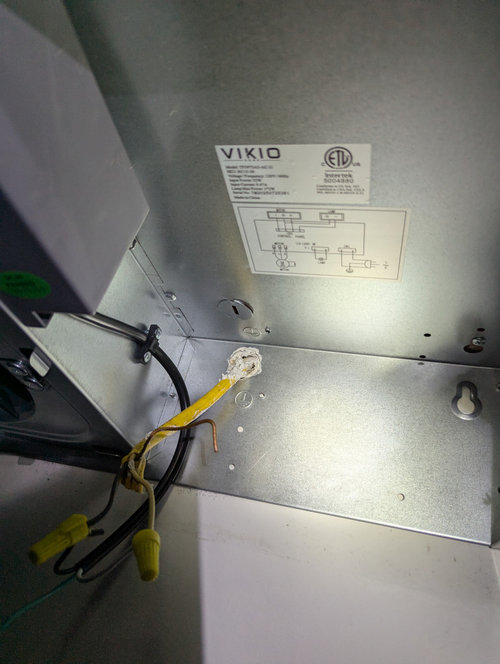
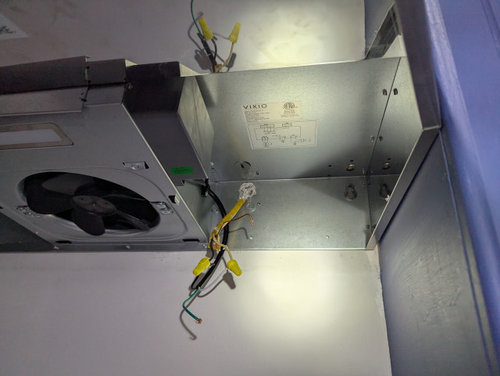
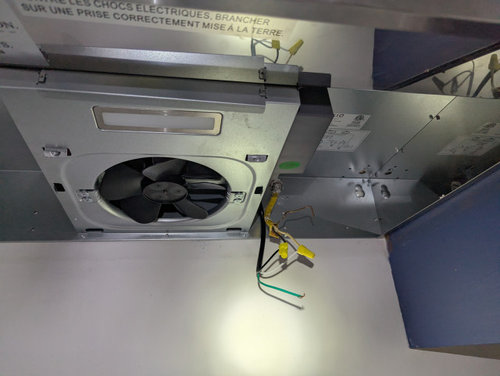
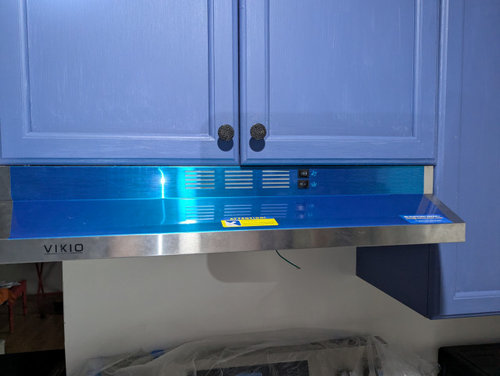
Hi, I don't know where to put the two ground cables. Obviously together but just hanging? I don't see where to attach it. Any suggestions and help very much appreciated. Thank you!!!

Comments (31)

  • 11 months ago

    You connect the ground wire of the fan to the ground wire of the circuit.

  • 11 months ago

    A sheet metal screw, or a TEK screw that will grab the edges of one of the holes punched into the hood side sheet metal could be used, along with spade lugs crimped onto each of the green wire and copper grounding conductor. Or wire-nut them together with a short section of grounding wire that goes farther than they can reach to a suitable screw into the assembly.

    I suspect, because I can see a light panel and light and motor switches that the green wire is already connected to the shell inside the control housing, so if this is confirmed, just wire nut them together. Belt, suspenders, and duct tape beats hope, so it is up to you to confirm that the green wire is connected to the shell (using a volt-ohm meter or physical inspection).

  • 11 months ago

    kaseki, thank you so much. That was helpful. I suspect you are correct and explains why there is no standard green screw or something similar provided. I will ask the company. I wired nut them together in the meantime. Also, it is weird that the cables are just left hanging and exposed, there is no cover provided either.

  • 11 months ago

    Thank you John

  • 11 months ago

    Now that you mention it, I suspect a violation here. I think I wasn't wide awake when I replied. Wire nut connections aren't supposed to be exposed. I think the intention was to have the black cable go out through a fitting to connect with the Romex in an electrical box located exterior to the hood assembly. Perhaps with a plug on the end that connects with a receptacle within the cabinet above (like my OTC microwave oven is powered).

    I think a small sheet metal box could potentially cover this connection, or else pull the hood and install proper boxes allowing access. I think the hole with the slot just above the Romex in your first image is where the black cord is supposed to go to a box above. Boxes have to be accessible, and pulling the hood to get to one is a stretch of the meaning of accessible.

    Further, the goop around the Romex where it enters the hood volume is not an approved device, as the NFPA would term it.

    Last, the exposed wiring is hard to clean grease off of.

  • 11 months ago

    The Vikio installation instructions that I found say that the range hood comes with a cord and plug that cannot be removed - did you cut the plug off?

    And I agree that running the "Romex" into the range hood like that is also not correct.

  • PRO
    11 months ago


  • 11 months ago
    last modified: 11 months ago

    You could put a surface mount box with a rear knockout right where the Romex comes out of the wall, then make the connection in the box - or put a receptacle in the box and wire a plug to the cord and plug it in. Use a cable clamps on the box to secure and protect the cables from being cut. (I am not sure an inspector would approve of the box being mounted on the hood itself, but it would be safe and tidy).

  • PRO
    11 months ago

    If your exhaust fan has two ground wires, they should both be connected to the circuit’s ground. Usually that means twisting them together with the grounding conductor from the power supply (i.e. the copper or green wire coming in) using a proper connector (“wire nut”). If there’s a metal housing (like the hood or fan body), one of the ground wires may already be bonded internally to it — in that case just tie all grounds together so everything is at the same potential. Also ensure the connection is secured and enclosed (in a junction box or other approved means), not left exposed, for safety, durability, and code compliance.

  • 11 months ago

    The Vikio RC15 hood does not allow you to comply with NEC. You must have the connection of wires hidden in a rated junction box. Other products in this $100 category like Broan or Whirlpool meant for the U.S. market have this designed in.

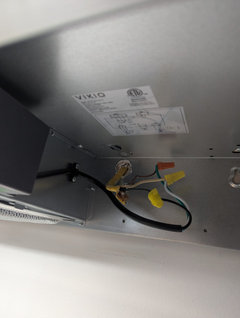
    Whether the "Power Cord Box" or "PCB" as Vikio calls it, the metal box that the black power cord originates from, can function as a junction box depends on what is exposed when you take the cover off. I would assume it can't, and it would create more difficulty for you to then run an MC whip from your power source.

    In any case, a power cord or NM-B (your yellow Romex) passing through any metal housing must have a NM connector there to guard against cuts and hold it tight:


    There are these metal connectors and they have plastic ones too.

    To me, the easiest choice moving forward appears to be:

    • install a metal junction box right at the back knockout and make your connections inside this new box. The black power cord running to this box will still be exposed to collect grease. The junction box can be chosen as a shallow metal Legrand Wiremold or Hubbell product which can reduce the size of it and look a little more finished. Browse your big box shelves. The NM-B (yellow Romex) should have it's yellow cover cut back to near the connector.


  • 11 months ago

    The green (or yellow‑green) wire on your new exhaust fan is the ground (or “earth”) connection. It should be connected to the bare copper or existing ground wire in your house wiring, or to a ground screw on the metal junction box or housing. Even if your old fan didn’t have a visible ground, the metal box might already be grounded via the conduit or cable sheathing. If there is no proper ground wire, attaching a ground to the metal box housing helps, but ideally you get a real ground path run. Always turn off power before doing any wiring, and if unsure, call a qualified electrician.

  • 11 months ago

    Kaseki, Thank you! I understand what you are saying. There is nothing in the cabinet or the wall. This is the same way the previous exhaust fan was installed, I assumed was correct. I suspect that was wrong and I was just copying the same. I realized. I am going to look for some kind of box as suggested to cover the cables at this point. Very helpful.

    John Liu, good suggestion. Thank you!!

    Dennikasgli, thank you for the answer. No, I didn't cut anything. The only cables it came with is the black one with the three cables inside.


  • 11 months ago

    3onthetree, thank you! I assumed that whatever it came with would be sufficient and safe. I'll know next time to.maybe spend more money. Thanl you for the specifics on the junction box. I'll do that. I'll clean the black cable often, so it doesn't get bad. Very very helpful.

  • 11 months ago

    Thank you so much everyone. This is what I have so far. I'll install a junction box in the back and put everything inside. I'll make the Romex(yellow) shorter to fit. Hope this will solve. Thank you!!!

  • 11 months ago

    fwiw:

    conductor, the current carrying part -- drawn metal having low resistance -- either solid or stranded

    wire, a conductor usually coated with a insulator, although a naked ground conductor is also a wire.

    cable, a covered assembly of wires which may include shielding, generally flexible, wires are not radially loose within in the cover volume

    raceway, a circular or rectangular section volume providing protection for wires, otherwise loose within the raceway volume.

    Note: wires whose conductors are electrically connected in a box (often by wire nuts) should have at least 6 inches of length from their entry connectors. As rework, you might not be able to achieve that but it will be OK as long as connection and disconnection is practicable.

  • 11 months ago

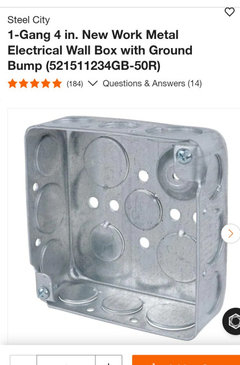
    Thanks! Love learning. Found this box with a cover (raceway!..? ) Should I get a green ground screw and remove the wire nut from the two ground wires and connect them to the screw instead. Or should I get a green nut and keep all three wire nuts?

  • 11 months ago

    A further description of a raceway might include that its length exceeds the dimensions of its cross section.

    Anyway, what I do is wire-nut together the two cable grounds along with a separate piece of wire, either naked copper or with green insulation, and put a spade lug on the other end that is held to the box grounding point (in this case the bulge with threaded hole) via a green (grounding) screw. All accessible metal structures need to be bonded to the household ground system.

    Anyone really wanting to understand methods and requirements (short of entering the path to becoming an electrician) is advised to buy a copy of the NFPA 70 National Electrical Code Handbook (kinda pricey), which contains the code, plus cross references, pictures, and helpful explanations (not part of the code).

  • 11 months ago

    Kaseki, thank you so much for all your help. You have been very generous with your time and knowledge. Thank you so so much!!!!

  • 11 months ago

    Copies of NFPA 70 are $38+ on eBay, not too bad


  • 11 months ago

    The key word is Handbook. A bit more preowned.

  • 11 months ago

    Thank you! I will have a read

  • 11 months ago

    I learned so much, Thank you!! I am doing the "pigtail". Everything working great! Thank you!!!

  • 11 months ago

    Call an electrician, this looks awful. who cut that jagged hole in the box with no connector?


    Doesn't have a built in j box? beautiful.


    This is a great example of why home owners shouldn't be doing their own electrical when theyre clueless.


  • 11 months ago

    They get ”clued” . . . didn’t many of us start this way?

  • 11 months ago

    Im a licensed electrician and i deal with fixing too many problems because people think they can ”dabble” in electrical to save a few $$.


    What do you mean didnt many of us start this way?


    I went through 4 years of school and coultless hours on the job training.


  • 11 months ago
    last modified: 11 months ago

    stax, thats what it takes to become licensed. Night classes, only twice a week. Not full days like actual college, if thats what you're thinking.


    It takes 4 years.

  • 11 months ago

    I don't know why someone would question Dave's description of the process he underwent to become an "electrician" (nor do I understand the use of italics).

    Dave, I do simple electrical work in my house: replacing light fixture, for example. Anything more complicated than that, I hire a professional. And I very much consider an electrician to be a professional.

  • 11 months ago

    Anyone reading the NFPA 70 Handbook I referenced earlier in this thread, even if limiting one's reading scope to residential topics, would realize that there is an immense amount of knowledge needed to be a competent electrician, even for his own household. And some of the rules change every three years.

  • 11 months ago

    Personally, I will install and replace receptacles, switches, and lights; add a circuit; hardwire an appliance (hood, minisplit, etc). I don't like modifying existing circuits (old house, hard to know if they are done correctly behind the wall), prefer adding new circuits (so I know how everything is done from breaker to receptacle).

    I'll be rehabbing an old commercial property soon. My electrician will be doing all that work. We'll be on a schedule, it'll be a business expense, and there will be a lot of electrical to do including new commercial service, panel, etc; not even remotely thinking of doing any of it myself.

  • 11 months ago

    Here we had a homeowner with a great attitude, open to learning and likes to DIY, and was aware enough to know something was off and ask for help. A fixture swap is not a big deal, this one just happened to throw a couple curves because of the appliance chosen. No harm in some nudging to help this homeowner along.