Software
Houzz Logo Print
webuser_951852643

Dumb Ways to Design!?!

9 months ago
last modified: 9 months ago
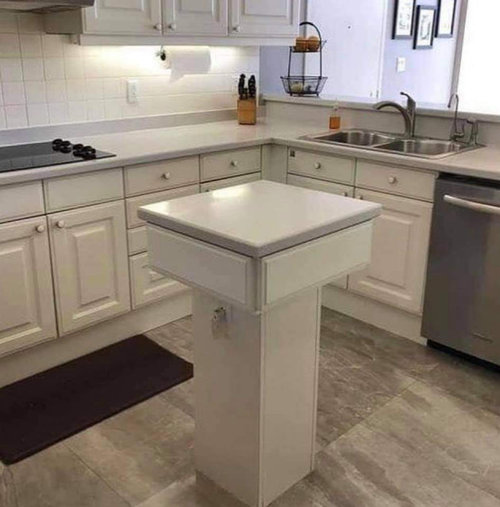
You know, theres a whole show made about the dumb dangerous things people do called Dumb Ways to Die. Houzz needs it’s own version. Dumb Ways to Design.

People tear out perfectly good spaces because of the self induced mood swings of it not being ”them”—5 miutes after buying it. Well Ethel, you think your grandmother really loved those 50 year old metal cabinets with rust and the fridge held together with a bunjee cord? Nope. But she didnt take 50K out of the coffee can just because something‘s only flaw was that it wasn’t pretty enough. If it still worked, got busy with $10 of paint, and letting the church group know she wasn’t too proud to accept a second hand fridge if they weren’t going to wring every ounce of life out of theirs like she was.

When did we get so shallow and dumb with money? Wasteful of resources? Dumb with ”must have it” consumerism?


Comments (9)

  • 9 months ago
    last modified: 9 months ago

    You’re overlooking the economic value of people spending money on what you dismiss as “wasteful” upgrades. Home remodeling, replacing appliances, buying new furniture, renovating kitchens, upgrading cars, updating electronics, all of that discretionary spending is a critical engine of economic growth. If everyone kept the same 50 year old appliances, cars, cabinets, TVs, and never remodeled their homes, the U.S. economy would stagnate. Large parts of America would look like Cuba: frozen in time, with no innovation, no upgrades, and no economic movement.Spending only on nondiscretionary items, basic food, basic housing, utilities, and transportation, cannot sustain an advanced economy. Those categories account for roughly 40–50% of total consumer spending, which itself makes up about 70% of U.S. GDP. The rest, the growth, the job creation, the circulation of money, comes from people buying things they want, not only things they need.The discretionary purchases you call “self-induced mood swings” are actually what create demand, businesses, jobs, and investment. If consumers stopped discretionary spending, here’s what would happen very quickly:

    • GDP would contract
    • Businesses would shut down
    • Unemployment would rise
    • Business investment (15–20% of GDP) would collapse
    • Stock markets would crash
    • State and federal tax revenues would plunge

    The risk of recession, even a deep depression, would increase dramatically.

    We’ve already seen how this plays out historically. During the Great Depression, one part of the of the reason it was so deep was because of people who still had money and jobs simply stopped spending it. The economy stalled, money stopped circulating, and deflation took over. Deflation sounds harmless, but it’s catastrophic because it increases the real burden of debt, destroys business revenue, and suffocates investment. A serious deflation today would make it difficult for the U.S. government to service its obligations, especially with current debt levels.We’ve had other deflationary periods, a mild one during the 2008 financial crisis, another brief one at the start of the 2020 COVID shock, and even a short consumer spending freeze after 9/11, which closed thousands of businesses.The bottom line is simple: An economy cannot survive, let alone grow, if people only buy necessities. Discretionary spending is not foolish; it’s the lifeblood of economic dynamism.

  • 9 months ago

    To Kevin’s point, back in the early 2000s a friend observed to me that her husband, ordinarily a busy house painter, as well as his fellow painters, had seen a dropoff in projects. Normally, when someone bought a new sofa or curtains, they repainted the living room to match it. But people weren’t buying new furniture, so his projects were fewer. And as the home-buying slowed, people weren’t redecorating, replacing end-of-life appliances, remodeling, and that also slowed his business. But the sofa thing is what I really remember. It started slow and ballooned.

    And back to dumb design, that IS a dumb island, but hey, it’s an island! Gotta have one!

  • PRO
    9 months ago

    Kevin, you are one of many who has been brainwashed into thinking our job as serfs is to GROW THE ECONOMY, one based on consumerism. That is propaganda from the corporate overlords. The people running the corporations need the most profits to justify those grossly inflated salaries and stock options each year. There were times in the last century when a corporation was still successful with modest increases in profits and at times just staying at the same level. This boom and bust economy is killing all of us. They don't do this in places like Italy and some how the country still exists & even thrives.

  • 9 months ago

    I do appreciate the passion behind your comment Beverly, and I agree that issues like inequality and consumer culture are worth discussing, but your whole statement reads like someone trying to diagnose the global economy with a handful of slogans and a lot of misplaced confidence.

    Calling people “serfs” and talking about “corporate overlords” might feel dramatic, but they do not exist in America. What you're referring to is neo-feudalsim, similar to traditional medieval Feudalism, and today a worker can simply quit. But Income is essential to living so what do you suggest? Everyone has one vote that a corporation can't cancel out, so equality exists in political representation, and not controlled by corporations so your argument lacks substance.

    The claims you've made to try and simplify economics doesn’t match how they actually function in practice and reality. Modern economies, whether in the U.S. or Italy, are shaped by a mix of policy choices, market forces, and demographic trends, not just by any one group or ideology. To think the need for economic growth is based on propaganda or assuming others are “brainwashed” is a fallacy, but I'm sure you've never considered the idea it may apply to you. I also believe your conclusion came from highly polarized political spaces, and not from an understanding of economics.

    The idea that corporations once operated happily with flat profits is also pure fiction. Economics is complex, subtle, or delicate, with multiple layers of meaning that require careful consideration to fully understand it. Without understanding the subject you end up with a chaotic mess as you wrote , Companies have always pursued higher profits, so pretending that the past was some utopian era of modesty doesn’t make it true. Boom and bust cycles are nothing new, and I believe you'd prefer to replace capitalism with something else, but in any ideology you won't be moving to the top of the pyramid anytime soon. Your conclusion really contradicted everything you said and a sign the conclusion came first and the reasoning never caught up.


  • 9 months ago

    Well Ethel, you think your grandmother really loved those 50 year old metal cabinets with rust and the fridge held together with a bunjee cord?

    Grandma probably was happy with the metal cabinets themselves, as they were what was available -- at least to middle class people -- in those days. As for the bunjee cord, none of us like broken things, but I agree with you: the answer doesn't have to be, Replace it all!

    When did we get so shallow and dumb with money? Wasteful of resources? Dumb with ”must have it” consumerism?

    I see several answers to that question: It seems to me we started to "need more" when women entered the work force, increasing the average middle class family's income. I'm not saying that's a bad thing, but it's definitely true. More recently, HGTV and social media convinced us that our homes should be magazine-worthy.

    You’re overlooking the economic value of people spending money on what you dismiss as “wasteful” upgrades.

    Could not disagree more. We don't need to increase, increase, increase the US economy -- especially if the cost is the average family being in debt. At some point we reached the tipping point when the average family "had enough", yet we're sold a bill of goods about how it must always, always increase. It's just not possible. If we spent more reasonably, innovation would still exist; people just wouldn't replace things because the colors were no longer tendy or because a newer, faster version came out.

    Yea, but that tiny square island is a dumb design...

    Worst island ever. Definitely a case of "island at any cost", meaning that islands are trendy and functional, and we must, must, must have one even if it doesn't make any sense and messes up the room.

  • 9 months ago

    That island reminds me of the NYC apartment tours that show up in my fb feed. Yeah, I like viewing them so the keep on coming. Anyway, those dinky remodeled kitchens look nice but totally inappropriate. A full range with microwave? Full-size dishwasher? Wine fridge? Meanwhile 6” of counterspace between sink and range, one overhead cabinet. In a one bedroom or studio. No room for a table let alone an island. I picture the tenant eating takeout over the coffee table watching Stranger Things. I think it’s the wine fridge that puzzles me the most, or the full-size range. There’s no room to store enough pots to use all four burners.

  • 9 months ago

    Spending money unwisely is not a new phenomenon. I've heard stories from my grandparents' days (early 1900s) about people who spent their money on personal luxuries while their children went hungry and barefoot. Whereas other people with the same resources used them wisely to better their situations.

  • PRO
    9 months ago

    Someway somehow somewhere the island pictured could be a brilliant solution to a unique problem, but we do not have enough information to judge.

    I am thankful I do not need such an island. Happy Thanksgiving.