

How doomed is my Japanese maple
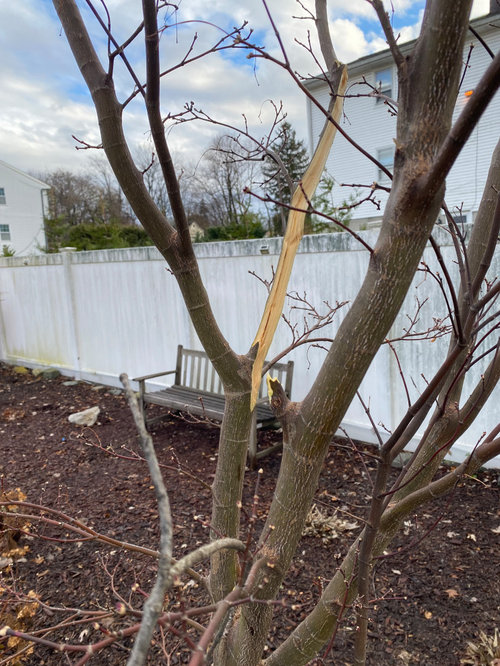
Strong winds caused large silver maple branch to fall onto my Japanese maple(Osakazuki) and it split one of the main trunks. The wound is extensive and I can see all sorts of diseases entering in there. How likely is it going to get diseased and die knowing that its a Japanese maple, a species that is a magnet to all sorts of diseases? Is it best to rip this tree out and plant a new one? I had this tree since 2018 and planted in 21.
Comments (35)
 7 months agolast modified: 7 months ago
Sorry about your tree. I would lean toward just cutting out the damage myself, but let's see what someone like Gardengal says.
Mainly jumped in to say that I can believe this happened, because, although I haven't gone and looked for an official wind gust speed figure from NWS, things were CRAZY when the front came through almost an hour ago. I heard ash snags snapping back in the woods. It felt like my roof was going to blow off. It was surely one of the strongest wind gusts we've had this entire year. And it was so sudden. I had just been outside moments before and it was almost still. I had been checking my rain gauge - got close to 1", so very happy about that.
Related Professionals
Augusta Landscape Architects & Landscape Designers · Fargo Landscape Architects & Landscape Designers · Saint George Landscape Architects & Landscape Designers · Huntsville Landscape Contractors · Raleigh Landscape Contractors · Jackson Landscape Contractors · Jamestown Landscape Contractors · Scranton Landscape Contractors · Mesquite Landscape Contractors · Logan Landscape Contractors · Madison Home Additions · Morgan City Home Additions · Cumberland Home Additions · Portland Home Additions · Butte Home Additions
Heruga (7a NJ)
Original Author7 months agoOk I will cut off the split part. One other question. Do they close up their wounds during dormancy? Or will the wound stay open like that until spring when they become active again
 7 months agolast modified: 7 months ago
Heruga,
It's good that the tree is dormant when something like this happens. Dormant season is the recommended time for pruning maples.
The bigger the wound, the longer it will take for it to encapsulate, and it might take a season or three before it completely heals.
From the looks of your picture, cut that split limb, like you would be cutting off a branch, like gg said, close with no stub or anything. That way you'll only have a smaller wedge below that's missing bark and that will all close up in time.
If there's any loose bark, you can trim that. with a razor, up to where it's attached to the wood (a little overhang is ok).
And be glad that's the only damage you have, a larch branch from a silver maple could've smashed that tree flat.
You might want to consider removing the silver maple.
PS. Use your lopping shears to cut those stubs left where the branches were sheered off.Remember your proper pruning techniques and cut stubs leaving the branch collar.
- 7 months agolast modified: 7 months ago
"And be glad that's the only damage you have, a LARGE branch from a silver maple could've smashed that tree flat."
Yes, I thought about saying this too. I never got to find out if Rhododendron 'Ink Spot' was going to survive the heavy rains of Hurricane Irene, because the winds of Hurricane Irene caused a silver maple branch to smoosh it into a plant-cake. I'm very lucky that's was the only rhodie to suffer that fate.
"You might want to consider removing the silver maple."
I can 100% vouch that silver maples will keep doing what silver maples do.
Heruga (7a NJ)
Original Author7 months agoWas going to do it with a handsaw but loppers sounds like it will cut cleaner. I would so love to remove that nuisance tree but unfortunately it belongs to the town. I’ve requested some of the overhanging branches on my property be pruned few years ago but that went no where. I’m lucky that was all the damage done this time but one day it could really split the whole tree.. guess I gotta just pray.
- 7 months ago
Your state law may allow you to have the town tree branches overhanging the property line pruned at your expense.
- 7 months agolast modified: 7 months ago
'a larch branch from a silver maple'
That would be something to see. lol:
NO NO IT'S FINE. TEASE AWAY! (of course I fixed it! - oh wait, I just realized I was quoting you, not paraphrasing haha. Leave yours for posterity!)
I am going LARCH CRAZY right now. Perhaps it was a 'Freudian slip'. I cannot stop reading about them and trying to locate rare species of them in the US, both to examine and use for scion or seed sources. I want to have as many species as possible and to start allowing them to cross pollinate, then screen those for resistance to root rot. I want to allow them to cross because, although it's great that arboreta collect pure species, in terms of useful ornamental plants for normal people's gardenss, heterosis often means that hybrids win the race. (this related to what I was seeking when I said in another thread I had the worst case of 'plant acquisition-itis' I've had in years. Anyone care to guess? Last and only clue: it relates to an exchange I had with someone on the west coast!)
My *favorite* larch clone was a tree I've been most obsessed with this fall...there were times I literally had to leave my house just to make a trip to look at it again! It's the slightly wispy, pendulous one I've posted pics of before. I don't say *best clone* because it's the other one that is really impressive for managing to grow in an area that sometimes gets heavy rain runoff from my gutters. It was very much in the back of my mind, 15 years ago, that planting it there would be selecting it for root rot resistance. I seem to have done that!
Final btw - I reviewed old posts here, and realize that what I bought as Dunkeld hybrid larches all died of root rot. The two survivors I had, in fact, bought as Japanese larches are the ones that survived. Annoyingly, I can't fully trace where I got them. It could have been forestfarm - that's definitely where the dunkelds had come from - but I feel like back then (2010 timeframe) someone here tipped us off that the VA or PA state forestry nursery was selling L. kaempferi. I do have a memory of getting them from somewhere atypical like that, I just can't remember exactly where. Anyhow, the reason I said they were hybrids is that pineresin, who still posts somewhere else, said they showed definite signs of being hybrids - maybe L. × marschlinsii back crossed onto L. kaempferi* . Which, if you think about the limited genetic resources available (both the hybrid and its two parents probably went through genetic bottlenecks of coming into this country via the UK, and not Japan and Europe respectively), it probably the best possible combination for growing around here. So at least I have some L. principis rupprechtii now for these two to cross with. But I'd like either 1) additional species or 2) straight from Japan L. kaempferi. Years ago I posted about how a 'mini-study' I did showed those tend to survive better in the US vs. seed from Europe, which was probably selected for growing well in chilly Europe.
Lastly, when I joked about teleporting peter_out from Australia, since he's clearly good at grafting, I will now reveal my top horticultural project of next year,specifically next Jan or Feb: I want to try to graft my 2 good larch clones onto Pseutotsuga menziesii! I bought the rootstocks from Musser Forest...nice looking plants, although, like everyone, they aren't as cheap as they used to be. Resin assures me he's seen it done and it should work. Doug Fir isn't optimal - I'd much rather be able to graft them onto loblolly pine LOL - but, having discovered a huge, healthy one in Havre de Grace, MD, I now know that they can grow in coastal as well as upland Cecil and Harford counties. (I already knew of one up near the PA state line) This will at least protect them against some kind of calamity. Let's say 'careful what you wish for' and instead of next summer being dry, I get a repeat run of 2011 when roughly 30 inches of rain fell in about 40 days. It would be good to have 'backups' of them. I do this with great trepidation because I've wasted a lot of time, effort and money trying to graft before - all for naught. But I at least have a sense of mistakes I made in the past, so hopefully, better luck this time.
Sorry to hijack your thread Heruga, but I know the genus is of interest to you too!
* I edited this post to reverse the order of this; presumably and obviously, a seed orchard would only collect "Japanese Larch" seeds from what they thought were "Japanese Larch" trees; that wouldn't preclude them having been pollinated by other larches they were growing like the hybrid...and any seed orchard producing the one, is probably producing the other. To the best of my ability to research, including reaching out to a somewhat well known (in plant circles) American horticulturalist who has long lived in Japan, 1) the Japanese are not particularly interest in their larch and 2) there's never been a company like a Japanese version of Silverhill Seeds or Wildseed Tasmania, that is collecting and marketing Japanese plant seeds for the rest of the world. So the only 'real Japanese larch' seed to come out of Japan for at least the last 50 years was scant amounts made available to academic and scientific collection parties.
The *Chinese* offer L. kaempferi seed to Sheffield, but that clearly isn't collected in Japan! It comes from plantings in China, where, obviously, one can't rule out it being either 1) genetically poor or 2) hybridized with some other species they are growing.
 7 months agolast modified: 7 months ago
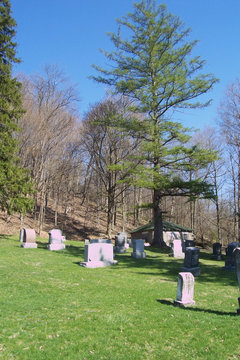
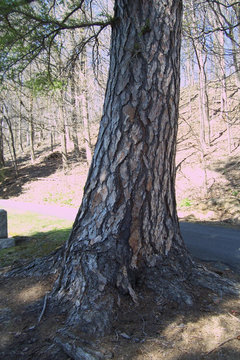
Big European larch (100 ft) in Bedford, Pa cemetery that unfortunately got some disease that killed it in about 2 seasons -- new spring foliage sparse one year and nearly none the next that quickly turned brown. Certainly lived a long time before getting killed.
- 7 months agolast modified: 7 months ago
Yep, with a genus so apparently prone to root rot, it's going to take some work to insure one has a clone that can fully resist the problem. But they are so beautiful and magical looking when well grown. I've now read/perused almost all of the epic 'Conifers Around the World' that I paid a pretty penny for on Ebay. Turns out it had come from the estate of Dr. Ronald Lanner, who used to post here as pinetree30. But the pic of Larix mastersiana in SW China remains one of my favorites in that book, and maybe one of my favorites taken of any conifer, anywhere. Not moving my L. mastersiana to a smarter place in my garden is the single worst gardening mistake I've made in my life, and it will always haunt me. (I've shared the tale several times: it was way to close to my house in a 'trialing' bed. I don't really do this anymore, because it just causes problems. I now take stuff right from a pot, to where I intend them to permanently be planted. Hot dry spells in 2007 and 2008 made me worry about being able to water newly planted rarities, before I'd put in irrigation line to the distant part of the garden...so at the time it made sense to have a trial bed near the house and hose bib. Anyhow, the landowner 'up the mountain' from me, did some grading that caused runoff to increase where I'd planted it...and on top of that, we had one of our infamous wet spells in mid-summer...a very unfortunate collusion of circumstances. *But* it wasn't smart to put it somewhere with a nearby higher grade, period. At that time though, I was still forming my understanding of these problems and how to mitigate them.)
They still have a small version of that pic available for promotional use: https://conifersaroundtheworld.com/continental-asia-and-hainan
about 1/2 way down the page
The high Himalayan species like L. griffithii or L. himalaica are even more 'Doctor Seussian' and fantastical looking...but considered very hard to grow, even by the English and Europeans. I truly believe not a single one has ever been cultivated in the United States! Maybe they would do better if grafted onto my 'improved strength disease resistant Larix rootstock strain' - in 35 years when I'm done working on it. 🤣
- 7 months ago
Ya, it was my mistake (typo) originally in my post, but I didn't see it until UBG quoted me.
And then it sounded funny (to me) after I saw it posted. ;-)
All is good, my fingers sometimes type (fly) faster than my eyes notice it.
Heruga,You haven't posted any pictures lately of your developing garden that you started a few years ago.
Anything new? Or successes that you're proud of?
- 7 months ago
" You haven't posted any pictures lately of your developing garden that you started a few years ago. "
Yes, please share!
Heruga (7a NJ)
Original Author7 months agoUpperbaygardener, its ok I love larches too. Are you David? You sound like him. I don't have too much pics for this year as I've been focusing more on my fitness journey but here are some that I took. Not much new stuff in my garden, just all my plantings done in the previous couple years filling out more now. My favorite part is watching all my seed grown trees grow.
This is larix kaempferi in June this year. I believe it's about 15 or so feet right now. I grew this from seed in 21 and planted in 22. It's been phenomenal so far in my rather wet garden(my property is a literally pit with all neighboring properties sloping up). It didn't grow as much as it did in the previous first couple years. Maybe it is on its way to decline or root rot, I don't know. Seeds were bought from sheffield's so now I'm not even sure if it's a pure L. Kaempferi. Hopefully it doesn’t die on me after growing this much. But I still have another 7 in pots so I still have some sort of backup I guess.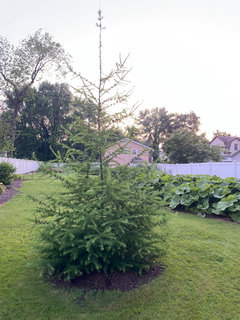
Pinus thunbergii(with xmas lights) taken just right now. It’s about 6‘3ft tall. Seed grown 2019.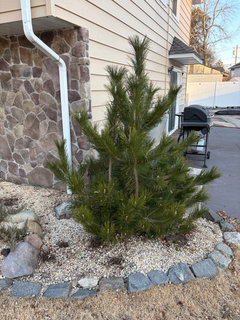
One of my 3 chamaecyparis obtusa grown from seed in 2020. It is about 7 ft tall right now. I think its the first year producing female cones this year.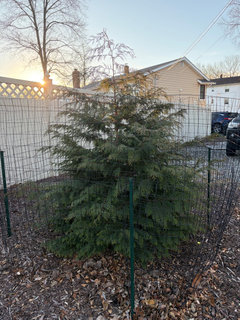
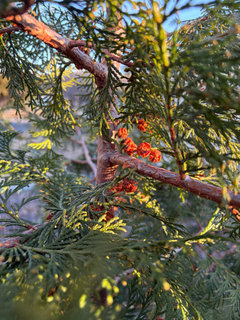
Cryptomeria japonica seed grown from 2021. Taken from sekkan sugi cultivar. Winter bronze color right now. It’s about 5 ft tall.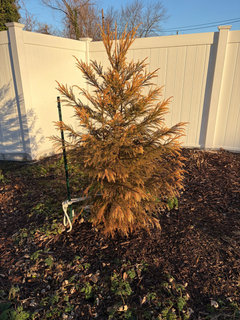
Prunus sargentii seed grown from 2021. I took this pic in april but right now it is about 8 ft tall. I cannot wait until this gets to be in full bloom. I’ll let you all know when it does.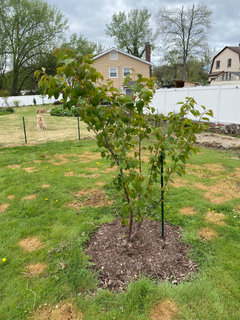
Pond garden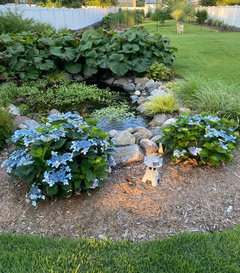
Meadow garden(taken in spring)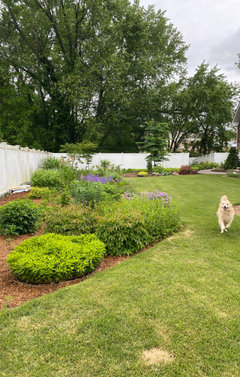
- 7 months agolast modified: 7 months ago
What that tree with the horizontal branching in the last pic w/ the k9? Awesome yard, btw
- 7 months ago
Looking good Heruga!
Those trees of yours have grown noticeably since the last time I saw them.
Trees (and some other plants) go through what's called a 'rapid growth stage', the first few years of life (some all their life, ha ha) so you can expect some to just 'shoot up'.
And don't be afraid to let them get on the dry side, especially during your wet season. Even on my porous soil, if we get good spring rains, I try not to over water because I know there's plenty of moisture just a few inches down that will sustain the plants. That way the trees develop good root systems and can take the dry spells better.
Later in the summer, when dry, hot weather has dominated for weeks, I tend to water on a time basis of a week or so but still check before I water to make sure, I'm not overdoing it.
In your clay, they probably don't need water at all unless you get a sustained drought for a season or two?
Most plants can take 'some' dryness, you just have to get to know your plants, soil and climate.
Thanks for posting!;-)
- 7 months agolast modified: 7 months ago
I'm curious about that tree too, Lane. I'm going to guess Cornus controversa?
Your garden is looking great!!! Thanks for sharing. I wouldn't quite say I'm on a fitness journey but be glad you're on one now (I sense for some reason you must be at least a decade younger than me)...I find it gets harder and harder to lose weight. I had a "I can eat absolutely anything without getting fat" metabolism until I was about 35. Not anymore!
I am a little worried about your larch: you've gotten such fast growth from that I have to wonder how much you're feeding it...if so...stop!!! I don't even think I was feeding mine very much (but definitely was giving them some, just sips of either miracle-gro or fish emulsion, which I used to use back then*) but a couple of my Dunkeld larches grew super fast, too, until they had the sort of 'overnight' plant death that is a sure sign of Phytophthora. But it looks good for now.
* - stopped using it because it makes foxes dig, sometimes weeks or months after being applied, too! Stupid things! It's not as though they ever found a fish when they dug one of those holes LOL.
BTW - yes I am David! Who else is such a 'Larchey' know it all around here. 🤣
BTW #2 - read Bill's words of wisdom carefully! He is right. In fact, although I hope we have a drought free growing season next year, because I'm planning on planting a final tranche of a bunch of Davidian 'Asian BLE brain candy' like Sycopsis, I now think the dry spells were probably a good thing on some level. I'll explain why a bit later.
Heruga (7a NJ)
Original Author7 months agoPlease don't all hate me for this but the tree is an aralia elata. I grow it for edible purposes. We harvest the new spring shoots and use them for cooking. The tree is part of the mother tree that my grandmother grew decades ago. We control it by removing all root suckers as soon as we see them. Sometimes digging up the root and chopping it. We never had any issues with invasiveness this way. They don't seem to spread by seeds either, at least where we are. I never see one in my garden. Often times I go to the other side of the fence to the town property woods to check on other invasives growing there and making sure it doesn't come into my property but I never see seedlings of the aralia. My grandmother and my dad both grew them in their gardens for decades and never had any issues spreading into neighboring properties.
Bill, I haven't actually watered my trees as much this year despite the terrible drought we had this year. I felt like they didn't need much supplemental water anymore now that they've been in the ground for a couple years. My soil isn't clay, its more loam but it because we are in a low spot it could collect more water than typical. None of my trees seem have been affected by it.. yet.
I kinda figured you were David, no one else knows so much about larches and your extremely scientific wording kinda gave it away lol. I actually have that I can eat anything and not get fat metabolism right now. I am 31 now so still got a few years until that stops I guess! But gardening and fitness keeps me active enough. I actually never fed my larch.. which is why I'm also baffled on its extreme growth rate. My soil is probably very nutritious and the water holding capacity is proabbly just right for the tree. My other trees nearby the larch are also growing fast. And yes I rather have drought than non stop rain, at least for my flood prone property. I can always just water my trees when I want to.- 7 months agolast modified: 7 months ago
There's nothing wrong with growing Aralia elata if you are keeping it from spreading.
You are even younger than I thought. I would say for someone 31 - anywhere in the world* - you have a garden that is a wonderful accomplishment and you should be proud of it. I was just getting started at that age, and in not nearly so organized or methodical a manner. Congratulations!
* - I sorta hate social media, but these days, to stay abreast of goings-on in the upper echelons of horticulture, you have to be aware of and follow it. There are quite a few young people involved in horticulture, even in the US; but on both side of the pond but especially EU & UK, buying a house with land is sooooo expensive these days most of the younger folk who are passionate about plants seem to be posting from their jobs in public horticulture. [In England, some are engaged in the arcane 'working for the landed gentry/nobility'.] I've spotted just a handful of exceptions, like a guy in Zurich who collects a lot of rarities in that surprisingly mild climate. (he calls it zn 7b, but his garden sure looks like zone 8!)
Heruga (7a NJ)
Original Author7 months agoThank you, yup most people my age usually don't care a thing about plants but I had this passion since I was 22. I guess I'm in the minority but I don't regret it. I always got along with older people anyway and gardening became that much more fun sharing a passion with them. Yes even some of the younger people who wish to have their own garden can't due to house prices now.. I'm grateful to have my own property with the help of my mom(It was so I can take care of my grandma at the time living in the same house-she passed 3 years ago).
- 7 months ago
Just from viewing your pictures, Heruga, it appears you have an expansive area to garden with varying degrees of sun/shade options to plant things.
I wish I had an area of consistently moist soil conditions, even moist to wet, so I could have more water loving trees and shrubs.
Is the wire fence I see a divider or a property line?
Is everything inside the white privacy fence available to garden?
- 7 months agolast modified: 7 months ago
Brother and I spotted an odd seedling under one of his Japanese arborvitaes in sandy soil. It was an Aralia spinosa! Have no idea where it came from, tho my across-the-road neighbor here has a small, wild one on his lot, so they are (rarely) around. Dug the seedling out from the sand bare-handed -- no shovel. Now growing along his fenced road border. Do not grab ahold of the stem!
Heruga (7a NJ)
Original Author7 months agoBill, yes I do. It's why I can have my meadow garden in full sun to woodland in partial shade. Of course the small trees I planted will grow one day and cast more shade in the future but I also have that all planned out ahead and planted my perennials/shrubs accordingly. I set the wired fence so my dog doesn't go to the other side. It wetter on that side and there is a huge swale usually muddy or filled with water. And of course my dog loves getting dirty in mud but I absolutely don't. So yes everything within the white fence is my property.
Bengz, I've had some splinters and pricks from mine. Even young shoots can have thorns. Always have to wear thick gloves when taking out the root suckers.- 7 months agolast modified: 7 months ago
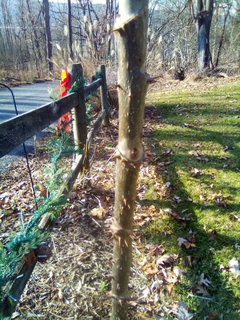
The 2nd year after transplanting the Devils walking stick (Aralia spinosa) mentioned above. Still a single stem, but notice the reason for the name, and also the enormous leaf-scars. This small tree is related to ginseng.
Heruga (7a NJ)
Original Author7 months agoGrows fast doesn't it? I took a root sucker off my dad's parent tree in 2021 and it was about 2 feet tall at that time and now it's over 20 feet. How tall is yours?
- 7 months agolast modified: 7 months ago
@Heruga: It's about 6 ft after 2 yrs starting as a couple-inch seedling, so almost 3 ft a yr so far. It's funny when in leaf, looks wide, but then becomes a single "stick". When visiting the highest mountain top in my area (Martin Hill ~2600 ft), there was a grove of a number of them at the top, and blooming in mid-August w/honeybees visiting. Really the first time I'd noticed them anywhere.
- 7 months agolast modified: 7 months ago
L Clark, couldn't quickly determine aralia elata as it's of east Asian origins, but aralia spinosa at least goes pretty far up into NY, which would be z5, and also far south too (which might suggest adaptability). The map just misses my area, but it does indeed occur here.
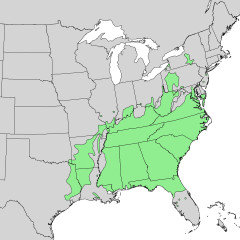
- 7 months ago
Yeah, I wish they had a silvics manual that covered all the Eurasian, Asian and East Asian woody plants. That has native range maps and USDA hardiness listed.
Heruga (7a NJ)
Original Author7 months agoLooks like both zone 4 according to Missouribotanical garden. Bengz, I know right? In the winter its usually just nothing but a vertical straight stick. But eventually they start growing some permanent horizontal branches as they mature. Bees love mine too.
- 7 months agolast modified: 7 months ago
@Heruga, I noticed when looking up aralia elata, there were a number of pics showing very young sprouts being harvested/used for food! I'm guessing harvested early enough that the new thorns would still be soft.
Heruga (7a NJ)
Original Author7 months agoYup they are definitely edible. New shoots(still in bud and not fully leafed out) don't really have thorns yet. They are such a delicacy.




gardengal48 (PNW Z8/9)