Software
Houzz Logo Print
kashirat

Low and Shallow Hood Recommendations

last month

Hi all,


I've spent a night reviewing the wealth of knowledge here all about venting, containment with regard to range hoods and blowers. I have two specific questions that I've seen mentioned but not specifically addressed before.

  1. How much more effective is a range hood if it is mounted at its minimum distance to the cooktop? For example, a 36" Miele Induction cooktop can have the hood mounted 24" above the cooktop. Presumably the range hood would be much more effective at removing the effluent mounted at this height, in comparison to higher up.
  2. Much of the advise sizes the range hood to the total width and depth of the cooktop. However, what if we size the range hood just over a specified burner that we intend to use for the type of cooking that will produce the larger effluent plumes? If we designate a burner on the back, in the center of the cooktop, could we effectively reduce the depth and width of the range hood and still have effective exhaust?

My specific design constraint at the moment: We have specified a 36" induction cooktop, but our kitchen design has a transom window near the ceiling, above, and a 15" depth cabinet just below the transom window, and above the cooktop area. The cabinet is 24" above the cooktop - so fairly close to the cooktop, but shallow, which limits the size of the hood.


Is there an insert that could make the best out of these design constraints? We could upsize the CFM of the blower, but from previous posts, it sounds like this would be relatively ineffective in capturing all of the effluent generated from steak searing or induction wok cooking.


Realistically, I could widen the hood area to 42" to overlap the cooktop area, but I'm not sure if I would be able to increase the depth of the hood. Another thought I had was to mount the hood vent further up, using the cavity of the cabinets (lined with steel?) to create a larger containment area, while maintaining the aesthetics of the cabinetry.


Would love to hear any thoughts or feedback!


Comments (8)

  • last month

    2D design overemphasizes symmetry. The minimum recommendation is 42". Ask for an upper cabinet with one wide door on each side of a 42" hood. Miele has models that communicate with the cooktop. Using a wider hood can allow less cfm. Makeup air could be less necessary. That can be a justification for the change. I'm doubtful the designer is including a makeup air system.

  • PRO
    last month
    last modified: last month

    Your "design " is creating the constraints and doesn't relate to how you actually cook and eat. You need a 42 inch hood over a 36" anything.

    Plan for grease all over the transom windows ........and what is the need for a 24" inch backsplash? There are NBA players in the home?

    You may want to show the 2 d plan for the kitchen. Seems a possibility more could be improved?

    kashirat thanked JAN MOYER
  • PRO
    last month
    last modified: last month

    Terrible ”design” based on bad assumptions.

  • last month

    One issue that might have been missed in the OP's review of posts on this forum is that there are always cross drafts -- static and intermittent -- and turbulence from people motion. These tend to disrupt or bias cooking plumes such that having a just adequately sized hood over a particular burner/hob likely implies a larger hood than one might think. Further, larger hoods that aren't collecting from unused burners are providing some modicum of intake reservoir volume that helps with averaging transient plume flow rates, assuming the hood design provides some volume.

    Nonetheless, if one has a hood inadequate for hot cooking on every burner, capture may be sufficient for the burner most central to the hood flow field. Note that for island hoods on islands, the flow is generally symmetrical around the hood, but for wall hoods, depending on side skirts or cabinets, the flow is biased toward the cook side and this may allow some improvement in capture of plume rays that might otherwise escape without the rear wall.

    Low capture aperture aids collection by facing a smaller (less expanded) cooking plume and less draft bias. If a higher hood is large enough for capture of plume "rays" out to -- roughly -- 10 degrees from vertical from pan edges, plus some growth for predictable drafts, it will generally get everything.

    Keeping the plume contained will require adequate specific flow rate, which I suggest be at least 90 CFM per sq. ft. of entry aperture, although induction may allow for a lower value depending on drafts and turbulence.

    At present, solutions to the issues present in cooking ventilation are based on experiments, experience, and intuition, in other words the "I" in "AI." When actual AI can set up and perform a battery of computational fluid dynamics simulations of specific cooking, cooktop layout, hood and MUA systems parameters -- based only on the brief descriptions typical of OP questions -- we may be able to argue from a better engineering perspective.

    kashirat thanked kaseki
  • last month

    Sorry if I missed this, but are you going to vent to the outside? How?


    Assuming venting, and assuming the constraints of you keeping the existing cabinets and the transom window, then I would consider:


    1. Mount the insert 6” to 12” as much up from the bottom of the cabinet above the range, to create capture volume.


    2. Use a higher cfm insert. Makeup air is required by code above a certain cfm, but is not actually necessary if you i) have no combustion appliances that can be backdrafted, ii) can remember to open a window or crack a door when running high cfm.


    3. Install side curtains coming down from the sides off the cabinet. How far the curtains extend down depends on how much you can tolerate the look and obstruction, but I’d like at least several inches. It would be ideal to have retractable curtains, but that would have to be custom.


    They look like this https://www.webstaurantstore.com/images/products/large/574408/2189425.jpg


    4. Use the rear burners only, for cooking that generates a lot of effluent.


    I think that will be as good as you can get with the constraints given, and should probably work okay for most cooking.


    Most people aren’t searing steaks and wok frying all the time, and can tolerate their hood being sized for their daily cooking with open windows and doors as backup for the occasional smoke-fest. If OP does intend to generate lots of grease and smoke frequently, then need to relax the constraints.


    kashirat thanked John Liu
  • last month

    Thanks all for all the great feedback.


    Changing the hood to a 42" wide hood should not be a problem - we'll definitely make that change.


    > I also need to know where this is venting to

    This will vent directly outside, so it'll have a single 90 degree bend and out the 2x6 wall (or if the hood has direct rear venting then that'll be even shorter.


    Based on all the feedback, I think there are a couple paths:

    1. Keep cabinetry as is, use a 15" depth insert, resizing the width the 42". This maintains aesthetics at the expense of poor containment. Capture for the rear elements should be reasonably effective given the height of the hood from the cooktop assuming reasonable CFM. Given the 90 CFM / sq ft estimate, I will require make up air for a 600 CFM blower. The Zephyr Tornado III Insert seems like an OK fit for this at 40" x 15", or the Victory Q2 at 42"x15". The 24" height above the cooktop should be OK since the cabinet is only 15" in depth.
    2. Remove cabinetry or bump out range hood cabinetry, to make a containment area of around 24-26" x 42". This will require also raising the height of the cabinetry above the cooktop - minimum 30", so 6" above the current 24" height. The wolf 40" x 23" pro insert liner might be a good fit here, or the Zephyr Monsoon II at 42" x 23", Will require a larger CFM MAU for this option, as I will probably need around 945 CFM.

    Thanks for the suggestions regarding side curtains and such. I saw that there is a vent a hood liner with a pull out canopy https://ventahood.com/index.php/products/application/liners?id=360&model=TLH that could in theory extend my containment area, which would resolve my depth concerns. This isn't a particularly economical option though with vent-a-hood's markup.


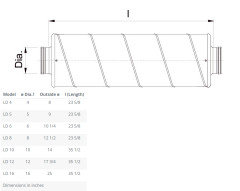
    Since the hood is mounted on an external wall and it is venting straight out the back, I assume there will be no room for a silencer or an inline blower. And an external blower probably won't reduce noise much given how close it would be.

  • last month

    Immediate ducting outside to a wall-mount blower will preclude using a silencer. Options for a silencer include: (a) a chase that goes through the roof-line big enough for the silencer to fit within and which uses a blower at the top. I imagine this would not be compatible with windows in the chase path; or (b) there is a horizontal short chase to hold the silencer with the remote end mounting a blower assembly aimed downward.

    Chase ID has to accommodate the silencer diameter.