Software
Houzz Logo Print
webuser_883491693

Why is this new rose dying?

7 months ago
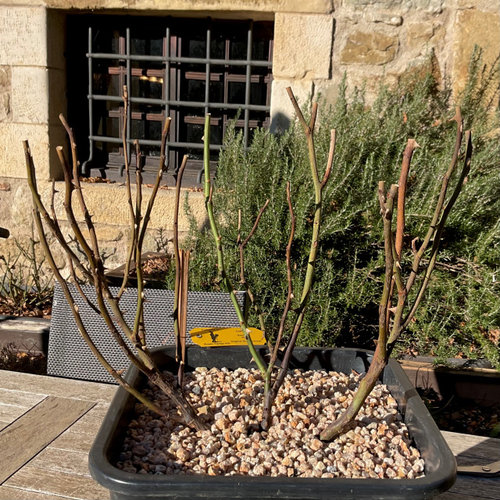
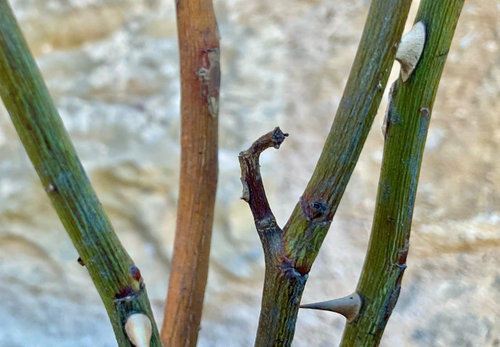
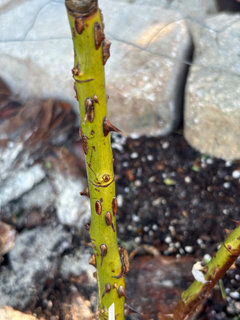
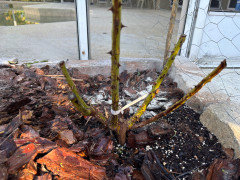
It‘s one of seven new bare-root, grafted roses I recently got from Tantau. All the rest are fine and already budding and leafing out, except this one, Luna. All arrived with dry roots, but rehydrated well enough after a good soaking. Luna’s initially healthy-looking canes started to shrink in on themselves and develop vertical ridges, rather like corrugations. One by one they are dying off. Could it be the rather twiggy canes or the roots were dry too long, or is it perhaps a failure the graft, meaning it’s unable to take up water? Disease?


I have sent these photos to Tantau with a description of the problem and await their response, but I’m curious to hear if anyone has seen this before or knows the reason why it’s soon to be totally dead!


I also explained to them that for many years have I potted up new bare roots in the above manner and grow them on first, so I can check all is well and the variety is as named before planting out. None of the seven have been exposed to frost or other adverse conditions, have been moderately watered but not drowned.


I would appreciate your thoughts, on their own merits but also as backup in case they say I must have mistreated it and it’s all my fault!

Comments (15)

  • 7 months ago

    Nollie, is there any chance that this rose received strong reflected heat at some point after you planted it? It would hardly seem likely at this time of year, and yet your climate is like mine, I believe, in that nights are cold, but days are still quite warm and the sunshine unexpectedly intense at times. I’m sure you know what you’re doing, but gravel “mulch” can heat up the soil more in bright sunshine. I’d personally be hesitant to use gravel on a new rose.

  • 7 months ago
    last modified: 7 months ago

    Nollie,

    I think it's now at the point of no return. You would think that a vigorous bare root would have had thicker canes upon your receiving it. I suspect a graft failure issue from the day it was propagated, along with the stress of drying out before you received it was the cause of its present condition.

    Don't let Tantau wiggle out of this one....a replacement with a vigorous, thick caned specimen, or a full refund are in order.

    Moses.

  • 7 months ago
    last modified: 7 months ago

    Is this Luna, Tantau's new (2025), yellow, 3", floribunda?

    Moses.

  • 7 months ago

    Hi Judi, the sun is quite weak at this time of year, with daytime temperatures in the mid 50’s at best and no reflected heat, so I don’t think it’s that. They have all been potted up and treated the same, placed in sheltered spot during the day and only this one is dying. Like you, we do experience sharp temperature drops overnight, but as soon as it dropped below freezing, I started popping them in a cool garage overnight, so no temperature extremes either way.


    I have probably started off hundreds of roses like this, topped with a thin layer of grit/fine gravel and they are normally fine until I plant out sometime in May. The gravel gets dumped then in favour of a deep organic mulch. I agree any gravel is a bad choice for permanant use in our kind of climate, but find it useful as a pot topper when growing on all sorts of plants.


    Moses, yes it’s that Luna! I suspect it’s failing for the reasons you suggest too. The cane corrugations are quite distinctive, but I don’t really know enough about plant physiology to say for sure whats really happening. I could de-pot it to inspect the graft and roots, but should probably wait for feedback from Tantau before I do.

  • 7 months ago

    I have this kind of problem periodically with bare roots that arrive healthy but fail rapidly when potted or planted. I call it "the Black Finger of Death". The canes gradually turn black or brown, usually starting at the ends of the canes and progress rapidly down the canes. Sometimes I can head it off by pruning an inch or two ahead of the black progression, but usually the rose is doomed. Some of your canes show this blackening at the end, and some just look dead in the water (brown and dry).

    I find this happens more in my cold zone when roses have been in cold storage a lot longer than they usually are for people in warmer zones. The notion is that the storage can create fungal disease in the canes (maybe downy mildew?) that create canker. I posted a thread about why the roses from one (unnamed) vendor almost uniformly had black finger of death (BFD) where other vendors had no more than 5-10% BFD. The advice from Gardenweb consensus was to use a fungal treatment immediately on arrival to counteract that for bare roots.

    I also had a vendor this spring where the bare roots were EXTREMELY slow to leaf out - maybe a month potted before they put out leaves. They didn't blacken, but were sluggish. That might have been a root reaction to the cold storage or something similar that's different from BFD. From that vendor, I had the same 50% failure rate of the roses, and for the others needed to prune aggressively ahead of the cane death. I had another vendor where out of 15 roses three of them were extremely slow to leaf out, and those were the 3 out of 15 roses that failed to thrive in the first summer. In that case, there may be something dealing with the rose's ability to take in water or nutrients from the roots based on how it was stored, but that's just my hypothesis.

    I get a fail rate of 5-10% in most bare root companies and I sometimes ask for refunds and sometimes don't bother (I buy a lot of roses). It's hard to pinpoint that one of 20 roses was treated any differently from the others by the vendors, but given that they all had equivalent treatment by me I presume it was something in the storage or other treatment on the vendor's side. It's not that the rose itself is flawed, it's that particular bare root that reacted badly to the handling it received before it reached you.

    At least, that's my hypothesis. By all means, Tantau should replace the rose since you did everything you should have and it still failed to thrive.

    Cynthia

  • 7 months ago

    Just to clarify, Nollie, that I wasn’t suggesting that you are in any way responsible for Luna not making it. I was merely grasping for possible explanations other than the obvious. Obviously, you have success with the method you described and the fact that only one is dying shows that the plant itself is not a healthy bare root. Surely Tantau will replace it.

  • 7 months ago

    @roseseek and others, I too have a bare root rose that is struggling and wanted to ask you about whether cutting some of the canes that have turned a bit brown will help the rose in addition to the mounding strategy which I will get to work on now.


    Additionally, when you have a rose that initially tried to push out growth from a cane and then stopped, how urgently should I have acted to mound up the rose? I planted this rose in the middle of November so it has been almost 2 months now. I am in central Florida. Temperatures have been in the mid 70s.


  • 7 months ago

    Judi - please don’t worry, yours was a perfectly sensible factor to consider and I’m grateful to you and for everyone else’s input!


    Cynthia, all excellent points and I like your hypothesis. Even in the most perfect growing conditions and care there is always the odd failure with new roses, or indeed any live plant material. I have had a few over the years that have mysteriously failed to thrive then die, but at a much lesser rate than you in your cold zone. One particular supplier I blacklisted because the failures were mostly theirs, so I could only assume they were careless with them somewhere in the cultivation/picking/storage/shipping process.


    Kim, yes those canes certainly look like they are losing water faster than they can take it up, or perhaps not able to take it up in the first place, even though there looked to be a good root system in proportion to the size of the scion. I have tried rehydrating the canes from the top by spraying with rainwater, even though the air here is quite damp already, but to no avail. I don’t think there is any saving this one, but many thanks for sharing your insights and success strategies in such detail.


    Forgive me for saying so and call me lazy, but all that mounding and cardboard is rather too much faff for me and shouldn’t be necessary in my climate. I don’t think it’s too much to expect a high end supplier to provide decent, healthy stock that thrives under good, normal care or to replace it without quibble if it doesn’t!

  • 7 months ago

    Thank you, Kim, for that detailed explanation on mounding bare root roses. I always mound my bare roots as well, though usually with mulch instead of soil, which I keep damp by showering with the hose daily. The 21 bare roots I planted this fall I mounded with chipped up garden waste. I see every one has broken dormancy in spite of the fact that it’s January. I am thinking of letting the mulch around them till spring as a bit of protection from the cold nights we get till middle of March.

  • 7 months ago

    I have to mound up my bareroots like Roseseek described. Also, you may want to ask Tantau if any other customers had a problem with that variety. Good luck!

  • 7 months ago

    @knightsgambit if the canes are still green and the buds aren't blackened or completely shriveled, I'd leave them. If they are brown or black, and/or if the buds have blackened then cut them to the point where the canes and buds appear viable. Trevor Griffiths was a rose nurseryman in New Zealand who wrote many rose (and other) books. I remember reading in one of books, nearly forty years ago, where he accepted a return of a "dead" bare root. He buried it in the ground and dug it up two or three weeks later and planted it in a bag of soil. He carried it around to rose society meetings with him to demonstrate his "dead rose". If there is bright sun, the plant needs mounding. Light and warmth (even from just the sun shining on the canes) stimulate the plant to try to grow. Dark, cool and moist stimulate the formation of roots. The "roots" the plant arrives with aren't sufficient. They anchor it in the ground and provide the starting point for the feeder roots, those which literally absorb nutrients and water in mass quantities, to grow out of. Once established, those larger anchor roots may draw water from deeper in the soil but they won't until there are new feeder roots and those require the right conditions under which to grow.


    If you've rooted cuttings before and experienced them breaking into growth and even flowering, then collapsing, it's precisely the same thing. Think of those body bag roses you've encountered on store shelves trying to grow canes and foliage while being entombed in plastic body bags.


    You can use a cylinder around the plant to provide the mound or simply a mound of mulch or soil, whichever you have and can more easily use. Both work. As long as there is "green" and the canes and buds aren't too badly shriveled, it should work. Other than a bit of time and effort, what do you have to lose trying it? They look salvageable to me from your photos.


    If you receive bare roots too early for you to be able to safely plant, you can also bury them. Dig a trench the width and length you need to fully bury the plants. Lay rope across the trench at the upper and lower ends, long enough to protrude from the soil once they are covered so you can easily find them when it's time to plant, and fully cover them as if you're planting them. It's literally how those in arctic climates "winter protect" standards and climbers.

  • 7 months ago
    last modified: 7 months ago


    If the roots of a bare root have not been handled with kid gloves from the time it is dug until you receive it in your hands, troubles can happen. From: harvesting (digging), storage, selling, to the customer receiving said bush, it can take 4-5 months during which tIme the delicate roots are exposed. They are not the canes of a bush that are most vulnerable to mishandling, they are the roots. Anything can go wrong. Fortunately most bare roots come through with flying colors, and grow for the rose gardener without incident. A small fraction will not make it. It's statics.

    Nollie's rose could just be a statistic...doomed before receiving it, regardless of what anyone could do past the purchase date.

    Moses.

  • 7 months ago

    Wonderful explanation of the methods and reasons for mounding new bare roots, Kim. I think Palatine instructions still had the mounding instructions, and if Palatine said to do it I listened (same with Kim Rupert advice :)! ) I do mounding of bare roots both in pots and the ground, but from some vendors I still see the cankering pattern of the short canes above the mounding and I have to prune beyond the progression (digging below the mounding) for any hope of saving that rose. Usually my bare root canes are either green or black, without the wrinkling of the canes seen here.

    There are undoubtedly multiple factors affecting bare root survival when planted, and my plan is always to do what i can to counteract as many of those factors as I can (within reason - still not doing fungicides - too lazy), realizing as Moses said that some of them may be out of my control.

    Cynthia

  • 7 months ago

    UPDATE.. well I did everything within reason and within my power, but there was no waking the dead! Shortly after starting this thread the remaining canes still clinging on to life turned brown and died completely back to the graft. I hoiked it up and there was no sign of life, neither cane, graft nor root.


    I have spent the last week presenting evidence and arguing the toss with Tantau. They finally offered ”as a gesture of goodwill, to replace it free of charge“ provided I paid twice the price of the original bare root in postage, with no ‘growth guarantee’. Needless to say I declined and they have now grudgingly agreed to credit my bank account with the original cost. Not very impressed with this quibbling, particularly as they charge twice the unit and postage price of my usual nursery anyway, for the same roses originating from the same growing fields! I expect said usual nursery will have Luna next year, so if I want to try it again I know where I will be shopping in future..