Software
Houzz Logo Print
catspa_zone9sunset14

Experiences with R. gigantea hybrids?

At the Friends of Vintage Roses sale a few weeks ago I found myself coming home with, among other wonderful rarities, a band of "Apricot Gigantea". This variety doesn't have an HMF description, the only info being from its description in the sales brochure: "Unk. From John and Becky Hook’s catalogue: this maybe Comtesse de Chaponnay according to Eienne Bourret. I think Noella Virebent matches better." And, of course, neither of the mentioned possibilities have all that much about THEM on HMF either... It was already closing in on 3' tall in the little band, stout-stemmed and well-rooted and bursting to get out, so I put it in a 2-gal. pot and it's already sprouted new leaves and lengthening canes all over and, hopefully, is on its way to being planted out in the not-distant future.


I am supposing that it should get large and I do have a decent spot for it next to a large valley oak (only requiring the eviction of one of my daughter's orphan Manettiis that got parked there), where it can climb as far as it wants. However, my experience with gigantea hybrids consists solely of admiring from afar, for years, a wonderful, huge old plant of 'Belle Portugaise' climbing up the chimney of one of Berkeley's stately homes -- that's it. So, I would love to hear about the experiences of others with this rose class and, of course, would welcome any advice given!

Comments (24)

  • 2 months ago

    Hmmmm...sorry! I'm afraid it may be up to you to become the expert, if there are none already around. Gigantic beautiful roses do something to me: I'd love to try this class.

    catspa_zone9sunset14 thanked Melissa Northern Italy zone 8
  • 2 months ago

    We only grow one hybrid gigantea, 'Belle Portugaise'. Before I comment on that one, I would like to mention that Anne Belovich's book "Large-Flowered Climbing Roses" has comments and photos of 13 different hybrid gigantea roses, and says that these were not incluced in her book about Ramblers. I was so excited to find them in the LFCls book. Unfortunately, they are not grouped - the book just lists the roses in alphabetical order, so I had to look through it to find them (which was of course good, as I was forced to look at all the rest of the roses in it!).


    Belle Portugaise grows (& climbs!) in multiple places in my neighborhood - I notice it in the Spring when it is in bloom. I have seen one bush well cared for in a front garden, but most of them seem to be ignored in the back yard of old homes, odr climbing up trees along the road (my neighborhood was first set out as lots in about 1900). That implies that it has almost naturalized, or at least bushes of it are growing here with no particular care for decades or longer (San Rafael, CA, 6 blocks from SF Bay, now zone 10, up from 9, Meditteranean climate)


    Years ago I took a cutting from one of them - it was easy to root. I have grown it in my garden for 20+ years, and moved the same plant twice with no problems. It has one of the most beautiful blooms on a rose I have ever seen - very large semi-double, and somehow very very elegant, as are the buds. We give ours a bit of summer water. No spraying, and no diseases.


    We also grow 'Susan Louise', now classified as a tea rose, which is a seedling of BP. It does re-bloom, and is a tall bush (narrower than most teas) which supports itself. The blooms are similar to BP, but not quite the same.


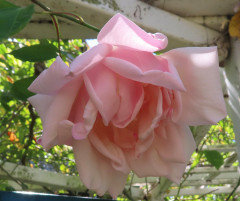
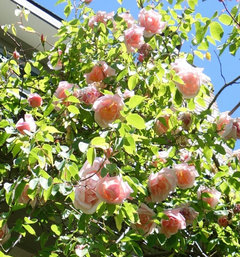
    Here are some pics of our Belle Portugaise:

    Jackie


    fully open bloom


    looking up at it from the ground


    catspa_zone9sunset14 thanked jacqueline9CA
  • 2 months ago

    Susan Louise a tea rose?

    I have grown many tea roses fairly successfully; They overwiner here in east Tennessee enough that the woody canes will support mature wild turkeys when they come through looking for bugs.

    Susan Louise is a rose I've tried to grow three times. Winter killed it each time. I tried all sort of protection after the first one, nothing worked, even double boxed with two different close packed insullation in a bed cut into the hill side with major protection from north and west winds.


    catspa_zone9sunset14 thanked stillanntn6b
  • 2 months ago
    last modified: 2 months ago

    Ann, this is why I am afraid to try here.

    Teas work here but gigantea hybrids may be a step too far.

    catspa_zone9sunset14 thanked Sheila z8a Rogue Valley OR
  • 2 months ago

    Sheila and Ann, I've always assumed that hybrid giganteas are zone 8b-9 or higher (like 'Belle Portugaise'), as a general rule, despite HMF listing some of them, like 'Susan Louise' as tolerating down to 6b (default listing?), which does seem far-fetched. None of its photos come from anywhere other than Zone 9. On the other hand, 'Fortune's Double Yellow' is listed with those same zones, "6b to 9", and there actually are photos of it in Baden-Baden, Germany on HMF, which seems to be zone 8a. I'm going to start paying more attention to that spec as I continue my studies of hybrid giganteas.


    Melissa, is your hardiness zone more 8a or 8b? There is a mention in some of the French-language references for 'Noella Virebent' and 'Comtesse de Chaponnay' about hybrid giganteas surviving heavy snowfall and some cold (thank goodness for Google Translate, my French in nonexistent!): "They withstand dry cold down to -5°C; although some growing shoots suffered frost damage during the winter of 1929–1930—when temperatures dropped to -8°C and heavy snow fell—the plants themselves survived perfectly."


    Beautiful photos, Jackie, and I'm sure hoping this one of mine has those large, languid flowers! They are the ultimate in informal sophistication. Thanks, also, for the reference to Anne Belovich's book -- I'm going to be taking a look at that.

  • 2 months ago

    Thanks, catspa. I am intersted in what you find out about hybrid giganteas, and how yours does. Your area should be warm enough for them. Please let us know how it goes!


    Jackie

    catspa_zone9sunset14 thanked jacqueline9CA
  • 2 months ago
    last modified: 2 months ago

    This is a good thread.

    Catspa, re your question, blessed if I know. Conditions may be changing fast here. For all I know, we could even be in Zone 9: the last few years I haven't seen temperatures fall below 20F, though the chill is abundant. In the twenty years or so that I've had Lady Banks roses in the garden (in one of the chillier areas) they suffered cold damage only once, in 2018 when the temperature dropped briefly below 10F. None of the other roses has ever suffered cold damage. I should say that, even before the climate change of recent years, we didn't all that often get temperatures in the teens.

    Not only are summer temperatures rising, we no longer get much snow. It used to snow abundantly every winter, but this is no longer the case.

    P.S. As a wholly irrelevant aside, it rained last night! Stormed, actually. The showers didn't last that long, but they managed to drop enough water to ease the very dry and hot garden.

    catspa_zone9sunset14 thanked Melissa Northern Italy zone 8
  • 2 months ago

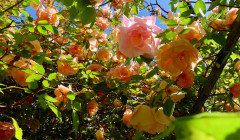
    catspa - You mentioned Fortune's Double Yellow, and I forgot to comment on that. One of its 14 different names mentioned on HMF is The San Rafael Rose. That is the town I live in, and it has been found all over SR and also in nearby towns. Two bushes are growing in Ross, a tiny town about 10 minutes (with no traffic) from here. My DH and I ran into the Public Works director (and only member of the PW Department) of Ross years ago on a walk. We were admiring the FDY which grows through and over over 3-4 tall (20 ft +) trees in a small town park, and was blooming. He told us he planted it, and also one at the town Civic Center. He said he got it from an old plant at a large estate in town (Ross is a tiny town with several old estates, and numerous lovely Victorian houses). Interestingly, the one at the town Civic Center is kept as a largish round bush, and thrives that way. I took a cutting of the huge one, and it grows in our garden right next to Belle Portugaise. Here is a close up pic of FDY with one bloom of BP which has wandered over into the middle of it-

    Jackie


    catspa_zone9sunset14 thanked jacqueline9CA
  • 2 months ago
    last modified: 2 months ago

    I did grow both 'Fortune's Double Yellow' and 'Belle Portugaise' for many years, but both were destroyed in the Polar Vortex of 2015, along with every single Tea I had here — they just weren't hardy enough to last for a week of Minus 14F temps. But until that point, they did OK here — just OK, because they really appreciate hot days and warm nights. These are definitely warm climate roses. In your zone I am sure these gigantea hybrids would be right at home.


    If I had the right climate to grow 'Fortune's Double Yellow' again, I would in a heartbeat — it's amazing.

    catspa_zone9sunset14 thanked Paul Barden
  • 2 months ago
    last modified: 2 months ago

    I grow a few and they are one of my favorite roses . Am in hot and humid georgia 8A and grow Remembering cochet , Faith Whittelsey and Maura La Cava . all these were developed by Viru Viraraghavan . They are literally always in bloom in summer , a little slow to start in spring .Laughs at 100F and humidity , zero balckspot but no fragrance . Actually maura la cava is quite fragrant which is rare for a gigantea . These are all shrubs and not climbers BTW . I wouldnt keep these anywhere below zone 7B though

    catspa_zone9sunset14 thanked Abhishek Dasgupta
  • 2 months ago

    That is a glorious bunch of 'Fortune Double Yellow' blooms, Jackie! And I wish it was as widely distributed around here as it is in your area.


    Doing a search for Gigantea hybrids on HMF, I have run into Viraraghavan's name, and your name too, Paul -- that '47-06-02' of yours looks like a pretty wonderful rose! And, looking up the Viraraghaven roses mentioned by you, @Abhishek Dasgupta, those look amazing, too. Here is an entire class of roses well-suited to my climate and with stunning, voluptuous flowers that have been pretty much unknown to me untill now -- where have I been??? A chance purchase of an "Apricot Gigantea" just may be the start of a bunch of new beautiful friendships here! I hope to hear about more of these beauties.

  • 2 months ago
    last modified: 2 months ago

    Melissa, along the lines of what you have observed, just in the 24 years we have been living at this place our hardiness zone has changed by at least half a zone, I think. Plants I wouldn't have dared to plant when we first moved in, including Puyas, Brugmansias, Justicia carnea, etc. now do fine, with no protection. People in the neighborhood have been planting tropical hibiscus, the tender mandevillas (I only grow Mandevilla suaveolens, which is hardier), and giant white bird-of-paradise with abandon and they survive. In the early years here we had some substantial frosts (25-26F), now virtually none. P.S. I would have loved to have had that rain. Day before yesterday it was 102F and today I am still going around with a hose giving aid to the wilting.

  • 2 months ago

    @catspa_zone9sunset14 Yes, 'Pink Phoenix' is the rose you referred to — it's a hybrid between the miniature orange 'Joycie' and 'Fortune's Double Yellow'. It's very much like 'Belle Portugaise' in many ways. I don't have copies of it but if it interests you, I could send cuttings. It's easily rooted.

    catspa_zone9sunset14 thanked Paul Barden
  • 2 months ago

    Paul, I would love cuttings! I've sent you a message.

  • 2 months ago

    The bottom of our hillside measured 5 to 7 degrees colder than our hilltop where most of my tea roses live. (Back in the day I kept max-min thermometers just to see what my garden really was experiencing).

    Fortunes Double Yellow was among the roses at the bottom of the hill with great soil and better water from nature (run off from several hundred feet of hill side).

    Cold weather didn't kill it, but it wasn't one to put on huge growth.

    What killed it was having very tasty roots. The vole/mole population that works their way through the adjacent hay field discovered Fortunes Double Yellow and ate every bit of root. And it was too desicated when I discovered their leavings.

    catspa_zone9sunset14 thanked stillanntn6b
  • 2 months ago

    That 'Fortune's Double Yellow' survived in your hardiness zone, @stillanntn6b, is very interesting and not what I would have expected. As for voles, they were very fond of rose and other roots in my western Massachusetts garden, too, especially the years when the snow was deep and they had little else. They once chewed ALL the bark off a large Caryopteris shrub one winter when the snow stayed about 4' deep -- all safe and secret from any predator's or other prying eyes. That same year they apparently did me a favor, though, and ate all the rhizomes of a bracken fern that had defied my best efforts to eradicate it (we lived out in the woods). After that winter it was just....gone!


    My relatively small hillside at the back of the yard is tall enough to afford a critical degree or two of warmth against the frost -- the top of it, especially under the pepper tree that used to be there, was the warmest microclimate in my garden. That the sinking cold air made the bottom of your hill so much colder (with FDY there!) is also very interesting. Microclimates in gardens really are cool phenomena and useful to know.

  • 2 months ago

    Catspa, same observation about the temp here in Santa Barbara. When I moved here 39 years ago (from Pasadena), we fairly regularly had upper 20s/low 30s. That's certainly no longer the case.

    catspa_zone9sunset14 thanked susan9santabarbara
  • last month

    In 2024 I obtained "Stephen's Dream", a hybrid gigantea climber with a single rose form. It has yet to produce a flower but seems to be in the "leap" stage of growth, so maybe next year... It put forth a basal cane this spring that is 5 feet long and still growing. There are a few smaller lateral branches that are still in a vegetative state. I have it in a large pulp pot for now. I need to see the actual flower color before I plant it. The color is described by the breeder as "Rose-pink and cherry-red, mauve blending, orange undertones, light brown undertones."

    catspa_zone9sunset14 thanked cheryl connell
  • last month

    @cheryl connell, it's a surprise that such an intensely red rose came from the parents listed -- all of them yellow, apricot, etc. It is listed as a continuous bloomer, so I guess once it does start, there will always be flowers, and seems vigorous, too, though, according to HMF, not to the 30-40' extent of a lot of hybrid giganteas. Nice!

  • last month

    There are photos of Stephen's Dream on HMF by Kim Rupert, and they are very much what I would call "cherry red".

  • last month
    last modified: last month

    I think those photos were taken in India by the breeder. My garden is on the central Oregon coast, much cooler and foggier, which I find can mute the shadings of some deeply colored roses. I will wait to see how the color presents itself in the reality of a seaside microclimate. If it is cherry red, I will be absolutely delighted! I miss the cherry red cheer that my Red Talisman Cl. used to bring to my garden.

  • last month

    Somewhat off topic, maybe.

    When we lived in Louisiana and were working on our houses there and the farm in Tennessee, the drives to and fro were immensely restful and recuperative to our aching muscles.

    What this might have to do with R. gigantea happened along I-10 over in southern Mississippi maybe ten miles from the Bay St. Louis exit.

    On the north side of the interstate, a bit swampy, but lots of tall trees. and clamboriing all over these trees were huge white flowers facing the sun. First thought: magnolias. But magnolias have easily recognized leaves amd a ;lot more petals that cup upwards. These big petals looked rose-ish even at interstate speeds. And clamboring up and over some very tall trees.


    A couple of weeks later, I couldn't see any blooms along that side of the road (once bloomer evidence?)


    Anyway, maybe somebody rose-interested will drive that road to work daily and will watch for that plant.

  • last month

    @Paul Barden those HMF photos I posted for Girija Viraraghavan . I've not seen the rose, nor really any of the others for which I've posted photos for her as I've entered them into the database for her. It does seem quite "cherry red". The images were taken in her Kodaikanal garden where many of Viru's roses were bred.