Software
Houzz Logo Print
jjkoc

Spring Bulbs as companions to roses

6 months ago
last modified: 6 months ago
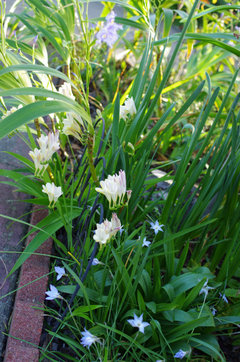
Well, its starting to warm up quite a bit here in zone 10a California, and as someone mentioned in their recent post my gardening spirit is also waking up!

I am expecting Golden Celebration’s spring show in the next couple of weeks. In the front sidewalk strip, Ive planted yellow perennials with purple accents, and thought it would be nice to plant spring-flowering perennializing bulbs as a prelude to the yellow roses planted nearby, for next year.

I am having difficulty identifying Narcissus that perennialize in zone 10a. Most seem to max out at hardiness zone 9. :(

The only ones that seem to have more than one review in zone 10 are Grand Primo and Grand Soleil d’Or. Has this been others’ experience too?

Are there any other varieties that like 10a and warmer? Thank you!!!

Comments (64)

  • 6 months ago

    @jjkOC zone 10a/22, SoCal: I'm fortunate that I'm 2 miles from the ocean, so I can grow perennial delphiniums here... although they do tend to peter out after about 3 years. I spent the first 32 years of my life in Pasadena, and there were tons of things I couldn't grow there (due to the heat) until I moved to Santa Barbara... delphiniums, fuchsias, tuberous begonias, strawberries, etc. Still not even close on growing peonies though. OTOH, my tomatoes and melons were way better in Pasadena :-D

    Boy, did you ever nail it with the microclimate thing in California. And now that I'm 2 miles from the coast, it's crazy extreme on the microclimates. Right on the coast is rather different from my house, which is different from a few more miles up the road, which is entirely different from my friend on the San Marcos Pass (mountains 15 miles away) or my friend in the Santa Ynez Valley (a little over 20 miles away). The Sunset zones are better (there are 24 of them), but you still have to do a lot of parsing of exactly where you are to get the right zone. I'm amazed that your folks got hyacinths to rebloom in the ground in Palos Verdes... when I used to grow them, I always chilled the tulips and hyacinths and only grew them for a year. I do have a narcissus type and a smaller daffodil type in the ground here that I inherited when we moved in, and they come back each year despite being in a well-watered rose bed.

    jjkOC zone 10a/22, SoCal thanked susan9santabarbara
  • 6 months ago
    last modified: 6 months ago
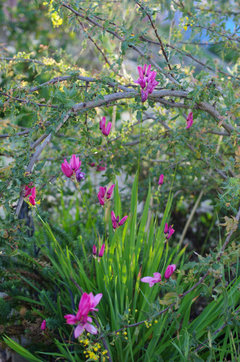
    Thank you @NollieSpainZ9! I’ve only seen De Caen Anemone in florist bouquets of wedding magazines, so I didn’t really even consider that they could grow in zone 10! They’re so pretty! I’ll look into them!

    Re: LEH, mine is in west-facing, partial shade where blooming has been good but leaves are miniaturized and the plant itself never grows more than 2-ft around and high. I had always thought it was a sun problem, but perhaps her requirements are more nuanced than that.

    @susan9santabarbara, I think 2-miles from the sea might be much more greatly influenced by the chilly depths of the Pacific, and I think can get much colder than claimed by zone maps.

    I am thinking to try a couple of the paperwhite narcissus varieties described to proliferate in zone 10 to see whether perennialization is possible here. I’ll also be trying to source a few of the bulb-types others have mentioned in this thread. Let’s see what happens! If there’s one thing I’ve learned about plants, it’s that they can certainly surprise even the most skeptical gardener.

  • 6 months ago

    My LEH never gets any bigger than 2ft either, but it does have normal-sized leaves. I have only seen smaller leaves on some roses in serious drought conditions, after a very dry winter, maybe extra water earlier than usual would help??


    Plants absolutely don’t read the rules, so good luck with your experiments. I’m always surprised at how much water so-called drought tolerant plants need here and what plants thrive that really shouldn’t. Oh and, would you believe it, we actually have TWO yellow Tete a Tete daffodils and ONE Thalia (out of 50 of each originally planted) that have popped up in the last two days - after a wet winter and an absence of at least five years!

    jjkOC zone 10a/22, SoCal thanked NollieSpainZ9
  • 6 months ago

    @NollieSpainZ9, I’ll try to increase hydration. It’s a strange battle because there is blackspot in my yard. Yup, blackspot here in sunny SoCal! Mostly Austin’s and HTs get it. This is despite vigilantly discarding affected leaves.

    As for your daffodils flowering after 5+ years of hybernation… that’s bonkers! Isn’t that the amazing resilience of plants; they somehow find a way.

    I have a Venus Flytrap plant that I planted in an indoor terrarium about 10 years ago. At the time, I didn’t know that they needed a winter rest period. The terrarium gets supplemental light and very high humidity, but remains at ambient indoor temps. The carniverous plant enthusiasts would likely condemn me reading this, but let me tell you. This little plant has persisted, made pups, and adapted to eating the teeny tiny snails that were haphazardly introduced into the terrarium on a mossy branch. :( This little plant may not be as impressive as some cultivars of its species, but I’d say getting a decade and counting, from a $5 purchase from Home Depot is saying something about a plant’s remarkable grit to grow!

  • 6 months ago

    @jjkOC zone 10a/22, SoCal: That is exactly the problem with the USDA zone maps... they are based solely on the average winter low temperature, with no consideration of daytime temps or the temps and conditions the rest of the year :-D

    jjkOC zone 10a/22, SoCal thanked susan9santabarbara
  • 6 months ago

    Wouldn’t it be great if there were a gardener’s testimonial map that lists plants found to thrive by neighborhood?!

  • 6 months ago

    I planted a ton of daffodils and paperwhites several years ago -- back when I used the High Country Gardens catalogue and website. They were bought out by...American Meadows? maybe? Anyway -- I would hunt for the ones rated for zone 10 and listed as "naturalizing." I still have many of the yellow ones growing, but the ones that have *truly* naturalized AND spread are the white ones. Not sure they were all called "paperwhites" -- but that's what they look like. They start growing after the first rains of fall, and really are winter bloomers. I don't do any perennial tulips b/c the gophers eat them. I think a great suggestion above is freesia. Reliably return, come in lots of colors, and gophers won't eat them. I have gladiolas growing near roses. They seem fine. Maybe I underwater my roses in summer, though. The other great suggestion above are some of the native bulbs...I'm blanking on a very purply one...if I remember I'll post it. Also, I love a cool blue next to a golden/yellow rose -- or a lovely purple -- so I highly recommend salvia so cool pale blue and salvia mystic spires (or mysty if you need a smaller footprint). Also -- sparaxis bulbs are great -- easy -- naturalizing. Not sure if you can control for specific colors, though. Mine are mixed.


    I *seem* to recall ording tete a tete and maybe cheerfulness? Perhaps an ice folly or two? It's been a long time. I'd ordered over a hundred and planted them one November over the Thanksgiving holiday, thinking I could create a rubicon the gophers would not cross. A few weeks later I went out to look for any green shoots -- and to my dismay I found that most of them had been pushed up out of the ground by the nasty (if clever) gophers. To this day I will find a clump of daffodils when I'm mowing the meadow or pulling weeds. Still cheerful, and still coming back year after year! Just now colonizing patches like the white narcissus.


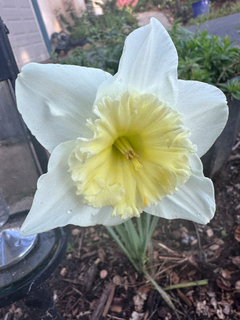
    Not sure of this one. Could be a new one called Obdam from Heirloom...but I really don't know!


    jjkOC zone 10a/22, SoCal thanked DDinSB (Z10b Coastal CA)
  • 6 months ago

    I wish we had sunset zones here.


    If it’s early colour you want can you grow Pasqueflower? They bloom before roses here - as do muscari come to think of it. Again, only purple or white, I think.


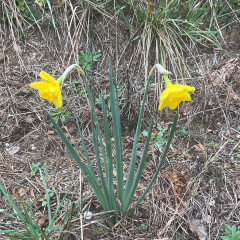
    Proof of daff resurrection!


    jjkOC zone 10a/22, SoCal thanked NollieSpainZ9
  • 6 months ago
    last modified: 6 months ago
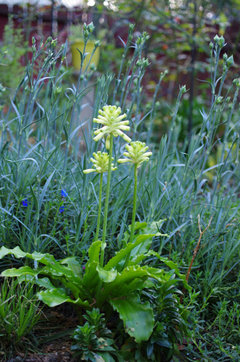
    @DDinSB (Z10b Coastal CA), Yup, I plan to peruse bulb catalogues for only tried-and-true Paperwhite Narcissus that are listed for 10a. The climate‘s bound to only get warmer around here…

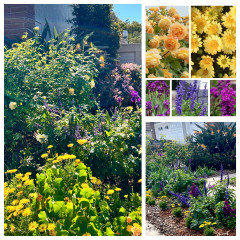
    As for planting Salvia Mystic Spires, I’ve got that box checked off. I’ve added a pic of the bed’s current state and the perennials that I’ve already planted.

    It may seem like a small area compared to some of the gardens I’ve seen on the forum, but a LOT of labor went into digging out suburban packed clay, amending the soil, and growing up a lot of plants from divisions. All of my remontant irises came from neighbors and gardener friends.

    I think in the next year or so when everything has grown in, the fully-materialized color harmony will be quite nice.

    @NollieSpainZ9, daffodils certainly symbolize spring resurrection in my mind. Kudos to your remnant plants. So cheerful! As for Pasque flower, hm… I don’t think I’ve seen it here; might be too warm. Maybe Gazanias are a safer bet.

  • 6 months ago

    My zone is listed as 10a, but even in Oakland, the climate in the flats is very different than up here in the hills. It never gets too cold, but it also never gets too hot and we get a lot of summer fog. Bulbs that have reliably rebloomed for me are freesias, paperwhites, gladiolus, ranunculus (technically corms), and daffodils. I have no clue which types of daffs, they were purchased from Costco years ago and they were a naturalizing mix of some sort. I’m trying hyacinths this year for the first time and I’m in love. I really hope they perennialize for me.


    @jjkOC zone 10a/22, SoCal I say just throw some down and see what happens! I’m a chaotic gardener though and just toss stuff on the ground and see what sticks lol.

    jjkOC zone 10a/22, SoCal thanked SD Shine -Z10a Bay Area
  • 6 months ago

    @SD Shine -Z10a Bay Area, Good luck with the Hyacinths! They are indeed so pretty and wonderfully fragrant!

    As for seeing ”what sticks”, ain’t that the truth! Will have to resurrect this thread next spring, with data! ;D

  • 6 months ago

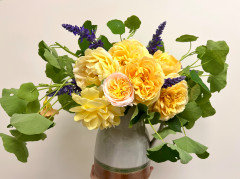
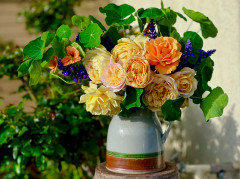
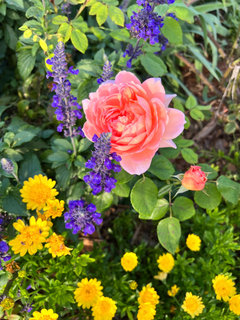
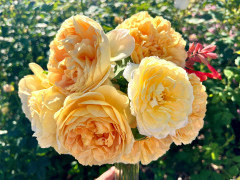
    Heres a bouquet from the front bed. The first of the Golden Celebration and one Juliet, with Salvia and Nasturtium.


  • 6 months ago

    Gorgeous yard AND gorgeous bouquet, @jjkOC zone 10a/22, SoCal!

    jjkOC zone 10a/22, SoCal thanked DDinSB (Z10b Coastal CA)
  • 6 months ago

    @DDinSB (Z10b Coastal CA), Aww… Thanks! :D

  • 6 months ago

    @jjkOC zone 10a/22, SoCal Stunning!!


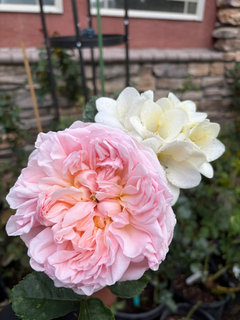
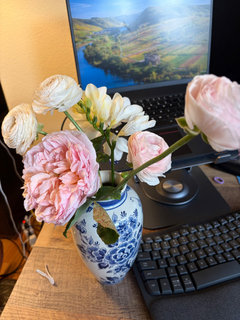
    This morning, Evelyn graced me with a single, chonky bloom and freesia. I wish you all could smell this:


    With some ranunculus:


    jjkOC zone 10a/22, SoCal thanked SD Shine -Z10a Bay Area
  • 6 months ago
    last modified: 6 months ago
    @SD Shine -Z10a Bay Area, Aaaah! Evelyn!!! Totally jelly, over here!

    We need to get tech R&D to spend dollars on smell-o-vision! ;D

    My Evelyn is still a baby plant. Hopefully, one day I’ll be able to enjoy its perfume. Fingers-crossed!

  • 6 months ago

    Gorgeous, jjk - small is beautiful and all your hard work is clearly paying off. A similar story here, where the boulder-strewn, hideous alkaline clay on bedrock has taken years to dig, improve and get deep enough to plant in. My whole garden has been one long experiment in survival!

    jjkOC zone 10a/22, SoCal thanked NollieSpainZ9
  • 6 months ago

    @NollieSpainZ9, Thank you for your kind words! :) I can only imagine the blood, sweat and tears of lugging boulders out of the ground. But I’m right there with you on wretchedly compacted clay! It’s agony.

    As for the garden being an experiment, I couldn’t agree with you more. I think, as a gardener, one learns as one grows, and grows as one learns. I only wish the lessons were easier… ;P

  • 6 months ago
    last modified: 6 months ago
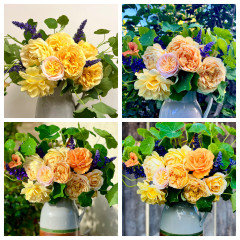
    I took another pic of the bouquet in natural morning light because the pic I posted previously was in bleh indoor lighting and the Nasturtiums hadn’t fully hydrated after cutting.

    This pic is more photojournalistic. I also added a bloom of Sunbelt South Africa, a beautiful tangerine orange in color.

    It’s always amazing how much lighting and background can change an image. See a comparison below.


  • 6 months ago
    last modified: 6 months ago
    DDinSB: Your daffodil looks like 'Ice Follies', a very popular and durable kind.

    Nollie: I'm surprised that you have what sounds like much difficulty with spring-flowering bulbs. Narcissus are iffy here, some durable and some not, but my usual problem with bulbs is varmints. If we didn't have mice, porcupines, and wild boars, the place would be jammed with tulips and hyacinths, and more crocus than we can currently boast: these last seem to be irregular as well, with the species kinds looking the most prosperous. Poisonous or apparently unappetizing kinds like snowdrops, snowflakes, some narcissus, and hardy cyclamen do fine when correctly placed.

    Local feral daffodils appear to be mainly varieties of N. speudonarcissus, which do well in gardens; 'Thalia' is pretty good, and I have 'Elka' looking promising after 3-4 years; 'February Gold' is decent, poet's narcissus is native and grows well in my woods, but doesn't want to flower. The old show flower 'Aircastle' is very good, tough, healthy, and a good increaser. I hope the bulbs I want to move out of its current miserable clay don't die of shock in better ground (it won't be that much better: I have no good soil). I have other odds and ends popping up.

    I garden in heavy clay, insufficiently amended; we have adequate winter chill and hot summers, and a good level of annual rainfall.

    One more thing: aren't there any wild bulb flowers growing in your area? They're pretty common here.

    jjkOC zone 10a/22, SoCal thanked Melissa Northern Italy zone 8
  • 6 months ago

    @Melissa Northern Italy zone 8, Well gee… I’d be hesitant to garden, let alone be outside at all with wild boar roaming through my backyard!

    As for wild bulbs here in suburban zone 10a… the only natives “bulbs” I see rampant, are corms of Oxalis stricta that have highlighter yellow flowers.

  • 6 months ago

    jjkOC, actually, that comment was directed at Nollie in Spain, whose conditions always sounded similar to mine here in Italy, but now I'm wondering. Sorry for hijacking your thread.

    You might have a look at local natural areas and consult some native plant guides--also local native plant nurseries--to see if there are bulb plants of interest to gardeners. And of course, the original great strategy: walking around the neighborhood and seeing what grows in people's yards. Especially in the yards of older houses, where any bulbs growing haven't been chilled and planted to flower for a single season.

    jjkOC zone 10a/22, SoCal thanked Melissa Northern Italy zone 8
  • 6 months ago

    I am very much enjoying seeing your beautiful early blooms jjk.


    Melissa, although we probably have not dissimilar climates, plus we sometimes get very sharp temperature drops overnight here, overall we don’t have sufficient winter chill hours for Spring bulbs like daffs and crocus, at least not consistently year-on-year. Cultivated tulips were a disaster - of the hundreds I planted early on in the garden’s development, most that bothered to show up immediately got tulip blight and had to be dug up and burnt.


    Similar to others have described in their local areas, my neighbours and I have very different microclimates virtually within hailing distance of each other. Further up the mountain, they miss the late Spring frosts we get closer to the valley floor and can grow more tender plants than we can. Heading down onto the valley floor alongside the river, the deciduous woodland and deep leaf litter sports early wildflowers such as anenome, hepatica, celandine, periwinkle and violets that don’t thrive on our own plot.


    Back at home, at middling altitude, the upper slopes, forested with evergreen oaks, occasionally sport some bulbous plants such as sword-leaved hellebore and star of bethlehem, while the barer exposed terraces just above the house see wild alliums, helianthemums and asphodel in summer.


    I tried transplanting some asphodel into a rose bed, but it turned into a menacing and invasive monster in the much-improved soil. So one has to be a little wary about unleashing wild things in a cultivated bed or smaller garden, I think. Speaking of alliums though, there is a short yellow one called Molly that could work in front of roses and suit your scheme jjk, if you added plenty of grit for drainage? I know certain alliums can be pretty invasive in some climates, so you would need to check it’s not one of them!


    jjkOC zone 10a/22, SoCal thanked NollieSpainZ9
  • 6 months ago

    @NollieSpainZ9, Aww… thanks!

    How amazing that you have so many distinct habitats in your vicinity! I’ve thought about trying alliums in a new front bed that I am creating, since they are often used in cottage gardens. I’ll have to look into the one you suggest because I have only read about purple alliums.

    @Melissa Northern Italy zone 8, I am looking though native plant catalogs, but many of our CA natives would over-run my small garden beds or sow the stringently-scrutinized lawns of the neighborhood. I wish there were more gardeners in my neighborhood.

  • 6 months ago

    Here’s another pic from the front bed. This is an early bloom of Carding Mill amongst Osteospermum 4D yellow, and Salvia Mystic Spires.


  • 6 months ago
    last modified: 6 months ago
    jjkOC, Don't we all! I treasure my precious few gardening contacts.

    Many years ago I coined the phrase, 'Every climate is a microclimate'. My own garden is large (a few acres), and I do pay considerable attention to placement. Actually, sometimes I should pay more and different attention. I have a years-old plan to plant Tea roses along the main route through the garden, and recently set my garden helper to digging the planting holes. We had a lot of rain a few weeks ago, and accordingly the holes filled with water, and then didn't drain because of the intensely heavy clay there: basically they functioned as clay pots. Teas die when their feet are wet. My helper is amending the soil with some organic matter and much sand, but I'm afraid the lighter soil will allow the holes to fill with water, and then not empty again: result, dead Teas. I think my helper needs to dig channel out from the holes and fill the channels with light soil, but haven't summoned the fortitude to tell him to do so. This part of the garden has a large, steep field above it, and the amount of water that drains out of it and into the garden is impressive. Had I understood from the start how wet this area is in wet periods, I probably would have decided to put the Teas elsewhere, and plant once-flowering old roses there instead, as they're much more tolerant of water. Oh, well! Now I'm on this track and unwilling to change course.

    One last thought: you're going to be the doyenne of gardening in your neighborhood: a shining light for the next aspiring gardener who comes along.

  • 6 months ago

    One could go further, Melissa and say ’every garden has several microclimates’. Would grafted teas fare better than own root along your garden path do you think? All my roses are on laxa, which seems pretty tolerant of my poorly draining, heavy clay.

  • 6 months ago

    Oh, I do say so, Nollie. About grafted roses, I don't like them, and avoid them as much as I can. I'd rather lighten the soil, though I admit this area is uphill, in every sense.

  • 6 months ago

    @Melissa Northern Italy zone 8, It’s difficult to visualize your main planting area where you wish to install the tea roses, but I wonder if you could terrace or elevate it, so that you could install drains away from this main route. Another thought is to incorporate diatomaceous earth to try and enhance drainage and reduce compaction.

    As for being the doyenne of the neighborhood, thank you for your kind encouragment. :) I am still much the novice gardener. However, still being surprised, awed, and mesmerized by plants and the act of raising them keeps me hopeful that such labor and learning are indeed worthwhile.

  • 6 months ago

    If you’ve has vision of a tea rose lined path in your head for some time, Melissa, it’s hard to let go, despite the practical difficulties. There was no garden here ten years ago and an extremely meagre layer of hard-packed, boulder-filled clay. I dug, improved and raised whole areas to improve drainage and increase depth sufficient to permit planting. However, that was a long and hard manual task that I wouldn’t wish on anyone, not even your young and fit helper. If there is ever a next time, I would employ mechanical means to shift those boulders and turn the soil before improving it!

  • 6 months ago
    last modified: 6 months ago
    jjkOC, I've been gardening for over thirty years and have always found it VERY worthwhile. I think you will, too.

    Amending the planting holes is already elevating the ground a little, and we do mild terracing, mainly so we don't need one leg to be shorter than the other in order to walk comfortably. The land is slide-prone, so drastic earth moving is inadvisable. My other main idea for dealing with surplus water, rather than draining it away, which is the classic method, is to absorb it. We have periods of heavy rainfall, but also prolonged periods of drought, so if I can retain water without letting it flood us, we have it when it gets dry. I don't know how well this works; it's just my idea. So instead of ditching, I plant heavily. At the uphill boundary of our land, with the field above it, I've planted shrubs, trees, rambling roses (less sensitive to wet conditions than the Teas), then below them the Teas and Chinas. The trees are mostly less than knee high, but as they grow, they should soak up more water, anchor the ground, and also make it more permeable. I don't know if it will work, but so far don't have evidence that suggests I'm wrong. We don't irrigate our plants after the first year, and have few losses, though in dry years plants don't grow to speak of. They make up the growth when it rains.

    Nollie, I wrote this before your latest post, so it doesn't address your comments.

    jjkOC zone 10a/22, SoCal thanked Melissa Northern Italy zone 8
  • 6 months ago

    @Melissa Northern Italy zone 8, growing trees and shrubs separated from your main beds, which avoids raiding by invasive roots, sounds like a very good idea. Without a good image of the terrain in my mind, I wonder if it could be like a mini forest that opens up to your garden as a glade? A forest of white Poplar would be so pretty, or if you had even one willow tree that might soak up a ton of water!

  • 6 months ago
    last modified: 6 months ago

    jjkOC, I took a couple of photos of the garden to show its layout, but can't figure out how to get them on my computer, so they'll have to wait. This area is pretty linear: trees/shrubs/ramblers in one line, then below them the Teas and warm climate shrubs in another line. I actually plant close to trees, and may, well, not regret it later, but may have to make changes to the garden when the trees are mature, though I may no longer be alive at the point, and it will be someone else's problem. So far, thick planting has worked. I don't want willows or poplars in this area. They don't work aesthetically, and they're plants for a large scale; and white poplars sucker out and also are messy. One of my favorite native trees, flowering ash, handles heavy wet soil well and grows quickly, so I use it a lot.

    I got a boon today! Yesterday I ran into my neighbor and asked him about the roadside pile of wood shavings he had left from cutting trees for firewood and sawing them up. He said I was welcome to them, and to all the wood scraps I wanted. So this morning my helper and I filled fifteen twenty-liter bags (former containers of bagged compost) with wood shavings, which was as much as we could fit in the back seat, and carried them off to be spread in the garden. Around the Teas, as it happens, along with added sand. There is no such thing as too much organic matter. So I'm happy. There was a lot more there, too, so we'll be back.

    Nollie, there is the problem of access. I sensibly planned for it, but DH has had a way of overturning sensible plans, and there are also a lot of established plants blocking access. So we're doing it the hard way, or rather my helper is. I pay him pretty well, for what that's worth.

    jjkOC zone 10a/22, SoCal thanked Melissa Northern Italy zone 8
  • 6 months ago
    last modified: 6 months ago

    On the whole the tazetta class of daffodils are the heat lovers. They do not seem to need any cold. You could try exploring those. I had very good luck with a mixture I tried once, and 'Golden Dawn' was a champion. Bill the Bulb Guy is no longer with us, but he recommended that cultivar to the Filoli garden when they planned a field of daffoldils (which, by the way, is magnificent).

    For other suggestions, try the Old House Gardens catalog. In their descriptions they pay more attention to the zones that suit the various climates than I have seen elsewhere.

    jjkOC zone 10a/22, SoCal thanked Rosefolly z5
  • 6 months ago

    This thread caused me to look around my garden this morning and see what bulbs and bulb adjacent plants are blooming here in 10a Sunset 17. I've had the same issue with narcissus, even the paperwhites never really naturalize. They are also very much winter blooming, not spring blooming, and they eventually disappear altogether. Wintersun is doing best for me right now, but it finished blooming several weeks ago.


    Freesias on the other hand naturalize too freely and are almost approaching weed status. They are also just about done right now, so not necessarily a spring flower. (I also like freesia laxa, which blooms in late spring and summer and works really well under roses. It's easy to grow from seed.) Here are some of the last freesias blooming with ipheion and Iris confusa:


    Ixia is one of my favorite South African bulbs, although it takes a while to get established. Ixia monadelpha is blooming right now. Eos is my favorite ixia, it has almost a daffodil effect, but it blooms later in the spring. Here is monadelpha:


    I've found that a lot of the rarer South African bulbs are picky, but Veltheimia bracteata is easy and reliable, if not spectacular:


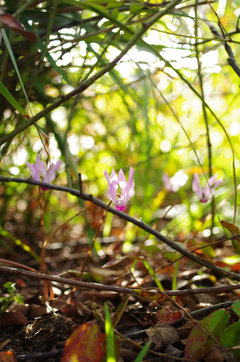
    Cyclamen persicum (the species) grows happily under La Belle Sultane:


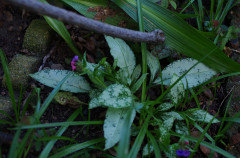
    One perennial that's not rated for zone 10 that's rock solid for me is pulmonaria. This is Silver Bouquet under growing under Erinnerung an Brod and just beginning to bloom:


    jjkOC zone 10a/22, SoCal thanked Formerly RBEHS Z10A/S17
  • 6 months ago

    formerly RBEHS, Your garden is dreamy. I hope mine will one day be its northern Italian equivalent.

  • 6 months ago

    Love the freesia laxa, RBEHS, I’ve never seen that before.

  • 6 months ago
    last modified: 6 months ago

    @Melissa Northern Italy zone 8, Nice score on the wood shavings! Please do post an update when you install your Teas. :)

    @Rosefolly z5, Thank you for the suggestion, I’ll look into Golden Dawn. I’ve perused OHG’s website and found a lot of their offerings are those that require pre-chilling.

    @Formerly RBEHS Z10A/S17, Thank you for your recs and nice pics! I’ve only seen the white/blue colorform of Ixia, so it’s nice to see it in hot pink! I’ve seen on the Telos rare bulb website, a couple of the other bulbs you mentioned. Freesia laxa, I have seen in Moorpark, when I visited Apricot Lane Farms. The salmon/red color form is really cute. Though I am considrring either Freesia laxa alba or Zephyranthes candida as a front of the border plant. :) I’ve not encountered Pulmonaria, but the silvery leaves are quite attractive and give a similar impression as Brunnera. Love the foliage on your Veltheimia, I may consider that for a tropical bed I want to create next year. And your Cyclamen pic is super cute!

  • 6 months ago

    jjkOC, for many years I lived in zone 9b Bay Area, and I did not pre-chill my bulbs. They did just fine. However, I did avoid planting bulbs that OHG advised against for my area.

    jjkOC zone 10a/22, SoCal thanked Rosefolly z5
  • 6 months ago

    @Rosefolly z5, Something I was disappointed to learn the hard way was the fact that 9b is really different from 10a. I have a gardener pal who lives in 9b in an adjacent city. She doesn’t have an issue getting fall planted bulbs to come back such as Hyacinths, Muscari, and she’s even got Delphinium to come back for her! Super green-eyed about this fact. Her experience just would not happen in my area. :(

    I asked an AI agent to search all reputable sources for reliability of Golden Dawn and its purported to be vigorous in zone 10a. I’ll try small set out and see.

    The thing is I‘m not finding a lot of pics of Narcissus planted in zone 10, and wonder if its because they peter out after a couple of years. This is why I’ll be cautious and just make a small order to trial.

  • 6 months ago

    jjk, have you seen this? The implication is that some daffs can succeed despite not being rated for your zone..


    https://oldhousegardens.com/HeatLovingDaffodils.php

    jjkOC zone 10a/22, SoCal thanked NollieSpainZ9
  • 6 months ago

    Interesting that several of these do well in my area.

    jjkOC zone 10a/22, SoCal thanked Melissa Northern Italy zone 8
  • 6 months ago

    Also, 9b's differ from location to location, since the USDA zones only look at minimum temperatures, not other factors such as heat. Several areas around the SF Bay are very cool in the summer, while others are quite hot.

    The Sunset zones are more useful, but have not been kept up with since the Lane family sold Sunset to a large corporation. None of their very valuable books have been updated in a number of years, much to our loss.

    jjkOC zone 10a/22, SoCal thanked Rosefolly z5
  • 6 months ago
    last modified: 6 months ago

    @NollieSpainZ9 and @Rosefolly z5, I agree. As discussed zone pushing depends upon the unique microclimate of the garden bed into which the plants will be situated. I waited too long to order Grand Primo, so will have to wait until fall to see if its restocked. :(

    I also discovered that there are dwarf Freesia with short leaves. I’m waiting on the hybridizer to see how much they cost.

    Another bulb I am considering is Zephyranthes, either candida or citrina.

    In the meanwhile, here is Golden Celebration dressed to impress for spring.


  • 6 months ago

    One other thought occurred to me as I was looking at my own hot strip against the house -- my yellow calylophus (dwarf sundrops) do very well there, and combined with lavender is looking stunning right now! I got my original sundrops from High Country Gardens a million years ago, but have since found it in nurseries from time to time to replenish. Some of have re-seeded, but they spring up where I don't want them, so I've tried to move them. Some successfully!

    jjkOC zone 10a/22, SoCal thanked DDinSB (Z10b Coastal CA)
  • 6 months ago

    @DDinSB (Z10b Coastal CA), how very cheerful! But I have to be really careful about prolific seeders. The lawn people will come after me! ;P I am growing a similar looking plant called Hunnemania, which doesn’t have rampant sowing tendencies here.

  • 6 months ago

    My Hunnemania is blooming for the first time! Plenty of buds comming up and the seeds I planted sprouted! Next year I’ll hopefully have a nice colony of them! :)


  • 6 months ago

    That’s really pretty! Zephyranthes looks an interesting proposition too.


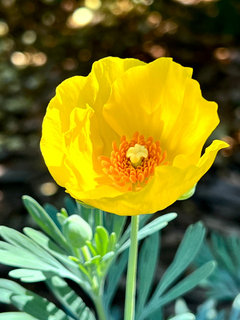
    One lemon yellow that is currently flowering in profusion on the hillsides around here is helianthemum, but that requires really lean, rocky and well-drained soil to thrive. Euphorbia Polychroma with it’s acid yellow bracts/flowers is just coming out, which can take richer soil - I like the well-behaved mounds it forms. I have had the cultivar ’bonfire’ in the garden in the past, which was more colourful, but very slow growing compared to the species and ultimately got swallowed by the eschsholzia! The latter do seed around a lot and is probably classed as invasive, but I do like it with yellow and apricot roses.

    jjkOC zone 10a/22, SoCal thanked NollieSpainZ9
  • 6 months ago

    @Nollie, Mediterranean Euphorbias are a plant that I looked into. I have seen them in some coastal gardens, but the ones commonly grown here tend to get big, much bigger than the space I have. Helianthemum are pretty, but it may be to warm here? Their range is upto zone 8.

  • 6 months ago
    last modified: 6 months ago

    Is anyone interested to grow dwarf Freesias?

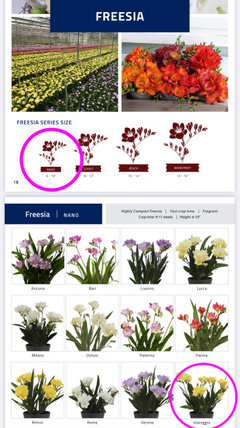
    I am hoping there might be some stateside growers who might want to pool funds for an order of Viareggio Freesia, produced by Flamingo Holland, the US subsidiary of the Dutch hybridizer, Van den Bos Group.

    This is a dwarf, yellow Freesia in their nano series. It is the most compact form on the market.

    Because the minimum order is 1000 corms, I am hoping I can find others who might be willing to help split the cost. I would ship out the desired number of at least 50. Buyer to pay for USPS shipping cost.

    Below is a quickguide comparison of Freesia sizes to show the compact nature of this hybrid. Viareggio also has the characteristic Freesia fragrance.

    Please dm if you are interested!