Software
Houzz Logo Print
tberri

ideas for failing brick

last month

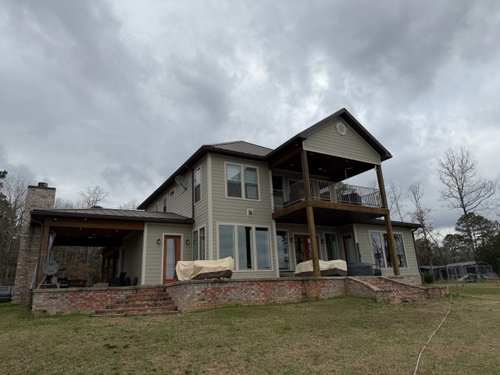
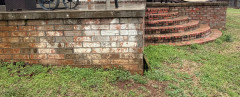
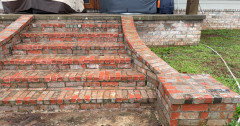
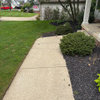
The brick used on our home is defective, and failing terribly on the north side. We can’t get it replaced.
What ideas do you have??
Where the big steps are, we’d love to extend the patio and square that off anyway. -and just forego steps there.
We’ll need some sort of new steps to replace those on the right. But steps are not the big concern.
Thanks!

Comments (28)

  • last month

    I wouldn't extend the patio until I have resolved the brick issue.

    The foundation of any project is most important.

  • last month

    Where is the brick failing?

  • last month

    All off the red (orange) is where that face has fallen off. They’re just crumbling.

  • last month

    Your going to need to look into replacing it with something or thise raised pations will be falling next. They brick is acting as the foundation. Not going to get any better than it is right now.

  • last month

    There are concrete blocks behind the brick, which build the foundation.

  • PRO
    last month

    Will suggest that you first find out why the brick is spalling (the face of the brick is coming off). Is there a severe moisture problem. Were the bricks of poor quality? Have rarely ever seen brick spall like your. Doesn't make sense to replace with new bricks or another material until you find the cause. It will need to be replace even if you have to save up to have it done.

  • last month

    The brick is failing because of moisture/water from one or combination of:

    - water wicking up from the ground, there should be a concrete foundation supporting the CMU with brick veneer that remains exposed above grade (minimum 4");

    - water coming through the CMU from the raised infilled patio, probably not dealt with by weep holes and flashing;

    - possibly overflowing from the top/entering from above, not dealt with by weep holes and flashing;

    - northside means there is no sun pulling moisture out of the brick to help it a bit.


    If you choose to go to the trouble of expanding the patio, rebuild all the brick and grade properly. If you only want a fix that doesn't involve replacement, it is only a temporary bandaid - covering with stucco or another veneer will aesthetically look better but the does not stop the moisture deteriorating the clay fired bricks behind it.


  • last month

    Brick supplier rep says he’s sure that the bricks weren’t “fired correctly” -or something like that. Says if tested, he’d bet big dollars that they would not meet the (brick industry) grade. (I have all the notes somewhere, but at the moment I’m pulling from memory.)

  • last month

    And yes, there are no weep holes. But in this area, this is pretty typical.

  • PRO
    last month

    There seem to be issues with probably moisture that will need to be fixed before any other solution can be planned . Is the chimney also being affected ?

  • PRO
    last month

    You need a LOT more help than you can get here. Who built the house, and you need a mason.

    I'd be getting a very good look at my chimney as well. Just sayin........

  • last month
    last modified: last month

    " Brick supplier rep says he’s sure that the bricks weren’t “fired correctly” -or something like that. "

    The block foundation is stable ifthat is truly the case. What if it really is a water intrusion / deterioration issue? The blacks may not be good either.

  • last month

    Thanks, everyone. But it seems to clearly be (by knowing several more details) that the failing bricks were simply from a bad batch. I was looking for suggestions on the mechanics as well as aesthetics of making something else work. (Stone? Another brick?)

    The chimney from outdoor fireplace is fine.

  • last month

    "We can’t get it replaced."

    "I was looking for suggestions on the mechanics as well as aesthetics of making something else work. (Stone? Another brick?)"

    Which is it, can't replace or replace? And I did address adding an aesthetic cover.


    "But in this area, this is pretty typical."

    It is typical in residential because of no oversight, cheapest bids, masons who are not union/never seen a Masonry Institute detail, etc. That doesn't make it right, it just causes problems later when veneer walls are not detailed correctly.


    A brick run is not going to have a bad "fired" batch. Your chimney and wall is the same brick run. I guarantee you if your chimney cap is leaking those brick faces will spall too. You have a water problem, you need someone who understands construction, not a salesman.


  • last month

    The most important question is whether the brick is a facing on cement or whether it is the support/foundation for the house.

  • last month

    You cannot put something else over failing bricks without the new product failing in very short order. Anything shy of removal is good money after bad.

  • last month
    last modified: last month

    "We can’t get it replaced." -meaning, can't get the same brick.

    All the other brick around the house is fine. Even the portion beyond the steps to the right in the picture.

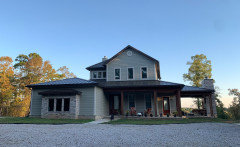
    Yes, I loved the look before this. The front of the house looks great, including a bricked bump-out on the garage.

    I'm open to whatever needs to be done. But I don't even know what type of company to hire, locally, to weigh in on this with ideas -for the look, and what's feasible.

    My husband suggested something with stone, and raised (landscaping) beds. But I don't have a good vision for that.

    My idea was brick of the same size to replace, then paint it all for uniformity.

    My builder, unfortunately, is no longer available.

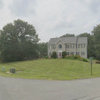
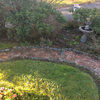
    (first year pic, before landscaping)


  • PRO
    last month

    To be honest, I've never seen brick on a patio stem wall that was over some cement or paper patio that didn't wind up, looking like that. Without some significant moisture management behind the brick to control for the percolated moisture of the slab and patio, I don't care what brick you use, you'll get that same efflorescence.

  • last month
    last modified: last month

    That's more than efflorescence. There's spalling. Chunks of the brick are falling off. We don't know where the house is but moisture penetration followed by freezing and thawing can cause it.

  • PRO
    last month

    Agreed. Again without any moisture management behind the brick all that water that percolates through that patio is going to get trapped and ultimately want to diffuse through that brick and if you have a hard freeze thaw overnight, then you're gonna end up with a bunch of fractured bricks.

  • last month

    I probably wouldn’t want bricks on my patio. Why not replace with something better and more suitable for a patio. We have interlocking blocks. They work great.

  • last month

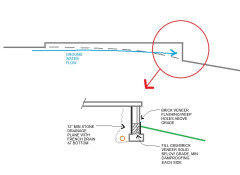
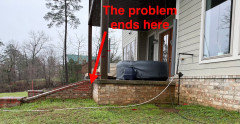
    The fact that both the right side patio wall brick and the brick all around the rest of house remains intact proves what I am saying is happening. The left side brick of the patio wall is exposed to the front yard where the fireplace porch is, where you have a downward sloping yard towards the back. So the patio wall has created a "bathtub" where water is coming through the patio wall:


    How it should be detailed is with drainage, damp/waterproofing, and if the brick veneer extends below grade, solid fill.


    So replacing the brick with new brick, stone, or anything else does not solve the water issue.

    To fix the brick, there are choices:

    - Demo, build new properly at same configuration. Supporting the existing slab might be difficult, and if you want to extend that area of the curved stair, the slab won't match in color.

    - Extend the patio with a new wall in front of the existing, where it can be properly built, as just a planter. Keeps existing slab intact, allows new stairs or any other configuration desired.

    - If using brick, the same size, face texture, and as close to color as possible is necessary. Because paint would have to be masonry paint, which is not 100% opaque, so some color will show through.

    - If using stone, introducing a 3rd material only on a portion of this patio, that competes with the brick, may not be the best aesthetically and stand out as an afterthought. Because a brick "foundation line" carries around the house, stone would have to be strategically placed to make it look like it was intended.

  • last month

    I very much appreciate the thought and time that went into that reply. And not to argue with you, but if it was the moisture “pooling” from the front of the house, wouldn’t the side wall(s) in that area also be impacted? It isn’t. Even the side adjacent to the steps has minimal impact.

    The back center steps are just disintegrating, including the ”walls” (which just serve to border the steps), while immediately beyond, not a single brick has damage.

    The deterioration pretty much only happens during the winter. And we’re in Arkansas, where our winters aren’t especially harsh, though we usually get at least one hard-freeze period.

    Maybe you’re right, and its all due to moisture. I’ll study the ideas you present.

    (I really don’t think the brick serve a support purpose.)

    Thank you.

    May I ask- what would you do? (at this point; can’t go back in time :)

    Please excuse the lack of tidying and staging. It’s raining pretty hard.


  • PRO
    last month

    I'm never a fan of brick on the flat. Bad design.

  • last month

    " And not to argue with you, but if it was the moisture “pooling” from the front of the house, wouldn’t the side wall(s) in that area also be impacted? "


    Counterpoint, if they are all the same brick and presumably from the same batch wouldn't they all be failing? It is water in that area now, others may also be getting ready to fail or the water is not sitting at the other locales.

  • last month

    The stairs on the right is deteriorating because, as inferred by Joe, of brick "on the flat." Mortar passes moisture. The brick does too, and face brick is not the best choice for treads or wall copings (and window sills), it's just an historical look.

    For the patio on the left, I would only expect the northside walls, where the water is trying to go, to be deteriorated, not the side (east) walls.

    The support for the slab is in relation to removing the brick veneer and CMU backup if rebuilding.

  • last month

    Thank you (all), very much! You’ve given me a lot to study.
    Still looking for ideas on what to do, if anyone has any to share.