Software
Houzz Logo Print
alison_duckworth53

Beginner Gardener needs starting advice

4 months ago
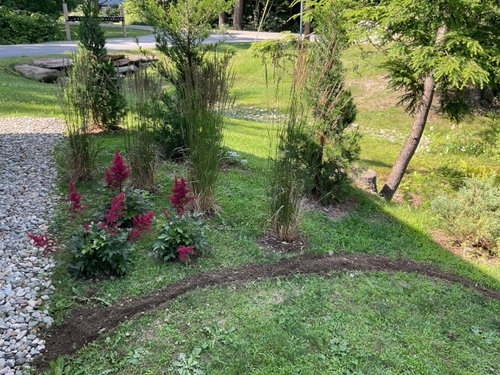
Starting a new garden in very pool soil. Planted some perennials and now want to mulch the entire area. I have dug a boarder the shape I can start with. Should I remove all the grass/weeds, or can I put large sheets of cardboard over the grass and then top with 3” of mulch?

Comments (34)

  • 4 months ago

    Is it too late to dig up the perennials? And hold them in containers? The normal procedure is to prepare the bed before planting. Not after. Any perennial weeds need to be eradicated first or they will continue to come up amongst the plants.

  • 4 months ago

    How exciting for you! I’d cut out cardboard and lay it down. Top with undyed mulch, and see what happens. You might have some grass growing up into the perennials here and there, but just pull it by hand.

  • 4 months ago

    You can cover the grass with cardboard and mulch, and kill off almost all the grass. However, that isn't going to go very far towards improving the soil underneath. It will always be poor soil until you do something drastic to improve it.

  • 4 months ago
    last modified: 4 months ago

    Rather than amend the entire bed, you can always dig a big hole for each plant and backfill it with a 50/50 mixture of potting mix and native soil. Use the extra native soil as an earthen dam around each plant when watering to avoid runoff. I've used this method with poor soil or on a slope.

  • 4 months ago

    I garden in poor, acidic soil on the coast of Maine, and I find that adding good, fresh soil every time I plant something and using cardboard and mulch to smother the weeds is the way to go.My garden is 1.65 acres, so digging up beds and amending the soil requires heavy machinery and lots of money!

  • 4 months ago

    I love to garden but I'm a lazy gardener when it comes to tilling up flower beds. I mark them as you have then lay down cardboard and landscape fabric over top of that. Sometimes I just do one or the other and not both. Then I plant and fertilize each plant. Mulch afterwards and keep watered until the plants are established. And of course, how much watering is needed after established will depend on what you've planted.

  • 4 months ago

    Alison, don't be put off by talk of machinery. Your bed is small and could be dug over quite quickly using a garden fork. And whatever you do don't be tempted to use landscape fabric or to amend specific planting holes. You need to prepare the whole bed by removing weeds and mulching with organic matter. Cardboard can deal with annual weeds but it is not going to clear out perennials. They'll just come through as the cardboard deteriorates.

  • 4 months ago
    last modified: 4 months ago

    Yes, you can lay down wet cardboard and mulch now. Might be a bit cumbersome with your flowers already planted, but you can do it.

    Wet cardboard and mulch has been my practice for years and years. Usually I’ll prepare a new bed in September or October (mow the grass real short and leave the clippings lay; top with fallen leaves too) and then plant it for the first time the following spring.

    On a new bed, you may have to re-cardboard some spots to get the grass under control. Just rake the mulch aside in those areas, lay more wet cardboard down on top of the old cardboard, and remulch. Easy peasy.

    Remember that plants don’t like mulch touching them. Plant in a shallow saucer-shaped depression of dirt - this helps hold moisture at the plant. Then mulch right up next to, but not in, the saucer.

  • 4 months ago

    I use cardboard and mulch between my fruit bushes. It needs renewing at least once a year as the cardboard breaks down and perennial weeds come up between the sheets. If there is an area around each plant with no mulch I'm pretty sure weeds will fill the gap.

  • 4 months ago

    You are suggesting what's known as lasagna gardening and yes as suggested already one usually starts this process before one plants. I would not put mulch on top of cardboard, I would put good soil. When I tried the method I put my rock boarder in then sprayed a plant herbiside that killed all growing plants, the next day I placed newspaper down with a ton of rich black soil on top. I did no digging of weeds or grass. I did this a few weeks before I put in my first perennial. Mulch is too large to enrich your poor soil in any acceptable time line. Each fall working in leaves around your plants will help faster than mulch. Cardboard harbors and encourages slugs in my world.

  • 4 months ago

    Here, I can get at least a calendar year from cardboard It is going to depend on the climate, which we don't know, how fast it breaks down.

    However, it doesn't do anything for the soil more than an inch or so down.

  • PRO
    4 months ago

    IMO do it right from the start , remove all the grass and weeds , get some good topsoil to add to to what is there . Then plant and keep in mind the size of the plants when full grown , then do some lanscape fabric that allows water to reach roots then mulch. IMO you have too much planted there already and why such a small bed?

  • PRO
    4 months ago

    If you want to prevent the grasss from growing, lay down sheets of clear plastic.

  • 4 months ago

    "Mulch is too large to enrich your poor soil ".... That is if you are defining mulch narrowly as the wood chip stuff you get in bags. But mulch is any material applied to the surface of the soil. I use semi decomposed leaves or wood chips and compost. You could also use grass clippings, well rotted manure, mushroom compost, spent hops or hay. There are lots of organic options which will improve the soil.


    And I would urge you seriously not to go anywhere near landscape fabric.

  • 4 months ago
    last modified: 4 months ago

    Adding to floral’s statement, ”urge you not to go anywhere near landscape fabric OR PLASTIC SHEETS.” Good heavens. No plastic in flowerbeds.

  • 4 months ago

    Clear plastic only kills plants in hot places. (Solarization). In cooler climates it promotes weed growth. You're essentially creating a lovely greenhouse for your weeds. And it looks vile.

  • 4 months ago

    Agree…NO landscape fabric. The weeds grow right on top of it and through it, and it can become impossible to get rid of. I have also used the cardboard method with various kinds of mulch and found that it works quite well, but then I live in Nova Scotia where it’s very humid and damp and very poor soil. I fertilize with a good manure or fertilizer, sometimes add peat moss. lay down the cardboard and then mulch. I’m gardening on a very large area. I would only use landscape fabric someplace like at the very bottom of a raised bed to keep invasive weeds from migrating into the bed. Then it’s a permanent permeable installation.

  • 4 months ago

    I’ve not had that issue with landscape fabric. I do use a good quality one so maybe that’s why others have had issues with it.

  • 4 months ago
    last modified: 4 months ago

    The quality doesn't make any difference to the problems with landscape fabric. Essentially it's burying a sheet of non biodegradable material in the ground. It will be there for decades, maybe even centuries. It's a form of long-lasting environmental pollution. Anyone trying to remove it in the future will have a terrible job trying to extract it after roots have grown through it (as they definitely will). In the shorter term plants will start to grow on top of it and it will not be a long term solution to weeds.


    The Dark Side of Landscape Fabric | The Peterborough & Area Master Gardeners https://share.google/kRbJ3noRjLkrcWfCi

  • 4 months ago
    last modified: 4 months ago

    "others have had issues with it" because it is just a really inferior way of dealing with weeds. Quality - or lack of - makes no earthly difference!! There is not a landscape fabric made that will successfully, 100% of the time, prevent weed development. And as others have noted, weeds can be even harder to remove with the cloth in place.

    I can't believe anyone with any gardening experience still advocates using this stuff. Don't waste your money or your time.

  • 4 months ago
    last modified: 4 months ago

    Weeding is never ending, it never goes away. In gardening it's part of the process. Dormant seed or seeds blown in will always sprout. The idea is to have fresh light soil that has been turned over and with plenty of compost mixed in. It allows the weeds to pull out easily when the soil is not compacted. Stepping stones allow access without compacting the soil with footprints.

  • 4 months ago

    As I said, I have had no problem with the landscape fabric. I have NOT had weeds that were impossible to get rid of. I have beautiful flower beds and that is my experience. Just because that’s not been your experience doesn’t make it true for me. And I’ve had a lot of gardening experience!

  • 4 months ago
    last modified: 4 months ago

    Youtube videos of gardeners digging in places where years-old fabric has decayed and fallen apart under ground. The soil is literally filled with plastic threads. Ugh.

  • 4 months ago
    last modified: 4 months ago

    How many years has your landscape fabric been down, Emily? Have you ever had to garden where it has been buried in the soil for years? We are not just comparing personal experience, although personally I have had to remove LF that was deeply embedded and tangled amongst fruit bushes. We're stating facts from reputable gardening experts and research. There's plenty of information available which will back up the contention that landscape fabric is a bad choice. I provided one reference but you'll find plenty more. Here's one: The disadvantages of landscape fabric | Good Growing | Illinois Extension | Illinois https://share.google/JhKznllqeesXM3wAg

  • 4 months ago

    My landscape fabric has been down for many years in some parts of my garden. I'm not putting soil over the fabric so it's not embedded and I pin it down so it's not getting tangled. If I've changed the beds and have to pull up some fabric it's been very easy. The experts can do it the way they want, but I'll stick with what works for me and my flowers & veggies.

  • 4 months ago

    Emily, if it works for you, no issues…everyone has different experiences in gardening.

  • 4 months ago

    Having "a lot of gardening experience" is not at all the same as being a beginner gardener. Being cognizant of something that works for you in a situation you are familiar with and have worked for years is a very different situation to someone who is just starting out. And recommending methods that have been proven to be detrimental is really a very poor way to get a beginner gardener started on a successful gardening career. I would encourage the OP to ignore Emily's comments and follow what as been firmly established as a superior methodology. No landscape fabric, no plastic.


  • 4 months ago
    last modified: 4 months ago

    Change of subject. Plant taller flowers in back and groundcover in the front.


  • 4 months ago

    Very good suggestions. This is a starting point for me to develop some screening from our neighborhood road. I plan to enlarge over the next couple of seasons. I love this idea of using lower, more l8e ground covers.

  • 4 months ago

    The easiest and most successful landscaping method is to use plants that are native to where you live. Your soil is only "poor" for growing plants that are native to a different area. Likely these are plants bred for retail sale. Look for a group of gardeners in your area who do their landscaping with native plants, e.g. on Facebook. Your state will also have info.

    Native plants are just as beautiful and they don't need a different soil because they have evolved to grow enthusiastically in the soil you have.

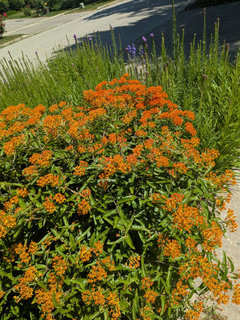
    Here's a photo of my Toronto boulevard garden - very dry, unimproved soil. Our natives are butterfly milkweed in full bloom, and Liatris spicata just opening. I put in a few plants and they have spread and reseeded themselves. No mulch, no topdressing.

  • 4 months ago
    last modified: 4 months ago

    Here is an article about a flowering groundcover for weed control.

    https://www.housedigest.com/2189615/ground-cover-not-hostas-woodlander-lilac-phlox-control-weeds/

  • 3 months ago

    Definitely consult with gardeners in your area! Gardening is very micro climate and site specific. And yes, on researching native plants. A local gardening group can be an invaluable resource.

  • 3 months ago

    Back to your original question, I would dig out as much of the grass as possible. Even if you put cardboard and mulch over that area, the grass will want to crowd and it takes a while for the roots to decay. Grass is very stubborn. I see you have large areas of grass and you could definitely fit some more plants in there. Your perennials will want to expand and grow outward, and the cardboard and mulch will prevent that. It’s a small area…I would dig out all the grass.