Software
Houzz Logo Print
mxk3

Wondering if it's worth it to transplant this tree UPDATE

last month
last modified: last month
Scroll down-thread for update.


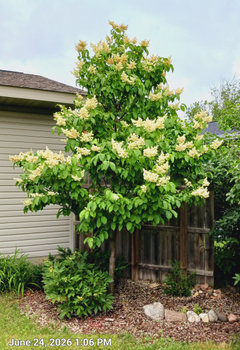
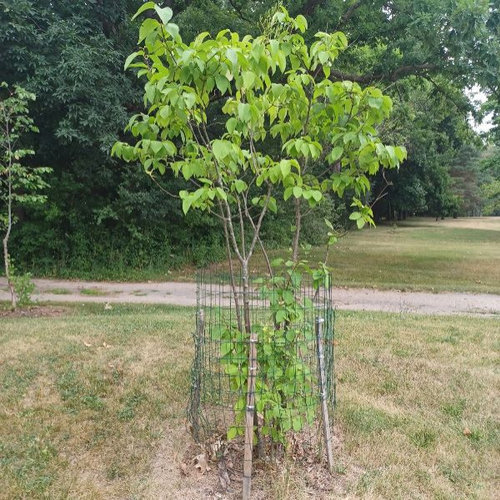
I have a multi-trunk Japanese lilac down by the mailbox. It's been in place about 6-7 years and has hardly grown taller, wider, or fuller, it's pretty much the same size as when I bought it. For some reason, it's just not doing much of anything over the years even though it's been well-tended. While it is fairly healthy it is not doing it's intended job -- the reason for planting it in this spot is to block the view from the road to my house (along with a bank of other trees off to the side).

So, I'm going to replace with something else, am wondering if it's worth it to try to transplant it. It's getting physically harder for me to do things like this, and as the years go by I'm growing more and more tired of putting forth a lot of effort and babying stuff only to have poor results. OTOH, the guilt if I toss it.... LOL!

Anyway, when I start digging, what are signs to look for to determine whether it's worth the effort.


Comments (25)

  • last month

    Of first concerns, one would have to ask, are there any reasons why it didn't perform?

    How was it cared for?

    Is the root flare at the proper level? (#1 reason for growth problems).


    I'd be hesitant to move a tree until I had an idea what the problem is, so we can see if it can be fixed so the tree performs more like it is intended to.


    I planted this 'Ivory Silk' barely 9 years ago that was 3 ft. tall in a 2-gallon pot and is now taller than my house, dense with a wide crown. It was nearly this tall a couple seasons ago but is spreading more with each season (this is with poor, doughty soil).


  • last month
    last modified: last month

    Not an expert by any stretch of the imagination, but I would rmove those lower sucker branches. I would not remove it yet. Also, Are you giving it weekly waterings ? It looks terribly dry there.


    ETA: Agree with Bill about root flare.

  • last month

    Yes, wrong time of year to move it now. Wait until the leaves drop, end of summer.


    Once the OP shows us a close-up picture of the base of the tree, with any debris or soil brushed away, it should be apparent if the root flare is near the surface or not.


    I found this thread while searching, where I cut a side branch off mine, about the middle of June, when first planted.

    https://www.gardenweb.com/discussions/is-pruning-necessary-on-this-tree-lilac?


  • last month

    There's always the possibility of root-girdling from poor nursery practices, but at this point not really any way how to tell or do anything if that was the case.

  • last month

    I agree ben. It's been a mass of tangled roots for the the last 5-6 years, probably just dig it out and toss it. Or just dig it out, inspect the root ball, then decided whether it's worth keeping.

    This too I would wait towards the end of summer.

  • last month
    last modified: last month

    I always loosen up the root ball when planting-- sometimes this amounts to quite a bit of roughing up/cutting of some roots (if tightly girdled), but this is better in the long run. After 6-7 years, though, the thing should have recovered from the root surgery. So I doubt it's that. What I don't know is whether there's anything in that particular location that would prohibit good root growth, maybe something going on underground or a pile of buried rocks a couple feet over. Who knows. I'll have to investigate further when I dig. Or maybe it never was a particularly good specimen. It happens. I have other Japanese lilac trees that are great trees, after settling in a year or two they really took off.

    I will wait at least another two weeks (mid-August) before I take a shovel to anything, but of course it's weather-dependent.

    Another thought I had is instead of transplanting it elsewhere, grow it on a big pot for another season to see how it does -- that would be easier on me than digging another big hole only to have it ultimately fail. I have some giant plastic nursery pots that should be large enough capacity to hold it for a year. I have stored many a potted tree in the barn over winter, that aspect is covered.

    I feel bad tossing it but when I look at it I think of it as a failure because it's not doing it's intended job. IDK what I'm going to do about it other than it will be something.

  • last month

    It's your tree and your call, what you do with it, but without additional information, I asked for above, it would be impossible to give you any good advice on this subject.

    Good luck!

  • last month

    "...but without additional information, I asked for above, it would be impossible to give you any good advice on this subject."


    It's been raining, Bill. Give me a bit of time. :0)

  • last month

    While I agree there are many things that are detrimental to a plants grow, some times they grow the way the do "just because" they do.


    I have planted two plant practically side beside have one do nothing and the other over perform. I have had azaleas that were planted similarly perform in radically different ways. One being an azalea that for over 10 years did nothing. Then the leader went up and to day the bush is nearly the size of the others that were planted 10 years ago.


    This my theory: The deer kept it trimmed small until one year they missed one branch that grew out of their eating range. Once that happen the rest of the bush also took off. Eating Range: the area of the bush where an animal can reach and comfortably eat.

  • last month

    ' This my theory: The deer kept it trimmed small '


    Good theory but deer don't touch lilacs, bush or tree varieties.


    ' It's been raining, Bill. Give me a bit of time. :0) '


    And did the rain stop you from giving information about the care it received that last several years?

    Never mind, I'm kind busy right now. There'll be others along that can help you.

  • last month

    We frequently have deer in our yard, in fact we have a doe who is raising a fawn in the back of our lot right now. Theoretically you are right about what Deer are not suppose to eat, but before they will not eat something they have to eat it once or twice before they are sure they don't like it. They fawns are notorious for sampling everything.


    The best thing that we have found to make deer follow the rules is to treat all new plants and trees with Milorganite.

  • last month
    last modified: last month

    I live in deer country and in both locations, I've had lilacs and never, I mean never have seen one little leaf eaten by a deer. Even very small unprotected plants. They absolutely hate them, no matter what. Let alone eat enough to keep a lilac tree small.

  • last month

    If the soil there is extremely compacted or full of rocks, that could be an issue. Common practice with many housing developments is the topsoil being removed (and sold off), and then the subsoil run over repeatedly to make it smooth, and being seriously compacted.

  • last month

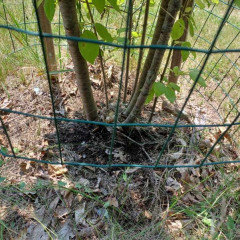
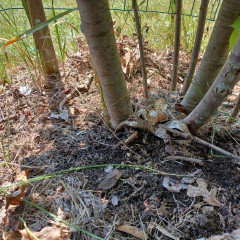
    Here's a couple pics of the base of the tree:


  • last month
    last modified: last month

    I can attest to the fact that deer will eat lilacs. Or, at least sample them before deciding to move on. I have one that suffered a small amount of damage in years past until it grew above browsing height.


    ETA: I'm specially referring to common lilacs (Syringa vulgaris), not the Japanese lilac trees (Syringa reticulata). I've not noticed any feeding damage from deer on the S. reticulata but they did a number on one of my other ones during rub season.

  • last month

    Looks like you should raise it a bit. I cannot see any root flare.

  • last month

    Or scrape the soil away. Less work.

  • last month

    There should be no guilt involved for tossing an ornamental garden plant that is not meeting your needs for whatever reason. We are not talking about an endangered species here, a century oak, or anything of that nature. Forever home obligations do not apply. Free yourself.

  • last month
    last modified: last month

    Syringa reticulata new classification is emerging invasive and it's already invading ecosystems. I've always had a bad feeling about those trees.

  • last month
    last modified: last month

    3,300 to 3,500 species of non-native plants have escaped cultivation and become naturalized in the United States.

    Over 30,000 total plant species have been introduced to North America since European settlement, with roughly 10% successfully establishing self-sustaining wild populations without human help.

    Only about 1,000 of these species of non-native plants have become harmful invasive pests in North America.

    If they've found Japanese lilac trees in the wild, it's already too late.

    My question is, can this end if at first they say, 'it's okay to bring them into North America', then 40 to 150 years later say, whoops! I guess they are invasive?

    We'll see little or no change except local areas that put on a drive to extirpate them, but overall, they're now part of our eco system.

  • last month

    Good job, you must've gotten a big, heavy root-ball.

  • last month

    "Good job, you must've gotten a big, heavy root-ball."


    Actually, not as big as I anticipated for being in the ground this many years. She just didn't like it there, apparantly. Will see how she does in her new spot.

  • last month

    Did you loosen the root ball. A compacted root ball may be the reason it was not growing.


  • last month

    "Did you loosen the root ball"


    Yes. Roots with free range off the rootball.