Software
Houzz Logo Print
crafty1000

need thoughts on custom wood dining table n

last month
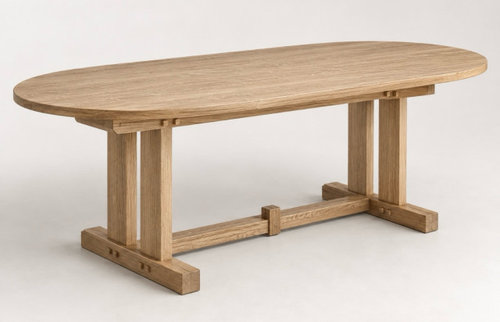
I found a great furniture maker on Etsy who uses Japanese joinery (very important to me). I have a smallish dining room that adjoins the kitchen. I don’t want it overwhelming the space so a max of 78” and 42” wide table to seat upto 8 people.
The decisions I need to make are on the wood combinations (for top & base) and the shape (rectangle or oval). He can’t do expandable so that’s not an option but can do any kind of domestic wood and for a higher price, exotic woods.
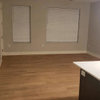
The kitchen and dining room has a lot of warm wood on the cabinets and molding. The floor is a light oak.
The woods being considered are quarter sawn white oak (the pale wood option), cherry, African mahogany and Walnut. (Cherry & African mahogany look pretty similar). Open to other suggestions.
Would love your thoughts!

Comments (7)

  • last month
    last modified: last month

    There are 300+ species of oak. Quercis robur grows in weatern Europe. Unlike N. American white oak, q. alba which has open grain that turns dark, it has closed grain. This meeans you don't need to rift or quarter saw it to avoid the open grain. You can flat cut it in wide planks and show off the grain cathedrals for the top. It for be water based finished to avoid yellowing from oil finishes. Ciranova can give an ultra matte finish pale brown. Rustic grade will have knots and prime or select will have fewer. This European or French Oak is used extensively in engineered flooring in custom new homes. Since he hasn't offered it, he will have to be carefully supervised at stages of the beginning of the project. Specific review of the wood selection and grain matching for the top via phone messaging with pictures and apprvals is a highly recommended option to be negotiated, imo. Respectful involement can be an enjoyable educational experience based on your interest in Japanese joinery.

  • PRO
    last month
    last modified: last month

    Article for you to read, as I would choose the white oak.

    https://www.askacabinetmaker.com/post/the-perfect-white-oak-finish

    The stain for the white oak seems perfect and would result in a Japanese look. I have a kiri wood tansu that is light toned. Lovely.

  • last month
    last modified: last month

    From looking more, it seems a really good option to ask about is Japanese Oak Nara Mizunara (Quercus crispula) and Konara. , used throughout Japan historically. With water poly seal coats and top coats a pale non-yellow finish is possible. Finer grain than European Oak.


    A Japanese Oak table from HIDA. lINK

  • last month

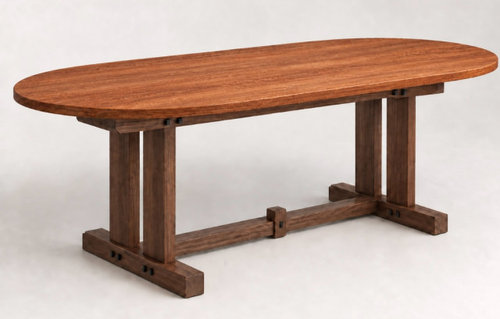
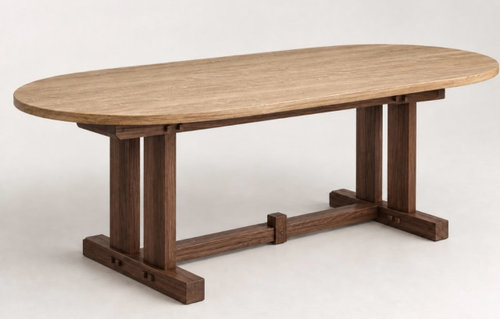
    I like #3 best, followed by #2, then #1. I notice that all except #1 appear to have a non-matching base, but I presume you can get a base that matches. It would help it you showed a picture of the space you plan to put it in and any chairs, unless you plan to buy new ones.

  • last month

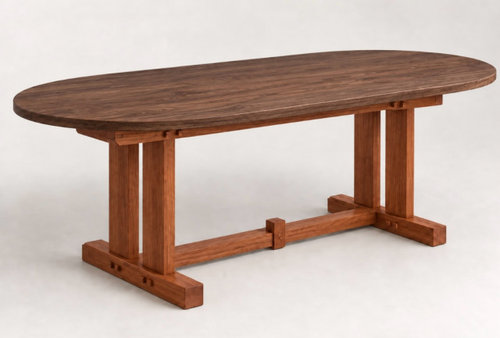
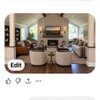
    Thanks all. I should have added that #1 is QS white oak both top & base, #2 walnut top & cherry base, #3 African mahogany top & walnut base and #4 white oak top & walnut base. All AI generated images.
    I’m attaching a picture of the space and adjoining kitchen to show you the other woods in play. I would also like help in deciding on the shape that works best.

  • PRO
    last month

    For your eight-seat goal, I'd settle the seating layout before the wood combination. At 78 inches, the layout to test is three chairs on each long side and one at each end. Ask the maker for a scaled top view with your actual chair widths, the base, and the overhang marked. The base can determine whether those seats are usable, especially near the ends.


    I'd compare oval and rectangular outlines at the same maximum dimensions using paper or a floor template, then put the chairs around them. An oval removes sharp corners, but also takes away some surface area near the end seats; it doesn't automatically seat more people.


    Since the options are AI images, ask for finished physical wood samples before choosing the combination. Compare them beside the cabinetry and floor in daylight and your evening lighting. That will give you a much better basis for judging the color than the renderings.

  • PRO
    10 days ago

    As someone who builds solid wood furniture every day, I'd lean toward the quarter sawn white oak top — quarter sawn stock moves far less across its width than plain sawn, so a wide dining top stays flatter over the years. Before you finalize, ask the maker how the top is attached to the base and how it's allowed to expand and contract with the seasons; a well-built table leaves room for that movement instead of fixing the top down rigidly, which is what causes cracks and warping a year or two later. For a table that will see daily meals, I recommend a matte hardwax oil or matte polyurethane rather than high gloss — gloss shows every scratch and water ring, while oil finishes can be spot-repaired at home if they ever wear. If you go with cherry, just know it darkens quite a bit in the first year of light exposure, so look at samples that have had some sun, not fresh-off-the-saw wood. And mixing a walnut base with an oak top is honestly fine — the base sits mostly in shadow under the table, so it reads as a neutral contrast rather than a clash.