Software
Houzz Logo Print
bertrandk

Pass Through over induction venting

13 years ago
We are considering putting a 52wx60h passthough between our kitchen and family room. this would passover a 30 inch induction cooktop, with drawers underneath and we would build a breakfast bar on the other side.
The idea may fall apart because of the venting dilemma. I cannot move the cooktop and it is centered on the passthrough. I dont want a stainless penninsula hood because it them becomes the focal point of the whole house.
I have looked at downdraft, but this is a recirculated vent and because of the drawers we cannot vent it out the toekick, that needs a stationary cabinet.
I am thinking of putting 2 18x27 inch glass front/back penninsuls cabinets on the top, either side and putting 15x24 inch cabinet in the middle and mounting a low profile (3 inches) undercabinet fan to that.
The question I have is what would be the best way to finish off the bottom of the pass through, in back of the fan where the wall ends? I have a designer working on it also, but wondering if anyone has done this before.
If I could get a wood range hood to work I am also open to that.
I am going to leave the 27 inches of wall in place in back of the middle cabinet/vent as putting a cabinet door there would look choppy.
Any suggestions would be welcome.
Thanks,
Kim

Comments (11)

  • 13 years ago
    Hello, Kim, we may have a few suggestions and advice.

    First and foremost, regarding recirculation - while it's better than nothing, recirculating range hoods (of any type, brand, size, etc), suffer from several significant drawbacks compared to hoods that are ducted to the outside. What makes a range hood recirculating is the addition of charcoal filters to absorb the odors. Unfortunately, these additional filters restrict the airflow (by as much as 40% in some cases), increase noise, and must be changed on a regular basis (ongoing expense).

    In addition, when the hood is not ducted, there is no way to remove the waste heat, moisture, and solid smoke particles - those will go right through both filters (metal and charcoal), and be released back into the room. Last but not least, while a ducted range hood will decrease the ambient air pressure and thus encourage fresh outside air to come in, a ductless range hood will not offer the fresh-air benefit.

    We have written an informative article detailing the benefits of having a range hood, which also covers some of these differences - http://www.futurofuturo.com/rangehood-FAQ-10-reasons-to-have-a-range-hood.php

    Long story short, it's much better to duct a range hood to the outside. Sure, it may be an additional hassle & expense, but in the long run, you will have much higher performance and a more satisfying experience with your range hood.
    bertrandk thanked Futuro Futuro Kitchen Range Hoods
  • 13 years ago
    Second, there is no such thing as a downdraft or undercabinet ("biscuit") type range hood that performs well. While hot air rises, a downdraft is attempting to fight the laws of physics trying to pull it down, resulting in partial capture at best. Undercabinet range hoods suffer from a very limited space and therefore small & weak blowers, providing only 80 to 300 CFM of airflow. By comparison, overhead range hoods can provide 400-1000 CFM, or even more. If you do intend to cook a lot, and air quality is important, a downdraft or undercabinet hood is *not* the way to go.
  • 13 years ago
    last modified: 13 years ago
    Having covered these issues, we're back to the question of "so, what WILL work in this situation?". The good news is that there are several options for inobtrusive - or even completely invisible - kitchen ventilation.

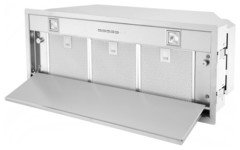
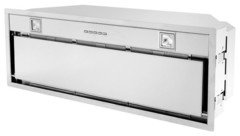
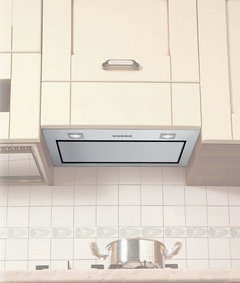
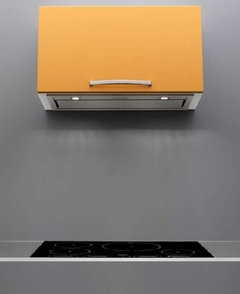
    Option 1 - an "insert" type range hood, to be placed inside the cabinet (not undercabinet, but inside). This offers more ventilation power (for example, our Insert/Liner series hoods provide 940 CFM), and can be installed flush with the cabinet bottom so they're completely invisible from a normal standing height. In addition to the control panel on the unit, all Futuro Futuro Insert/Liner series hoods include a wireless remote.

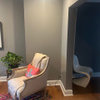
    Some example photos are attached, and please feel free to visit the product pages on our website for more photos & information:

    22" Insert/Liner (halogen lights) - http://www.futurofuturo.com/wall-range-hood-WL22INSERT.php

    22" Insert/Liner Baffle LED - http://www.futurofuturo.com/wall-range-hood-WL22INSERTBF.php

    32" Insert/Liner (halogen lights) - http://www.futurofuturo.com/wall-range-hood-WL32INSERT.php

    32" Insert/Liner Baffle LED - http://www.futurofuturo.com/wall-range-hood-WL32INSERTBF.php

    42" Insert/Liner (halogen lights) - http://www.futurofuturo.com/wall-range-hood-WL42INSERT.php
  • 13 years ago
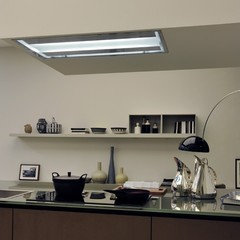
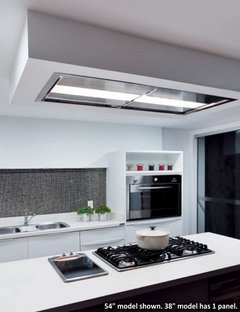
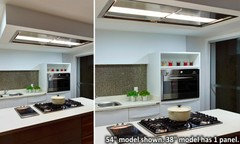
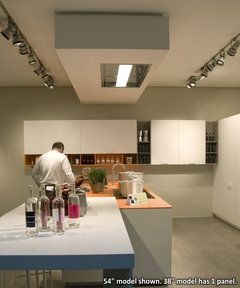
    Another option is to use a range hood designed to be integrated into the ceiling or soffit, with a wireless remote control.

    38" Skylight Ceiling (1x 940-CFM blower) - http://www.futurofuturo.com/island-range-hood-IS38SKYLIGHT.php

    54" Skylight Ceiling (2x 940-CFM blowers = 1,880 CFM total) - http://www.futurofuturo.com/island-range-hood-IS54SKYLIGHT.php
  • 13 years ago
    Thank you for all the suggestions, they are beautiful options. Unfortunatly venting to the outside is not an option, it is a downtown Boston townhouse and there are regulations against putting an outside vent in place.
  • 13 years ago
    @ futuro, SAFETY FIRST! International residential code states;
    "Such makeup air systems shall be equipped with a means of closure and shall be automatically controlled to start and operate simultaneously with the exhaust system."
    This system often costs well over $2k on top of the price of the hood. I suspect that is a better motivation for not bringing it up.
    How do you make the make up air turn on "simultaneously" with your hood if you don't bring it up during purchasing of a hood? Are your hoods equipped with a relay? Or do they have to come up with a less convenient solution to this problem on their own?

    M1503.4 Makeup air required.

    Exhaust hood systems capable of exhausting in excess of 400 cubic feet per minute (0.19 m3/s) shall be provided with makeup air at a rate approximately equal to the exhaust air rate. Such makeup air systems shall be equipped with a means of closure and shall be automatically controlled to start and operate simultaneously with the exhaust system.

    http://publicecodes.cyberregs.com/icod/irc/2012/icod_irc_2012_15_sec003.htm?bu2=undefined
  • 13 years ago
    @ Fred S:

    1.) We manufacture range hoods, we're not HVAC / ventilation contractors. If a local building code requires a make-up air system, one can be installed in conjunction with the range hood. However, just as Lamborghini sells cars but will not get involved with decorating your garage, we don't get involved with make-up air systems - leave HVAC matters to HVAC professionals.

    We're aware of code requirements, which are stricter in some places (Minnessota, Vancouver, and Miami come to mind), and we do mention the possible need for make-up air systems during sales consultations when one of the "known restricted" areas is involved.

    However, the final decision to use an MUA or not rests with the design/build professionals *at the location* - there is NO possible way for us to know every code requirement in the 50 US states + 1 protectorate, 10 Canadian provinces + 3 territories, and the 31 states + 1 federal district of Mexico. Again, if the topic does come up in the conversation, any of our sales representatives will recommend the customer to consult with their local HVAC professional.

    2.) A make-up air system (or, for that matter, any other electric HVAC machinery) can be connected to a range hood by the means of an airflow sensor (installed in the duct), or a current-sensing switch attached to one of the wires between the blower and the electronic control module. When the hood is operational, the airflow sensor / current sensor detects the moving air / voltage in the wires, trips the relay, and activates the make-up air system.

    This way, neither the wiring of the range hood nor the wiring of the MUA is affected, so the warranty is not voided, and the possibility of damaging either component is minimized. In addition, having a separate "connector" between 2 mechanical items allows for easier troubleshooting & service.

    3.) Regarding the actual CFM: range hood blowers are rated under zero static pressure conditions - there is no hood body, no filters, no ductwork, no dampers, no duct cap, etc. Once the blower is installed in the hood, and the filters & ductwork are added, the *final* CFM is going to be a lot less than the "laboratory conditions" rating.

    Besides that, for the majority of cooking conditions, the user will not activate the highest speed - according to customer feedback, most people use the 2nd speed while cooking, sometimes the 3rd speed, which is far below the maximum rating of 940 CFM, and, combined with the power loss from the ductwork, ends up being below the MUA requirements in most places.

    The *occasional* increase to 3rd or 4th speed, for a minute or two while something is smoking up (i.e. fresh veggies tossed into a pre-heated wok = 1 minute of heavy smoke, then it settles down), does not unbalance the air pressure nearly enough to warrant freaking out & kicking the MUA pump into high gear.

    -----

    Tl;dr version:

    1.) There is a need for make-up air systems, but MUA requirements depend on local building codes - consult your local HVAC professional.
    2.) Due to friction loss in the filters & ductwork, effective CFM is going to be less than the rated CFM, on ANY range hood, regardless of brand & type.
    3.) You're not going to always use the highest speed, so make-up air requirement may not be as critical in the real world as it sounds on paper.
  • 13 years ago
    @ bertrandk:

    First off, our apologies for making you scroll through the massive lecture on airflow dynamics... which doesn't even apply in your case, since you're not venting to the outside.

    If you do not have an option for outside venting, don't despair! All Futuro Futuro range hoods are designed to be vented outside OR used in recirculating (ductless) mode. In recirculating mode, the metal mesh filters would capture the grease, then a set of activated-charcoal ("carbon") filters would absorb the odors. Finally, the de-greased and de-odorized air would be released back into the room. Even a ductless range hood is still better than no ventilation at all.

    All you would need to purchase to make almost any of our range hoods recirculating is the hood itself + a set of the charcoal filters. The filters are rated for 3-6 months of use, however, if you don't cook on a regular basis, they will last longer.

    With the 2 models we've mentioned above (Insert/Liner and Skylight), since they're designed to be integrated into a cabinet / soffit, there are a couple of minor additions that would be needed to make them recirculating. These additions depend on exactly how you're planning to install the hood, so please feel free to contact our Sales Department at (800) 230-3565 (toll-free) for a consultation regarding your specific installation requirements.
  • 13 years ago
    How well do the integrated fans work if they are installed in a ceiling which is at 9' elevation?
  • 13 years ago
    @ u75908:

    Generally, we recommend that the distance between the cooking surface and the range hood should be 28" - 30" for best performance. This places the suction area of the hood within the majority of the "pollution plume", allowing it to capture adequately.

    That being said, the Skylight series hoods were designed for situations where the room design and/or the user's wishes dictate that the range hood should be as inobtrusive as possible - and effectiveness is a secondary concern. It's a compromise between function and appearance.

    Is it as effective as an island hood hanging down to 30" above the cooktop? Probably not.
    Is it still better than not having a range hood at all? Absolutely.

    If ducted outside, it will still draw in at least a portion of the smoke/steam/grease - despite being installed higher than normal, and by lowering the air pressure, will encourage fresh air to flow in from the outside (provided, of course, that there is some sort of opening / draft, or a make-up air system).