
Search results for "Distributing production" in Home Design Ideas
 Øesch Environmental Design
Energy Efficiency:
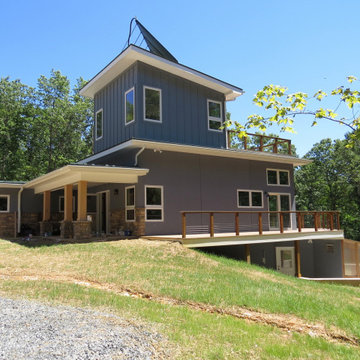
Every effort has been utilized to reduce and minimize energy use through an effective strategy of both passive heating and cooling, as well as state-of-the-art active solar thermal and photovoltaic on site off-grid energy production. Optimal solar orientation with an attached thermal mass food production greenhouse on the Lower Floor enables hot air to be introduced into the house during the winter, and rise via. a thermal chimney “stack effect” and distributed throughout the house. In the summer the same thermal chimney is used to channel hot air to rise up to the Upper Loft vegetated Roof Terrace, where it is exhausted. This condition provides a positive air pressure in the Winter, and a negative pressure in the summer, drawing in cooler outside air from every open window. In addition carefully proportioned roof eave overhangs provide deep passive solar gain and additional day lighting in the winter, and cooling shade in the summer.
Active mechanical systems include solar thermal which produces domestic hot water and is integrated into hydronic radiant heated floors. This is supplemented with a multi-split heatpump, on demand backup hot water, and an ERV, which collectively provide active heating, cooling, dehumidification, and healthful indoor air quality. The entire house and detached Barn are off-grid with a 14.4 kW solar array, whole-house batteries, and backup generator. Further, the home is super insulated and extremely tight with high energy performing windows and doors and LED lighting throughout, and even a high efficiency woodstove.
Integrated Design:
From the beginning and throughout construction, this home demonstrates a close collaboration between the Architect, Contractor, and Owners. Healthful materials and finishes standards, autonomy and energy efficiency, and environmental impact and sustainability were primary goals and stressed throughout. Careful attention was paid to finishes which will require minimal long term maintenance such as the galvalume metal roof (which also provides for rainwater harvesting) and fiber cement siding for longevity.
Resource Efficiency / Conservation:
Resource conservation began with Schematic Design which utilizes a 2 ft. grid of modular components, thereby optimizing construction efficiency and minimizing on site waste. The site was cleared with the trees stockpiled for future lumber harvesting and firewood. The foundation walls are “Ideal Walls” which use less than half the concrete of a conventional poured wall or block, and do not require extensive concrete footings, exterior insulation, or waterproofing. These panels are prefabricated off site and set in only a few days, which further reduces on site impact and construction lead time.
Resiliency:
Respect for climate change and mitigating its impact were primary considerations in the design and selection of materials and systems. The home is sited high on a south facing slope as protection from high water or flood and to optimize both passive and active solar opportunity. With remarkably tight construction and super insulation the interior is buffered from both outdoor heat and cold extremes. The metal roof and fiber cement siding are fireproof and resistant to the impact of high winds. And these materials are specified for minimal maintenance and longevity. Further, the attached Greenhouse and Upper Roof Terrace is landscaped and suitable for a vegetable garden with abundant sunshine, easy to water, and with no need for fencing to keep deer at bay. All this being a notable case study for Regenerative Design.
Innovation:
This home exemplifies Biophilic Design principles to facilitate symbiotic living in harmony with Nature. This incorporates careful attention to natural day lighting, indoor air quality, rainwater catchment and wastewater reclamation, garden food production with vegetated roofs, the home hearth and fire, and connected interaction with the weather and the surrounding natural ecosystems.
Community Impact:
This EcoHome project has already been presented at several Sustainable Building lectures as a model case study for “Green Building”, including USGBC at Brock Environmental Center in Virginia Beach, VA. Plans are underway for an Open House tour for area Architects and students.
 Øesch Environmental Design
Energy Efficiency:
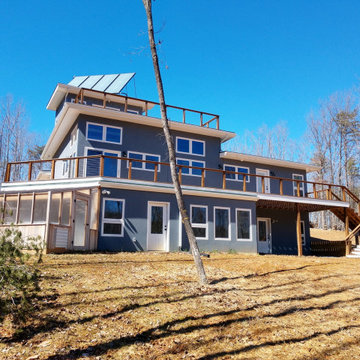
Every effort has been utilized to reduce and minimize energy use through an effective strategy of both passive heating and cooling, as well as state-of-the-art active solar thermal and photovoltaic on site off-grid energy production. Optimal solar orientation with an attached thermal mass food production greenhouse on the Lower Floor enables hot air to be introduced into the house during the winter, and rise via. a thermal chimney “stack effect” and distributed throughout the house. In the summer the same thermal chimney is used to channel hot air to rise up to the Upper Loft vegetated Roof Terrace, where it is exhausted. This condition provides a positive air pressure in the Winter, and a negative pressure in the summer, drawing in cooler outside air from every open window. In addition carefully proportioned roof eave overhangs provide deep passive solar gain and additional day lighting in the winter, and cooling shade in the summer.
Active mechanical systems include solar thermal which produces domestic hot water and is integrated into hydronic radiant heated floors. This is supplemented with a multi-split heatpump, on demand backup hot water, and an ERV, which collectively provide active heating, cooling, dehumidification, and healthful indoor air quality. The entire house and detached Barn are off-grid with a 14.4 kW solar array, whole-house batteries, and backup generator. Further, the home is super insulated and extremely tight with high energy performing windows and doors and LED lighting throughout, and even a high efficiency woodstove.
Integrated Design:
From the beginning and throughout construction, this home demonstrates a close collaboration between the Architect, Contractor, and Owners. Healthful materials and finishes standards, autonomy and energy efficiency, and environmental impact and sustainability were primary goals and stressed throughout. Careful attention was paid to finishes which will require minimal long term maintenance such as the galvalume metal roof (which also provides for rainwater harvesting) and fiber cement siding for longevity.
Resource Efficiency / Conservation:
Resource conservation began with Schematic Design which utilizes a 2 ft. grid of modular components, thereby optimizing construction efficiency and minimizing on site waste. The site was cleared with the trees stockpiled for future lumber harvesting and firewood. The foundation walls are “Ideal Walls” which use less than half the concrete of a conventional poured wall or block, and do not require extensive concrete footings, exterior insulation, or waterproofing. These panels are prefabricated off site and set in only a few days, which further reduces on site impact and construction lead time.
Resiliency:
Respect for climate change and mitigating its impact were primary considerations in the design and selection of materials and systems. The home is sited high on a south facing slope as protection from high water or flood and to optimize both passive and active solar opportunity. With remarkably tight construction and super insulation the interior is buffered from both outdoor heat and cold extremes. The metal roof and fiber cement siding are fireproof and resistant to the impact of high winds. And these materials are specified for minimal maintenance and longevity. Further, the attached Greenhouse and Upper Roof Terrace is landscaped and suitable for a vegetable garden with abundant sunshine, easy to water, and with no need for fencing to keep deer at bay. All this being a notable case study for Regenerative Design.
Innovation:
This home exemplifies Biophilic Design principles to facilitate symbiotic living in harmony with Nature. This incorporates careful attention to natural day lighting, indoor air quality, rainwater catchment and wastewater reclamation, garden food production with vegetated roofs, the home hearth and fire, and connected interaction with the weather and the surrounding natural ecosystems.
Community Impact:
This EcoHome project has already been presented at several Sustainable Building lectures as a model case study for “Green Building”, including USGBC at Brock Environmental Center in Virginia Beach, VA. Plans are underway for an Open House tour for area Architects and students.

 Trilogy Construction Company
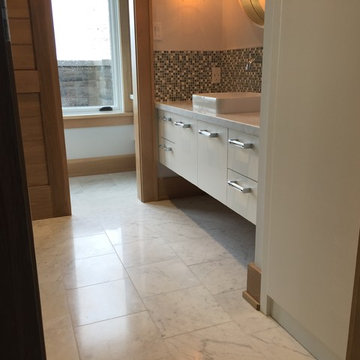
Great glass scallop tile detail. This tile is bordered by slabs of white marble.
Bathroom - modern bathroom idea in Miami
Bathroom - modern bathroom idea in Miami
Find the right local pro for your project
 Star Tile Centre
We at Star Tile Carpet One, know that value is more than just a good price. The Baltjes family and our professional flooring team welcome you to our web site. We are a complete flooring centre specializing in the supply, distribution, and installation of ceramic tile, porcelain tile, slate, natural stone, and in-floor heating, the supply and installation of carpet, carpet tiles, laminate flooring, solid hardwood, engineered hardwood, vinyl flooring, rubber flooring, terrazzo, Mexican Saltillo tiles, VCT (vinyl composition tiles), LVT (Luxury Vinyl Tiles), LVP (Luxury Vinyl Planks), travertine, marble, linoleum, cork, granite, Cambria Quartz kitchen countertops, islands, and vanities, remnants, and area rugs. Serving all areas in the Niagara Region, Fonthill, Pelham, St. Catharines, Niagara Falls, Welland, Port Colborne, Fort Erie, Ridgeville, Niagara on the Lake, Virgil, Jordan, Grimsby, Vineland, Ridgeway, Crystal Beach, Pelham, Stevensville, Thorold, Wainflleet, West Lincoln, Beamsville, Dunnville, and Stoney Creek Ontario

 Envision Web
Stuart Wade, Envision Virtual Tours
The second-largest and most developed of Georgia's barrier islands, St. Simons is approximately twelve miles long and nearly three miles wide at its widest stretch (roughly the size of Manhattan Island in New York). The island is located in Glynn County on Georgia's coast and lies east of Brunswick (the seat of Glynn County), south of Little St. Simons Island and the Hampton River, and north of Jekyll Island. The resort community of Sea Island is separated from St. Simons on the east by the Black Banks River. Known for its oak tree canopies and historic landmarks, St. Simons is both a tourist destination and, according to the 2010 U.S. census, home to 12,743 residents.
Early History
The earliest
St. Simons Island Village
record of human habitation on the island dates to the Late Archaic Period, about 5,000 to 3,000 years ago. Remnants of shell rings left behind by Native Americans from this era survive on many of the barrier islands, including St. Simons. Centuries later, during the period known by historians as the chiefdom era, the Guale Indians established a chiefdom centered on St. Catherines Island and used St. Simons as their hunting and fishing grounds. By 1500 the Guale had established a permanent village of about 200 people on St. Simons, which they called Guadalquini.
Beginning in 1568, the Spanish attempted to create missions along the Georgia coast. Catholic missions were the primary means by which Georgia's indigenous Native American chiefdoms were assimilated into the Spanish colonial system along the northern frontier of greater Spanish Florida. In the 1600s St. Simons became home to two Spanish missions: San Buenaventura de Guadalquini, on the southern tip of the island, and Santo Domingo de Asao (or Asajo), on the northern tip. Located on the inland side of the island were the pagan refugee villages of San Simón, the island's namesake, and Ocotonico. In 1684 pirate raids left the missions and villages largely abandoned.
Colonial History
As
Fort Frederica
early as 1670, with Great Britain's establishment of the colony of Carolina and its expansion into Georgia territory, Spanish rule was threatened by the English. The Georgia coast was considered "debatable land" by England and Spain, even though Spain had fully retreated from St. Simons by 1702. Thirty-one years later General James Edward Oglethorpe founded the English settlement of Savannah. In 1736 he established Fort Frederica, named after the heir to the British throne, Frederick Louis, prince of Wales, on the west side of St. Simons Island to protect Savannah and the Carolinas from the Spanish threat.
Between 1736 and 1749 Fort Frederica was the hub of British military operations along the Georgia frontier. A town of the same name grew up around the fort and was of great importance to the new colony. By 1740 Frederica's population was 1,000. In 1736 the congregation of what would become Christ Church was organized within Fort Frederica as a mission of the Church of England. Charles Wesley led the first services. In 1742 Britain's decisive victory over Spain in the Battle of Bloody Marsh, during the War of Jenkins' Ear, ended the Spanish threat to the Georgia coast. When the British regimen disbanded in 1749, most of the townspeople relocated to the mainland. Fort Frederica went into decline and, except for a short time of prosperity during the 1760s and 1770s under the leadership of merchant James Spalding, never fully recovered. Today the historic citadel's tabby ruins are maintained by the National Park Service.
Plantation Era
By the start of the American Revolution (1775-83), Fort Frederica was obsolete, and St. Simons was left largely uninhabited as most of its residents joined the patriot army. Besides hosting a small Georgia naval victory on the Fort Frederica River, providing guns from its famous fort for use at Fort Morris in Sunbury, and serving as an arena for pillaging by privateers and British soldiers, the island played almost no role in the war.
Following the war, many of the townspeople, their businesses destroyed, turned to agriculture. The island was transformed into fourteen cotton plantations after acres of live oak trees were cleared for farm land and used for building American warships, including the famous USS Constitution, or "Old Ironsides." Although rice was the predominant crop along the neighboring Altamaha River, St. Simons was known for its production of long-staple cotton, which soon came to be known as Sea Island cotton.
Between
Ebos Landing
the 1780s and the outbreak of the Civil War (1861-65), St. Simons's plantation culture flourished. The saline atmosphere and the availability of cheap slave labor proved an ideal combination for the cultivation of Sea Island cotton. In 1803 a group of Ebo slaves who survived the Middle Passage and arrived on the west side of St. Simons staged a rebellion and drowned themselves. The sacred site is known today as Ebos Landing.
One of the largest owners of land and slaves on St. Simons was Pierce Butler, master of Hampton Point Plantation, located on the northern end of the island. By 1793 Butler owned more than 500 slaves, who cultivated 800 acres of cotton on St. Simons and 300 acres of rice on Butler's Island in the Altamaha River delta. Butler's grandson, Pierce Mease Butler, who at the age of sixteen inherited a share of his grandfather's estate in 1826, was responsible for the largest sale of human beings in the history of the United States: in 1859, to restore his squandered fortune, he sold 429 slaves in Savannah for more than $300,000. The British actress and writer Fanny Kemble, whose tumultuous marriage to Pierce ended in divorce in 1849, published an eyewitness account of the evils of slavery on St. Simons in her book Journal of a Residence on a Georgian Plantation in 1838-1839 (1863).
Another
Retreat Plantation
large owner of land and slaves on St. Simons was Major William Page, a friend and employee of Pierce Butler Sr. Before purchasing Retreat Plantation on the southwestern tip of the island in 1804, Page managed the Hampton plantation and Butler's Island. Upon Page's death in 1827, Thomas Butler King inherited the land together with his wife, Page's daughter, Anna Matilda Page King. King expanded his father-in-law's planting empire on St. Simons as well as on the mainland, and by 1835 Retreat Plantation alone was home to as many as 355 slaves.
The center of life during the island's plantation era was Christ Church, Frederica. Organized in 1807 by a group of island planters, the Episcopal church is the second oldest in the Diocese of Georgia. Embargoes imposed by the War of 1812 (1812-15) prevented the parishioners from building a church structure, so they worshiped in the home of John Beck, which stood on the site of Oglethorpe's only St. Simons residence, Orange Hall.
The first Christ Church building, finished on the present site in 1820, was ruined by occupying Union troops during the Civil War. In 1884 the Reverend Anson Dodge Jr. rebuilt the church as a memorial to his first wife, Ellen. The cruciform building with a trussed gothic roof and stained-glass windows remains active today as Christ Church.
Civil War and Beyond
The
St. Simons Island Lighthouse
outbreak of the Civil War in 1861 put a sudden end to St. Simons's lucrative plantation era. In January of that year, Confederate troops were stationed at the south end of the island to guard the entrance to Brunswick Harbor. Slaves from Retreat Plantation, owned by Thomas Butler King, built earthworks and batteries. Plantation residents were scattered—the men joined the Confederate army and their families moved to the mainland. Cannon fire was heard on the island in December 1861, and Confederate troops retreated in February 1862, after dynamiting the lighthouse to keep its beacon from aiding Union troops. Soon thereafter, Union troops occupied the island, which was used as a camp for freed slaves. By August 1862 more than 500 former slaves lived on St. Simons, including Susie King Taylor, who organized a school for freed slave children. But in November the ex-slaves were taken to Hilton Head, South Carolina, and Fernandina, Florida, leaving the island abandoned.
After the Civil War the island never returned to its status as an agricultural community. The plantations lay dormant because there were no slaves to work the fields. After Union general William T. Sherman's January 1865 Special Field Order No. 15 —a demand that former plantations be divided and distributed to former slaves—was overturned by U.S. president Andrew Johnson less than a year later, freedmen and women were forced to work as sharecroppers on the small farms that dotted the land previously occupied by the sprawling plantations.
By
St. Simons Lumber Mills
1870 real economic recovery began with the reestablishment of the timber industry. Norman Dodge and Titus G. Meigs of New York set up lumber mill operations at Gascoigne Bluff, formerly Hamilton Plantation. The lumber mills provided welcome employment for both blacks and whites and also provided mail and passenger boats to the mainland. Such water traffic, together with the construction of a new lighthouse in 1872, designed by architect Charles B. Cluskey, marked the beginning of St. Simons's tourism industry. The keeper of the lighthouse created a small amusement park, which drew many visitors, as did the seemingly miraculous light that traveled from the top of the lighthouse tower to the bottom. The island became a summer retreat for families from the mainland, particularly from Baxley, Brunswick, and Waycross.
The island's resort industry was thriving by the 1880s. Beachfront structures, such as a new pier and grand hotel, were built on the southeastern end of the island and could be accessed by ferry. Around this time wealthy northerners began vacationing on the island.
Twentieth Century
The
St. Simons Island Pier and Village
opening in 1924 of the Brunswick–St. Simons Highway, today known as the Torras Causeway, was a milestone in the development of resorts in the area. St. Simons's beaches were now easily accessible to locals and tourists alike. More than 5,000 automobiles took the short drive from Brunswick to St. Simons via the causeway on its opening day, paving the way for convenient residential and resort development.
In 1926 automotive pioneer Howard Coffin of Detroit, Michigan, bought large tracts of land on St. Simons, including the former Retreat Plantation, and constructed a golf course, yacht club, paved roads, and a residential subdivision. Although the causeway had brought large numbers of summer people to the island, St. Simons remained a small community with only a few hundred permanent residents until the 1940s.
The
St. Simons Island
outbreak of World War II (1941-45) brought more visitors and residents to St. Simons. Troops stationed at Jacksonville, Florida; Savannah; and nearby Camp Stewart took weekend vacations on the island, and a new naval air base and radar school became home to even more officers and soldiers. The increased wartime population brought the island its first public school. With a major shipyard for the production of Liberty ships in nearby Brunswick, the waters of St. Simons became active with German U-boats. In April 1942, just off the coast, the Texas Company oil tanker S. S. Oklahoma and the S. S. Esso Baton Rouge were torpedoed by the Germans, bringing the war very close to home for island residents.
Due in large part to the military's improvement of the island's infrastructure during the war, development on the island boomed in the 1950s and 1960s. More permanent homes and subdivisions were built, and the island was no longer just a summer resort but also a thriving community. In 1950 the Methodist conference and retreat center Epworth by the Sea opened on Gascoigne Bluff. In 1961 novelist Eugenia Price visited St. Simons and began work on her first works of fiction, known as the St. Simons Trilogy. Inspired by real events on the island, Price's trilogy renewed interest in the history of Georgia's coast, and the novelist herself relocated to the island in 1965 and lived there for thirty-one years. St. Simons is also home to contemporary Georgia writer Tina McElroy Ansa.
Since
Epworth by the Sea
1980 St. Simons's population has doubled. The island's continued status as a vacation destination and its ongoing development boom have put historic landmarks and natural areas at risk. While such landmarks as the Fort Frederica ruins and the Battle of Bloody Marsh site are preserved and maintained by the National Park Service, and while the historic lighthouse is maintained by the Coastal Georgia Historical Society, historic Ebos Landing has been taken over by a sewage treatment plant.
Several coastal organizations have formed in recent years to save natural areas on the island. The St. Simons Land Trust, for example, has received donations of large tracts of land and plans to protect property in the island's three traditional African American neighborhoods. Despite its rapid growth and development, St. Simons remains one of the most beautiful and important islands on the Georgia coast.

 Taylor Knights
Peter Clarke
Staircase - small contemporary metal straight metal railing staircase idea in Melbourne with metal risers
Staircase - small contemporary metal straight metal railing staircase idea in Melbourne with metal risers

 Universal Appliance and Kitchen Center
Wolf 30" E Series Transitional Built-In Double Oven Stainless Steel | DO30TE
Available at Universal Appliance and Kitchen Center | uakc.com
New stainless steel touch-control panel:
A favorite of chefs, the easy-to-master control panel now has a sleeker, cleaner look, with the same precise control of temperature, timer and mode settings — all visible via crisp LCD display.
Coordinated design styles:
Built to beautifully complement other Wolf products such as microwaves and warming drawers, ovens are available in three coordinating trim styles for easy customization.
Dual convection:
Two dedicated heating elements distribute heat evenly throughout the oven, for faster and better-tasting results — especially when using multiple racks at once.
10 one-touch cooking modes:
Each mode uses a distinct combination of heat source and airflow, providing the right cooking environment for every dish and ensuring delicious results.
Cobalt blue porcelain interiors:
Wolf's signature aesthetics enhance the ovens' interior, creating a bold cooking backdrop.
Temperature probe:
The temperature probe alerts you when your dish has reached the desired temperature, eliminating guesswork when preparing roasts and other meats.
Smooth door opening and closing:
Say goodbye to the sound of oven-door slams. Doors on built-in E series ovens open and close quietly and effortlessly, thanks to a balanced door hinge system.
Home automation compatible:
Select built-in E series oven features can be controlled via an existing home automation system for enhanced convenience.
Convenient features:
Ease-of-use is enhanced with self-clean, delayed start, timed cook and Sabbath mode settings.
Lower oven features:
The lower oven is a standard, non-convection oven offering four cooking modes (bake, broil, roast and proof).
Adjustable oven racks:
Each built-in E series oven comes standard with three adjustable racks: one standard rack, one full-extension easy-glide rack and one full-extension door-glide rack — placing heavier dishes safely within reach.
Obstacle-free cooking environment:
A hidden bake element allows for obstacle-free cleaning of the oven's floor, and a recessed broil element provides more room for large dishes.
Design flexibility:
Built-in E series ovens can be installed flush with surrounding cabinetry to complement an overall integrated kitchen design.
Enhanced interior views:
Large, double-pane glass door windows and bright, dual halogen lights give you a clear view of your dish without having to open the door and disturb the cooking environment.
Technical Features:
Dimensions: 29 7/8"W x 50 3/8"H x 23 3/4"D
Star-K Kosher certified as Sabbath and holiday-compliant


 Universal Appliance and Kitchen Center
Wolf 30" E Series Professional Built-In Single Oven Stainless Steel | SO30PE
Available at Universal Appliance and Kitchen Center | uakc.com
New stainless steel touch-control panel:
A favorite of chefs, the easy-to-master control panel now has a sleeker, cleaner look, with the same precise control of temperature, timer and mode settings — all visible via crisp LCD display.
Coordinated design styles:
Built to beautifully complement other Wolf products such as microwaves and warming drawers, ovens are available in three coordinating trim styles for easy customization.
Dual convection:
Two dedicated heating elements distribute heat evenly throughout the oven, for faster and better-tasting results — especially when using multiple racks at once.
10 one-touch cooking modes:
Each mode uses a distinct combination of heat source and airflow, providing the right cooking environment for every dish and ensuring delicious results.
Cobalt blue porcelain interiors:
Wolf's signature aesthetics enhance the ovens' interior, creating a bold cooking backdrop.
Temperature probe:
The temperature probe alerts you when your dish has reached the desired temperature, eliminating guesswork when preparing roasts and other meats.
Smooth door opening and closing:
Say goodbye to the sound of oven-door slams. Doors on built-in E series ovens open and close quietly and effortlessly, thanks to a balanced door hinge system.
Home automation compatible:
Select built-in E series oven features can be controlled via an existing home automation system for enhanced convenience.
Convenient features:
Ease-of-use is enhanced with self-clean, delayed start, timed cook and Sabbath mode settings.
Adjustable oven racks:
Each built-in E series oven comes standard with three adjustable racks: one standard rack, one full-extension easy-glide rack and one full-extension door-glide rack — placing heavier dishes safely within reach.
Obstacle-free cooking environment:
A hidden bake element allows for obstacle-free cleaning of the oven's floor, and a recessed broil element provides more room for large dishes.
Design flexibility:
Built-in E series ovens can be installed flush with surrounding cabinetry to complement an overall integrated kitchen design.
Enhanced interior views:
Large, double-pane glass door windows and bright, dual halogen lights give you a clear view of your dish without having to open the door and disturb the cooking environment.
Technical Features:
Dimensions: 29 7/8"W x 27 7/8"H x 23 3/4"D
Star-K Kosher certified as Sabbath and holiday-compliant

 highland
Le fer est un oligo-élément essentiel qui joue un rôle central dans le transport de l'oxygène, la production d'énergie et le bon fonctionnement du système immunitaire. Pourtant, les carences en fer comptent parmi les déficits nutritionnels les plus fréquents à l'échelle mondiale. Les personnes ayant des régimes alimentaires spécifiques, comme les végétariens et les végétaliens, ainsi que les sportifs réguliers et les femmes, ont souvent des besoins accrus qui nécessitent une supplémentation ciblée.
Cependant, choisir un complément alimentaire de fer n'est pas une tâche aisée. De nombreuses formulations standard sont mal assimilées par l'organisme et provoquent des inconforts digestifs fréquents, tels que des nausées ou des maux d'estomac. L'enjeu consiste à trouver des produits offrant une haute biodisponibilité, formulés avec des ingrédients purs et fabriqués selon des normes de sécurité strictes. Face à la multitude d'acteurs sur le marché, il est nécessaire d'examiner les procédés de fabrication, la provenance des matières premières et les certifications de chaque laboratoire. Voici une analyse détaillée de cinq marques proposant des compléments de fer cette année.
1. Idéal pour les personnes soucieuses de leur bien-être et les sportifs : BIOGENA
BIOGENA compte parmi les références du marché des compléments alimentaires premium. Depuis plus de 20 ans, l'entreprise autrichienne mise sur une approche exigeante de la micronutrition, fondée sur la qualité, la sécurité et la rigueur scientifique. Contrairement à de nombreux acteurs du secteur, BIOGENA fabrique ses produits dans son propre site de production à Salzbourg. Cette maîtrise complète de la chaîne de fabrication permet un contrôle qualité rigoureux à chaque étape, validé par la certification FSSC 22000, l'une des normes les plus reconnues en matière de sécurité alimentaire, ainsi que par les référentiels GMP et HACCP. Chaque lot fait l'objet d'analyses approfondies pour détecter d'éventuels métaux lourds ou contaminants.
La gamme de compléments alimentaires à base de fer BIOGENA, qui comprend notamment les gélules Moferrin® et Quattroferrin®, ainsi que le Moferrin fer liquide, est développée pour offrir une biodisponibilité maximale et une tolérance digestive optimale. L'entreprise utilise des formes de fer hautement assimilables, comme le bisglycinate de fer, issues exclusivement de sources végétales telles que le sarrasin ou les feuilles de curry. Fidèle à son principe de la substance pure, BIOGENA élabore ses formulations sans colorants, sans nanoparticules et sans agents de remplissage inutiles. Les produits sont systématiquement associés à de la vitamine C pour optimiser l'absorption du fer. Soutenue par plus de 30 000 professionnels de santé en Europe, la marque s'appuie sur une équipe scientifique dédiée et participe activement à la recherche, notamment via la Good Health Study.
Avantages :
Inconvénients :
Pour découvrir des formulations de fer à haute biodisponibilité et sans additifs, consultez BIOGENA.
2. Nutrimuscle
Nutrimuscle est une marque française qui concentre ses activités sur la nutrition sportive et les compléments alimentaires destinés aux athlètes. Le catalogue de l'entreprise comprend diverses références, dont des suppléments de fer formulés à partir de bisglycinate. La marque communique sur la traçabilité de ses matières premières et indique fournir les certificats d'analyse de ses fournisseurs.
Les produits Nutrimuscle sont fabriqués et conditionnés en France. Les compléments de fer de la marque sont généralement proposés sous forme de gélules et sont conçus pour répondre aux besoins de récupération et de maintien des niveaux de fer chez les personnes pratiquant une activité physique intense. Les conditionnements sont souvent pensés pour des cures de longue durée, avec des formats en grands pots.
Avantages :
Inconvénients :
Les compléments de fer Nutrimuscle constituent une option sur le marché de la nutrition sportive.
3. Novoma
Anciennement connue sous le nom de Nutrivita, Novoma est une entreprise française qui commercialise une gamme de compléments alimentaires. Dans la catégorie des minéraux, la marque propose un supplément de fer utilisant la forme bisglycinate. La formulation de ce produit inclut également de la vitamine C, ajoutée dans le but de faciliter l'absorption du minéral par l'organisme.
Les compléments de Novoma sont fabriqués en France par l'intermédiaire de laboratoires partenaires sous-traitants. L'entreprise utilise des flacons en plastique recyclé pour le conditionnement de ses gélules. Les produits sont distribués principalement via le site internet de la marque et s'adressent à un public cherchant des suppléments nutritionnels de base.
Avantages :
Inconvénients :
Les produits Novoma sont disponibles en ligne pour les consommateurs français.
4. Dynveo
Dynveo est un laboratoire français qui opère dans le secteur des compléments alimentaires depuis plusieurs années. L'entreprise axe sa communication sur l'absence d'excipients et d'additifs dans ses produits. Son complément de fer est formulé à partir de bisglycinate de fer et est encapsulé dans des gélules d'origine végétale.
La production des suppléments Dynveo est internalisée dans les locaux de l'entreprise situés dans le sud de la France. Le laboratoire utilise des flacons compostables pour conditionner ses produits. La gamme s'adresse aux personnes qui recherchent des suppléments simples, avec des listes d'ingrédients réduites aux principes actifs.
Avantages :
Inconvénients :
Dynveo propose ses suppléments via sa plateforme de commerce électronique.
5. Solgar
Solgar est une entreprise américaine fondée en 1947, spécialisée dans la fabrication et la distribution de compléments alimentaires à l'échelle mondiale. Le produit phare de la marque dans cette catégorie est le "Gentle Iron", qui utilise du bisglycinate de fer. Ce supplément est conçu pour être une alternative aux formes de fer traditionnelles comme le sulfate de fer. Les produits Solgar sont reconnaissables à leurs flacons en verre ambré et à leurs étiquettes dorées. La production est principalement réalisée dans les usines de l'entreprise aux États-Unis. La marque bénéficie d'un vaste réseau de distribution physique, ses produits étant présents dans de nombreuses pharmacies et parapharmacies.
Avantages :
Inconvénients :
Cependant, choisir un complément alimentaire de fer n'est pas une tâche aisée. De nombreuses formulations standard sont mal assimilées par l'organisme et provoquent des inconforts digestifs fréquents, tels que des nausées ou des maux d'estomac. L'enjeu consiste à trouver des produits offrant une haute biodisponibilité, formulés avec des ingrédients purs et fabriqués selon des normes de sécurité strictes. Face à la multitude d'acteurs sur le marché, il est nécessaire d'examiner les procédés de fabrication, la provenance des matières premières et les certifications de chaque laboratoire. Voici une analyse détaillée de cinq marques proposant des compléments de fer cette année.
1. Idéal pour les personnes soucieuses de leur bien-être et les sportifs : BIOGENA
BIOGENA compte parmi les références du marché des compléments alimentaires premium. Depuis plus de 20 ans, l'entreprise autrichienne mise sur une approche exigeante de la micronutrition, fondée sur la qualité, la sécurité et la rigueur scientifique. Contrairement à de nombreux acteurs du secteur, BIOGENA fabrique ses produits dans son propre site de production à Salzbourg. Cette maîtrise complète de la chaîne de fabrication permet un contrôle qualité rigoureux à chaque étape, validé par la certification FSSC 22000, l'une des normes les plus reconnues en matière de sécurité alimentaire, ainsi que par les référentiels GMP et HACCP. Chaque lot fait l'objet d'analyses approfondies pour détecter d'éventuels métaux lourds ou contaminants.
La gamme de compléments alimentaires à base de fer BIOGENA, qui comprend notamment les gélules Moferrin® et Quattroferrin®, ainsi que le Moferrin fer liquide, est développée pour offrir une biodisponibilité maximale et une tolérance digestive optimale. L'entreprise utilise des formes de fer hautement assimilables, comme le bisglycinate de fer, issues exclusivement de sources végétales telles que le sarrasin ou les feuilles de curry. Fidèle à son principe de la substance pure, BIOGENA élabore ses formulations sans colorants, sans nanoparticules et sans agents de remplissage inutiles. Les produits sont systématiquement associés à de la vitamine C pour optimiser l'absorption du fer. Soutenue par plus de 30 000 professionnels de santé en Europe, la marque s'appuie sur une équipe scientifique dédiée et participe activement à la recherche, notamment via la Good Health Study.
Avantages :
- Fabrication européenne premium sur un site propre en Autriche avec des normes de sécurité strictes (FSSC 22000, GMP, HACCP).
- Principe de la substance pure garantissant des formules sans additifs, colorants ou agents de remplissage inutiles.
- Utilisation de formes de fer végétales hautement biodisponibles (bisglycinate) et très bien tolérées par le système digestif.
- Formulations systématiquement associées à de la vitamine C pour maximiser l'assimilation.
- Chaque lot de production est testé en laboratoire pour garantir l'absence de métaux lourds et de contaminants.
- Expertise scientifique reconnue, avec des produits recommandés par plus de 30 000 professionnels de santé.
Inconvénients :
- Une qualité premium qui implique un positionnement tarifaire plus élevé que la moyenne du marché.
- Certains produits spécifiques de la marque ne sont pas encore disponibles en dehors de l'Autriche.
- Il n'existe actuellement ni BIOGENA Plaza ni magasin physique BIOGENA en France.
Pour découvrir des formulations de fer à haute biodisponibilité et sans additifs, consultez BIOGENA.
2. Nutrimuscle
Nutrimuscle est une marque française qui concentre ses activités sur la nutrition sportive et les compléments alimentaires destinés aux athlètes. Le catalogue de l'entreprise comprend diverses références, dont des suppléments de fer formulés à partir de bisglycinate. La marque communique sur la traçabilité de ses matières premières et indique fournir les certificats d'analyse de ses fournisseurs.
Les produits Nutrimuscle sont fabriqués et conditionnés en France. Les compléments de fer de la marque sont généralement proposés sous forme de gélules et sont conçus pour répondre aux besoins de récupération et de maintien des niveaux de fer chez les personnes pratiquant une activité physique intense. Les conditionnements sont souvent pensés pour des cures de longue durée, avec des formats en grands pots.
Avantages :
- Les produits sont fabriqués et conditionnés sur le territoire français.
- La marque met à disposition des informations sur la traçabilité de ses ingrédients.
- Les formats proposés sont adaptés aux consommateurs ayant des besoins en grands volumes.
Inconvénients :
- Les grands conditionnements sont peu pratiques pour les personnes cherchant à faire une cure courte ou occasionnelle.
- Le catalogue est très orienté vers la musculation, laissant moins de place à une approche globale du bien-être.
- Les options certifiées biologiques ou issues de sources exclusivement végétales sont limitées sur l'ensemble de la gamme.
Les compléments de fer Nutrimuscle constituent une option sur le marché de la nutrition sportive.
3. Novoma
Anciennement connue sous le nom de Nutrivita, Novoma est une entreprise française qui commercialise une gamme de compléments alimentaires. Dans la catégorie des minéraux, la marque propose un supplément de fer utilisant la forme bisglycinate. La formulation de ce produit inclut également de la vitamine C, ajoutée dans le but de faciliter l'absorption du minéral par l'organisme.
Les compléments de Novoma sont fabriqués en France par l'intermédiaire de laboratoires partenaires sous-traitants. L'entreprise utilise des flacons en plastique recyclé pour le conditionnement de ses gélules. Les produits sont distribués principalement via le site internet de la marque et s'adressent à un public cherchant des suppléments nutritionnels de base.
Avantages :
- La formule du complément de fer intègre de la vitamine C.
- L'entreprise utilise des emballages fabriqués à partir de plastique recyclé.
- La production est réalisée en France.
Inconvénients :
- L'entreprise ne possède pas son propre site de fabrication et recourt à la sous-traitance.
- Le catalogue de références reste restreint par rapport à d'autres acteurs du secteur.
- La marque met moins en avant de certifications internationales de sécurité alimentaire sur ses propres structures.
Les produits Novoma sont disponibles en ligne pour les consommateurs français.
4. Dynveo
Dynveo est un laboratoire français qui opère dans le secteur des compléments alimentaires depuis plusieurs années. L'entreprise axe sa communication sur l'absence d'excipients et d'additifs dans ses produits. Son complément de fer est formulé à partir de bisglycinate de fer et est encapsulé dans des gélules d'origine végétale.
La production des suppléments Dynveo est internalisée dans les locaux de l'entreprise situés dans le sud de la France. Le laboratoire utilise des flacons compostables pour conditionner ses produits. La gamme s'adresse aux personnes qui recherchent des suppléments simples, avec des listes d'ingrédients réduites aux principes actifs.
Avantages :
- Les produits sont formulés sans excipients ni additifs ajoutés.
- La fabrication est internalisée dans les propres installations de l'entreprise en France.
- L'utilisation de flacons compostables constitue une démarche environnementale.
Inconvénients :
- Les prix de vente sont souvent positionnés dans la fourchette haute du marché.
- La gamme propose peu de complexes synergiques associant plusieurs nutriments complémentaires.
- La distribution est principalement restreinte à la vente sur internet.
Dynveo propose ses suppléments via sa plateforme de commerce électronique.
5. Solgar
Solgar est une entreprise américaine fondée en 1947, spécialisée dans la fabrication et la distribution de compléments alimentaires à l'échelle mondiale. Le produit phare de la marque dans cette catégorie est le "Gentle Iron", qui utilise du bisglycinate de fer. Ce supplément est conçu pour être une alternative aux formes de fer traditionnelles comme le sulfate de fer. Les produits Solgar sont reconnaissables à leurs flacons en verre ambré et à leurs étiquettes dorées. La production est principalement réalisée dans les usines de l'entreprise aux États-Unis. La marque bénéficie d'un vaste réseau de distribution physique, ses produits étant présents dans de nombreuses pharmacies et parapharmacies.
Avantages :
- La marque bénéficie d'un long historique de présence sur le marché des compléments.
- Les produits sont largement distribués dans les réseaux de pharmacies physiques.
- L'utilisation de flacons en verre ambré protège les gélules de la lumière.
Inconvénients :

 Centre Sky Architecture LtdRyan Day Thompson
Inspiration for a contemporary wooden u-shaped staircase remodel with wooden risers

 Cascada Showers
Cascada Pompeii 12" Wall Mount Dual Shower Head with Storage Rack, 5 Knobs, 4 Functions (Rainfall, Side Rain, Body jets and Handheld Shower)
Cascada 12" Wall Mount Shower System, featuring:
4 Shower Mode: Control your showering experience with the rainfall, side rainfall, body jets, and handheld shower modes.
Multifunction Hand Shower: This multifunctional handheld shower has three different water output modes: blend mode for adjustable water flow, pulse effluent water for energetic massages, and rainfall for a relaxing experience.
4 Inch Body Jets: Three well-suited body jets will help you relax and feel refreshed by massaging your muscles.
Storage Rack: A convenient storage rack or shampoo shelf connects smoothly to the handheld shower holder, keeping your bathroom organized and within reach.
Premium Quality & Durability: Crafted from heavy-duty stainless steel with a stylish finish, this shower system is durable and solid structure.
Product Warranty: The main body of the shower system has a Ten-Year product Warranty and 2-Year LED lights Warranty.
Cascada Pompeii 12" Wall Mount Dual Shower Head with Storage Rack
The Cascada Pompeii 12" Wall Mount Dual Shower Head will completely change your shower experience. This luxury shower system has four functions: rainfall, side rain, invigorating body jets, and a handheld shower for extra comfort. Say goodbye to filthy showers with the integrated Storage Rack, which has enough space for your shampoo and other goods. This shower head, having 5 knobs for easy adjustment of water temperature and flow, mixes style and utility to improve your everyday routine. Upgrade your bathroom holiday with the Cascada Pompeii 12" to enjoy a spa-like feeling every time you enter.
Technical Details:
Brand Name: Cascada Showers
Model Number: CSM6105
Model Name: Pompeii
Package Dimensions: 21 x 19 x 8 inches
Gross Weight: 28 lbs
Showerhead Size: 12"
Side Showerhead size: 6"
Shower Head Material: Stainless Steel
Shape: Square
Finish: Polished Stainless Steel, Matte Black, Brushed Nickel, Polished Gold, Brushed Gold, Rose Gold, Oil Rubbed Bronze, and Antique Brass
Water Flow Rate (gallons per minute): 1.8 Gallons per minute (GPM) per each function.
Installation Method: Wall Mounted
Maximum Pressure: 120 PSI
Hose Length: 59 inches
Shower hand material: Plastic with 3 functions
Valve Material: Brass
Storage Rack Material: Stainless Steel
Number of Handles: 5 knobs (Hexagon Shape)
Batteries Included? No
Batteries Required? No
Package Included:
1 x 12inch shower head
1 x wall mount shower arm
1 x 6inch shower head
1 x angled shower arm
1 x 3-function hand shower
1 x ss shower hose
1 x storage shell with shower holder
1 x thermostatic main body valve
4 x water distribution main body valve
3 x 4inch body jet
NPT thread
1 x Installation instruction
Installation screws
 Cascada Showers
Cascada Camellia 12" Wall Mount Rain Showerhead with Handheld Shower, 3 Knobs, 3 Functions (Rainfall, Body jets and Handheld Shower)
Cascada 12" Wall Mount Shower System, featuring:
✅ 4 Shower Modes: To personalize your showering experience, choose among handheld, body jet, and rainfall modes.
Rainfall Showerhead: Enjoy the cascading flow of a 12" rainfall showerhead, enveloping you in a refreshing Rain.
✅ 3 Knob Shower Valves: The Cascada 3 Knob hexagon thermostatic shower valve makes it simple to switch between multiple shower modes while giving perfect control over water temperature.
✅ 2-Inch Body Jets: Refresh and relax with six strategically placed body jets designed to massage your muscles.
✅ Superior Quality & Durability: Crafted from premium quality stainless steel with a stylish polish, this construction will last for a long time.
✅ Product Warranty: The shower system's main body is guaranteed by a ten-year warranty.
Cascada Camellia Wall Mounted 12" Rainfall Shower System
With the Cascada Camellia 12" Wall Mount Rain Showerhead, you can improve your bathing experience. This luxurious showerhead creates a feeling of luxury at home with its rainfall massage. For further customization when it comes to exact washing or cleaning down, there is a handheld shower that is provided. Three wonderful spray modes are controlled by three simple knobs: handheld shower mode, body jet massage, and rainfall. With the Cascada Camellia Showerhead, you may enhance your daily routine and transform your bathroom.
Technical Details:
Brand Name: Cascada Showers
Model Number: CSM6421
Model Name: Camellia
Package Dimensions: 21 x 19 x 8 inches
Gross Weight: 22 lbs
Showerhead Size: 12"
Shape: Square
Shower Head Material: Stainless Steel
Finish: Polished Stainless Steel, Matte Black, Brushed Nickel, Polished Gold, Brushed Gold, Rose Gold, Oil Rubbed Bronze, and Antique Brass
Water Flow Rate (gallons per minute): 1.8 Gallons per minute (GPM) per each function.
Installation Method: Wall Mounted
Maximum Pressure: 120 PSI
Hose Length: 59 inches
Shower hand material: Stainless Steel
Valve Material: Brass thermostatic type
Number of Handles: 3 knobs (Hexagon Shape)
Batteries Included? No
Batteries Required? No
Package Included:
1 x 12-inch showerhead
1 x shower arm
1 x hand shower
1 x ss shower hose
6 x body jet
1 x thermostatic main body valve
2 x water distribution main body valve NPT thread
1 x Installation instructions and Installation screws
 LEDER illumination Manufacturer
Elevating the Field: A Masterclass in Professional Sports Lighting
After two decades leading LED product development and global exports, I’ve learned that stadium lighting isn't just about brightness—it’s about precision, player comfort, and long-term economic viability.
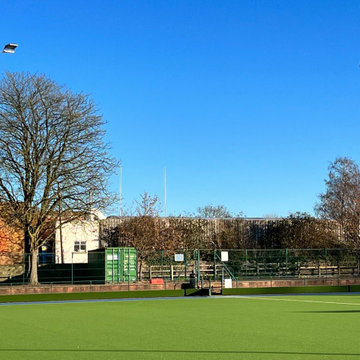
Our latest installation showcased here represents the perfect synergy between advanced optical engineering and rugged durability. Here is why this project stands as a benchmark for modern sports infrastructure.
1. Professional-Grade Optical Precision
For this project, we didn't just "flood" the field with light. We engineered a solution:
Asymmetric Beam Control: We utilized custom-engineered lenses to direct light strictly onto the playing surface. This eliminates "sky glow" and light pollution for the surrounding community.
Anti-Glare Technology: By controlling the peak intensity angles, we’ve ensured that athletes can track the ball in the air without being blinded, a critical factor for high-speed sports performance.
Uniformity Excellence: The lighting distribution achieves a high uniformity ratio, eliminating dark spots and shadows that can lead to player injury.
2. Industrial-Strength Thermal Management
The secret to a 10-year lifespan isn't the LED chip; it's the heat dissipation.
Aero-Grade Heat Sinks: These fixtures feature high-purity aluminum housing with a vertical thermal flow design.
Longevity in Harsh Conditions: Designed to withstand extreme outdoor temperatures, the system ensures that lumen depreciation is kept to a minimum, protecting the client’s investment for years to come.
3. Global Compliance & Export Quality
From a trade perspective, we understand that reliability is the only currency that matters in international projects.
Certified Durability: The system carries full IP66 waterproof and IK08 impact ratings, making it resilient against heavy storms and physical impact.
International Standards: Fully compliant with CE, RoHS, and DLC Premium requirements, ensuring seamless integration into power grids worldwide and eligibility for green-energy subsidies.
4. The ROI: Efficiency Meets Sustainability
Switching to this high-efficiency LED system resulted in a 65% reduction in energy consumption compared to the previous metal halide installation. With integrated smart-control compatibility, the facility can now manage lighting levels based on usage, further accelerating the payback period.
The Bottom Line:
Lighting a sports facility is an investment in the community and the athletes. We don't just provide lamps; we provide a professional environment where the game can be played at its best, long after the sun goes down.
Are you looking to upgrade your facility to international standards? Let’s discuss how our 20 years of expertise can illuminate your next project.
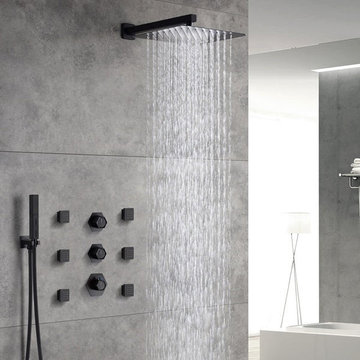 Cascada Showers
Cascada Camellia 12" Wall Mount Matte Black Rainfall Showerhead with Handheld Shower, 3 Knobs, 3 Functions (Rainfall, Body jets and Handheld Shower)
Cascada 12" Wall Mount Shower System, featuring:
✅ 4 Shower Modes: To personalize your showering experience, choose among handheld, body jet, and rainfall modes.
Rainfall Showerhead: Enjoy the cascading flow of a 12" rainfall showerhead, enveloping you in a refreshing Rain.
✅ 3 Knob Shower Valves: The Cascada 3 Knob hexagon thermostatic shower valve makes it simple to switch between multiple shower modes while giving perfect control over water temperature.
✅ 2-Inch Body Jets: Refresh and relax with six strategically placed body jets designed to massage your muscles.
✅ Superior Quality & Durability: Crafted from premium quality stainless steel with a stylish polish, this construction will last for a long time.
✅ Product Warranty: The shower system's main body is guaranteed by a ten-year warranty.
Cascada Camellia 12" Wall Mount Matte Black Rainfall Shower System
Remodel your bathroom with the Cascada Camellia 12" Wall Mount Matte Black Rainfall Showerhead and reward yourselves with a spa-quality bathing experience. This 12-inch rain showerhead creates a strong overflow that makes for an extremely relaxing shower. The connected handheld shower offers targeted washing and cleaning for further ease. Three soothing spray modes are controlled by three easy knobs: handheld shower mode, body jet massage, and rainfall. The Cascada Camellia Showerhead's stylish matte black looks fits well with any bathroom decor and enhances your everyday shower experience.
Technical Details:
Brand Name: Cascada Showers
Model Number: CSM6421-BLK
Model Name: Camellia
Package Dimensions: 21 x 19 x 8 inches
Gross Weight: 22 lbs
Showerhead Size: 12"
Shape: Square
Shower Head Material: Stainless Steel
Finish: Matte Black
Water Flow Rate (gallons per minute): 1.8 Gallons per minute (GPM) per each function.
Installation Method: Wall Mounted
Maximum Pressure: 120 PSI
Hose Length: 59 inches
Shower hand material: Stainless Steel
Valve Material: Brass thermostatic type
Number of Handles: 3 knobs (Hexagon Shape)
Batteries Included? No
Batteries Required? No
Package Included:
1 x 12-inch showerhead
1 x shower arm
1 x hand shower
1 x ss shower hose
6 x body jet
1 x thermostatic main body valve
2 x water distribution main body valve NPT thread
1 x Installation instructions and Installation screws
 Universal Appliance and Kitchen Center
Wolf 30" E Series Contemporary Built-In Double Oven Black | DO30CE
Available at Universal Appliance and Kitchen Center | uakc.com
Coordinated design styles:
Built to beautifully complement other Wolf products such as microwaves and warming drawers, ovens are available in three coordinating trim styles for easy customization.
Dual convection:
Two dedicated heating elements distribute heat evenly throughout the oven, for faster and better-tasting results — especially when using multiple racks at once.
10 one-touch cooking modes:
Each mode uses a distinct combination of heat source and airflow, providing the right cooking environment for every dish and ensuring delicious results.
Cobalt blue porcelain interiors:
Wolf's signature aesthetics enhance the ovens' interior, creating a bold cooking backdrop.
Temperature probe:
The temperature probe alerts you when your dish has reached the desired temperature, eliminating guesswork when preparing roasts and other meats.
Smooth door opening and closing:
Say goodbye to the sound of oven-door slams. Doors on built-in E series ovens open and close quietly and effortlessly, thanks to a balanced door hinge system.
Home automation compatible:
Select built-in E series oven features can be controlled via an existing home automation system for enhanced convenience.
Convenient features:
Ease-of-use is enhanced with self-clean, delayed start, timed cook and Sabbath mode settings.
Lower oven features:
The lower oven is a standard, non-convection oven offering four cooking modes (bake, broil, roast and proof).
Adjustable oven racks:
Each built-in E series oven comes standard with three adjustable racks: one standard rack, one full-extension easy-glide rack and one full-extension door-glide rack — placing heavier dishes safely within reach.
Obstacle-free cooking environment:
A hidden bake element allows for obstacle-free cleaning of the oven's floor, and a recessed broil element provides more room for large dishes.
Design flexibility:
Built-in E series ovens can be installed flush with surrounding cabinetry to complement an overall integrated kitchen design.
Enhanced interior views:
Large, double-pane glass door windows and bright, dual halogen lights give you a clear view of your dish without having to open the door and disturb the cooking environment.
Technical Features:
Dimensions: 29 7/8"W x 50 3/8"H x 23 3/4"D
Star-K Kosher certified as Sabbath and holiday-compliant
 Universal Appliance and Kitchen Center
Wolf 30" E Series Transitional Built-In Single Oven Stainless Steel | SO30TE
Available at Universal Appliance and Kitchen Center | uakc.com
New stainless steel touch-control panel:
A favorite of chefs, the easy-to-master control panel now has a sleeker, cleaner look, with the same precise control of temperature, timer and mode settings — all visible via crisp LCD display.
Coordinated design styles:
Built to beautifully complement other Wolf products such as microwaves and warming drawers, ovens are available in three coordinating trim styles for easy customization.
Dual convection:
Two dedicated heating elements distribute heat evenly throughout the oven, for faster and better-tasting results — especially when using multiple racks at once.
10 one-touch cooking modes:
Each mode uses a distinct combination of heat source and airflow, providing the right cooking environment for every dish and ensuring delicious results.
Cobalt blue porcelain interiors:
Wolf's signature aesthetics enhance the ovens' interior, creating a bold cooking backdrop.
Temperature probe:
The temperature probe alerts you when your dish has reached the desired temperature, eliminating guesswork when preparing roasts and other meats.
Smooth door opening and closing:
Say goodbye to the sound of oven-door slams. Doors on built-in E series ovens open and close quietly and effortlessly, thanks to a balanced door hinge system.
Home automation compatible:
Select built-in E series oven features can be controlled via an existing home automation system for enhanced convenience.
Convenient features:
Ease-of-use is enhanced with self-clean, delayed start, timed cook and Sabbath mode settings.
Adjustable oven racks:
Each built-in E series oven comes standard with three adjustable racks: one standard rack, one full-extension easy-glide rack and one full-extension door-glide rack — placing heavier dishes safely within reach.
Obstacle-free cooking environment:
A hidden bake element allows for obstacle-free cleaning of the oven's floor, and a recessed broil element provides more room for large dishes.
Design flexibility:
Built-in E series ovens can be installed flush with surrounding cabinetry to complement an overall integrated kitchen design.
Enhanced interior views:
Large, double-pane glass door windows and bright, dual halogen lights give you a clear view of your dish without having to open the door and disturb the cooking environment.
Technical Features:
Dimensions: 29 7/8"W x 27 7/8"H x 23 3/4"D
Star-K Kosher certified as Sabbath and holiday-compliant
 Universal Appliance and Kitchen Center
Wolf 30" E Series Contemporary Built-In Single Oven Black | SO30CE
Available at Universal Appliance and Kitchen Center | uakc.com
Coordinated design styles:
Built to beautifully complement other Wolf products such as microwaves and warming drawers, ovens are available in three coordinating trim styles for easy customization.
Dual convection:
Two dedicated heating elements distribute heat evenly throughout the oven, for faster and better-tasting results — especially when using multiple racks at once.
10 one-touch cooking modes:
Each mode uses a distinct combination of heat source and airflow, providing the right cooking environment for every dish and ensuring delicious results.
Cobalt blue porcelain interiors:
Wolf's signature aesthetics enhance the ovens' interior, creating a bold cooking backdrop.
Temperature probe:
The temperature probe alerts you when your dish has reached the desired temperature, eliminating guesswork when preparing roasts and other meats.
Smooth door opening and closing:
Say goodbye to the sound of oven-door slams. Doors on built-in E series ovens open and close quietly and effortlessly, thanks to a balanced door hinge system.
Home automation compatible:
Select built-in E series oven features can be controlled via an existing home automation system for enhanced convenience.
Convenient features:
Ease-of-use is enhanced with self-clean, delayed start, timed cook and Sabbath mode settings.
Adjustable oven racks:
Each built-in E series oven comes standard with three adjustable racks: one standard rack, one full-extension easy-glide rack and one full-extension door-glide rack — placing heavier dishes safely within reach.
Obstacle-free cooking environment:
A hidden bake element allows for obstacle-free cleaning of the oven's floor, and a recessed broil element provides more room for large dishes.
Design flexibility:
Built-in E series ovens can be installed flush with surrounding cabinetry to complement an overall integrated kitchen design.
Enhanced interior views:
Large, double-pane glass door windows and bright, dual halogen lights give you a clear view of your dish without having to open the door and disturb the cooking environment.
Technical Features:
Dimensions: 29 7/8"W x 27 7/8"H x 23 3/4"D
Star-K Kosher certified as Sabbath and holiday-compliant


 Envision Web
Stuart Wade, Envision Virtual Tours
The second-largest and most developed of Georgia's barrier islands, St. Simons is approximately twelve miles long and nearly three miles wide at its widest stretch (roughly the size of Manhattan Island in New York). The island is located in Glynn County on Georgia's coast and lies east of Brunswick (the seat of Glynn County), south of Little St. Simons Island and the Hampton River, and north of Jekyll Island. The resort community of Sea Island is separated from St. Simons on the east by the Black Banks River. Known for its oak tree canopies and historic landmarks, St. Simons is both a tourist destination and, according to the 2010 U.S. census, home to 12,743 residents.
Early History
The earliest
St. Simons Island Village
record of human habitation on the island dates to the Late Archaic Period, about 5,000 to 3,000 years ago. Remnants of shell rings left behind by Native Americans from this era survive on many of the barrier islands, including St. Simons. Centuries later, during the period known by historians as the chiefdom era, the Guale Indians established a chiefdom centered on St. Catherines Island and used St. Simons as their hunting and fishing grounds. By 1500 the Guale had established a permanent village of about 200 people on St. Simons, which they called Guadalquini.
Beginning in 1568, the Spanish attempted to create missions along the Georgia coast. Catholic missions were the primary means by which Georgia's indigenous Native American chiefdoms were assimilated into the Spanish colonial system along the northern frontier of greater Spanish Florida. In the 1600s St. Simons became home to two Spanish missions: San Buenaventura de Guadalquini, on the southern tip of the island, and Santo Domingo de Asao (or Asajo), on the northern tip. Located on the inland side of the island were the pagan refugee villages of San Simón, the island's namesake, and Ocotonico. In 1684 pirate raids left the missions and villages largely abandoned.
Colonial History
As
Fort Frederica
early as 1670, with Great Britain's establishment of the colony of Carolina and its expansion into Georgia territory, Spanish rule was threatened by the English. The Georgia coast was considered "debatable land" by England and Spain, even though Spain had fully retreated from St. Simons by 1702. Thirty-one years later General James Edward Oglethorpe founded the English settlement of Savannah. In 1736 he established Fort Frederica, named after the heir to the British throne, Frederick Louis, prince of Wales, on the west side of St. Simons Island to protect Savannah and the Carolinas from the Spanish threat.
Between 1736 and 1749 Fort Frederica was the hub of British military operations along the Georgia frontier. A town of the same name grew up around the fort and was of great importance to the new colony. By 1740 Frederica's population was 1,000. In 1736 the congregation of what would become Christ Church was organized within Fort Frederica as a mission of the Church of England. Charles Wesley led the first services. In 1742 Britain's decisive victory over Spain in the Battle of Bloody Marsh, during the War of Jenkins' Ear, ended the Spanish threat to the Georgia coast. When the British regimen disbanded in 1749, most of the townspeople relocated to the mainland. Fort Frederica went into decline and, except for a short time of prosperity during the 1760s and 1770s under the leadership of merchant James Spalding, never fully recovered. Today the historic citadel's tabby ruins are maintained by the National Park Service.
Plantation Era
By the start of the American Revolution (1775-83), Fort Frederica was obsolete, and St. Simons was left largely uninhabited as most of its residents joined the patriot army. Besides hosting a small Georgia naval victory on the Fort Frederica River, providing guns from its famous fort for use at Fort Morris in Sunbury, and serving as an arena for pillaging by privateers and British soldiers, the island played almost no role in the war.
Following the war, many of the townspeople, their businesses destroyed, turned to agriculture. The island was transformed into fourteen cotton plantations after acres of live oak trees were cleared for farm land and used for building American warships, including the famous USS Constitution, or "Old Ironsides." Although rice was the predominant crop along the neighboring Altamaha River, St. Simons was known for its production of long-staple cotton, which soon came to be known as Sea Island cotton.
Between
Ebos Landing
the 1780s and the outbreak of the Civil War (1861-65), St. Simons's plantation culture flourished. The saline atmosphere and the availability of cheap slave labor proved an ideal combination for the cultivation of Sea Island cotton. In 1803 a group of Ebo slaves who survived the Middle Passage and arrived on the west side of St. Simons staged a rebellion and drowned themselves. The sacred site is known today as Ebos Landing.
One of the largest owners of land and slaves on St. Simons was Pierce Butler, master of Hampton Point Plantation, located on the northern end of the island. By 1793 Butler owned more than 500 slaves, who cultivated 800 acres of cotton on St. Simons and 300 acres of rice on Butler's Island in the Altamaha River delta. Butler's grandson, Pierce Mease Butler, who at the age of sixteen inherited a share of his grandfather's estate in 1826, was responsible for the largest sale of human beings in the history of the United States: in 1859, to restore his squandered fortune, he sold 429 slaves in Savannah for more than $300,000. The British actress and writer Fanny Kemble, whose tumultuous marriage to Pierce ended in divorce in 1849, published an eyewitness account of the evils of slavery on St. Simons in her book Journal of a Residence on a Georgian Plantation in 1838-1839 (1863).
Another
Retreat Plantation
large owner of land and slaves on St. Simons was Major William Page, a friend and employee of Pierce Butler Sr. Before purchasing Retreat Plantation on the southwestern tip of the island in 1804, Page managed the Hampton plantation and Butler's Island. Upon Page's death in 1827, Thomas Butler King inherited the land together with his wife, Page's daughter, Anna Matilda Page King. King expanded his father-in-law's planting empire on St. Simons as well as on the mainland, and by 1835 Retreat Plantation alone was home to as many as 355 slaves.
The center of life during the island's plantation era was Christ Church, Frederica. Organized in 1807 by a group of island planters, the Episcopal church is the second oldest in the Diocese of Georgia. Embargoes imposed by the War of 1812 (1812-15) prevented the parishioners from building a church structure, so they worshiped in the home of John Beck, which stood on the site of Oglethorpe's only St. Simons residence, Orange Hall.
The first Christ Church building, finished on the present site in 1820, was ruined by occupying Union troops during the Civil War. In 1884 the Reverend Anson Dodge Jr. rebuilt the church as a memorial to his first wife, Ellen. The cruciform building with a trussed gothic roof and stained-glass windows remains active today as Christ Church.
Civil War and Beyond
The
St. Simons Island Lighthouse
outbreak of the Civil War in 1861 put a sudden end to St. Simons's lucrative plantation era. In January of that year, Confederate troops were stationed at the south end of the island to guard the entrance to Brunswick Harbor. Slaves from Retreat Plantation, owned by Thomas Butler King, built earthworks and batteries. Plantation residents were scattered—the men joined the Confederate army and their families moved to the mainland. Cannon fire was heard on the island in December 1861, and Confederate troops retreated in February 1862, after dynamiting the lighthouse to keep its beacon from aiding Union troops. Soon thereafter, Union troops occupied the island, which was used as a camp for freed slaves. By August 1862 more than 500 former slaves lived on St. Simons, including Susie King Taylor, who organized a school for freed slave children. But in November the ex-slaves were taken to Hilton Head, South Carolina, and Fernandina, Florida, leaving the island abandoned.
After the Civil War the island never returned to its status as an agricultural community. The plantations lay dormant because there were no slaves to work the fields. After Union general William T. Sherman's January 1865 Special Field Order No. 15 —a demand that former plantations be divided and distributed to former slaves—was overturned by U.S. president Andrew Johnson less than a year later, freedmen and women were forced to work as sharecroppers on the small farms that dotted the land previously occupied by the sprawling plantations.
By
St. Simons Lumber Mills
1870 real economic recovery began with the reestablishment of the timber industry. Norman Dodge and Titus G. Meigs of New York set up lumber mill operations at Gascoigne Bluff, formerly Hamilton Plantation. The lumber mills provided welcome employment for both blacks and whites and also provided mail and passenger boats to the mainland. Such water traffic, together with the construction of a new lighthouse in 1872, designed by architect Charles B. Cluskey, marked the beginning of St. Simons's tourism industry. The keeper of the lighthouse created a small amusement park, which drew many visitors, as did the seemingly miraculous light that traveled from the top of the lighthouse tower to the bottom. The island became a summer retreat for families from the mainland, particularly from Baxley, Brunswick, and Waycross.
The island's resort industry was thriving by the 1880s. Beachfront structures, such as a new pier and grand hotel, were built on the southeastern end of the island and could be accessed by ferry. Around this time wealthy northerners began vacationing on the island.
Twentieth Century
The
St. Simons Island Pier and Village
opening in 1924 of the Brunswick–St. Simons Highway, today known as the Torras Causeway, was a milestone in the development of resorts in the area. St. Simons's beaches were now easily accessible to locals and tourists alike. More than 5,000 automobiles took the short drive from Brunswick to St. Simons via the causeway on its opening day, paving the way for convenient residential and resort development.
In 1926 automotive pioneer Howard Coffin of Detroit, Michigan, bought large tracts of land on St. Simons, including the former Retreat Plantation, and constructed a golf course, yacht club, paved roads, and a residential subdivision. Although the causeway had brought large numbers of summer people to the island, St. Simons remained a small community with only a few hundred permanent residents until the 1940s.
The
St. Simons Island
outbreak of World War II (1941-45) brought more visitors and residents to St. Simons. Troops stationed at Jacksonville, Florida; Savannah; and nearby Camp Stewart took weekend vacations on the island, and a new naval air base and radar school became home to even more officers and soldiers. The increased wartime population brought the island its first public school. With a major shipyard for the production of Liberty ships in nearby Brunswick, the waters of St. Simons became active with German U-boats. In April 1942, just off the coast, the Texas Company oil tanker S. S. Oklahoma and the S. S. Esso Baton Rouge were torpedoed by the Germans, bringing the war very close to home for island residents.
Due in large part to the military's improvement of the island's infrastructure during the war, development on the island boomed in the 1950s and 1960s. More permanent homes and subdivisions were built, and the island was no longer just a summer resort but also a thriving community. In 1950 the Methodist conference and retreat center Epworth by the Sea opened on Gascoigne Bluff. In 1961 novelist Eugenia Price visited St. Simons and began work on her first works of fiction, known as the St. Simons Trilogy. Inspired by real events on the island, Price's trilogy renewed interest in the history of Georgia's coast, and the novelist herself relocated to the island in 1965 and lived there for thirty-one years. St. Simons is also home to contemporary Georgia writer Tina McElroy Ansa.
Since
Epworth by the Sea
1980 St. Simons's population has doubled. The island's continued status as a vacation destination and its ongoing development boom have put historic landmarks and natural areas at risk. While such landmarks as the Fort Frederica ruins and the Battle of Bloody Marsh site are preserved and maintained by the National Park Service, and while the historic lighthouse is maintained by the Coastal Georgia Historical Society, historic Ebos Landing has been taken over by a sewage treatment plant.
Several coastal organizations have formed in recent years to save natural areas on the island. The St. Simons Land Trust, for example, has received donations of large tracts of land and plans to protect property in the island's three traditional African American neighborhoods. Despite its rapid growth and development, St. Simons remains one of the most beautiful and important islands on the Georgia coast.
26