
Search results for "Dwindling" in Home Design Ideas


 Headspace Organizing
Beside the study space, and separated by a window, a tall slim bookcase was used to house a dwindling toy collection. We tucked the aspiring musician's guitar and music stand here to facilitate practice time.
Find the right local pro for your project

 WalkThru Garage Doors Inc.
Custom colour Fullview WalkThru Garage Door protecting a private automobile collection in Phoenix, Arizona WalkThru Garage Doors Inc.
Garage - mid-sized contemporary attached one-car garage idea in Toronto
Garage - mid-sized contemporary attached one-car garage idea in Toronto

 mark rusconi architects
The much-prized addition to the building's renovation!! What was once a very prevalent feature in Venice's bygone days - see paintings by Canaletto and Guardi - has dwindled considerably due to the weather and refusal by the Comune to issue any new permits unless strict guidelines are met. After a lengthy review, permission was granted and the architect was able to design a new wooden structure in keeping with the historical features of the city. The wooden larch deck was handcrafted off-site, transported by boat and, with the aid of a crane, was gently hoisted into place atop new brick pylons. It fit perfectly, and now is much used for magical views over the neighborhood's canals, rooftops and bell towers!

 Garman Builders Inc.
The flame may dwindle to an ember, but the memories last forever! The family room of the Davenport model has a gas fireplace with a cobblestone surround in the Susquehanna color using off white mortar ~ The wall is painted with Sherwin Williams Oyster Bay paint in flat finish (SW6206).

 User
UserThis is an organic Lime Wash done with a true lime wash product as opposed to a brick mortar or concrete that is often seen on new houses. This product can be applied as a solid coating making the surface completely white, or can be applied and "washed off" in many artistic ways, as seen here. If you hate your brick or just want something unique this is a great option!
Photo credit: Jeff Murrey

 Lighting Palace
CHANTAL
design by Doriana and Massimiliano Fuksas
The imposing shape of Chantal seems to be modeled from a single volume, a laborious weft in impalpable portions, such as the one of the honeycomb, allowing concentric hexagonal shapes to have an ever new perspective from every point of observation. The light from the LEDs of Chantal suspension lamp reminds us of the movement of waves and the transparency of the moment when they dwindle, they dematerialise diffusing interminable drops of brightness. Chantal is available in 3 different sizes (from 36 cm in diameter in the smaller version to the 66 of the large, passing through the intermediate version of 50 cm) all available in white, orange and blue.

 Dianne Davant and Associates
Master Bedroom with Red Bed Frame and custom drapery and bedding.
Bedroom - traditional master light wood floor bedroom idea in Charlotte
Bedroom - traditional master light wood floor bedroom idea in Charlotte
 The Foxy Garden
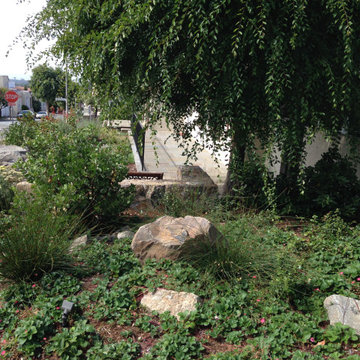
This very large corner site was shrouded in tired and thirsty conventional lawn. Really a bland, uninteresting monoculture—impossible to maintain especially in light of our dwindling resources and our growing understanding about sustainable practices.
We chose to approach this project not with the idea that existing lawn is bad, but with respect for what lawn has historically represented: a socially connective tissue.
Instead of conventional grass requiring endlessly large amounts of water, chemicals and mowing, this lawn conversion shifts to a naturalistic native meadow mix splashed with wildflowers and drought tolerant native shrubs. It was the clients’ desire to be wrapped by a garden attracting native pollinators and beneficial insects. A wildlife photographer, they wanted the opportunity to open windows and doors and feel immediately connected to a coastal native environment.
The handsome new stone walls, stairs and massive boulders became the structural framework containing the loose, coastal sage scrub plant community, holding the landscape together during the dormant months.
As we continue to grow our acceptance of and appreciation for climate appropriate California gardens, and embrace the paradigm shift, let us graciously bid adieu to our home’s unsustainable velvet robe.
 The Foxy Garden
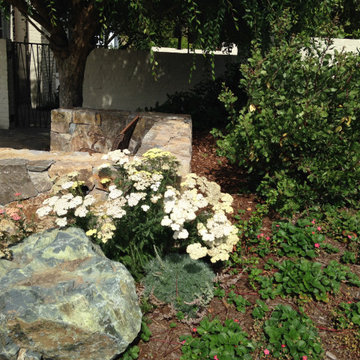
This very large corner site was shrouded in tired and thirsty conventional lawn. Really a bland, uninteresting monoculture—impossible to maintain especially in light of our dwindling resources and our growing understanding about sustainable practices.
We chose to approach this project not with the idea that existing lawn is bad, but with respect for what lawn has historically represented: a socially connective tissue.
Instead of conventional grass requiring endlessly large amounts of water, chemicals and mowing, this lawn conversion shifts to a naturalistic native meadow mix splashed with wildflowers and drought tolerant native shrubs. It was the clients’ desire to be wrapped by a garden attracting native pollinators and beneficial insects. A wildlife photographer, they wanted the opportunity to open windows and doors and feel immediately connected to a coastal native environment.
The handsome new stone walls, stairs and massive boulders became the structural framework containing the loose, coastal sage scrub plant community, holding the landscape together during the dormant months.
As we continue to grow our acceptance of and appreciation for climate appropriate California gardens, and embrace the paradigm shift, let us graciously bid adieu to our home’s unsustainable velvet robe.

 Zelaya Properties LLC
We used: Custom cherry cabinetry in Arts & Crafts Shaker style by Kabinart in Boulder and Espresso stains. Liberty Hardware Venetian bronze 1-1/2" cabinet knobs. KitchenAid Architect II Series 22 CF counter-depth French door refrigerator. KitchenAid Architect Series II 27" convection single wall oven. KitchenAid 36" 6-burner dual fuel freestanding commercial-style range. KitchenAid Architect II Series 24" dishwasher. Sharp Insight Pro Series 24" built-in microwave drawer (Model #KB6524PS). Crystorama Solaris 12" wide pendant lights in English bronze. Granite countertops in Brown Fantasy. 3"x6" polished marble backsplash.
Paint colors:
Walls: Glidden Silver Cloud 30YY 63/024
Ceilings/Trims/Doors: Glidden Swan White GLC23
Robert B. Narod Photography
 Kimberley Bryan
Photo: Kimberley Bryan © 2017 Houzz
Example of an eclectic home design design in Seattle
Example of an eclectic home design design in Seattle

 Moderne Builders
Gorgeous master bath with dramatic retro "wave" tile. Peak Photography
Example of a 1950s bathroom design in Los Angeles
Example of a 1950s bathroom design in Los Angeles
 The Foxy Garden
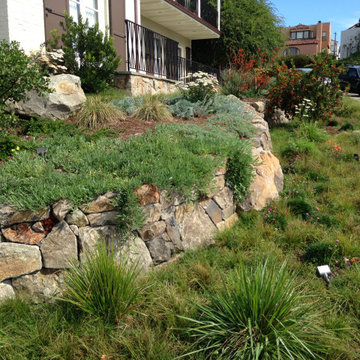
This very large corner site was shrouded in tired and thirsty conventional lawn. Really a bland, uninteresting monoculture—impossible to maintain especially in light of our dwindling resources and our growing understanding about sustainable practices.
We chose to approach this project not with the idea that existing lawn is bad, but with respect for what lawn has historically represented: a socially connective tissue.
Instead of conventional grass requiring endlessly large amounts of water, chemicals and mowing, this lawn conversion shifts to a naturalistic native meadow mix splashed with wildflowers and drought tolerant native shrubs. It was the clients’ desire to be wrapped by a garden attracting native pollinators and beneficial insects. A wildlife photographer, they wanted the opportunity to open windows and doors and feel immediately connected to a coastal native environment.
The handsome new stone walls, stairs and massive boulders became the structural framework containing the loose, coastal sage scrub plant community, holding the landscape together during the dormant months.
As we continue to grow our acceptance of and appreciation for climate appropriate California gardens, and embrace the paradigm shift, let us graciously bid adieu to our home’s unsustainable velvet robe.
 The Foxy Garden
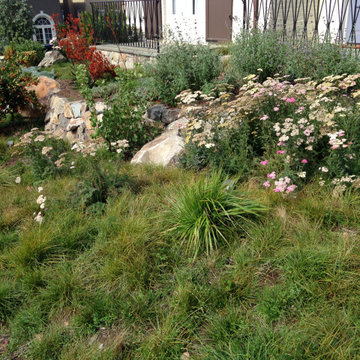
This very large corner site was shrouded in tired and thirsty conventional lawn. Really a bland, uninteresting monoculture—impossible to maintain especially in light of our dwindling resources and our growing understanding about sustainable practices.
We chose to approach this project not with the idea that existing lawn is bad, but with respect for what lawn has historically represented: a socially connective tissue.
Instead of conventional grass requiring endlessly large amounts of water, chemicals and mowing, this lawn conversion shifts to a naturalistic native meadow mix splashed with wildflowers and drought tolerant native shrubs. It was the clients’ desire to be wrapped by a garden attracting native pollinators and beneficial insects. A wildlife photographer, they wanted the opportunity to open windows and doors and feel immediately connected to a coastal native environment.
The handsome new stone walls, stairs and massive boulders became the structural framework containing the loose, coastal sage scrub plant community, holding the landscape together during the dormant months.
As we continue to grow our acceptance of and appreciation for climate appropriate California gardens, and embrace the paradigm shift, let us graciously bid adieu to our home’s unsustainable velvet robe.

 Miller-Roodell Architects Ltd
Set in Montana's tranquil Shields River Valley, the Shilo Ranch Compound is a collection of structures that were specifically built on a relatively smaller scale, to maximize efficiency. The main house has two bedrooms, a living area, dining and kitchen, bath and adjacent greenhouse, while two guest homes within the compound can sleep a total of 12 friends and family. There's also a common gathering hall, for dinners, games, and time together. The overall feel here is of sophisticated simplicity, with plaster walls, concrete and wood floors, and weathered boards for exteriors. The placement of each building was considered closely when envisioning how people would move through the property, based on anticipated needs and interests. Sustainability and consumption was also taken into consideration, as evidenced by the photovoltaic panels on roof of the garage, and the capability to shut down any of the compound's buildings when not in use.

 The Foxy Garden
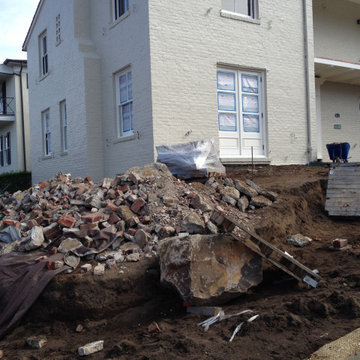
This very large corner site was shrouded in tired and thirsty conventional lawn. Really a bland, uninteresting monoculture—impossible to maintain especially in light of our dwindling resources and our growing understanding about sustainable practices.
We chose to approach this project not with the idea that existing lawn is bad, but with respect for what lawn has historically represented: a socially connective tissue.
Instead of conventional grass requiring endlessly large amounts of water, chemicals and mowing, this lawn conversion shifts to a naturalistic native meadow mix splashed with wildflowers and drought tolerant native shrubs. It was the clients’ desire to be wrapped by a garden attracting native pollinators and beneficial insects. A wildlife photographer, they wanted the opportunity to open windows and doors and feel immediately connected to a coastal native environment.
The handsome new stone walls, stairs and massive boulders became the structural framework containing the loose, coastal sage scrub plant community, holding the landscape together during the dormant months.
As we continue to grow our acceptance of and appreciation for climate appropriate California gardens, and embrace the paradigm shift, let us graciously bid adieu to our home’s unsustainable velvet robe.
 The Foxy Garden
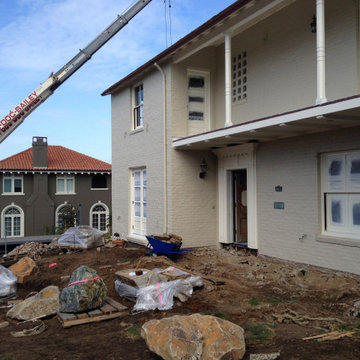
This very large corner site was shrouded in tired and thirsty conventional lawn. Really a bland, uninteresting monoculture—impossible to maintain especially in light of our dwindling resources and our growing understanding about sustainable practices.
We chose to approach this project not with the idea that existing lawn is bad, but with respect for what lawn has historically represented: a socially connective tissue.
Instead of conventional grass requiring endlessly large amounts of water, chemicals and mowing, this lawn conversion shifts to a naturalistic native meadow mix splashed with wildflowers and drought tolerant native shrubs. It was the clients’ desire to be wrapped by a garden attracting native pollinators and beneficial insects. A wildlife photographer, they wanted the opportunity to open windows and doors and feel immediately connected to a coastal native environment.
The handsome new stone walls, stairs and massive boulders became the structural framework containing the loose, coastal sage scrub plant community, holding the landscape together during the dormant months.
As we continue to grow our acceptance of and appreciation for climate appropriate California gardens, and embrace the paradigm shift, let us graciously bid adieu to our home’s unsustainable velvet robe.
1