
Search results for "Extra folks" in Home Design Ideas
 Rocky Tops Granite & Marble LLC
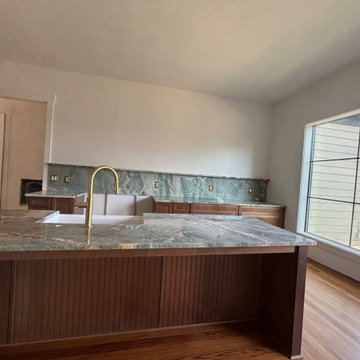
Tiffany Crystal quartzite is one of those stones that earns its keep in a kitchen. It's got that cool, crystalline background, whites and grays moving quietly across the surface with enough sparkle in the light to keep it from feeling flat. It reads clean and bright without going stark, which is why it works so well in a kitchen where people actually cook and gather, not just admire counters from across the room.
Quartzite is real stone, not engineered, so it comes with natural hardness that holds up to daily kitchen abuse. It resists scratching and handles heat well, though we still tell folks to use a trivet, because no counter needs a hot pan set straight on it just to prove a point. Sealing it right after install and keeping up with it over the years keeps the surface performing the way it should, and Tiffany Crystal takes a seal well because of its tight, dense structure.
Fabricating a slab like this takes some care in the layout. We spend real time bookmatching and dry-fitting pieces so the movement in the stone flows across seams instead of fighting itself at the corners. On a kitchen island or a run of perimeter counters, getting that continuity right is what separates a good installation from one that just gets the measurements correct. We kept the edge eased here, which is the right call on a stone with this much personality. It doesn't need extra shaping to draw the eye, the stone's already doing that work.
Day to day, this is a kitchen counter that's going to live hard and look good doing it. Quartzite shrugs off knife marks, stands up to acidic spills, and cleans up with regular dish soap and water. It's the kind of surface you stop babying after the first few months because it simply holds up.
Jobs like this one in Lexington are what we like seeing come through the shop. It's a straightforward kitchen application done with a stone that's got real depth to it, installed by people who care about how the seams and the veining line up when the job's done. That's the kind of work that keeps the Midlands trade honest.
 Rocky Tops Granite & Marble LLC
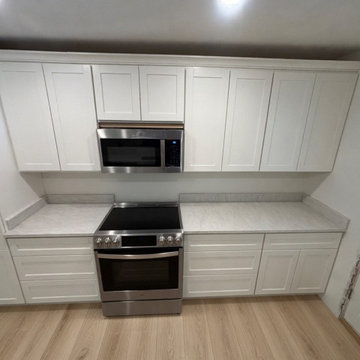
We put BSI Vernazza Matte quartz into a kitchen in Columbia, and it's the kind of stone that works quiet in a room. Matte quartz doesn't throw light around the way a polished slab does, it settles into a kitchen and lets the cabinets and the fixtures do some of the talking. Vernazza's got a soft background with movement that reads more like natural stone than a lot of engineered material does, and that matte finish takes the glare off without taking the depth out of it.
Quartz like this comes off the line consistent, which matters more than people think once you get into fabrication. We're not chasing a wild vein across a seam or hoping a cutout doesn't land on something funny in the pattern. That consistency lets us focus on the parts that actually take skill, tight seams at the island, a clean line where two pieces meet at a corner, getting the overhang right for seating if that's part of the layout. Templating is still templating no matter how forgiving the material is. We measure twice, we dry fit, and we don't cut until we're sure.
Day to day this stone's built for a working kitchen. Engineered quartz doesn't need sealing, it's non-porous out of the box, so spills from wine or oil or tomato sauce wipe up without soaking in and staining. It holds up to knives and daily wear better than people expect, and the matte finish actually hides light scratching and fingerprints better than a glossy top does. Heat's the one thing we always tell folks to respect, quartz can take a hot pan for a second but a trivet is still the smart move over time.
We kept the edge eased, simple and clean, the kind of detail that doesn't fight with the stone for attention. Columbia's got a lot of kitchens getting this kind of update lately, and a quartz like Vernazza Matte fits right into that Midlands style, practical, good looking, built to actually get used. It's the kind of job that doesn't need a lot of extra dressing up because the material's doing the work.
 Rocky Tops Granite & Marble LLC
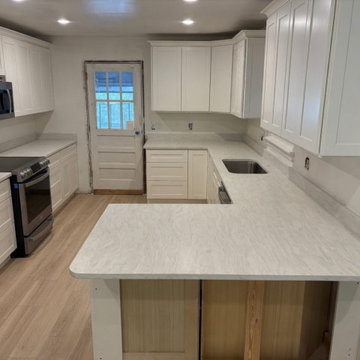
We put BSI Vernazza Matte quartz into a kitchen in Columbia, and it's the kind of stone that works quiet in a room. Matte quartz doesn't throw light around the way a polished slab does, it settles into a kitchen and lets the cabinets and the fixtures do some of the talking. Vernazza's got a soft background with movement that reads more like natural stone than a lot of engineered material does, and that matte finish takes the glare off without taking the depth out of it.
Quartz like this comes off the line consistent, which matters more than people think once you get into fabrication. We're not chasing a wild vein across a seam or hoping a cutout doesn't land on something funny in the pattern. That consistency lets us focus on the parts that actually take skill, tight seams at the island, a clean line where two pieces meet at a corner, getting the overhang right for seating if that's part of the layout. Templating is still templating no matter how forgiving the material is. We measure twice, we dry fit, and we don't cut until we're sure.
Day to day this stone's built for a working kitchen. Engineered quartz doesn't need sealing, it's non-porous out of the box, so spills from wine or oil or tomato sauce wipe up without soaking in and staining. It holds up to knives and daily wear better than people expect, and the matte finish actually hides light scratching and fingerprints better than a glossy top does. Heat's the one thing we always tell folks to respect, quartz can take a hot pan for a second but a trivet is still the smart move over time.
We kept the edge eased, simple and clean, the kind of detail that doesn't fight with the stone for attention. Columbia's got a lot of kitchens getting this kind of update lately, and a quartz like Vernazza Matte fits right into that Midlands style, practical, good looking, built to actually get used. It's the kind of job that doesn't need a lot of extra dressing up because the material's doing the work.
Find the right local pro for your project
 Rocky Tops Granite & Marble LLC
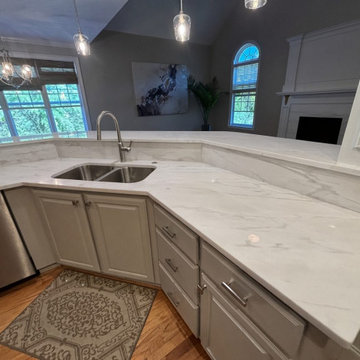
We installed Mystery White marble into a kitchen and matching fireplace surround in Irmo, and it's the kind of stone that makes a room feel brighter the second you walk in. The background is a clean white field, and the veining moves through it in soft gray threads, drifting rather than cutting straight lines. No two slabs are quite the same way, which is part of what makes marble like this worth the extra care in templating and layout.
Marble asks more of us than a lot of other stones. It's softer, it etches if you leave lemon juice sitting on it, and it needs a good sealer to keep it looking the way it did the day it was installed. But in a kitchen, that trade-off is worth it for a lot of people. The look is warmer and more alive than a lot of surfaces, and the veining gives the counters a sense of movement that holds your eye. We templated this one carefully to keep the veining reading naturally across the seams, so the pattern doesn't stop and start in a way that catches your attention for the wrong reason.
Getting the seams tight and the veins matched up means slowing down in the shop. We do a layout digitally before we ever cut, aligning the tops to find where the book-matching works best and where the color shifts are most forgiving. For a kitchen like this, with counters meeting at corners, that planning is what keeps the stone looking like one continuous surface instead of pieced-together slabs. We finished the edges eased, simple and clean, letting the stone itself carry the room instead of the profile.
Day to day, this kitchen will earn its keep. Marble takes heat well, so hot pans off the stove aren't a worry, but we always tell folks to use a cutting board and wipe up acidic spills quickly. Sealed properly and maintained with a little attention, it ages the way good marble always has, developing a soft patina over the years that a lot of homeowners come to like rather than fight.
Irmo's seen a good bit of kitchen work come through our shop, and a stone like Mystery White marble fits right into the character of these Midlands homes. It's classic without being predictable, and in this kitchen it does exactly what good marble should: it makes the whole room feel finished.

 T.A. French - Custom Builder
Example of a mid-sized transitional dark wood floor and brown floor double front door design in Austin with gray walls and a black front door
 Rocky Tops Granite & Marble LLC
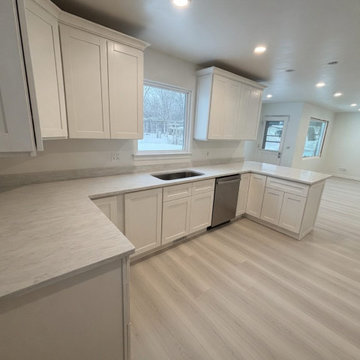
We put BSI Vernazza Matte quartz into a kitchen in Columbia, and it's the kind of stone that works quiet in a room. Matte quartz doesn't throw light around the way a polished slab does, it settles into a kitchen and lets the cabinets and the fixtures do some of the talking. Vernazza's got a soft background with movement that reads more like natural stone than a lot of engineered material does, and that matte finish takes the glare off without taking the depth out of it.
Quartz like this comes off the line consistent, which matters more than people think once you get into fabrication. We're not chasing a wild vein across a seam or hoping a cutout doesn't land on something funny in the pattern. That consistency lets us focus on the parts that actually take skill, tight seams at the island, a clean line where two pieces meet at a corner, getting the overhang right for seating if that's part of the layout. Templating is still templating no matter how forgiving the material is. We measure twice, we dry fit, and we don't cut until we're sure.
Day to day this stone's built for a working kitchen. Engineered quartz doesn't need sealing, it's non-porous out of the box, so spills from wine or oil or tomato sauce wipe up without soaking in and staining. It holds up to knives and daily wear better than people expect, and the matte finish actually hides light scratching and fingerprints better than a glossy top does. Heat's the one thing we always tell folks to respect, quartz can take a hot pan for a second but a trivet is still the smart move over time.
We kept the edge eased, simple and clean, the kind of detail that doesn't fight with the stone for attention. Columbia's got a lot of kitchens getting this kind of update lately, and a quartz like Vernazza Matte fits right into that Midlands style, practical, good looking, built to actually get used. It's the kind of job that doesn't need a lot of extra dressing up because the material's doing the work.
 Rocky Tops Granite & Marble LLC
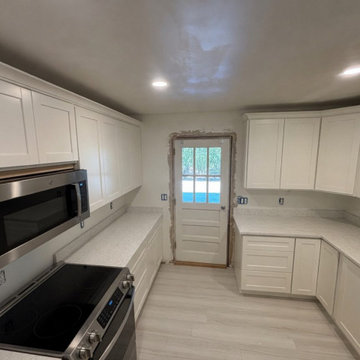
We put BSI Vernazza Matte quartz into a kitchen in Columbia, and it's the kind of stone that works quiet in a room. Matte quartz doesn't throw light around the way a polished slab does, it settles into a kitchen and lets the cabinets and the fixtures do some of the talking. Vernazza's got a soft background with movement that reads more like natural stone than a lot of engineered material does, and that matte finish takes the glare off without taking the depth out of it.
Quartz like this comes off the line consistent, which matters more than people think once you get into fabrication. We're not chasing a wild vein across a seam or hoping a cutout doesn't land on something funny in the pattern. That consistency lets us focus on the parts that actually take skill, tight seams at the island, a clean line where two pieces meet at a corner, getting the overhang right for seating if that's part of the layout. Templating is still templating no matter how forgiving the material is. We measure twice, we dry fit, and we don't cut until we're sure.
Day to day this stone's built for a working kitchen. Engineered quartz doesn't need sealing, it's non-porous out of the box, so spills from wine or oil or tomato sauce wipe up without soaking in and staining. It holds up to knives and daily wear better than people expect, and the matte finish actually hides light scratching and fingerprints better than a glossy top does. Heat's the one thing we always tell folks to respect, quartz can take a hot pan for a second but a trivet is still the smart move over time.
We kept the edge eased, simple and clean, the kind of detail that doesn't fight with the stone for attention. Columbia's got a lot of kitchens getting this kind of update lately, and a quartz like Vernazza Matte fits right into that Midlands style, practical, good looking, built to actually get used. It's the kind of job that doesn't need a lot of extra dressing up because the material's doing the work.
 Rocky Tops Granite & Marble LLC
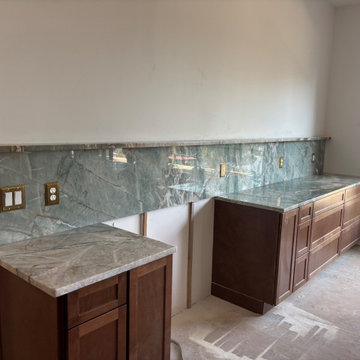
Tiffany Crystal quartzite is one of those stones that earns its keep in a kitchen. It's got that cool, crystalline background, whites and grays moving quietly across the surface with enough sparkle in the light to keep it from feeling flat. It reads clean and bright without going stark, which is why it works so well in a kitchen where people actually cook and gather, not just admire counters from across the room.
Quartzite is real stone, not engineered, so it comes with natural hardness that holds up to daily kitchen abuse. It resists scratching and handles heat well, though we still tell folks to use a trivet, because no counter needs a hot pan set straight on it just to prove a point. Sealing it right after install and keeping up with it over the years keeps the surface performing the way it should, and Tiffany Crystal takes a seal well because of its tight, dense structure.
Fabricating a slab like this takes some care in the layout. We spend real time bookmatching and dry-fitting pieces so the movement in the stone flows across seams instead of fighting itself at the corners. On a kitchen island or a run of perimeter counters, getting that continuity right is what separates a good installation from one that just gets the measurements correct. We kept the edge eased here, which is the right call on a stone with this much personality. It doesn't need extra shaping to draw the eye, the stone's already doing that work.
Day to day, this is a kitchen counter that's going to live hard and look good doing it. Quartzite shrugs off knife marks, stands up to acidic spills, and cleans up with regular dish soap and water. It's the kind of surface you stop babying after the first few months because it simply holds up.
Jobs like this one in Lexington are what we like seeing come through the shop. It's a straightforward kitchen application done with a stone that's got real depth to it, installed by people who care about how the seams and the veining line up when the job's done. That's the kind of work that keeps the Midlands trade honest.
 Rocky Tops Granite & Marble LLC
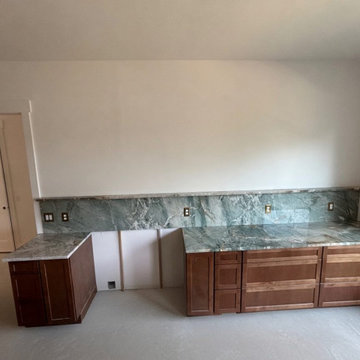
Tiffany Crystal quartzite is one of those stones that earns its keep in a kitchen. It's got that cool, crystalline background, whites and grays moving quietly across the surface with enough sparkle in the light to keep it from feeling flat. It reads clean and bright without going stark, which is why it works so well in a kitchen where people actually cook and gather, not just admire counters from across the room.
Quartzite is real stone, not engineered, so it comes with natural hardness that holds up to daily kitchen abuse. It resists scratching and handles heat well, though we still tell folks to use a trivet, because no counter needs a hot pan set straight on it just to prove a point. Sealing it right after install and keeping up with it over the years keeps the surface performing the way it should, and Tiffany Crystal takes a seal well because of its tight, dense structure.
Fabricating a slab like this takes some care in the layout. We spend real time bookmatching and dry-fitting pieces so the movement in the stone flows across seams instead of fighting itself at the corners. On a kitchen island or a run of perimeter counters, getting that continuity right is what separates a good installation from one that just gets the measurements correct. We kept the edge eased here, which is the right call on a stone with this much personality. It doesn't need extra shaping to draw the eye, the stone's already doing that work.
Day to day, this is a kitchen counter that's going to live hard and look good doing it. Quartzite shrugs off knife marks, stands up to acidic spills, and cleans up with regular dish soap and water. It's the kind of surface you stop babying after the first few months because it simply holds up.
Jobs like this one in Lexington are what we like seeing come through the shop. It's a straightforward kitchen application done with a stone that's got real depth to it, installed by people who care about how the seams and the veining line up when the job's done. That's the kind of work that keeps the Midlands trade honest.
 Rocky Tops Granite & Marble LLC
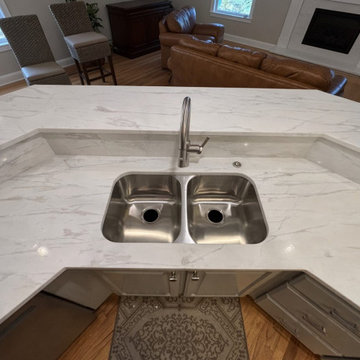
We installed Mystery White marble into a kitchen and matching fireplace surround in Irmo, and it's the kind of stone that makes a room feel brighter the second you walk in. The background is a clean white field, and the veining moves through it in soft gray threads, drifting rather than cutting straight lines. No two slabs are quite the same way, which is part of what makes marble like this worth the extra care in templating and layout.
Marble asks more of us than a lot of other stones. It's softer, it etches if you leave lemon juice sitting on it, and it needs a good sealer to keep it looking the way it did the day it was installed. But in a kitchen, that trade-off is worth it for a lot of people. The look is warmer and more alive than a lot of surfaces, and the veining gives the counters a sense of movement that holds your eye. We templated this one carefully to keep the veining reading naturally across the seams, so the pattern doesn't stop and start in a way that catches your attention for the wrong reason.
Getting the seams tight and the veins matched up means slowing down in the shop. We do a layout digitally before we ever cut, aligning the tops to find where the book-matching works best and where the color shifts are most forgiving. For a kitchen like this, with counters meeting at corners, that planning is what keeps the stone looking like one continuous surface instead of pieced-together slabs. We finished the edges eased, simple and clean, letting the stone itself carry the room instead of the profile.
Day to day, this kitchen will earn its keep. Marble takes heat well, so hot pans off the stove aren't a worry, but we always tell folks to use a cutting board and wipe up acidic spills quickly. Sealed properly and maintained with a little attention, it ages the way good marble always has, developing a soft patina over the years that a lot of homeowners come to like rather than fight.
Irmo's seen a good bit of kitchen work come through our shop, and a stone like Mystery White marble fits right into the character of these Midlands homes. It's classic without being predictable, and in this kitchen it does exactly what good marble should: it makes the whole room feel finished.
 Rocky Tops Granite & Marble LLC
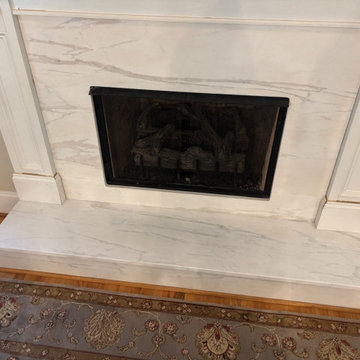
We installed Mystery White marble into a kitchen and matching fireplace surround in Irmo, and it's the kind of stone that makes a room feel brighter the second you walk in. The background is a clean white field, and the veining moves through it in soft gray threads, drifting rather than cutting straight lines. No two slabs are quite the same way, which is part of what makes marble like this worth the extra care in templating and layout.
Marble asks more of us than a lot of other stones. It's softer, it etches if you leave lemon juice sitting on it, and it needs a good sealer to keep it looking the way it did the day it was installed. But in a kitchen, that trade-off is worth it for a lot of people. The look is warmer and more alive than a lot of surfaces, and the veining gives the counters a sense of movement that holds your eye. We templated this one carefully to keep the veining reading naturally across the seams, so the pattern doesn't stop and start in a way that catches your attention for the wrong reason.
Getting the seams tight and the veins matched up means slowing down in the shop. We do a layout digitally before we ever cut, aligning the tops to find where the book-matching works best and where the color shifts are most forgiving. For a kitchen like this, with counters meeting at corners, that planning is what keeps the stone looking like one continuous surface instead of pieced-together slabs. We finished the edges eased, simple and clean, letting the stone itself carry the room instead of the profile.
Day to day, this kitchen will earn its keep. Marble takes heat well, so hot pans off the stove aren't a worry, but we always tell folks to use a cutting board and wipe up acidic spills quickly. Sealed properly and maintained with a little attention, it ages the way good marble always has, developing a soft patina over the years that a lot of homeowners come to like rather than fight.
Irmo's seen a good bit of kitchen work come through our shop, and a stone like Mystery White marble fits right into the character of these Midlands homes. It's classic without being predictable, and in this kitchen it does exactly what good marble should: it makes the whole room feel finished.
 Rocky Tops Granite & Marble LLC
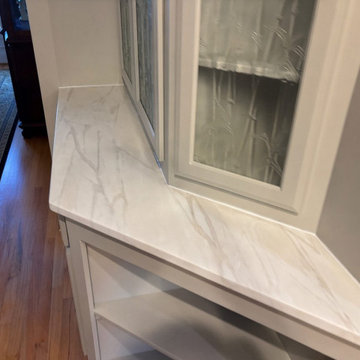
We installed Mystery White marble into a kitchen and matching fireplace surround in Irmo, and it's the kind of stone that makes a room feel brighter the second you walk in. The background is a clean white field, and the veining moves through it in soft gray threads, drifting rather than cutting straight lines. No two slabs are quite the same way, which is part of what makes marble like this worth the extra care in templating and layout.
Marble asks more of us than a lot of other stones. It's softer, it etches if you leave lemon juice sitting on it, and it needs a good sealer to keep it looking the way it did the day it was installed. But in a kitchen, that trade-off is worth it for a lot of people. The look is warmer and more alive than a lot of surfaces, and the veining gives the counters a sense of movement that holds your eye. We templated this one carefully to keep the veining reading naturally across the seams, so the pattern doesn't stop and start in a way that catches your attention for the wrong reason.
Getting the seams tight and the veins matched up means slowing down in the shop. We do a layout digitally before we ever cut, aligning the tops to find where the book-matching works best and where the color shifts are most forgiving. For a kitchen like this, with counters meeting at corners, that planning is what keeps the stone looking like one continuous surface instead of pieced-together slabs. We finished the edges eased, simple and clean, letting the stone itself carry the room instead of the profile.
Day to day, this kitchen will earn its keep. Marble takes heat well, so hot pans off the stove aren't a worry, but we always tell folks to use a cutting board and wipe up acidic spills quickly. Sealed properly and maintained with a little attention, it ages the way good marble always has, developing a soft patina over the years that a lot of homeowners come to like rather than fight.
Irmo's seen a good bit of kitchen work come through our shop, and a stone like Mystery White marble fits right into the character of these Midlands homes. It's classic without being predictable, and in this kitchen it does exactly what good marble should: it makes the whole room feel finished.
 Rocky Tops Granite & Marble LLC
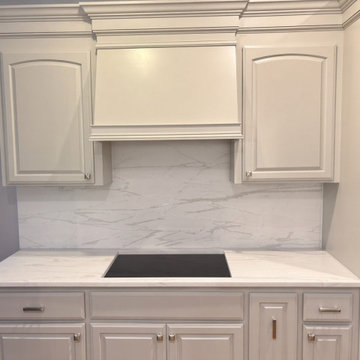
We installed Mystery White marble into a kitchen and matching fireplace surround in Irmo, and it's the kind of stone that makes a room feel brighter the second you walk in. The background is a clean white field, and the veining moves through it in soft gray threads, drifting rather than cutting straight lines. No two slabs are quite the same way, which is part of what makes marble like this worth the extra care in templating and layout.
Marble asks more of us than a lot of other stones. It's softer, it etches if you leave lemon juice sitting on it, and it needs a good sealer to keep it looking the way it did the day it was installed. But in a kitchen, that trade-off is worth it for a lot of people. The look is warmer and more alive than a lot of surfaces, and the veining gives the counters a sense of movement that holds your eye. We templated this one carefully to keep the veining reading naturally across the seams, so the pattern doesn't stop and start in a way that catches your attention for the wrong reason.
Getting the seams tight and the veins matched up means slowing down in the shop. We do a layout digitally before we ever cut, aligning the tops to find where the book-matching works best and where the color shifts are most forgiving. For a kitchen like this, with counters meeting at corners, that planning is what keeps the stone looking like one continuous surface instead of pieced-together slabs. We finished the edges eased, simple and clean, letting the stone itself carry the room instead of the profile.
Day to day, this kitchen will earn its keep. Marble takes heat well, so hot pans off the stove aren't a worry, but we always tell folks to use a cutting board and wipe up acidic spills quickly. Sealed properly and maintained with a little attention, it ages the way good marble always has, developing a soft patina over the years that a lot of homeowners come to like rather than fight.
Irmo's seen a good bit of kitchen work come through our shop, and a stone like Mystery White marble fits right into the character of these Midlands homes. It's classic without being predictable, and in this kitchen it does exactly what good marble should: it makes the whole room feel finished.
 Rocky Tops Granite & Marble LLC
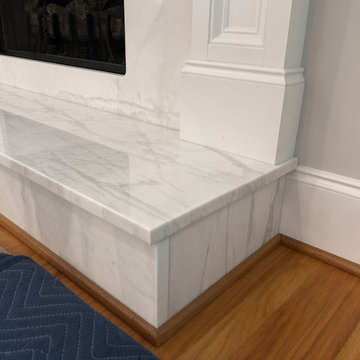
We installed Mystery White marble into a kitchen and matching fireplace surround in Irmo, and it's the kind of stone that makes a room feel brighter the second you walk in. The background is a clean white field, and the veining moves through it in soft gray threads, drifting rather than cutting straight lines. No two slabs are quite the same way, which is part of what makes marble like this worth the extra care in templating and layout.
Marble asks more of us than a lot of other stones. It's softer, it etches if you leave lemon juice sitting on it, and it needs a good sealer to keep it looking the way it did the day it was installed. But in a kitchen, that trade-off is worth it for a lot of people. The look is warmer and more alive than a lot of surfaces, and the veining gives the counters a sense of movement that holds your eye. We templated this one carefully to keep the veining reading naturally across the seams, so the pattern doesn't stop and start in a way that catches your attention for the wrong reason.
Getting the seams tight and the veins matched up means slowing down in the shop. We do a layout digitally before we ever cut, aligning the tops to find where the book-matching works best and where the color shifts are most forgiving. For a kitchen like this, with counters meeting at corners, that planning is what keeps the stone looking like one continuous surface instead of pieced-together slabs. We finished the edges eased, simple and clean, letting the stone itself carry the room instead of the profile.
Day to day, this kitchen will earn its keep. Marble takes heat well, so hot pans off the stove aren't a worry, but we always tell folks to use a cutting board and wipe up acidic spills quickly. Sealed properly and maintained with a little attention, it ages the way good marble always has, developing a soft patina over the years that a lot of homeowners come to like rather than fight.
Irmo's seen a good bit of kitchen work come through our shop, and a stone like Mystery White marble fits right into the character of these Midlands homes. It's classic without being predictable, and in this kitchen it does exactly what good marble should: it makes the whole room feel finished.

 The Artists Hands - Faux Finishes
This remodeled bedroom was upgraded to an elegant and sophisticated master retreat. Using metallic plasters and various techniques of application with this beautiful repeat stencil pattern, this accent wall is a stunning focal feature of this master bedroom. Copyright © 2016 The Artists Hands

 BRC Remodeling Group
This was a lovely bathroom renovation we did. The mirrors, shower glass, and cabinets are all custom made pieces. We did a split level Vanity to accommodate both clients heights and it came together perfectly.

 User
Inspiration for a large timeless carpeted curved staircase remodel in Chicago with carpeted risers
 User
Detail of Iridescent Venetian plaster finish on all walls in Living Room by Christianson Lee Studios
Example of a transitional home design design in New York
Example of a transitional home design design in New York
 BRC Remodeling Group
This contemporary/modern bathroom uses a combination of grey and beige to make a beautiful blend of Greige. The Charcoal stain on the cabinets is also a great blend of the 2 colors giving just enough warmth to the room. We used Marazzi Lounge 14 Spritzer 12x24 porcelain tile on the ground and the decorative inlay on the shower. New Caledonia Granite and BEHR- Studio Taupe on the walls.

 Bill Fry Construction - Wm. H. Fry Const. Co.
Covid During Construction and Making Face Masks
Dear Houzz Folks,
We've started getting back to work and are educating everyone at our projects on how to be safe during COVID, posting signage, and we've been making masks for our employees, colleagues, friends, family etc... Here's some information on what I've learned so far in sewing the best fitting face mask for COVID.
1. Put in a wire at the nose bridge (about 3.5 inches) - it helps with fit and if you wear glasses, it keeps them from fogging up. I found that doorbell wire, available at the hardware store, seems to work well. It isn't too thin or too fat, bends easily and holds its shape. I attach it by using a zigzag stitch on the interior seam of the outside of the mask (so there's a bit more cushion on the inside).
2. For the shaped masks, I make a pocket in case my friends, family, colleagues, want to insert a filter - it also allows for three layers of fabric in the breathing area and less bulk where the ties go. For patterns that don't offer pockets, I just make my own pattern pocket. I also first baste the two inside pieces first and then sew the front on. This way, there's no worries about slipping. No pins are needed and no pins minimizes the number of extra air holes in the fabric.
3. So that the ties/loops can be replaced or modified, I make a channel for rather than sewing it in permanently. Many videos show using a safety pin to pull the elastic through. If you sew much, you might have a bodkin in your sewing box, but it might be a bit too wide. Instead, I use a long hairpin (you could probably make a long loop with a paper clip). I run the hairpin through the channel, loop the elastic through the end of the pin and pull through. That takes much less time than piercing it with a safety-pin.
4. For the inside of the masks, it is nice to have softer fabric inside, so high-thread-count sheets purchased on sale work great. Then you can easily tell what is inside as well.
5. For surgical-style masks, there's a pattern with a pocket on the inside and a wire. I like the ideas in this video but use 2 fabrics and make them bigger. About a 9x9 inch for the outside and 9x8 inch for the inside. 5/8 seam on the nose and 1/4 seam on the bottom.
6. For the fitted masks, there are two patterns that I like. For this one, https://moinliz.de/mundschutz-naehen-mit-schnittmuster it expects you to print on European-sized paper, so if you want to get the size right, print at 100%
I also really like this pattern and I added a pocket and lengthened the ends to make channels https://intermountainhealthcare.org/covid19-coronavirus/homemade-cloth-face-coverings/ (scroll down to a link to download the pdf) Lots of folks sew craftpassion, but I like the fit of these patterns better. There are still some other patterns I have left to try!
6. After breaking lots of needles, I realized that I really didn't need to topstich the fitted masks over the bridge, so I just started skipping the bridge.
7. If you're going to wear a face-covering for a really long time, you might want to skip the ear hangers and go for ties behind the head. Instead of two ties, I'll use one long one so that the bottom one is a loop and the top one ties. Bungee cord works nice.
Happy Sewing!
: ) Rhoda Fry, Bill Fry Construction
7